Read the introduction and first section (pp.105–10) of the article ‘Discussing Documentary’by Maartje van den Heuvel (Documentary Now! 2005). Write a short summary in your learning log. (Open College of the Arts, 2014:33).
Mirror of visual culture
A summary:
The author believes that the debate about documentary in an art context should take visual literacy as a starting point to enable the value of documentary photography in art to be better assessed; are these practices effective and legitimate or has the border into fiction been blurred too much?
Much of our experience is not direct but found through the media so we are becoming more visually literate and able to interpret things
Documentary images are part of a wider movement including journalism, advertising, games, pop culture and film where art is functioning increasingly as a mirror of visual culture
The author reviews the classical documentary tradition and then shares examples that show a documentary remix, as artists free themselves from traditional documentary images:
2 historical visual traditions: Western Anglo-Saxon human-interest film and photography and the Eastern Communist/socialist Russian and German.
Documentary as a militant eyewitness, from around 1900: Jacob Riis (1849-1914), Lewis Hine (1874-1940) with reformist ambitions
Documentary was connected to film, when John Grierson designated a film non-fiction. Documentary as a realistic counterpart to fiction as film a recorder of social conditions: FSA, Walker Evans, Dorothea Lange. Magazine images in Life, Picture Post magazines, and the investigations of the Magnum agency.
Documentary as a picture tradition in communist and socialist countries to support revolution for the working class.
Documentary for left wing activism in the 50s and 60s with coarse grainy black and white 35 mm film images
Documentary as art as from the 1970s moved from a belief in realism and transparency with the easy accessibility of TV and advertising in different forms as people learnt that media images could be manipulated. A move away from the traditional black and white grainy images previously associated with authenticity awareness of subjectivity in documentary
Documentary with technical, stylistic or narratives, sharp detail and colour: Thomas Struth, Andreas Gursky and Thomas Ruff. This included functional directions such as topographical or architectural photography.
Documentary with social narratives: martin Parr on the middle class, Karen Knorr on the wealthy. Nan Goldin on her own surroundings
Documentary with depth: Allan Sekula’s project on economic and trading routes, Fazel Sheikh on people (Ramadan Moon). Giles Peress on the genocide in Rwanda (The silence)
Documentary photographers focusing on the publicity and distribution channels of photography: Susan Meiselas on Kurdistan (In the shadow of history)
Documentary using inside knowledge: Julian Germain collaborating with Don McCullin (Steelworks)
Documentary questioning images: Hiroshi Sugimoto on how the suggestion of reality is constructed, and any artificiality that simulating documentary images in artificial surroundings such as waxworks and any artificiality that suggest reality
Documentary that is staged: Jeff Wall imitating media pictures.
Documentary through re-enacting: Pierre Huyghe Third Memory; it has three layers of time and imagery, original journalistic media about a bank robbery, the 1975 film (Dog day Afternoon) and his own images of a re-enactment of the robbery. Christoph Draeger (Catastrophes) where he imitates disaster scenes, and his Black September on the terrorist hijacking and murder of Israeli athletes during the 1972 Olympic games
The author suggests though the artists differ as to how much their work reflects upon he documentary tradition, what these works have in common is that they analyse and comment on the structure and effect of documentary images in the mass media which testifies to increased visual literacy amongst the artists and appeals to the viewers to be visually aware also.
MY LEARNING
I should consider carefully visual literacy and how much the viewer has.
It was really useful to have these suggested stages/categories of documentary set out, it helps to clarify things for me. I may use this as a starting point to develop some ideas for assignment 2, in particular to research further, documentary as art and manipulation and documentary for questioning images.
Read ‘Bill Brandt’s Art of the Document’ by David Campany.Write a short summary in your learning log. How did B&W become such a respected and trusted medium in documentary? (Open College of the Arts, 2014:32).
(The Met, 2020)
This article illustrates how on image can play different roles at different times especially when presented in different ways, or as Company calls it “mobile images” (Company, 2006: p51). It also gives an insight into the career of Bill Brandt.
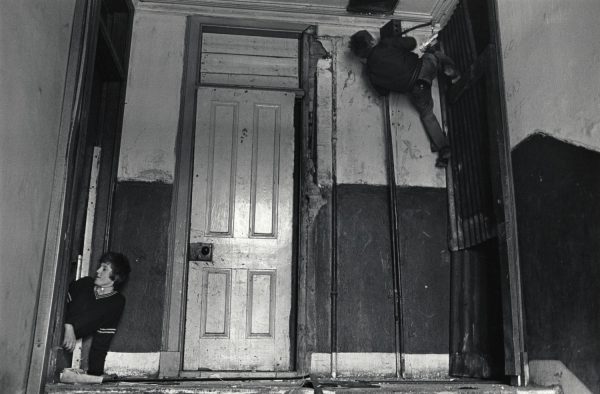
The image that the article discusses is shown above “Parlour maid and under-parlour maid Ready to Serve Dinner”. It first appeared in Brandt’s first book “The English At Home” (1936) a pictorial survey across the social classes. The book presents images from across a social divide through pairings of images, though it is not an in your face revolutionary document as the previous work I discussed “Survival Programmes: In Britain’s Inner Cities”, Brandt clearly presented these disparities in one book for a viewer to see if they wished to see. Company calls this “poetic realism” pictorial artfulness that tried to assume social authority. However, in this one image in particular you can see the tension between classes contained in one photo. Company says that The English at Home was a picture of the English that they struggle to recognise themselves (Company, 2006:54).
In 1938 Brandt published in Verve photo- essay styled as “day in the life of” though this image was not included essay style, possibly as he thought the image too powerful; these images work together but not on their own. After the 1940s Brandt moved away from the photo-essay either to singular images or those juxtaposed to add strength to his meaning. This image was reprinted in “Shadow of Light” (1966) and placed opposite an image of a Kensington drawing room, emulating the juxtaposed images in his 1936 book.
I was interested to read that Brandt changed to a more surrealistic approach to the photographic document as he was not convinced that a photograph could give straightforward social description and was wary of its use for social reform. Surrealists approached documentary in a more ambiguous way leaving more room for viewers to make their own responses. Company explains how Brandt is sometimes viewed as a historical and sometimes a contemporary artist, sometimes a documentary photographer and sometimes and artist though he would call him documentary artist.
I’m not sure how this article relates to the back and white document, though it does mention that black and white defines the details in a photograph. Also, perhaps to say that there is no such thing metaphorically as a black and white image and that as Brandt always worked in black and white. It has however reopened my eyes to Brandt’s work and reminded me of the fluidity of images over time.
MY LEARNING
Remember the ability of a photograph to be presented for different purposes
Read the article ‘Survival Programmes’ in Eight magazine (V5N1, June 2006). (Open College of the Arts, 2014:32).
Between 1974 and 1979 three British photographers Nicholas Battye, Chris Steele-Perkins and Paul Trevor set up the Exit Photography Group to record life in some of Britain’s inner-city areas. This work was published their work in the book Survival Programmes in Britain’s Inner Cities (1982). They chose black and white photography as they thought its seriousness and visual authority would add to the seriousness of their message of the need for social reform for race, religion, class and justice. the medium would strengthen the message.
“In aiming to create a lasting testimony that would resonate beyond the immediate political circumstances of the time, the three Exit photographers developed a complex and multi-layered response to the situation” (Survival Programmes: In Britain’s Inner Cities – Exit Photography Group, 2020).
Sharing the same position that inner city poverty was endemic and leading to social disorder, they used oral evidence (people’s interviews) to capture such experiences. They worked in different cities, contacting community groups, walked around deprived districts, talked to people on the streets, and knocked on doors; Nicholas Battye commented that back then people were happy to talk to photographers. The images were sequences from frustration to anger on 4 chapters: through growth, promise, welfare to reaction. The book gave the same space to the interview transcripts as images, which they discussed and chose from together. I was interested to learn that they shot in black and white to save money. Their work certainly brought viewers really close to the truth.
MY LEARNING POINTS
Although times were different then they still must have worked hard to build relationships and trust with the communities that they photographed to get so close to them
Reminds me again of the responsibility of the photographer to shoot with Integrity, the images are intimate but respectful.
The benefits of working as a team and having a shared ethos
The impact that sharing the truth can have when laid bare
Read the 1939 article on documentary photography by Elizabeth McCausland.Write a short bullet list of McCausland’s main points in your learning log. Explain in your own words, in a single paragraph, why this article is relevant to this part of the course. (Open College of the Arts, 2014:31)
Notes on Elizabeth McCausland’s article:
Documentary photography has arisen from “creative impulses”
It uses photography to chronicle the external world, to expose serious issues, unlike previous applications which were comparatively romantic
Documentary photography uses realism using new eyes
Facts are more important to represent than a photographer’s personality though he can control the aesthetics by giving the facts a form
There are many opportunities for publishing honest images of everyday life
The work of the Farm Security Administration and the Federal Art Project “changing New York” series by Bernice Abbott ae the strongest precedent for documentary photography as the government has been the best sponsor of knowledge
Photography may have been confused with painting, is it art for instance; however, it is bound to realism, photographs give us truth.
Society now wants truth and even in art wants content and something that has something to say to an audience.
Photography can reveal much all at once and is not limited
Every subject is significant, and a documentary photographer should use technical ability to present in a simple and modest way the wider world, to inform people in a serious and sometimes shocking way.
My response: The premise of McCausland’s beliefs about documentary photography are that truth and honesty are paramount and that this takes precedence above a photographer expressing his personal voice. It must be recognised that this comes after the relaxed period of the 1920s before the serious times of WW2.
Nevertheless, this is mostly how documentary photography is perceived today. Truth, honesty and a message to communicate in the work holds true. I do believe however that we are now aware that it is naïve to believe that camera cannot lie and that a documentary photographer will always present absolute facts; in fact even in the work of the FSA cited as an exemplar by McCausland editorship and purpose was used to drive a certain narrative. Today we are more alert to the possible influences of purpose, editorship, audience and presentation on the bald facts. This article does however remind me of the importance of holding to an intention and my responsibility to the subject as a documentary photographer.
Produce a small photo essay of 10 images that demonstrates your engagement with the lives, experiences and histories of your local community and its people.Decide on a single theme, topic or activity to focus on.Do this assignment with only one camera and one lens.
Provide a short commentary (200 words) explaining your ethos and rationale along with your images(Open College of the Ats, 2014:31).
___
NICOLA SOUTH STUDENT NUMBER: 514516
PROVISIONING AND PROTECTING
COMMENTARY
This theme of this photo essay is of my family isolating at home during the “lock down” of Covid19. My choice of subject was driven by the lockdown necessitated by the world-wide pandemic and the adjustments that myself and my immediate family made as we became a physically isolated community. Though the images may appear straight forward they represent my personal response to the suddenly imposed conditions, and the threat of both the pandemic and the isolation to my family. My intention is to share how my attention was initially funnelled to providing what my community would need to survive in an uncertain situation and protecting us; provisioning and protecting.
My concept was to communicate the protection and adjustments that I built for my community but also the isolation and barriers that I was feeling. I was also suffering from being separated from the place that my soul calls home, my second home 220 miles away that I was forbidden to visit. My visual strategy developed from these personal reactions to the situation.
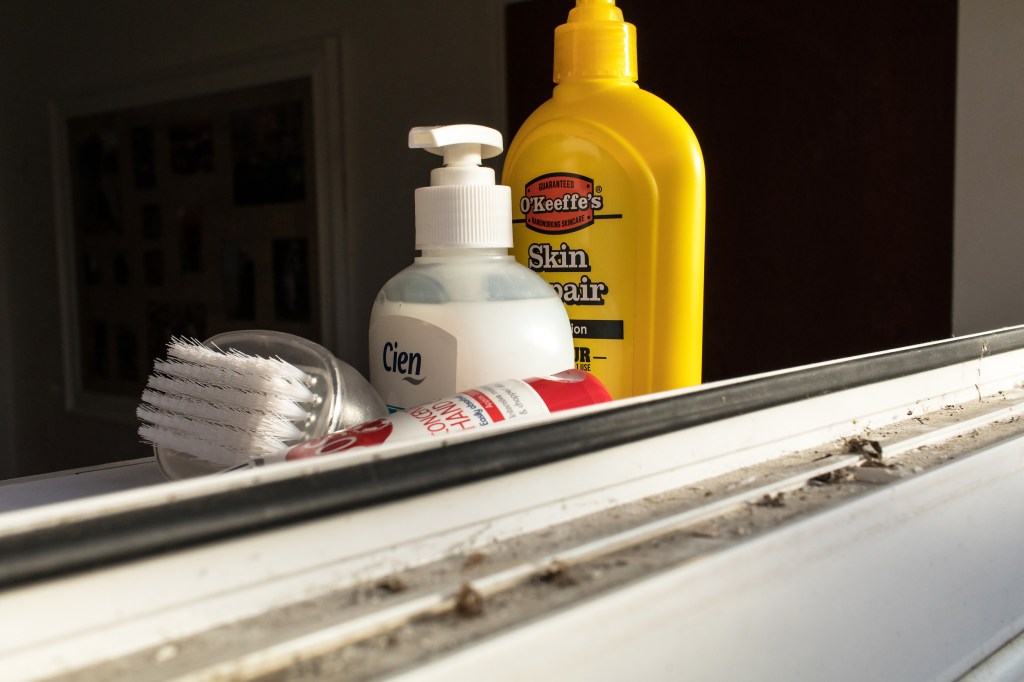
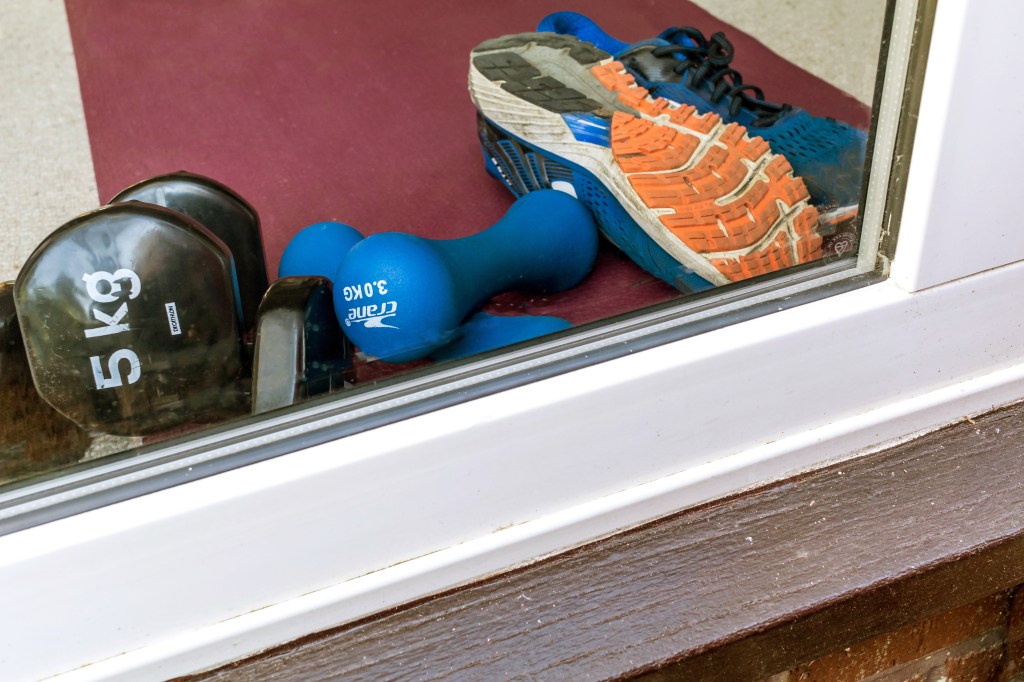
The windows of my house represent physical barriers between the world outside and inside, as well as emotional ones. The subjects photographed through my windows, though mundane, will be familiar to others who have lived through this time. I hope that viewers will connect to these images through their shared experience of the time, using their imagination and experiences to ascribe exact meanings for them, as they trigger their own responses to this shared situation.
Reference:
Open College of the Arts (2014) Photography 2: Documentary-Fact and Fiction (Course Manual). Barnsley: Open College of the Arts
___
ARTIST STATEMENT
This work shares my experience of isolating at home with my family during Covid 19. The subjects on view are those that I fixated on initially in my personal battle to protect our community. This series is a response to my personal feelings of withdrawal for our protection and to the barriers imposed that separated me from my second home, causing an even stronger sense of nostalgic longing, hiraeth.
I was pleased with my feedback. My tutor was positive about my images, my solution to shooting in the lockdown situation, the concept, and the narrative technique.
I look forward to discussing with my tutor clarifying what he means about possibilities for “direct controlled observation” and “playful narrative peformances”.
Due to the circumstances this was in shot it would be a difficult assignment to reshoot and I don’t think the feedback suggests that I should do this. However I have actioned below my tutor’s suggestion to think about the form of the final work and how it might be delivered, especially in the light of the new learning I’ve taken onboard in the intervening period.
A physical representation would be good, in a gallery. I realise that exhibitions have to be adapted for the gallery space, so I would look for a gallery where I could set up a rectangular shape in the middle of the gallery.
With a rectangular central space, where the images are placed around the outside, and the viewers could walk around the outside of a house – as if they are viewing my house through windows, as in my work. This would give a good opportunity for activating viewers memories and responses.
Focusing on traces of an isolating community from the outside, my visual strategy was to shoot through windows exposing details in the mundane, keeping things simple and uncluttered and with good depth of field.
Technically my concept proved challenging to execute, working with glass is never easy. I experimented both by using reflections and eliminating them. I decided to give the simple detail I wanted, I would eliminate reflections as they would be distracting; this took patience and experimentation.
Composition and framing were led by the need to include some window frame as context and I learnt a lot as I tried different perspectives (angles, heights, distances) to achieve this.
I decided that I could vary the perspective between images if I maintained continuity of subject strongly enough.
I tried various techniques to achieve the clarity that I wanted, working always with a tripod: Good depth of field, clean windows, various times of day and weather conditions (unfortunately it was predominantly sunny for the period), polarising filter (though ultimately I didn’t use this), black fabric as a blocker to eliminate reflections, live view so I could check for shadows, colour casts and distracting details.
I used my prime lens efs 24mm to keep the focal distance constant.
I shot and revised the images over a couple of weeks until I achieved what was looking for.
Achieving consistency of colour across the series of window frames was challenging, as they do vary and of colours shooting conditions changed – I tried my best to make these uniform, but maybe more could have been achieved? Would this have been realistic though?
Quality of outcome
The outcome looks simple, but I believe it communicates on other levels as well and that viewers will empathise with the representation.
When shooting and editing I constantly returned to my intention and I think has helped to give a clear story.
I considered at one stage adding text (perhaps govt messages) to the images, but realised that discontinuity is likely to be minimal and that for a long time to come viewers should quickly connect and give meaning to the images.
Importantly I believe that the series does say something to my audience about my personal response and allows them to reflect and respond also.
My regret is a lack of punctum, I feel, except in the first image; I considered ways to go beyond the signifiers and signified to achieve this but I wanted to share the ordinary in a simple way so decided against constructing something that wasn’t there.
Demonstration of creativity
I was forced to be flexible as the Covid19 situation unfolded, as I had to restart this assignment in a different location from my first draft and under restricted conditions.
My loss of equilibrium stalled me for a while, however eventually certain advice helped to get me going again: embrace the constraints, don’t get too wrapped up in the end product, develop the project over time.
Though the series may appear simple the windows represent my feelings of isolation and barriers to my freedom, and the hiraeth I felt* whilst the subjects show my reaction to perceived threats to my community and my coping mechanisms – I have expressed my emotions.
Some of my creativity in this project was technical as I struggled to get clear shots without reflections of the subjects through glass – I tried a lot of new things.
Context
There was an awful lot of reflection over the period I worked on this project. My increased interactions with my peer groups aided this and I have recorded these, as well as my actions after such reflections. I also created a “Covid 19 thoughts” document to capture pertinent reflections and advice.
Whilst I was preparing to share the work, I reflected that the work is also a response to me withdrawing from the world not only for my safety but also as I felt isolated from my second home.
My research outside of the coursework was led by concept for my assignment but also by opportunities to attend virtual artist talks and virtual photography events.
In fact, the increased opportunities for learning online slowed my ability to submit this assignment but I believe it will be a worthwhile time investment long term. I have set out in learning log and mind maps my learning points from the research that I’ve done and advice that I’ve gathered.
I have more general research that I’ve done during this period but will post later as I don’t want to delay this assignment submission further; I suppose it is a regret that I don’t seem to have enough hours to do all the research that I would like to!
*Hiraeth (Welsh pronunciation: [hɪraɨ̯θ, hiːrai̯θ]) is a Welsh word for homesickness or nostalgia, an earnest longing or desire, or a sense of regret (Wikipedia 2020)
Produce a small photo essay of 10 images that demonstrates your engagement with the lives, experiences and histories of your local community and its people.Decide on a single theme, topic or activity to focus on.Do this assignment with only one camera and one lens.
Provide a short commentary (200 words) explaining your ethos and rationale along with your images(Open College of the Ats, 2014:31).
___
NICOLA SOUTH STUDENT NUMBER: 514516
PROVISIONING AND PROTECTING
COMMENTARY
This theme of this photo essay is of my family isolating at home during the “lock down” of Covid19. My choice of subject was driven by the lockdown necessitated by the world-wide pandemic and the adjustments that myself and my immediate family made as we became a physically isolated community. Though the images may appear straight forward they represent my personal response to the suddenly imposed conditions, and the threat of both the pandemic and the isolation to my family. My intention is to share how my attention was initially funnelled to providing what my community would need to survive in an uncertain situation and protecting us; provisioning and protecting.
My concept was to communicate the protection and adjustments that I built for my community but also the isolation and barriers that I was feeling. I was also suffering from being separated from the place that my soul calls home, my second home 220 miles away that I was forbidden to visit. My visual strategy developed from these personal reactions to the situation.
The windows of my house represent physical barriers between the world outside and inside, as well as emotional ones. The subjects photographed through my windows, though mundane, will be familiar to others who have lived through this time. I hope that viewers will connect to these images through their shared experience of the time, using their imagination and experiences to ascribe exact meanings for them, as they trigger their own responses to this shared situation.
Reference:
Open College of the Arts (2014) Photography 2: Documentary-Fact and Fiction (Course Manual). Barnsley: Open College of the Arts
___
ARTIST STATEMENT
This work shares my experience of isolating at home with my family during Covid 19. The subjects on view are those that I fixated on initially in my personal battle to protect our community. This series is a response to my personal feelings of withdrawal for our protection and to the barriers imposed that separated me from my second home, causing an even stronger sense of nostalgic longing, hiraeth.
Produce a small photo essay of 10 images that demonstrates your engagement with the lives, experiences and histories of your local community and its people.Decide on a single theme, topic or activity to focus on. Discuss your ideas with your tutor before committing to it. Do this assignment with only one camera and one lens. Provide a short commentary (200 words) explaining your ethos and rationale along with your images. Provide a short commentary (200 words) explaining your ethos and rationale along with your images.
Delivery: For this assignment you’ll need to submit 10 unmounted quality prints. The size should be 8×10 or A4. Liaise with your tutor regarding the technical aspects of printing your photographs.
Aims
The emphasis is on engaging with the world with your camera. You’re encouraged to be a participant-observer in the situations and activities that you photograph. By limiting your field of action to your immediate surroundings, you’ll develop the ability to find the extraordinary in the ordinary – the things that may go unnoticed when you’re familiar with a place. This assignment will develop your observational skills and prepare you for more involved projects towards the second half of the course (Open College of the Arts, 2014, p31).
This took me to the 15th of March when the impact of Covid19 began to have an effect on social engagement. I had planned to return to Pembrokeshire for the next committee meeting 26th of March with a developed plan (conceptual, visual narrative) to finish the project. It quickly became evident that this would not be possible.
I dithered whether to stop, move on and return to the work later or start afresh.
Generally my peers suggested moving on, and we talked about new ways in the current circumstances that I could capture community engagement (Traces of people, disruption in the community, changes in the community, barriers to engaging with the community).
Following these meetings I have resolved to start again with a new idea for assignment 1, even though I lost a lot of time but I was concerned that if we have a “lockdown” opportunities will be even more limited. In the event the lock down did begin March 23rd and I had to conceive a new idea that would show my community engagement withing these restrictions. I contacted my tutor to let him know that I’d lost time by beginning over.
ASSIGNMENT ONE SECOND ATTEMPT:
BRAINSTORMING:
So my first idea and shoots for assignment 1 thwarted I looked for other ideas. Now in Hampshire and quite rural I felt my options were quite limited. I considered shooting from my window or through my gate but there is little footfall outside my street so that didn’t look fruitful. So I turned to the community inside my house, 2 older adults and 2 young ones, some home working some not. I brainstormed some ideas:
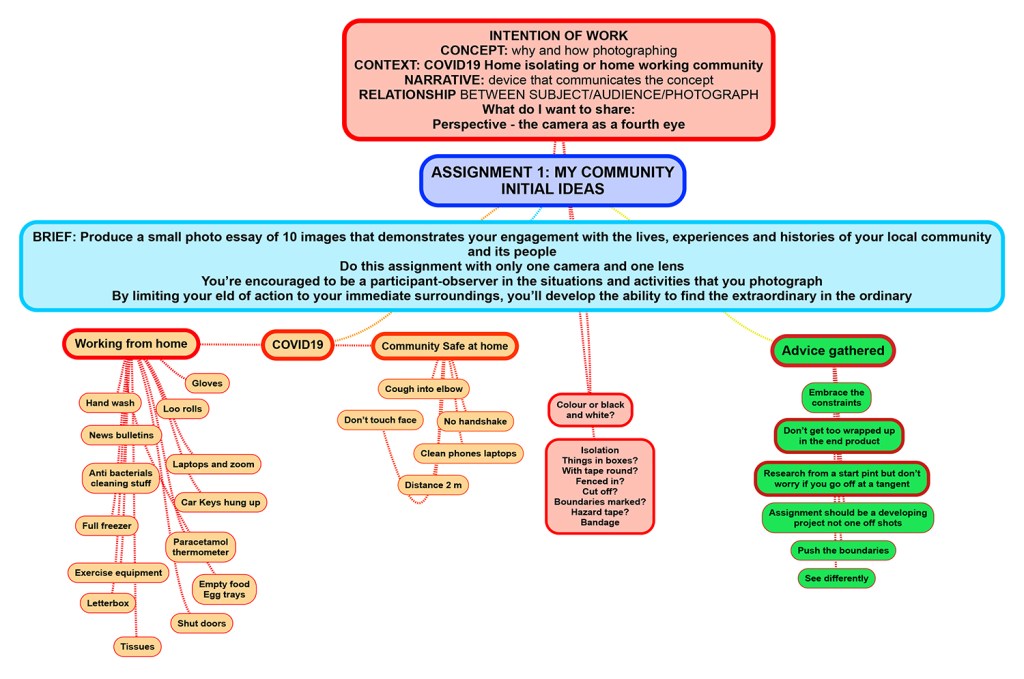
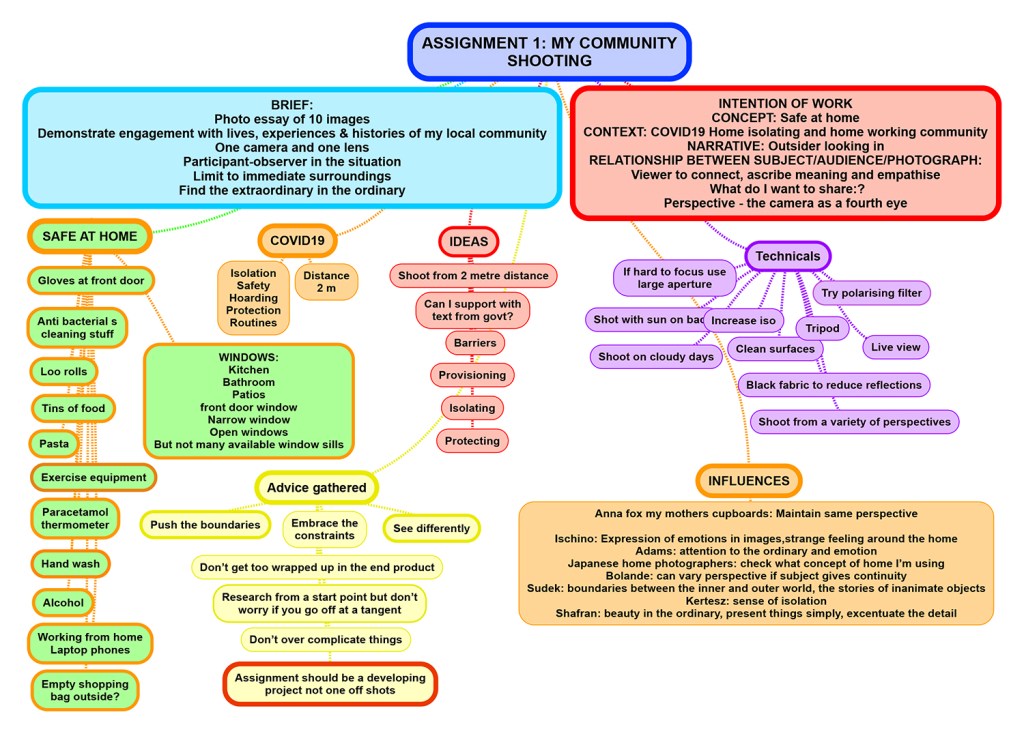
Mindmap Initial ideas:
I also considered advice I had recently in particular, embrace the constraints, don’t get wrapped up in the end product, see differently.
My research made me consider:
Express my emotions in the images
Pay attention to the ordinary and bring attention to it
Really think about what concept of home/community I am sharing
That I can vary the perspective if I maintain continuity of subject strongly enough
Show a sense of isolation
Advice gathered encouraged me to:
Accentuate the detail in the ordinary
Show the boundaries between the inner and out worlds
Show a sense of isolation
Be sure what concept of the home I’m sharing
SHOOTING
I decided to go with the theme of staying safe at home and to begin by photographing by looking in through my windows as an outsider would, I wanted to portray a house in a Covid 19 lock down. I reduced my initial ideas for subjects to about 10 that represented for me life in a lock down house, these would be headed by an image of the front door opening carefully as if to an outsider, and finished with an image of a closed front door with an empty shopping bag outside. I also knew from the outset that this would be a colour project.
To fit with the brief I used one lens, my prime Efs 24mm.
The idea seemed simple but the execution I discovered was not. To begin with I live in a house with few window sills downstairs as they are nearly all full length windows so I had to be inventive to get the variety of locations that I needed. I found reflections were a huge consideration and I experimented with shots without reflections and those with reflections accentuating them. I decided that for the message I intended to share I wanted clear images with detail, so shot at different times of day and directions until I got what I needed.
Part way through I re-clarified my objectives to make sure that I was capturing the right images for my narrative:
CONCEPT: Safe at home – a community isolating at home
CONTEXT: COVID 19
NARRATIVE: Outsider looking in at traces of a protected community inside
RELATIONSHIP BETWEEN AUDIENCE/SUBJECT/PHOTOGRAPH: Physical barriers but connections through understanding
WANT TO SHARE: Feeling of being outside looking in at a protected world
I decided that it was important to:
Express in my images how I am feeling (barriers, isolated, provisioning, protector).
Attention and focus on the ordinary
Present things simply- don’t over complicate for the sake of it
I shot as close as I could to subjects but could only go so close before I lost the window frame and therefore the context.
Mindmap shooting:
EDITING
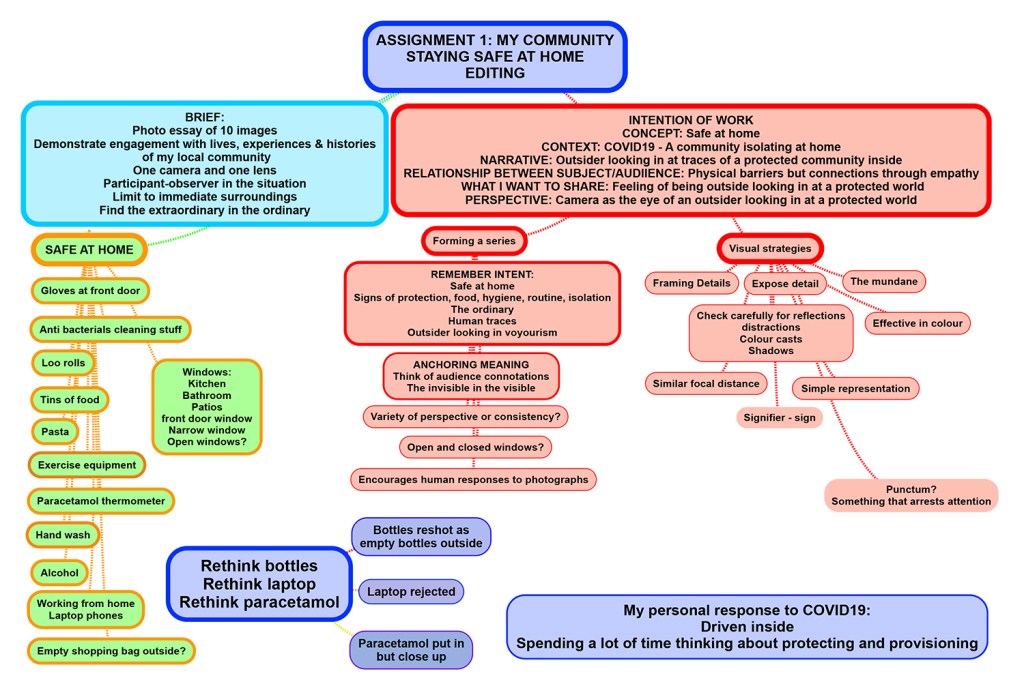
As I edited my images I began to form the series.
When shooting I captured windows and subjects both straight on and at angles and considered like Anna Fox in “My Mother’s cupboards” keeping the same perspective throughout the series; I settled on a variety of perspectives but keeping a similar focal length and simple composition. Likewise after asking others I decided that it was okay to have some windows open and some closed, this was more realistic and increased my options when shooting and making the series.
After sharing twice with different OCA peer groups I’d reshot my bottles on the window sill as empty bottles outside the backdoor instead (as this seemed more realistic). And even after reshooting the laptop at a closer distance after peer group advice I chose not to use it and replaced it with a close up of paracetamol packets which I had reshot at a closer distance.
Simple representation (framing, focus, lack of distraction-less is more)
Detail in the ordinary – Good depth of field
Subjects that viewers will ascribe a Covid19 lockdown connotation to- the invisible in the visible
Images that viewers will empathise and respond to
Signs of human traces of: protection, safety, provisioning, routines and barriers
Mindmap Editing:
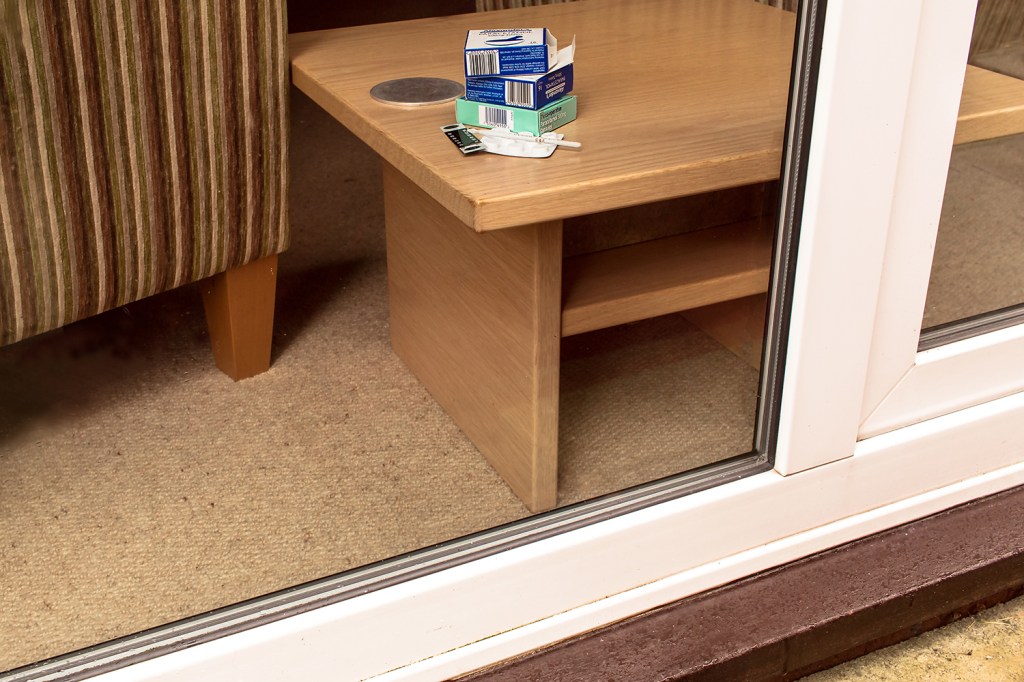
From my first draft of the series I decided to drop this image of the paracetamols on a table as it was too long range, as well as this image of a lap top on a table:
I re shoot the paracetamol at closer range and used this in the final series. I did re shoot the lap top at closer range but ultimately it was still an image I dropped because I thought it fitted less well:
I also deliberated over which of these two images of washing up to use but decided on the angled perspective.
For the final series of 10 I replaced this image of full bottles of wine on the window sill for empty ones outside the door as I felt it was more realistic:
Presentation:
I considered whether to add text to the images such as government orders to the images so that they would have context later, or whether not to in order to allow some discontinuity. I have decided that text won’y be necessary to give context as I’m now sure that the event will live on for a very long time and I think be very easily recognised in the future.
The size of the prints will be A4 which is the ratio as shot.
The brief for our 1st assignment tells us to read the section entitled ‘The Photographic Brief’ in Short, M. (2011) Creative photography: context and narrative. Lausanne: AVA Publishing, pp.20–26.
THESE ARE MY NOTES:
The brief defines the context of the final output
May contain relevant information regarding the conceptual approach
It can be simple: what you are taking a photograph of, where and why.
Give yourself time to develop your idea through practice
The Student brief:
Usually a defined period, possibly loose briefs to enable personal responses.
They should initiate, develop and articulate ideas translating them into photography.
Research and take photographs soonest to share with peers to get feedback – this encourages
Read brief carefully
Clarify own learning aims
Reference:
Short, M., 2011. Context And Narrative. Lausanne: AVA Publishing SA.

 (The Met, 2020)












 Photography 2: Documentary