Read ‘In the American East’ by Richard Bolton (in Bolton, 1992, pp.262–83) and write a 200-word reflective commentary on its relevance to documentary practice. Then look at the work of Charlotte Oestervang in Appalachia (Open College of the Arts, 2014:42).
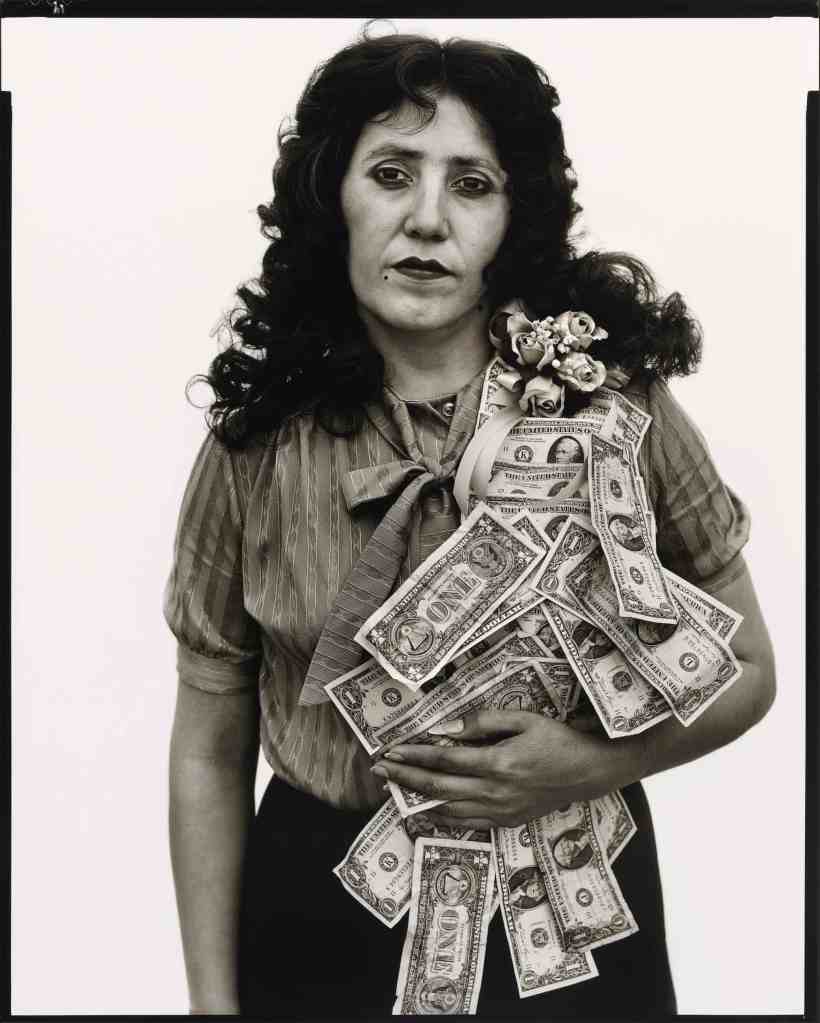
In 1979 Avedon began photographing the “marginal and dispossessed citizens of the West”, those in usually uncelebrated jobs. Bolton examines how Avedon “refashions this class” and how art is used in public relations.
Avedon decontextualized his subjects in front of a shadowed studio backdrop, reducing the 3D effect and exaggerated it further with post photographic processing. Bolton suggests this is to emphasis expected ugliness and sloppiness of such subjects and to effectively “render them mute”; Avedon says that a portrait is not a likeness and that his are truthful. Bolton goes so far as to say that Avedon “exploits members of a lower class for the edification of his own” (Bolton,1992:265), his view is that Avedon’s typologies are reduced to absurdity by formal devices and in particular repeating the subject’s “direct, uncomfortable, awkward, grim” look (Bolton, 199: 267).
(Richard Avedon: In the American West – in pictures, 2017)
Bolton goes on to suggest how the art press helped what he calls this constructivism, that it was a trail run for a different type of advertising and that the publicity that obsessively controlled it made it successful, that it became an “empty vessel” to promote the artist, the museum and the corporate sponsor.
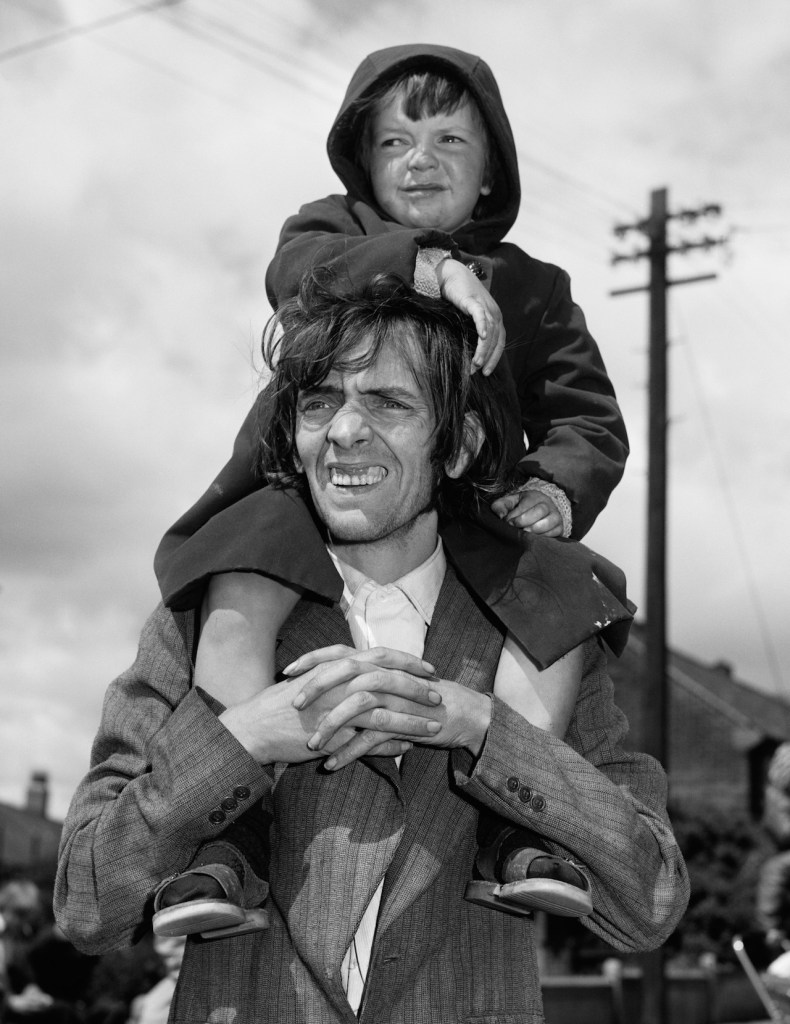
Charlotte Oestervang’s portraits of people in Appalachia do give us some context as they are taken in their own surroundings; however I’m not sure that this shows them more respect, how do we know if she has manipulated their surroundings? They stare directly at the camera and are shot starkly rather like Avedon’s and still leave me uncomfortable.
(Foto, 2020)
My learning here in about the relevance of these works in relation to documentary practice is questions about:
Context
Control
Manipulation
stereotyping
Bias
Social responsibility
These are some of the same issues raised by Sander’s, Nelson and Penn’s work that I addressed below. I guess the important thing is to be aware of these issues and to take the approach that you think is socially and morally appropriate.
Read the information that accompanied August Sander’s exhibition People of the 20th Century at the San Francisco Museum of Modern Art. Write a 200-word reflective commentary on Sander’s seven-category system. Briefly discuss the implications of his classification system within the socio-cultural context of the time. Make connections with contemporary practice such as that of Zed Nelson, if appropriate.(Open College of the Arts, 2014:41)
Reflective commentary:
I saw 80 of Sander’s photographs from his same work “People of the 20th Century”, at an Exhibition at the National Museum Cardiff (13.12.19; it was great to see his work first hand, which I’d already studied when doing my Identity and place course.
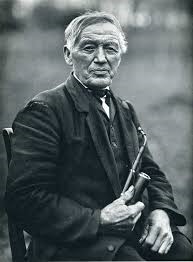
Sandler made posed portraits of ordinary people from across society, who he grouped to occupational, social or familial types; he then put these into seven archetypal categories: The farmer, The Skilled tradesman, The Woman, Classes and Professions, The Artists, The City and The Last People (the elderly and disabled).
These images were taken by August Sanders in the early 20th century and published in 1929 as Antlitz der Zeit (Face of Our Time). They have been put online by various galleries or on Pin interest and are used here in an educational context only.
Walter Benjamin in his “A short history of photography” suggested that people use Sander’s work to increase “physiognomic awareness” in what he described as dangerous times (Jeffery, 1981:132.) The author Alfred Doblin said the work had evidence of social tensions in classes and generations (Jeffery, 1981: 133), calling Sandler a realist. Jeffery suggests that there was some subversiveness about the work, as it is a history of Germany in transition, and maybe that is what I caused the Nazi authorities to disapprove of his categorisation and stop his work. Now, and possibly more so in the wake of the “Black lives matter” campaign and focus on discrimination, this scientific objectivity, including the separating of women would be seen disapprovingly, I think.
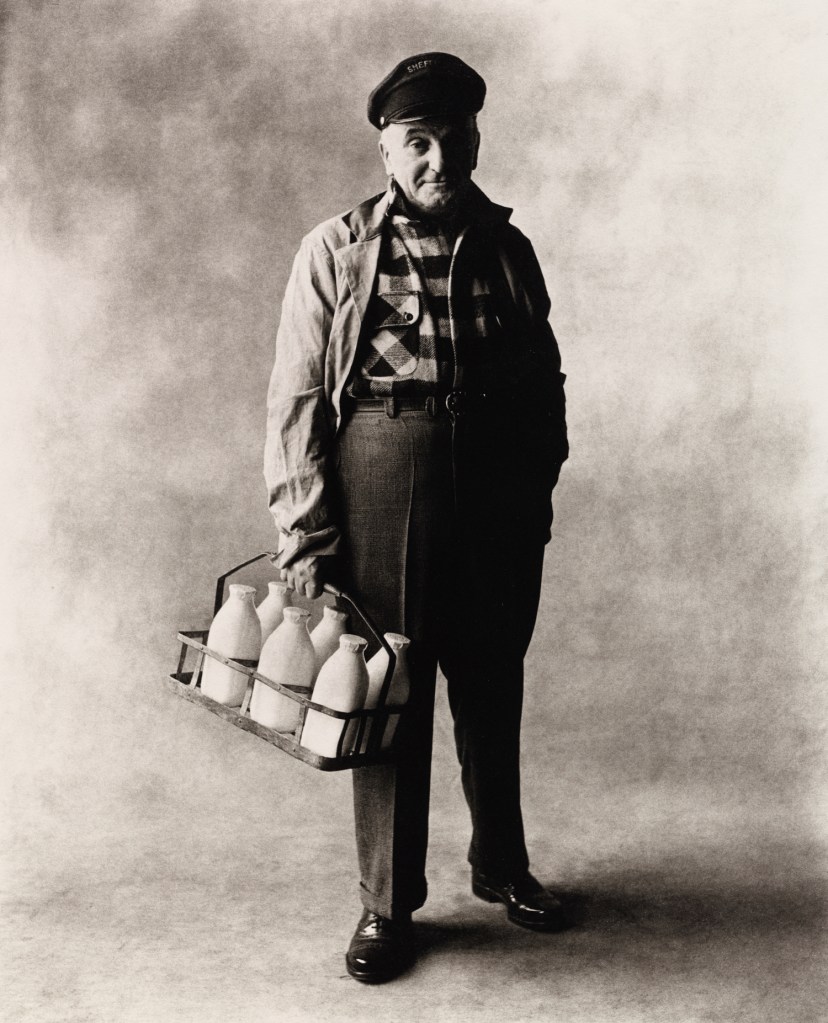
It is suggested by the OCA, that Zed Nelson’s Disappearing Britain and Small Trades by Irving Penn have some connections to Sander’s work. Certainly, Small Trades does document common occupations and in a straightforward manner, but these are not across society as Sanders did.
Milkman 1951 Pompier Paris 1950 (fireman) (The Irving Penn Foundation, 2020)
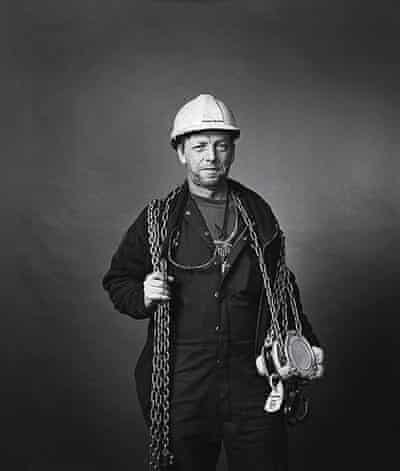
Nelson focuses on dying trades presenting them as art photography; his subjects usually stare into the camera proudly as do Penn’s. They have relevant props as Sanders portraits often did.
(Morrison, 2011)
Although contemporary with “Arty” lighting a sense of nostalgia pervades both of these works; they are both preserving the past rather than cataloguing the now as Sander did.
These photographers had different motives for photographing in what on the surface seems like a similar way.
Listen to Daniel Meadows talking about his work. Then read the essay ‘The Photographer as Recorder’ by Guy Lane.(Open College of the Arts, 2014:40)
The link suggested is broken but I listened to British photographer Daniel Meadows discussing his movie High Street Stories: detailing his inspirations, working processes (using both sound and photography), editing and his working methods after being diagnosed with MS. In this Meadows talks about using old traditions for photography, like using tape recordings rather than videos.
Here in 2014-15, he made a series of visits to West Bromwich High Street, indoor and the outdoor markets. To document those who work and use the market, he made many connections with the people he met. The movie is made up of hundreds of Daniel’s photographic images that are animated to accompany the sound recordings made on location, he used stills like broken animation “multi stories”.
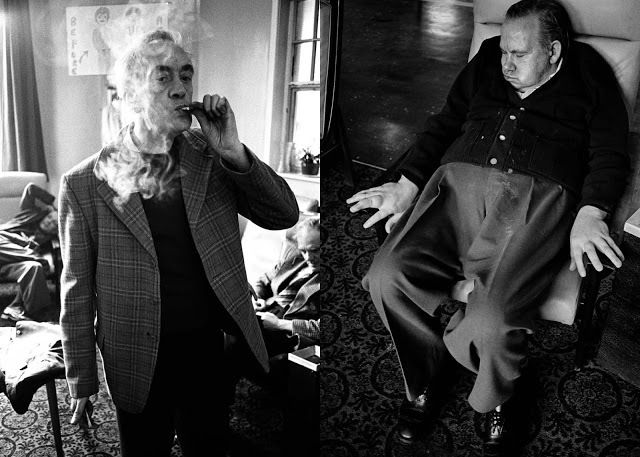
I also watched his work “Smoking room” about mental illness and effectively “care in the community”, where in 1978 Meadows, spent two weeks living in a psychiatric hospital, in a ward for long-term schizophrenics, Clayton Ward. He called the work the smoking room as tokens were earned by the patients as rewards for “Good’ behaviour” which they could exchange for amongst other things tobacco.
He intersperses quotations, narration, and his soundbites on his observations; it all combines as a sort of poetry visual and audio and in a simple but in a very effective way conveys in the space of 4 minutes 34 seconds, the absolute essence of the goings on and essence of like on the ward.
July 2015 – Café Royal Books (2020)
The paper ‘The Photographer as Recorder’ by Guy Lane, looks at Daniel Meadows plans to survey the English people. In this he follows three lines of enquiry taken from Foucault’s “The Archaeology of Knowledge”: the first, Discursive Practice, he describes Meadows non-commercial approach, though publicly funded and with a prospective audience. The second, Emergence, where lane notes that the project was possible because of cultural shifts in photography in the 1970s. The third, Archive, where Lane categorises and assimilates Meadow’s work where the photograph is about urban modernisation discursive intervention. These lines of enquiry Lane suggests are permeated by the absence of tradition in Meadow’s work; he describes Meadows work in Bus Statement as a “dialectic of English life and social change, tradition and modernity, intervention and anxiety (Lane, 2011) 172)
Daniel Meadows is a documentarist, who engages with others to gather as factually as possible, then present stories made out of photographs and/or oral testimony to document our times.
What I’ve learned from Daniel Meadows:
Use curiosity about the world as a driver
Engage with others and mediate other stories
People will talk about their lives
The effectiveness of “actuality recording”
Listen carefully as silence is as telling as the spoken word
Lane, G (2011) “The photographer as a recorder”: Daniel Meadows, Records, Discourse and Tradition in 1970s England. In: Photographies 4 (2) pp.157-173.
Read Mraz’s essay in full. Research the work by Salgado to which Mraz refers and evidence your research in your learning log. (Open College of the Arts, 2014:39)
My notes:
Mraz reflects on Salgado’s representation of his homeland and compares this to Mexican photographers such as Manuel Alvarez Bravo, Nacho Lopez, Hector Garcia and the “new photojournalists”.
Sebastio Salgado
Born in Brazil, started as a freelance photographer and eventually entered Magnum, published books and has had many exhibitions. Best known for documentary projects on hunger, workers, and migrants around the world. Has always photographed through Latin American eyes “Finally you photograph with all of you” (Mraz, 2002:15).
His first book Other Americas, described by Mraz as depicting misery and gloom with “a dominant tone of mystery”(Mraz, 2002:16). Salgado believed that the hunger and poverty exposed here are simply part of the landscape, however Mraz thinks that Salgado forgot the causes of capitalism, class differences and over expanded cities as he fell into the trap of representing his community picturesquely; however he did display alienation and estrangement through structures like doors and crossing gazes.
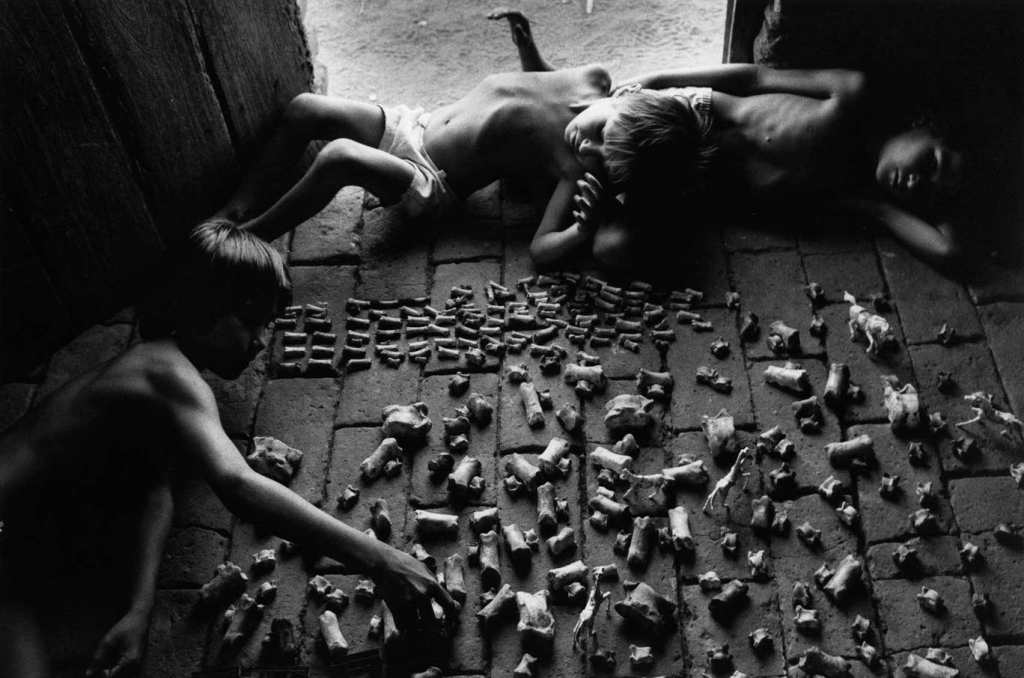
According to Mraz, Salgado represents despair when photographing children playing with animal bones, emphasising poverty by the absence of real toys, prostration on the floor and solemn faces. Lopez similarly photographs children playing with a rat but says that he is showing creativity with his low angled shot.
Salgado represents death in animals in explicit ways whilst Lopez is more matter of fact. Salgado shows the landscape as distressed, he uses cactus the Mexican symbol as sharp threatening points, whilst Alvarez Bravo treats it with humour.
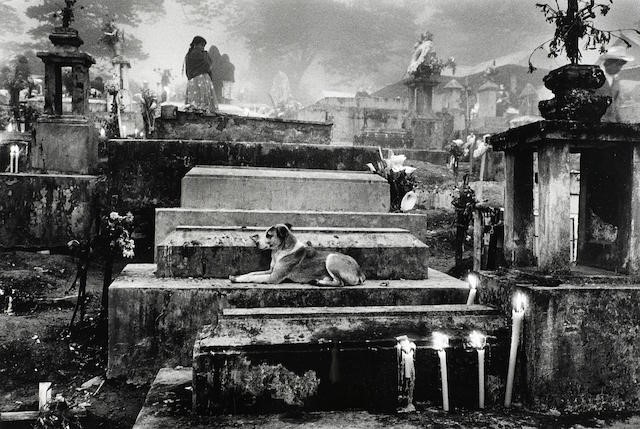
Mraz says that Salgado is obsessed with death and points out that this is common to other Mexican photographers. Nacho Lopez photographed a man being measured for his coffin whilst Alvarez Bravo photographs girls stood near a mortuary sign, all shoot in graveyards.
(Sebastião Salgado, 2020)
Sebastião Salgado, 2020Coffin makers, Nonoalco Street, Mexico city (SFMOMA, 2020)
Mraz notes Salgado’s fine arts tradition of images with minimal explanations, allowing viewers to form their own opinions rather than giving specific context, saying that images are more expressive than photojournalism telling us more about the photographer. Salgado put universal and eternal symbols above specifics in an image, which Mraz describes as symbols and metaphors. Mraz believes that the best photojournalism fuses information and expression, shown in this image from his chapter Garimpeiros in The Workers, of gold miners as ants on the landscape:
I like Salgado’s description of the need to get inside what you are photographing:
“When you work fast, what you put in your pictures is what you brought with you – your own ideas and concepts” and that when spending time on a project you learn to understand your subject; Salgado describes a synchronicity between subjects and photographer resulting in them giving the pictures to him. Jonathan Jones in the Guardian explains “The picture is not being taken by a passive camera, though. It’s by the person holding the camera” as he “somehow puts his soul into the image” (Jones, 2015)
Pedro Meyer a pioneer of digital photography captures juxtapositions and relies more on the decisive moment than immersion:
(Exhibition, 2020)
(Pedro Meyer, 2008)
He was actively involved with Sem-terra movement in Brazil, revolting dispossessed peasants, book: Struggle of the Landless. The 1997 book Terra uses expressive captions to contextualise; this is a book in two parts, one of the people the land and their hardships and one of migration and rural land takeovers. Photographing migration and urban landscapes was new for him. Though he has been criticised for aestheticizing misery it also shows strong formal design and photographic modernism, emphasising geometry, and visual contrast. This work is a contrast to the traditional picturesque work for the masses that he gave in Other Americas and is “an effort to get Brazilians what they need” (Mraz, 2002:28)
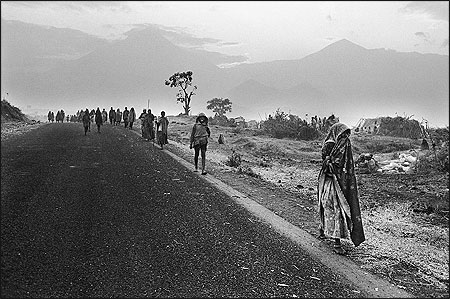
1993 book Migrations on refugees and migrants used a similar structure and his portrayal of the US-Mexican border and migrants is dark. Salgado shares that he works with fast film and opens the diaphragm to give huge depth of field and that volumes of photographs are important to him, “Reality” says Salgado, “is full of depth of field” (Jones 2015)
Migrations: The Story of Humanity on the Move (Nieman Reports, 2020)
Mraz calls Salgado a “new breed of photojournalist”(Mraz, 2002:30); Salgado says himself that he rejects the idea that he creates art saying that he is more concerned to report the historical moments in which he lives. He began by following a traditional path in subject and technique, picturesque and mainstream, however he discovered that to say anything new he needed to go beyond the stereotypes to show the struggles of communities, “his practice of commitment to the oppressed, and his capacity to stretch the limits of what is acceptable” (Mraz, 2020:30) offers a model of photojournalism for the future.
My Learning:
Salgado represents his community picturesquely, although he also showed alienation and estrangement.
Salgado is and Lopez focused on death in common with other Mexican photographers.
Salgado shows the landscape as distressed.
Alvarez Bravo treats the landscape with humour.
Salgado put universal and eternal symbols above specifics in an image,
Pedro Meyer captures juxtapositions relying on the decisive moment more than immersion
Salgado says reality is full of depth of field
Salgado went beyond the stereotypes to show the struggles of communities
Salgado used minimal explanations and context to allow viewers to form their own opinions
References:
Bonhams: Sebastião Salgado (born 1944); Cemetery of the Town of Hualtla de Jiménez, Mexico, from Other Americas; (2020) At: https://www.bonhams.com/auctions/21017/lot/96/ (Accessed 27/05/2020).
This exercise revolves around the body of work The Americans, by Robert Frank. You’ll need to do your own web research to find relevant images and background information. (Open College of The Arts, 2014:39)
PART 1Find five images in The Americans where symbols are used. Explain what they are and how they function in the images.
Symbol: Window frames – Segregation- separation of races
This image which he apparently shot only the one of as he caught it as he turned around form shooting something else is on the surface a photograph of people on a bus. The imagery is much deeper than that as he the window panes heighten the division on the bus of white people at the front and African Americans at the back; probably the white children are in the middle as they may be between their White parents and African American carers. The expression on the first African American man is very poignant, he looks deeply unhappy, the expressions on the white boy and lady are classically stern and controlled.
The Caucasian baby’ pale white skin is juxtaposition against the dark colour of the nanny’s, denoted by her uniform. The expression on the nanny is neutral, which would be less likely if it were her own child and similarly the child is expressionless, they seem together but separate. In the background the street edge is lined with expensive looking cars suggesting that this is a wealthy neighbourhood.
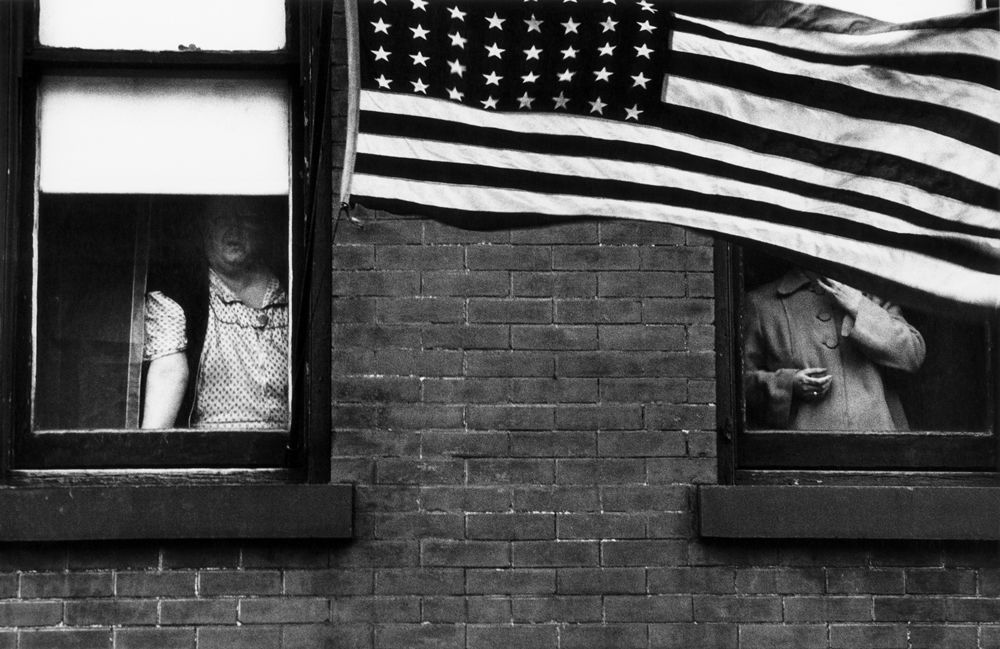
Symbol: American flag – Stars and stripes- American patriotism
The American flag flies from the window of the woman on the left, she has a summer dress on whilst the other is in a coat; is one apartment heated and one not or has the woman on the right just come in from outside? It looks like the woman in the coat is smoking, is this another symbol of a class difference. Certainly, the brick wall denotes a separation. Was this shot chosen by Frank because the flag is obscuring their vision in some way, metaphorically?
Image 4:
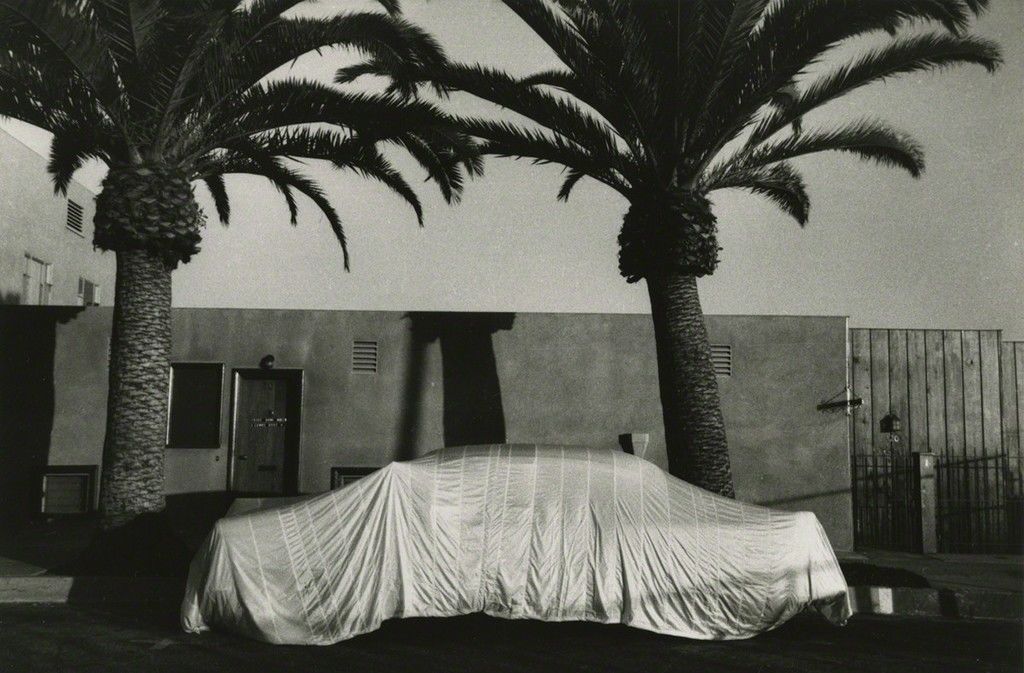
Robert Frank Covered Car–Long Beach, California, 1956/1956c (Indrisek, 2018)
Symbols: Palm trees – California & Covered car- prized possession
The house looks like a small working-class house and the car is covered to keep it clean; is it their cherished car or their employers? Interestingly in Kerouac’s introduction to the book he explains that the “car shrouded in fancy expensive tarpaulin…to keep soots of no soot Malibu falling on new simonize job as who is a two dollar-an -hour carpenter snoozes in house with wife and TV” (1994).
The shiny car seemingly glides on the empty road outside the large factory. The factory appears bland and harsh. Are the roads quiet because it is a Sunday, or quiet because the workers are all inside working? The road is angled upwards, this would have been deliberate; is it to signify upward mobility?
Part 2.Read the introduction to The Americans by Jack Kerouac. Find symbolic references that you can also identify in Robert Frank’s photographs – not necessarily the five images that you chose for the first part of this exercise. (Open College of the Arts, 2014:38)
Symbols mentioned in the text:
Coffins and Juke boxes “you end up finally not knowing anymore whether a jukebox is sadder than a coffin” (Kerouac p.1)
I have read this chapter before during Context and narrative. It was interesting to re-read this 2 years later, these are points that I find salient now:
Chapter 4 Narrative:
Visual narrative techniques are used as punctuation to create frames of reference and context for an audience to give meaning and coherence – a thread to follow or a concept.
In photography narrative may not follow the traditional beginning middle and end, it may look to the past or future, be cyclical, make cross references or be in just one image
The artist citing their method of production is important to convey their intention The way images are presented gives subtle visual clues to an audience and so it should be considered: Is it a typology, an installation that requires interactivity, a photo essay, a sequential story or standalone images.
The size of an image in a series can be visual punctuation
Remember the role of the of the camera as the eye of the viewer, which can be from another perspective
The narrative within a photograph can be drawn from all components of it and breaking it down into these components to help think about what you ae showing an audience.
Photographers that construct images photographers like Gregory Crewdson are deciding what to show an audience
I was interested to learn that many well-known single images have been extracted from larger bodies of work. Short suggests that because these emerge from immersion in a subject overtime, they often convey the essence of the photographer’s intention; their personal response combined with the meaning in a scene that are brought together I a moment.
In summary Short suggests considering when presenting images:
• Will the audience see all the images at once?
• Do you want them to follow an identifiable sequence?
• Will some pictures take more prominence than others?
• Do you need a lead picture that sums up the intention?
• Do you want to use visual punctuation? (size or shape)
“Ultimately the aim of narrative technique is to provide or anchor meaning and coherence for the image and its audience” (Short, 2011:109).
Chapter 5 Signs and symbols
The study of signs is calls semantics and can be used to illuminate visual language and the context of these must also be considered. Ferdinand de Saussure (1857-1913) Swiss linguist and American philosopher Charles Sanders Peirce (1839-1914) developed models of semantics on which much of this terminology is based:
Symbol: something that represents something else.
Signifier (the form a sign takes)
Signified The concept represented)
Studium (general interest in the photograph)
Punctum (that which arrests attention)
Representamen (the form that the sign takes)
Interpretant (the sense made of the sign)
Object (to which the sign refers)
The photographer may introduce these accidently or in a constructed way. A signifier can be:
A symbol – is something that represents something else
Indexical– physically or causally linked to the signifier: smoke, footprints
An Icon – resembling the signifier
Signs and symbols can be constructed by the photographer as they respond to their environment. Practical techniques such as aperture, shutter speed and lighting can be used to bring signs and symbols into photography.
Download from the OCA student site the tear sheet of the newspaper in which the Shields photograph was originally published. Read the accompanying text and answer the questions below:
Does the text relate to your initial deconstruction of the image? If so, how?
Does the text change your perception of the image? If so, how? (Open College of the Arts, 2014:37)
My response:
The text both changes my response to the image and confirms some of my initial thoughts, in particular the connotation, overall, it adds to my interpretation:
It confirms that it is a dilapidated estate but in addition states that it is a council estate
It was new information that it was Glasgow.
If I had to guess what article the image accompanied as the boys in football strip were central to the image I would have expected the story to centre around the boys or football: friendship in hard times, friendship across a divide, or a hope for playing fields;. It was a surprise to find that the article is about regeneration of public housing.
My Learning:
A reminder of the power of text to anchor an image and also the power of an image to be used perhaps out of context and have its meaning misappropriated.
Reference:
Open College of the Arts (2014) Photography 2: Documentary-Fact and Fiction (Course Manual). Barnsley: Open College of the Arts.
Analyse Martin Shields’ photograph of two young footballers. What are the denotations and connotations of this image? You can write your answer in descriptive prose or make a bullet list if you find this easier. Compare your findings with those of other students via the OCA student forums. (Open College of the Arts, 2014:37)
Response:
(Open College of the Arts, 2014:37)
Denotations:
Two children with different outfits on
Walking with their arms round each other with footballs under their arms
They are walking past a housing estate
They are walking on a rough pavement
A road is on their left
The weather is grey but not raining
Connotations:
Two boys with different football strip on
They are friends
They are probably walking to play football as their clothes look clean
Their body language signifies that they are happy
It is a low-income area as the houses look run down
Read the interview with Marcus Bleasdale in Eight magazine (V4N3, Dec 2005).See also the article in the Guardian magazine 16 January 2010. (Open College of the Arts, 2014:34)
Notes: Marcus Bleasdale is a documentary photographer who uses his work on human rights and conflict to influence world decision makers and global policy makers around the world. The last ten years he has covered the conflict in the Democratic Republic of Congo, highlighting both the reasons for and the effects of that conflict on the Congolese population. He has published two books: One Hundred Years of Darkness in 2002 and The Rape of a Nation in 2009, he believes that photography can bring positive change.
Points of particular interest:
He doesn’t believe that photojournalism and conflict go hand in hand and cites the work of Eugene Smith and the Spanish Village abut a country doctor and midwife as events such as famines and natural disaster that aren’t conflict but have a conflict edge to them.
Following the talk Anna fox gave where she explained how fiction affects her photography, I was interested how Bleasdale takes inspiration from writers such as Conrad saying that his language is very visual
His disappointment that media conflict of conflict is often ended due to financial reasons and that foreign news is often limited in favour of the lucrative celebrity market.
He explains that he shoots what he wants for NGO first and then edits towards their brief later
When asked if he thinks people understand both individual and series of images he says yes, but particularly cites the impact of the single image particularly “the one moment of clarity or the question raised by the work that touches people” and this may motivate people to do something
He says that respect for those you work with and them for you is paramount for the success of an image and that he spends a lot of time with subjects to achieve this.
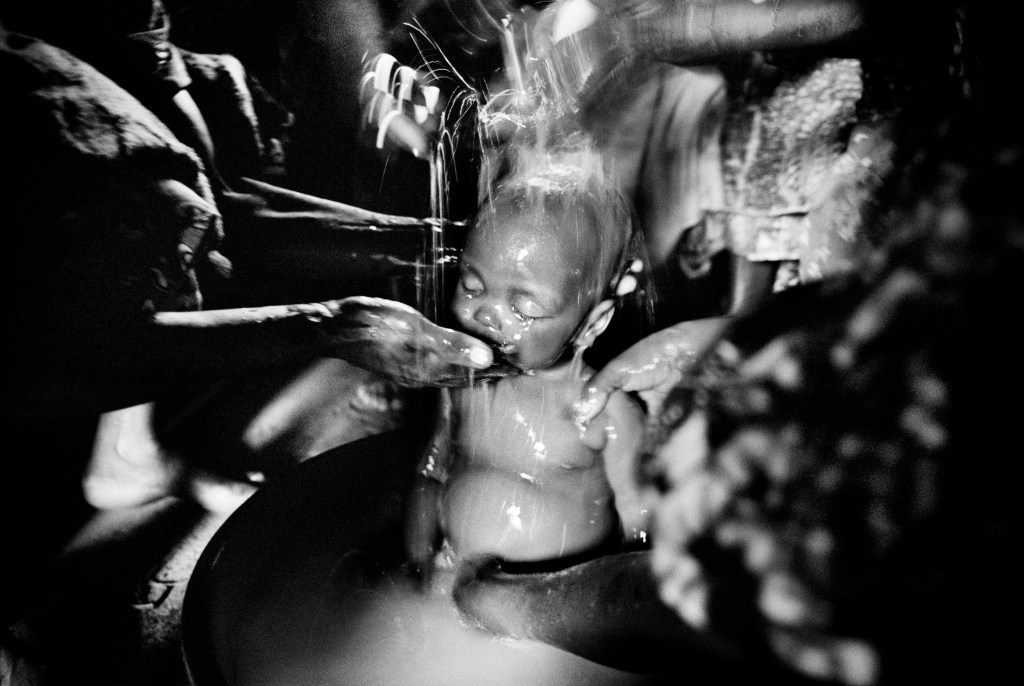
When asked which of his work represents what he wants to achieve as a photojournalist he cites his work in Sakura Lisi in the Congo, where he showed the desperation with dignity. This image below I think shows the way that he has gained the respect of the people to capture an event:
The washing of the body at the burial of the eight-month-old Sakura Lisi, the daughter of a gold miner in Mongbwalu, northeastern Congo. 2004
(Congo. Bleasdale, 2004)
My response:
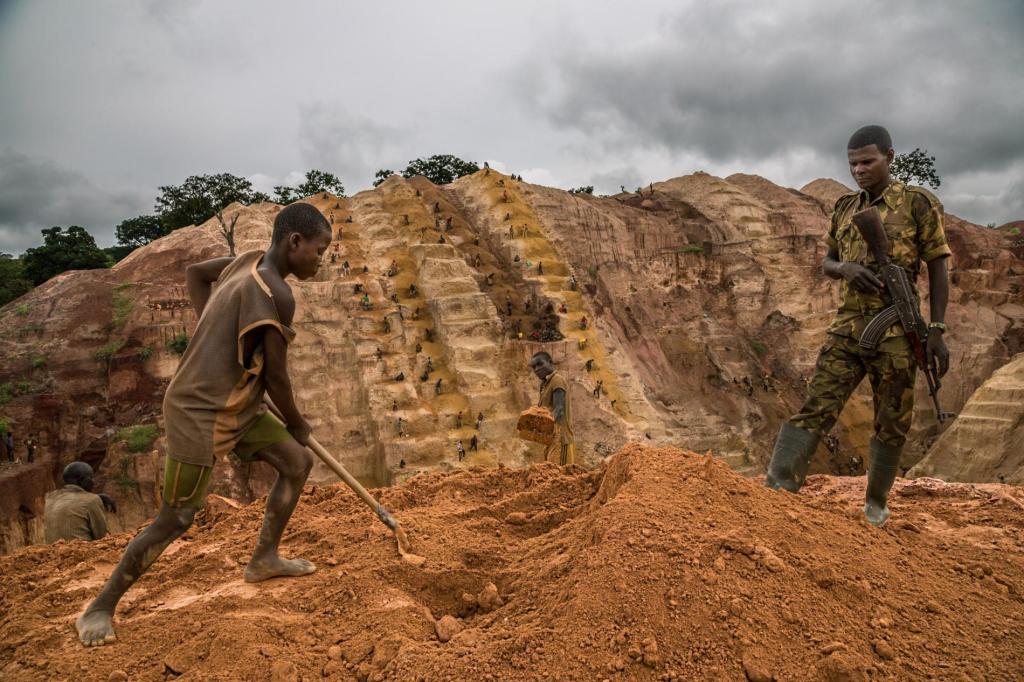
Having viewed his website, I was amazed at the aesthetics in his images as well as the strong portrayal of desperate realities. I particularly saw this in his colour images such as the one below and yet I can see that when he presents in black and white the images seem more gritty and dramatic, somehow more honest and stronger– I should bear this in mind when choosing between black and white and colour.
Child miners from the series Unravelling
(Congo. Bleasdale, 2004)
My Learning:
At a simple level I was amazed at his work and will follow it carefully.
Consider taking inspiration from writers and fiction
Be aware of the power there can be in a single image when it comes from a part of a longer project
I come back again that respect for those you work with and them for you is paramount for the success of an image
Do your own research into the work of the socially committed B&W photographers discussed so far, both British (Exit Photography Group, Chris Killip, Nick Danziger, Bill Brandt) and American (Jacob Riis, Lewis Hine). Was this social documentary work their prime focus? How does it fit with other work done by these photographers?Make notes in your learning log or blog. (Open College of the Arts, 2014:34)
which I add to a little here. Then I will look at those I’ve not researched before……
BILL BRANDT (1904-1983)
He had a multifaceted carer, shaped initially by a circle of friends in the surrealist movement in France, including spending time in the studio of Man Ray; he later moved into fine art photography.
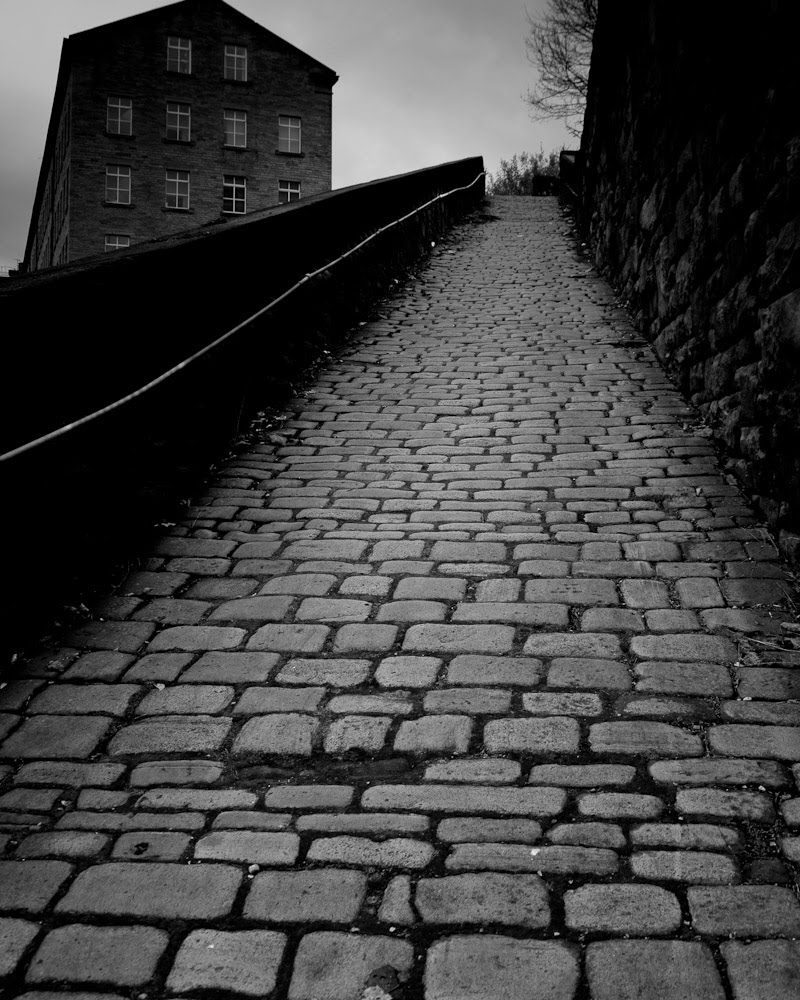
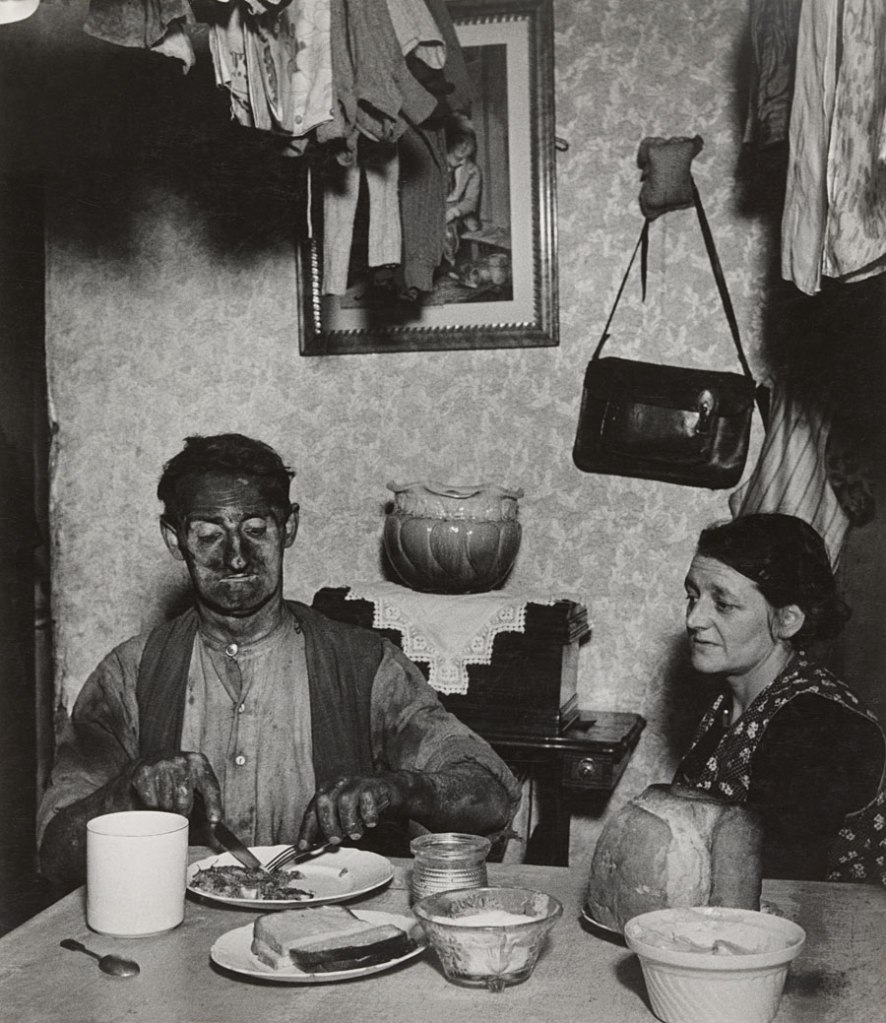
His work The English at Home exposed ironies in the British Class system (Johnson, 2012) and his book A Night in London also looks at the British class system. Brandt also photographed the depression compassionately in the North, especially the miners in Northumberland:
1937 A Snicket in Halifax (Bunyan, 2020)
Northumbrian Miner at His Evening Meal 1937 (Bunyan, 2020)
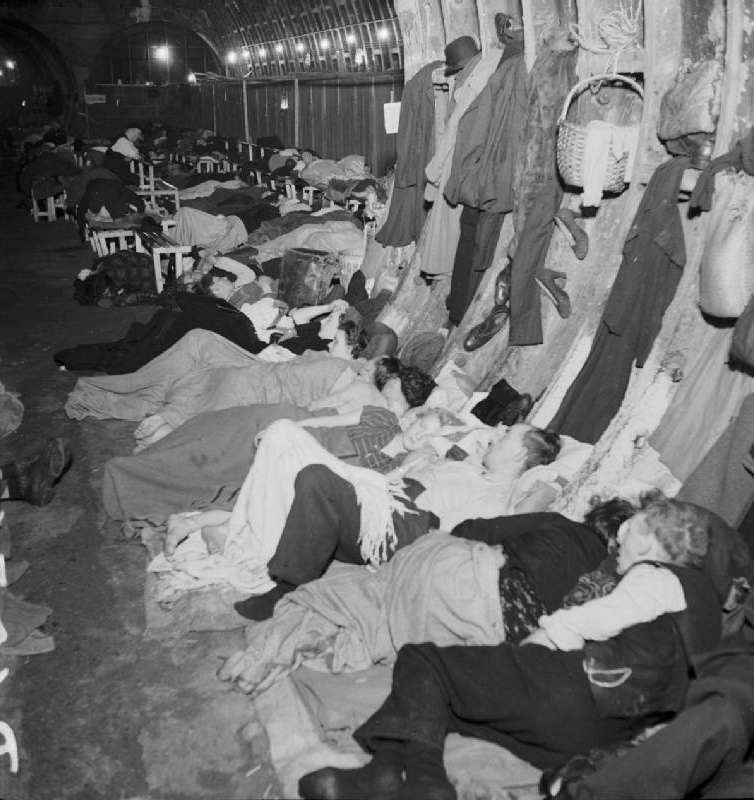
He was commissioned to take photographs of the many underground bomb shelters during the second World War:
Liverpool Street Underground Station Shelter (Bunyan, 2020)
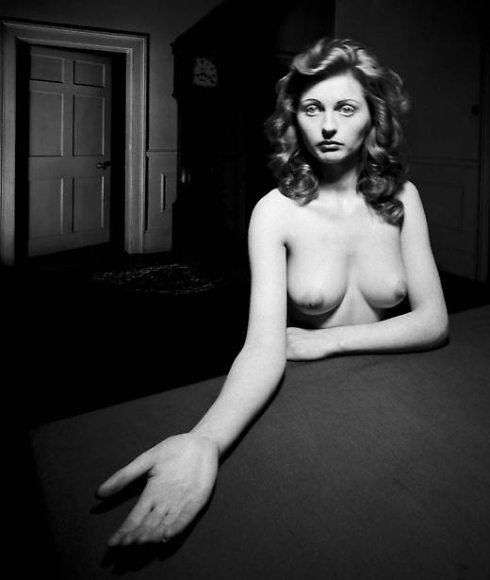
After WW2 he investigated themes portraying poetic sensibilities displayed in contemporary art photography and as he increasingly arranged things for the camera, he took the nude from the studio and placed in domestic situations , even on the beaches of England and France. He used a wide angle camera lens so that he could photograph whole rooms; and was recommended one but he found that it distorted and the images of distorted abstract nudes came from this accident, he describes them as abstract sculpture. His surrealist abstract photographs were not popular at the time but are now. He describes some of them as lucky finds but I believe it is down to his eye.
nude London 1952
nude Hampstead London 1952
Nude Micheldever Hampshire 1948
(Bill Brandt, 2020)
However despite his photographs of the Depression and social class, I’m not convinced that his work went beyond the artistic portrayal of their sooty blackened bodies and wouldn’t label him as socially committed.
Chris Killip (b1946)
Photographed the heavily industrialised areas of the north during the 1972 and 80s, steel works, shipyards and coal mines; these were published in his book “In Flagrante” (1988). He spent a long time in a place whilst photographing, sometimes years, often in closed communities, but not always of those he knew. He says his photographs changed as he got to know people. He says “history is written, my pictures ae what happened” ( Smyth, 2017) ). Killip says that he was interested in recording people as part of history rather than to blame politicians. He seems to me to be a socially committed photographer as he portrays in an unromantic straightforward way what he sees and knows from learning about a place and people.
Father and Son Watching a Parade, West End, Newcastle; Chris Killip (British, born 1946); Newcastle, England; negative 1980; print 1986; Gelatin silver print; 34.7 × 26.5 cm (13 11/16 × 10 7/16 in.); 2014.36.22
Youth on Wall, Jarrow, Tyneside; Chris Killip (British, born 1946); England; negative 1976; print 1986; Gelatin silver print; 27.5 × 34.1 cm (10 13/16 × 13 7/16 in.); 2014.36.14
(Smyth, 2017)
Nick Danziger (b1958)
Danziger’s Britain was published in 1996, it focused on under privileged members of society; he lived among the homeless and unemployed in many of the ruined manufacturing “no-go” areas of Scotland, Wales, Northern Ireland and England where he slowly won the trust of the street children and got to hear the stories of hundreds of society’s outsiders; it was a powerful and disturbing documentary.
The British (2001) contrasted the worlds of the upper and under class, showing the inequalities and polarisation in the upper and underclass; a vivid portrayal. In 2003 Danziger travelled with Times editor Peter Stothard for a month to document visually the Prime minister Tony Blair; here President George W. Bush and Blair make eye contact as if both are looking into a mirror, taken the day before American troops had entered Baghdad, this was an important document of history.
President Bush and Prime Minister Blair at Hillsborough Castle, 2003 (Nick Danziger | Widewalls, 2020)
He establishes close relations to his subjects, though not impartial; however he does aim to give those who rarely feature in the media a voice. He believes that photography can bring positive social change for individuals and local communities.
He has done much of his work abroad often in war torn places, recording the ordinary people caught up in the conflicts; here you can see his social commitment.