Continue working on your personal project and produce a photo essay of 15 images. Your work should demonstrate good research, a methodical approach and a wider scope than previous assignment work.
Decide on the best submission format for your work. Discuss your ideas with your tutor while you do the projects and exercises in Part Five. (Open College of the Arts, 2014:120)
Background information:
This personal project spans a year of reflection on the village of Newport (Tredraeth) Pembrokeshire. At the beginning of this time I was a second home owner, “exiled” from the village by the pandemic lockdown, observing the “temperature” of the place from afar. Mid way through the year I relocated there permanently. I have been an insider/outsider observer of the place for many years, known and accepted by many. Now that I have become a local, other’s experience tells me that it will take me years to be recognised as such.
As with everything this year, emotions have magnified, and voices have become louder. To rationalise what I was reading on social media and the press, I researched for facts to seek the cultural, political, social, and economic truths about the impact of visitors and second homeowners to this rural area, during the pandemic lockdown, and more generally as well.
Having discovered my “truth” I considered how to share this visually. My background reading of those such as Sekula, Tagg, Berger, Levi Strauss and Borge, increased my awareness that photographs are only representations of reality, part captured in the moment and the rest supplied by the photographer. Whilst I carry the responsibility and accountability of a documentary photographer to present reality, in this story I present various layers of truth, material, moral, impression and form. Images are never neutral, but having synthesised much information, as well as emotion, I have recorded and presented the truth as I understand it. I have recorded what my eyes saw. The text that accompanies the images is to support the truths I have discovered, rather than appropriate the images, as well as to provoke thoughts.
Photographs are not predictable communicators “they cannot carry meanings in any straightforward way” (Company, 202:8), but I have announced my path to this truth, and my position in it, though do hope that viewers will question the truths that I share.
References:
Campany, D. (2020) On Photographs. London: Thames and Hudson.
Open College of the Arts (2014) Photography 2: Documentary-Fact and Fiction (Course Manual). Barnsley: Open College of the Arts.
Artist statement:
This work is a personal reflection on aspects of a village, over a year. Though this has been an unusual time, the feelings and opinions felt and expressed, are simply magnifications of continued underlying tensions between locals and visiting outsiders. I have sought to uncover the truths that lie beneath these emotions, and share them here. These layers of truths are presented with integrity and research, though just as I have formed my own relationship with them, so may you.
Tutor hangout feedback meeting 25.2.21: This was to discuss my feedback on Assignment 4 Critical review, but we also discussed my proposal for assignment 5.
In her feedback my tutor queried several points about my assignment proposal. She asked me to:
Clarify my approach and undertaking in relation to the criteria: Critical and analytical skills, Develop intellectual understanding, Synthesis information, Communication skills
Would my proposal allow critical engagement with the blurring boundaries between fact and fiction/different truths?
How this assignment develops my work further from assignment 3?
When I first received my feedback I was puzzled, however I quickly saw that my proposal had not been explicit about these points and that much of the methodology, approach and workflow was in my head. By the time we had this discussion I think I had clarified the points myself and this is how I answered her questions:
I was able to explain how I realised that I hadn’t set out my methodology in my proposal: My intent is to move from the subjective social media comments that I have collected from face book, to collecting data and facts from various sources. Sources such as the Town council and government, press releases, property companies, census, and business owners. I will focus on facts about the house market (home ownership, house prices, rental opportunities), business demographics (proportion of income taken in the tourist season)and tourist demographics, to ascertain facts about the impacts of visitors to the community.
I explained that I will add to the collated social media comments from locals and visitors, demographic, economic and housing facts, from various gatekeepers. This will give me a better intellectual understanding of the situation and enable me to decide on my stance on the various issues. At the heart of this is a synthesising of the various voices, messages and information- the different truths- so that I can communicate my understanding of the concerns.
I described how this work is a progression from my assignment 3 work which identified the pressures of the rise in visitors to the town during the summer season, exemplified by the increased traffic in a car park. This work is of a much wider scope; assignment 3 was connotative of the issues, this expanded work allows me to denote more fully the concerns and issues arising from this phenomenon.
Extracts from my Assignment proposal:
Working title: Tensions arising from visitors.
Theme: Different sides of a story.
It’s a personal project, that began a year ago when I was in lockdown in England and not allowed to travel to my then “second home” in Pembrokeshire Wales. During this time I observed many discussions on social media about visitors to our “second” town, as well as Welsh national media highlighting lockdown infringements. The coverage was mostly one-sided and uncomfortable to read. As the year progressed and I travelled to my second home, I was able to gauge the real breadth of feeling from local residents to visitors; though not “local” I am well established in the community here and talk to people on both sides of the divide.
The second part of this year I have been resident here in what is now my only home where my research continued, capturing media articles and comments, knowing I would probably use the material for assignment 5. I added to this notes on conversations had, overheard and related.
Methodology: Photograph local contentious subjects such as, caravan parks, holiday houses, shops, roads, footpaths. Present images with short text/captions from research.
Further research: Photographers, and bodies of work to support my presentation approach, through websites, books, talks, and online interviews. I may also look at my archive of images, to compliment those that I shoot over the next month.
Approach: Probably a slideshow sharing images with overlaying text contradictory to each photograph, and possibly a third layer (perhaps audio) communicating another perspective on issues.
RESEARCH
I began with reading around “truth” in photography, investigating photographers’ who’ve written on the subject and photographic philosophies on the topic. I have written my responses to the thoughts of Allan Sekula, John Tagg, Levi Strauss, Borge and also explored other such as David Company “On photographs” (2020) and David bates Photography: The key concepts (2009).
I came away that there must be some belief in images or they lose their value. Therefore where there is power over an image the photographer, editor, curator, pubisher and so on there needs to be some transparency about their intention and influence. It is is also important that the viewers ask questions of an image, because a photograph can only be a representation of a reality, not reality itself.
My extended research led me down many rabbit holes, from a starting point of social media comments to Government web sites, Newspaper articles, council meeting minutes, letters from MPS, Tourism data sources, property information sources, and interviews with local business owners. I also attended some local virtual meetings.
My conclusion that there is a real trade off with local businesses and economies who need the income from tourists and the impact that this has local house prices and rental availability as well as some feelings of “invasion” at certain times of the year.
PHOTOGRAPHING
My work above showed emerging themes:
Tensions caused by tourism
Fears about Tourists and second home owners breading Covid lockdown rules
The dependency of the local economy on visitors
The impact of second home owners on the housing and rental markets.
I went out to photograph with these themes in mind. On the first 2 themes the evidence of tourists visiting was scant so I focused on representing this, empty streets, empty rental cottages, empty second homes, empty caravan and camping sites, empty car parks and so on.
For the 3rd theme, the local economy, again the visual evidence was different to many of the views expressed of food shortages and a lack of welcome by local businesses, as I photographed the local high street. The 4th theme, housing was different and I had to take a more representational approach as evidence of lack of affordable housing and long term rental housing is hard to capture.
I shot similar subjects and locations over a period of time to get the right light, weather and traffic (human and vehicular) conditions. They are all necessarily mundane subjects which I found less than inspiring to shoot so had to keep returning myself to the research and my intention to justify my photographing, but found the challenge of capturing the subjects in the manner that I wanted enough to maintain my momentum. At the time of shooting we were in a period of “Stay local” Covid 19 restrictions, which meant locally that you were not even allowed to drive for exercise, so I was restricted to photographing within walking distances. Most of my exploratory first images were taken on my I phone when out running or when walking locally for other purposes. I then returned with my larger camera on planned visits around, weather, light and time of day.
EDITING
During my editing I decided which images needed improving or taking from a different aspect. As I then began to put these to the text I had acquired I discovered where I had gaps and needed to photograph other subjects. My shooting was time limited as I needed to complete it before the area opened back up to tourists as this would have provided another perspective and a different story to that which I was writing. This was another story I could have written but it would have taken me past my course deadlines, it was a story that I already touched on in assignment 3. However it could be another project going forward.
PRESENTING
Early on I the work I thought that I would prefer to use four of five repeating images with varying text to show the different truths, Subjective social media, subjective press reports, Government and official reports, statistical data and my voice. However the brief is to use 15 images and having discussed this with my peers in an OCA hangout group I decided to present multiple images withina theme with different aspects against them.
This was my first draft of my power point documentary:
I shared my first draft with my peers in the Documentary/level 3 OCA hangout group. The feedback was really useful. I asked:
Should I give more context, perhaps in the title? but was told to keep the ambiguity.
Whether they could see my voice and what they thought my message was?
Some did realise that I was taking a tongue in cheek position and that the visuals are opposed to the text.
The fact that one peer asked me where I sat in the whole thing told me it wasn’t clear enough.
Some thought the message was about spreading corona virus, holiday homes
So I realised that my message wasn’t clear, nor was my voice.
No one had realised that I had put the subjective Facebook comments on a grey background, and facts on white background- so that hadn’t worked!
We discussed what I wanted to convey and how I could adjust to achieve this and to ensure the visuals come through. There were suggestions to:
Reduce the text
Separate the text in some places from the visuals
Put the facebook comments on ticker tape under the images
Present some facts without visuals on a text only page.
Afterwards I thought more about how to make it clear what my position is:
I need to really think about where I am in the story.
Let my voice speak in the visuals.
Make sure the work is really tongue in cheek.
Actions taken:
I pared down the text, by critically looking at each piece of text eliminating what is not essential.
I threw all the parts up in the air and looked at afresh, which enabled me to see it afresh and make decisions on what order was most effective for the various parts.
I chose to differentiate the factual text by giving the appearance of newspaper column print.
I experimented with ticker tape but then arrived at the idea that I’d like to viewers to see the images first and then with a delay provide the contradictory facebook comments. So I faded the text in after the image.
I reduced the backgrounds all to a simple white.
I have added an end note before the references to explain my unique position in the situation.
This is personal project. It began a year ago, I was in lockdown in England and not allowed to travel to my then “second home” in Wales. During this time, I observed many discussions on social media about visitors to our “second” town, as well as Welsh national media highlighting lockdown infringements. The coverage was mostly one-sided and uncomfortable to read. As the year progressed and I travelled to my second home, I was able to gauge the real breadth of feeling from local residents and visitors; though not “local” I am well established in the community here and talk to people on both sides of the divide.
The second part of this year I have been resident here in what is now my only home. I continued researching, capturing media articles and comments, knowing I would probably use the material for assignment 5. I have added to this note on conversations had, overheard and related. Now I need to develop a visual photographic response to this personal, and socio-political study. I would like to explore layers of truth, something that has interested me increasingly as I have progressed through the documentary course. Though my research has been during the coronavirus year 2020-2021, I don’t intend the work to focus on this; the research highlights local/societal/nationalist issues that exist normally, such as the economy, resources, housing, tourism, and hospitality businesses.
Working title: Tensions arising from visitors.
Theme: Different truths.
Methodology: Photograph local contentious subjects such as, caravan parks, holiday houses, shops, roads, footpaths. Present images with short text/captions from research.
Audience: Myself. I will create it for myself, depending on the outcome I might release to the community later as a healing tool; currently it would inflame the situation locally.
Further research: Photographers, and bodies of work to support my presentation approach, through websites, books, talks, and online interviews. I may also look at my archive of images, to compliment those that I shoot over the next month.
Approach: Probably a slideshow sharing images with overlaying text contradictory to each photograph, and possibly a third layer (perhaps audio) communicating another perspective on issues.
Though my research has been during the coronavirus year 2020-2021, I don’t intend the work to focus on this; the research highlights local/societal/nationalist issues that exist normally, such as the economy, resources, housing, tourism, and hospitality businesses.
I have collected information on topics relating to tensions caused by visitors to my local area (both relevant to the coronavirus pandemic and outside of it) using social media, government web sites and publications, news reports and local sources.
Context:
Newport (Tredraeth), is a small bustling town located in the county of Pembrokeshire Wales in the Pembrokeshire Coastal Park. It is on the coast, under the shelter of a mountain, on the mouth of a river and has sailing and boating facilities and moorings by the old harbour as well as a very large sandy beach, which attracts people from far away. Though officially a town it is the size of a village, with a population of only just over 1000.
TRAVELLING TO BEAUTY SPOTS:
In the first lockdown of spring 2020 there was strong emotion locally as residents felt that tourists were ignoring the pandemic travel restrictions, disrespecting local communities.
This was a theme that continued in the later lockdowns and into 2021. Face book posts such as “So today has been rather busy in town, much more traffic and people…What is it tourist and second-home owning refuges don’t understand about this?, were prevalent (Face book, April 2020). The local and national press reported widely, for instance:
“On the Easter bank holiday weekend, police and officers from Pembrokeshire Council stopped 1,660 vehicles and issued 39 fixed penalty notices to people who had left their homes without a reasonable excuse”. (Clements, 2020).
Though the Welsh Government repeatedly increased fines for lockdown breaches in Wales, they said:
“Evidence from the four police forces show a small minority of people are breaking the coronavirus regulations, particularly by traveling to well-known beauty spots throughout Wales” (Welsh Government,2020).
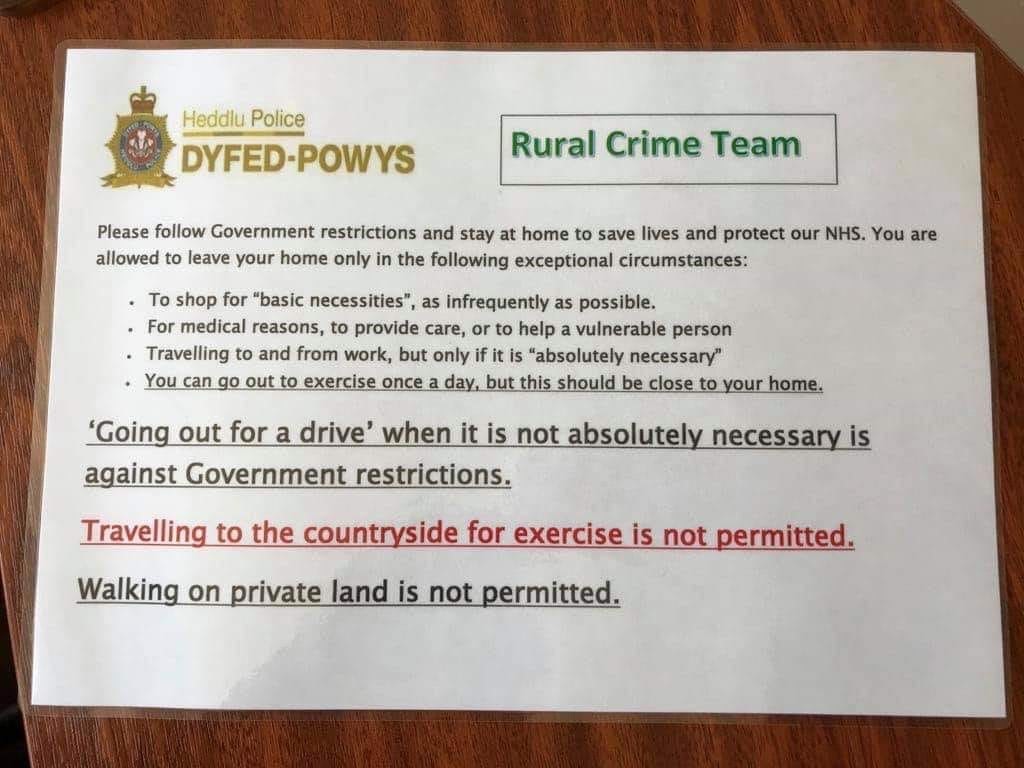
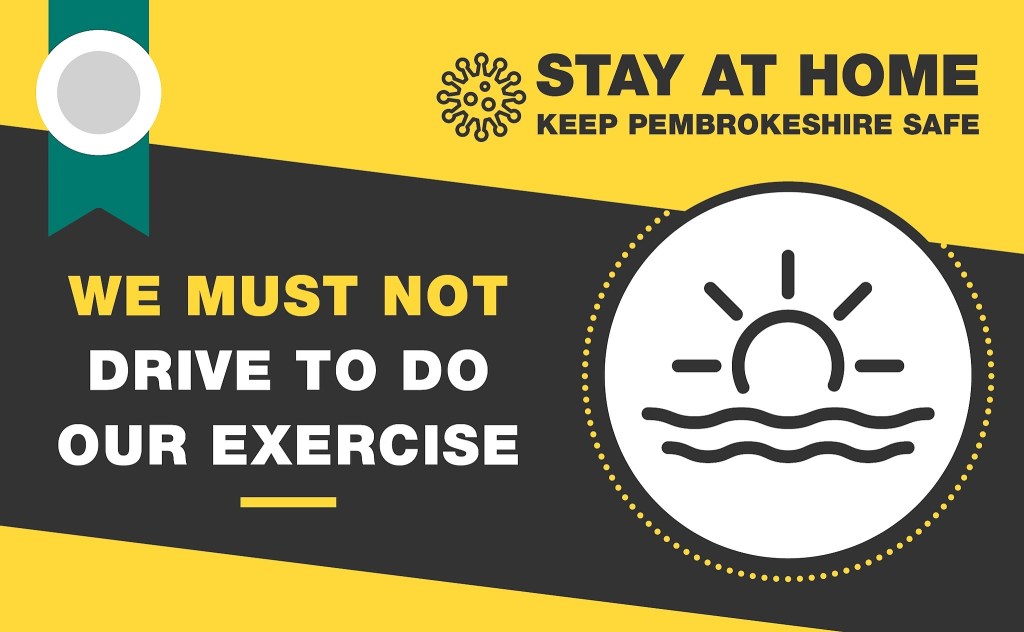
Enforcement messages were spread particularly over social media:
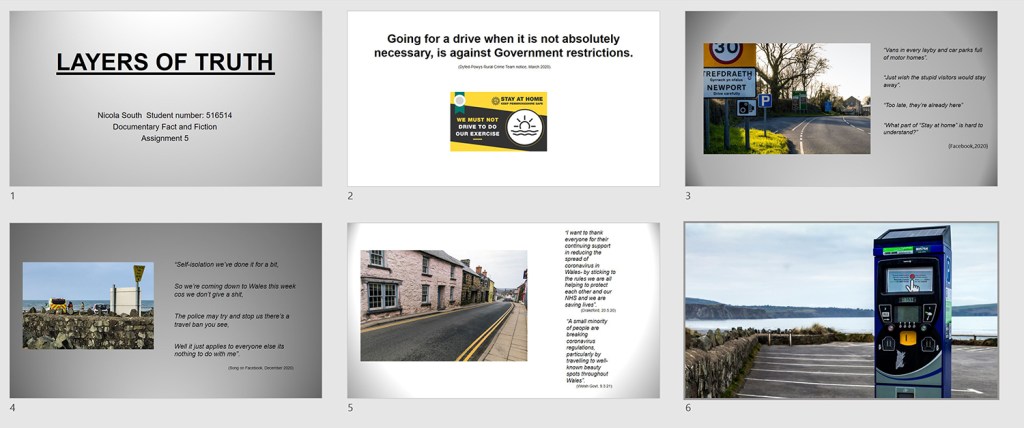
(DYFED-POWYS Rural crime team notice, 2020)
As were personal facebook messages:
“Caravans and campers going down the road from England like RAF stealth aircraft”
“Vans in every layby and car parks full of motor homes”
“So today has been rather busy in town, Much more traffic and people…What is it tourist and second-home owning refuges don’t understand about this?”
However by the spring 2021 “lockdown” focused more on tourist taking recreational drives than on holiday makers staying in the area.
Coastal car parks at beauty spots remain closed: Movement is restricted to your local area. Alert Level 4 in Wales means that even us locals cannot drive to our favourite spots for exercise. We can exercise outdoors but our exercise must start and end at home. Thank you. (Pembrokeshire County Council, 2021).
Mark Drakeford the first minister of Wales said in a press conference “I want to thank everyone for their continuing support in reducing the spread of coronavirus in Wales – by sticking to the rules, we are all helping to protect each other and our NHS and we are saving lives”. (Drakeford, 2020). And has been generally positive that people have been abiding the temporary rules. During the lockdown in 2021 there has still been some local “noise” about tourists visiting but less so. This shift a year into the pandemic I believe was caused by, holiday makers understanding restrictions and not attempting to stay in holiday accommodation, and by the local residents realising that those infringements were in fact rare.
SECOND HOME OWNERS TRAVELLING TO PEMBROKESHIRE DURING LOCKDOWNS AND AFTERWARDS.
In Newport tensions ran high and their feelings and facebook posts made it to the the local then the national press in March 2020. Wales online reported at the beginning of March 2020, how in the early days of the coronavirus pandemic, locals painted messages on wooden boards:
“Your holiday, our lives – turn around” There was resentment and anger that second homeowners and holidaymakers were choosing to travel to self-isolate in the countryside (Clements,2020).
This was then reported in the national press, ‘Total stupidity’: Welsh town hits out at Londoners escaping to the country to avoid coronavirus’ (Clark, 2020). It was explained that as there are almost 4,000 second homes in Pembrokeshire, it could mean an additional 9,600 people living in an area with a high number of vulnerable elderly people, depending on a hospital ½ an hours drive away with only 7 intensive care beds and ventilators.
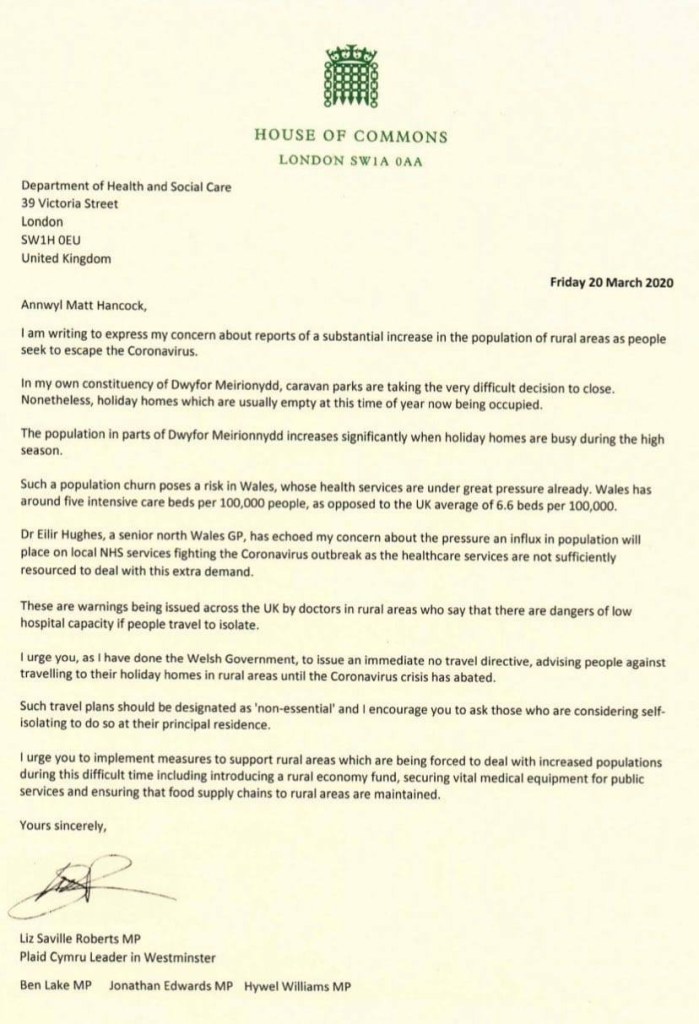
A local MP (Roberts, 2020) wrote to Matt Hancock, underlining that warnings are being issued across the UK by doctors in such rural areas, that there are dangers of low hospital capacity, as people travel to isolate, and asking the UK Government to issue a no travel directive:
(Saville Roberts, 2020)
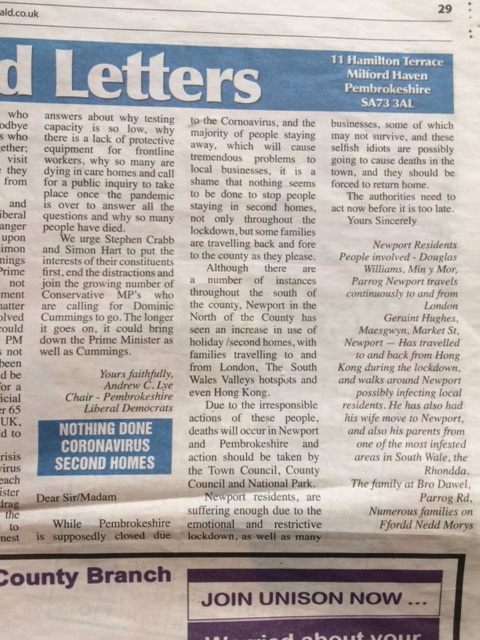
However as the Wales online article also described “in a small close-knit place like Pembrokeshire- everybody knows everybody else and visitors stick out like a sore thumb. But rural life is also renowned for vicious rumour”(Clements,2020).This played out when local residents wrote an anonymous letter to the local paper the Herald ‘We can’t cope with second-home owners’’ (Letters, 2020), naming names of those thought to be breaking the law.
There was also a letter published in the local paper the Western Telegraph:
“So, you can forgive me for being concerned about the number of people fleeing their contaminated cities and towns and seeking sanctuary in their second homes in Pembrokeshire. Don’t they realise that we lack the facilities to deal with such a sharp influx of possible contaminated people? I say ‘possibly contaminated’ because the vast majority of them will have not been tested for coronavirus.
They’ve seemed to have ignored the importance of self-isolating within their own communities, or perhaps they’re thinking that this policy doesn’t apply to the wealthy”.
Resident Trefdraeth
(Western Telegraph, 2020)
Following this the local authority carried out a programme of visits to 68 properties to establish whether the properties were breaking the Welsh Government rules. The Leader of Pembrokeshire County Council reported that 36% were found to be unoccupied, 54% were either the primary residence of the occupant or they were second homes in which the owners had taken up residence prior to the lockdown, and that only 5% (or3-4 houses) required follow up by the Public Protection Division (Newport Town Council, 2020). The Parish council responded in a statement by a County Councillor that: “A number of visits have been carried out in the Newport area but no Local Authority enforcement was required because they were either empty, occupied as a primary residence or they were occupied by second home owners who arrived before lockdown (a situation which is permitted by the regulations)” (Newport Town council, 2020). However reports of holiday businesses receiving visitors and second homes being occupied locally continued.
This placed a great strain on the relationship of the local population and the second home owners. In particular there was a tendency by the press to report infringements by the English, rather than by Welsh second home owners. There were also occasional frustrated murmurs from second home owners in 2020 that they were paying council tax and for services that they weren’t able to access.
(Facebook March 2020)
Tourism
Pembrokeshire visitor surveys show a marked increase in visitors between 2004 and 2011. The same data shows that the majority of visitors are from Wales (over 50%) and that less than 10 % are from the South East of England and London, see below:
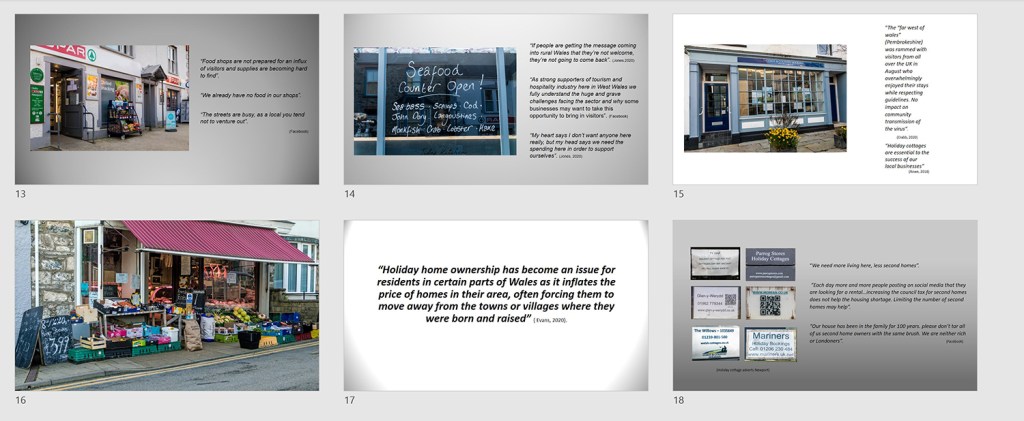
(Pembrokeshire coast national park authority, 2018)
There is no doubt about the dependence of Newport Pembrokeshire on tourism.
On its main street, the main road along the west coast of Wales in the space of ¼ of a mile there are 5 pubs and 5 restaurants, and many gift shops . To example the dependence of the local economy on tourism at Newport Boat Club, a members bar and sports club, 84% of its members are not local but returning holiday visitors, and it takes 56% of its annual takings in 3 months only (June to August). The local chemist that has a resident customer base and 80% NHS business still takes 33.5% of its business in those 3 summer months and even they say “to a degree we have become a seasonal business like the hospitality businesses, but it’s not such a steep tourism takings curve as bars and restaurant as they are protected by NHS work” (Mather, 2021).
There were varied social media postings during and after various lockdowns, reflecting both the dependence on tourism and the tensions caused by it:
“The consequences of an influx of tourists into West Wales is a serious risk that there will be an overwhelming, unnecessary pressure on our services and supply chains”.
“We are serving locals only. .. we ask that everyone who respects our fabulous community & businesses to please stay at home as were all doing”
“My heart says I don’t want anyone here really but my head says we need the spending here in order to support ourselves”
“Thank you to all our loyal customers who supported the small businesses here, we couldn’t have got through these difficult months without you”
“As strong supporters of tourism and hospitality industry here in West Wales we fully understand the huge and grave challenges facing the sector and why some businesses may want to take this opportunity to bring in visitors at this time”
“If visitors don’t feel welcome they’ll not come back, we need to be careful not to undermine the economy we have here in rural Wales”
“We can’t wait to catch up with our customers and welcome new ones”
Second homes
Pembrokeshire is also a mecca for people owning second homes for holiday.
3% of second homes in the UK are in Pembrokeshire (Reuben, 2015). This amounts to approximately 3,600 in Pembrokeshire (Sinclair, 2021). This does not include the static caravans in holiday parks of which there must be thousands, though I have found it impossible to obtain data on the quantity of their ownership. Many of these are second homes but are not rated as so by the council so do not appear on the statistics. It should be noted also that anecdotal information points to them being predominantly owned by Welsh people and rarely by English. Even without this 37% of houses in Newport Pembrokeshire are second homes “Rowe, 2018). Estimates do seem to vary however at the 2011 Census the Pembrokeshire Coast National Park has “one of the highest percentages of households with “no usual resident” in England & Wales. This is indicative of second residences or holiday homes” where there are 28% in the Pembrokeshire coastal National Park, 13% in Pembrokeshire, and only 6% across Wales.
There has been much both written and said about the impact of second homes on rural areas but the following are widely acknowledged:
Advantages:
Holiday cottages “are essential to the success of local businesses… A huge number of local companies and livelihoods depend on the tourism trade”.
“They give work to builders and to people employed by the properties”.
Regeneration – “Old historic homes can be a bit of a burden if they are just owner occupied” they tend to be more renovated as second homes/holiday lets.
Price out local people- Only 8% of affordable housing stock is in rural areas. Second home owners tend to have significant resources so are happy to pay the premiums. Holiday lets are popular and this pushes prices up.
Disadvantages:
Winter ghost towns, depopulating areas.
Younger populations leaving areas. (Rowe, 2018)
Local business are well aware of their dependence on tourist trade, “My heart is saying we don’t want people here, just to safeguard ourselves but my head says we need them here, we need people spending here in order to support the jobs of the people I employ at the moment“(Jones, 2020), “if people are getting the message coming into rural Wales that they’re not welcome, they’re not going to come back” (Woods, 2020).
HOUSING MARKET
Locals talk a lot about the impact of second home ownership on the housing market, especially on face book:
“English people are driving the prices up”
“We need more living here, less second homes”
“I would like to see more affordable homes to buy”
“Each day more and more people posting on social media that they are looking for a rental… increasing the council tax for second homes does not help the housing shortage. Limiting the number of second homes may help”
“Don’t go buying a home which prevents a young local person/family from getting one, like so often happens”
“These people drive up the prices of houses”.
House prices are comparatively high in Newport, consistently higher than Pembrokeshire as a whole and Wales. Comparing them to Crymch a town just 11 miles inland these are the average sold prices 2019:
Newport: detatched 370K semi-detatched 225k Terraced 340 k
Crymch: ‘’ 208K ‘’ 137K ‘’ 125K (Jones, 2020)
Median house prices in June 2020 for these and Fishguard (a coastal town 13 miles south) are:
Rental stock is much lower in Pembrokeshire generally than in Wales:
Wales: 70% owner occupied, 15% privately rented, 10% Social rentals, 6% rental local authorities
Pembrokeshire: 87% Owner and private rentals, 10% social housing 5% LA (Welsh Government, 2019). And “commitments to affordable housing have been low” (Pembrokeshire coast national park authority, 2018), though it must be remembered that local authorities set their own thresholds for affordable housing.
Various measures have been put in place in the UK with similar housing problems caused by tourism.
An additional 3% stamp duty is taken on second homes across the UK to try to dampen the demand for second homes. In St Ives where in 2016 25% of properties were second homes it was ruled that new homes should be reserved for full time residents, and housebuilding has continued without the incentive to build second homes and holiday lets (Rowe, 2018). Lynton and Lynmouth new builds have to be affordable to local people and if sold on the open market they must be primary residences. It has also been suggested that planning permission should be required for change of use from a house to a holiday let.
In Pembrokeshire the council tax has for some time applied a 50% surcharge on second homes.
This has now been doubled to 100% surcharge, which on the 3,600 second homes in Pembrokeshire it is said will net £4m (Sinclair, 2021). This second home funding does give a boost to local causes such as Age Cymru outreach services, and volunteering support. Last year Newport town council reported it would receive grants for community projects of £13,000 (Philips, 2020). I learnt at a local meeting about ECO housing that the extra taxes had been used to build affordable 18 houses in Solva Pembrokeshire.
Although some measures have been taken, there is no doubt that holiday home ownership has become an issue for residents inflates the price of homes in their area, often forcing them to move away from the towns or villages where they were born and raised. The suggestion of the Pembrokeshire Coast National Park data (2018) is that the migration from the area of the 15-30 age group who predominantly move out of Pembrokeshire might be driven by educational, employment or cultural opportunities available outside Pembrokeshire. Whilst the Pembrokeshire migration of the over 30s which is mostly to the rest of Pembrokeshire is probably is motivated by difficulty in accessing appropriate housing within the national park (Pembrokeshire coast national park authority, 2018).
REFLECTIONS:
Having spent the first lockdown as a second home owner away from Newport and then the later lockdowns on Newport as a resident I believe I am in a unique position to see different perspectives to the tensions. I understand the attitudes of residents of this rural area particularly during the time of the pandemic when they may feel they are having their safety threatened by outsiders, however I do think they exaggerate any outsider’s infringements.
Local businesses are very aware that their livelihoods depend on the tourism and want a quick return to trading and opening once lockdowns are lifted, whilst many locals want the visitors to continue to stay away. I do think that many of the resident underestimate the breadth of the community’s reliance on tourism; that it extends beyond the money that the pubs and restaurants take, to the work there is for local trades people, and other service industries, particularly those supporting the many holiday rental houses. There is also a tendency to point the finger at the English visitors when the majority of visitors are actually Welsh. However there are some English visitors, who can when they visit not be as respectful as they should to the local community. Though they are few this exacerbates the tension.
Whilst the proportion of second home owners economically regenerates the area and the housing, it is true that they have pushed house prices up considerably. This means that youngsters find it impossible to buy in the Town, though often they chose to move out for work and a younger culture. The second homers pay a high price in taxes, which some resent as they are paying for services they may only use for a tenth of the year. However some of the various taxes on second home owners do go to local communities, it would be good if a high proportion of this is returned to the Town. Certainly more could be done to invest in rental and affordable housing for locals who want to stay or return here.
A sense of perspective is needed on both sides but this is especially hard to find when people are feeling vulnerable, as has been the case for the past year.
Woods (2020) cited in: Jones, T. G. (2020) ‘Coronavirus: Tourism tensions ‘could put industry at risk’’ In: BBC 19/08/2020 At: https://www.bbc.co.uk/news/uk-wales-53824412 (Accessed 10/03/2021).
Talk: David Levi Strauss with Duncan Wooldridge (online) The Photographer’s gallery. 7.12.20 (zoom)
I attended this zoom event before I knew that I would be reading his new book as research for my assignment 5. At the first time of reading I found it challenging and did not complete my reflection, knowing that I would have to return to it to understand it.
A few months on with more background reading, I find that I can read his book now with a better understanding, perhaps I just needed a purpose! I have now revisited the recording of the talk, made notes and reflected.
The event: David Levi Strauss was in conversation with photographer, writer and curator Duncan Wooldridge examining belief in the image.
My notes:
In his new book Photography and Belief Levi Strauss writes:
“Visual images become more like testimony than like perception… If we do not find a way to believe what we see in images, we lose the ability to act socially.”
This book came out of an essay that he wrote Co-illusion: Dispatches from the end of communication (2020), which was the precursor to this book, and a response to the Trump phenomenon. Levi Strauss describes it as essays on the present and how we believe and allow ourselves to be manipulated by them. He explains that being part of a process that has been going on for a long time, we tend not to question images:
Belief is a commitment, the beginning of a process of manipulation
We are manipulated by images as we think of images as self-evident so we don’t question them or our belief in them.
Belief is social, as it is dependent on belief by a large part of society – a common belief
It is empowering if you read images knowing the discourse behind them
When he talks of “magic” he is describing the agency created by our technological devices.
Levi Strauss talked of Flusser who wrote Towards a Philosophy of Photography in 1983 that introduced theories about changes in our communication environment. Fusser is concerned that these “apparatuses” will reduce freedom and points to experimental photographers who he says play against the camera.
Much of the interview discussed his book co-illusion (Strauss, 2020) in which he describes how he adopts languages of power to reveal how they speak to the image. Here he Looks at the changes in our communications environment and how that allowed the political dangers that he talks about in the USA, as critical views have been reduced and even how political events can now be set up for the camera. Levi- Strauss call this closing down of questioning very dangerous.
An idea that came out in the Q&A session was on image production and dissemination: Does the photographer need to announce their active part in the work before an image can be read? To which Levi Stauss agreed as he did to the suggestion that ultimately it is the way that the viewer acts that’s important.
Even the second time of viewing I find the talk material challenging, so I will return to his book Photography and Belief to increase my understanding of his ideas.
Having taken time to digest these readings, it seems that the documentary photography that I took at more so at face value at the beginning of this course, is becoming less and less trustworthy or certainly pure. And that is without even a photographer, curator or editor’s intention, all of which I have also become more aware of. Images are definitely open to those who want to take charge of them (Campany,2020:8).This is especially so in our digital and post photographic age.
There also seems to be a theme that there must be some belief in the truth of photographs or they lose their value. Therefore it is important to have some transparency in those with power over the meaning, photographer, editor, publisher, curator. It is also important that viewers ask questions of the image whilst reading it, as ultimately an image has no meaning without a spectator. Certainly a photograph can only be a representation of reality not reality itself.
The cultural and political space of the photograph has also been made clear to me, as have the many ways that people can take power over an image. Whether images can move above these influences I will need to investigate, watch and see. As Batchen (1999) says whilst its vital that we determine the difference between reality and representation we also need to save its indexical (contextual) relationship with reality otherwise it simply becomes another sign.
In the meantime I intend to explore the various layers of truth that photographs may contain, and as Bogre suggests different times of truths possibly,and how I might use them in my own work, bytaking some of this forwards into my proposal for assignment 5 “layers of Truth”: https://nkssite5.photo.blog/2021/04/09/assignment-5-draft-proposal/
Additional references:
Batchen, G. (1999) Burning with Desire: The Conception of Photography. MIT Press.
Campany, D. (2020) On Photographs. London: Thames and Hudson
Bogre explores throughout her book what truth is and how it came to be “chained” to documentary. She points out that there are various types of truths, moral, material, truth of impression and truth of form (Bogre, 2019:28).
She asks how documentary photography can relate to the truth when it is only a representation and therefore can only be a part of the truth? She quotes Stephen Mayes who says “Factual images have always been used to tell lies”.
Bogres underlines that we understand that a photograph is not reality, but is a representation of reality, part captured in the moment and the rest supplied by the photographer. They are a “decontextualised representation of reality recorded by a subjective human being”, who makes choices before, during and after taking them (Bogre, 2019:58). Such a representation always involves a mediation and transformation, a telling of the truth as the photographer sees it.
She suggests that photographs may be best thought of as an expanded notion of the truth and having various layers, actual, indexical, situational, or universal (Bogre, 2019:58):
Actual: accurate facts
Indexical: accurate detail
Situational: accurate situation
Universal: accurate in its transferrable universal meaning
I agree with Bogre’s premise that photographs still have evidential status even though there is the knowledge that they can manipulated. Courts use photographs as evidence and juries believe in them, even though it is acknowledged that a photographs “truth” can be challenged. Every image has been processed.
The truth of an image is also dependent on the relationship between the photograph and the viewer, as the viewer will also project their imagination. She sets out a covenant of trust between viewer and photograph that “imposes on the documentary photographer layers of responsibility and accountability” (Bogre, 2019:121).
At that time she made me really consider trust, and whose truth is in an image; I am well aware now that
“There is a difference between what is shown in the image and what is shown by the image” (Bogre, 2019:128).
What has been interesting for me reading her book is to delve deeper into the various layers of truth that may exist in an image, especially in this age of digital photography. Bogre actually prompts us to think whether a digital photograph is a photograph or should it have a new term? Should we have new rules for documentary photography now that we have control over instantaneous capturing unlike earlier periods – this would help us to confirm truths. In her webinar (AOP, 2020) she helpfully suggests that there might be a difference between “True and truth, between the truth and a truth”, this gives me more rabbit holes to disappear down as I research!
David Levi Strauss interrogates the concept that “seeing is believing”. He suggests the proverb “Seeing is Believing” dates back to 1609 and is of an Anglo-Saxon origin, “to believe is to hold dear“; I’d not thought about its origin before. His definition of belief is a “strong agreement of the intellect, but the intervention of the will is always required to convince the intellect to agree.” (Levi Strauss, 2020:11).
In chapter 2 he considers various theories of truth in photography.
He shares that:
Walter Benjamin suggested that early surrealist photography enabled a politically schooled gaze, where details are illuminated and “signalled a shift to a blasphemous belief in the thing itself”.
Berger however suggests that in late capitalism all that exist becomes quantifiable both because it can be reduced to a statistical fact and a commodity. Berger said that photographs are said to be truthful as there is no distinction made between them as scientific evidence and as a means of communication. He says that this isn’t an oversight but a proposal “when something is visible, it is a fact, and that facts contain the only truth”. Apparently Berger distinguishes between what the eye sees and the camera records, a photograph quotes from an appearance but may not tell us the truth; this he calls a half-language of appearance as there is expectation of further meaning to follow – I like this description.
Barthes, states that the essence of photography is the belief that something has existed, and therefore it is a copy of a past reality.
Levi Strauss cites indexicality as one of the main bases for the claim of photography to be true. The term comes from Charles Sanders Peirce’s semiotic theory of the 3 ways a sign may stand for it’s object: as an existential connection (indexical), a likeness (inconic) or a habit/law (symbolic). However Levi Strauss points out that others suggest that the photograph cannot speak for itself as it has no language, and therefore relies on others to say things about it.
Levi Strauss suggests that to understand why we believe photographic images in the way that we do we should look to the past, before “technical” images were invented and old “image-beliefs” were transferred onto them. A key to this is what some call a sense of magic or a science of the imaginary and the connection between this thought of magic and technology.
Ultimately Levi Strauss explains that because he believes in photographs doesn’t mean that he is gullible or uncritical about them; he describes himself as realist like Barthes, who takes the photograph not as copy of reality but as a copy of a past reality. He points out that the consumption of images, due to technology, has changed. More images today are viewed by streaming flow than as singular images, so are seldom dwelled on or revisited. He also points to the increasing manipulation of technical images and the control there is over communication apparatuses that can give concentrated control over belief. Levi Strauss believes that reality is increasing “under siege” in technological, political and social terms. Also that our belief in technology has reduced our inclination to challenge what is presented.
Belief he says, is important for “the social” without which we lose the ability to act socially. We need images of the world to believe in it.
Reflections:
I think he is correct to look at the implications of technological change, (smart phones and the internet amongst them), on photographs and belief. Photographs have always been used to manipulate the truth and what we see, it is just the methods that keep changing. It does create a constant challenge to our belief in the image, but we need images and have to find a way to believe in them. I guess this will constantly shift over time, especially as images now shift from a singular trace to a flow.
I also agree with one of the final statements in the book, that it is vital to know the origins of an image, who made it and for what purpose. This has to be my starting point when looking for truth in an image.
I also enjoyed his collection of quotes at the end of the book on belief, such as: “The true mystery of the world is the visible” Oscar Wilde.
Barthes, R (1981) Camera Lucida:Reflections on Photography. Translated by Richard Howard. New York:Hill and Wang/Farrar, Struass and Giroux, 1981.
Benjamin, W (1999) Convolute Y [Photography]. In The Arcades Project pp671-692. Ranslated by Howard Eiland and Kevin McLaughlin. Cambridg, MA:Belknap Press of Harvard University Press 1999.
Berger, J (2013) Understanding a photograph. Edited and with an introduction by Geoff Dyer. New York: Aperture, 2013.
Strauss, D. L. (2020) Photography and Belief. David Zwirner Books.
The Disciplinary Frame: Photographic Truths and the Capture of Meaning- John Tagg (2009)
In this book Tagg asks how the meaning of a photograph becomes fixed and analyses the ways in which photography claims to be truthful evidence. He looks at the discourse surrounding photography and how the discipline of all that frames it keeps the photograph and viewers in place and determines it’s truthfulness.
He explains that during the 19th century it became obvious that a photograph can’t be viewed as “transparent”. Tag describes it as the image having no power of its own but is an instrument for those who have power, “the transparent reflection of a power outside itself” (Tagg, 2009:pxxix). Tagg points out that discursive formation is not a surrounding context or a frame, but that the effect of a photograph are made by the discursive formations of both the photograph and the apparatus of discipline. He shares arguments that shows that documentary value cannot be within a camera itself and its imagined access to the real, because of the institutions, discourses and systems of power which “sully” it (Tagg, 2009:pxxxii). Tagg calls this a mutation from “document” to “documentary”.
His first chapter follows the role of the photographic archive and the social regulatory uses of photography in the constitution of the modern Liberal State. He says that the State in this sense has a war logic of coercive force and instrumentalises culture promoting social inclusion and citizenship.
He proceeds through the documentary photographic work of the late 1920s and 1930s, John Grierson, and the Farm Security Administration (FSA). Here he describes how the paternalistic state and expressed itself in photography based on transparency. Tagg describes the then photographer’s moral burden to join the dignity of fact with the burden of truth; an “ethical contract between the citizen and the state as the form of our collective participation in that truth” (Tagg,2009:93). He then explores Walker Evan’s documentary photography work in the 1930s, where he finds his ambiguity, gives distance from its subject and power to that which creates the subject.
In his chapter Running and Dodging, 1943: The breakup of the documentary Moment, Tagg shows that the end of the FSA project, World War 2 and political changes which altered social groupings meant that the previous documentary “contract” lost its conditions. It seems that this negated the idea of the transparency of a photograph alone in representing a subject, as there was now a social transparency which through photography could be interpreted as visual and symbolically transparent (Tagg,2009:207).
Tagg refers to Foucalt who installed the evidentiary value of an image in disciplinary knowledge, however he insists that the meaning and power of photographs are due to the discursive effects of the regimes that produce them, for example historical, art, or documentary; “If Documentary documents anything, it is only a certain strategy of power and desire… If documentary captures anything, it is only a certain subject-subject to that strategy of power” (Tagg, 2009:94).
He also investigates Barthes idea that the inventions of photography and history were simultaneous and that history needs such a code to be a discourse. Tagg finds himself that whilst a photograph is a “certificate of presence” it doesn’t invent but authenticates, and history lacks authentication. He finds lots of paradoxes; a photograph is complete and finite and can authenticate history, yet it is “fleeting” as we can’t be sure of its duration.
Taggs final chapter explores elements of “the frame” as a discipline; discussing the image (the work itself), the frame (that which gives rise to the work), and the apparatus (Museum apparatus- art history). He looks at possible directions for continuing the 1970s project of New Art History and calls it “endless metacommentary” (Tagg, 2009:259). This metacommentary is where discursive practice is attached to the realm of the social and political. He ends by suggesting we should “strike against the frame” (Tagg, 2009:263).
Reflections:
I have previously read from John Tagg’s Essays on The Burden of Representation (1993). The corresponding essay for me in that book is Chapter 2 Evidence, Truth and Order: Photographic Records and the Growth of the State. Here he says that photographs are not evidence of history but that they are themselves historical (Tagg,1993:65) and interestingly suggests here that the way photography has been historically implicated in the technology pf power-knowledge should be studied. In that book Tagg also draws on semiotics, cultural debate and the work of others such as Foucault to reject photography as a “record of reality” and calls for an analysis of the part these representations played in social regulation.
In this book he like Sekula challenges the notion of photography as neutral but in particular Tagg insists that the meaning and power of photographs are due to the discursive effects of regimes such as history, art, or documentary.
References:
Tagg, J. (1993) The burden of representation: Essays on photographies and histories. Vol. 80. Minneapolis: U of Minnesota Press.
Tagg, J. (2009) The Disciplinary Frame: Photographic Truths and the Capture of Meaning. Minneapolis: University of Minnesota Press, 2009. 392 pp. ISBN 978—0816642885. Minneapolis: The university of Minnesota Press.
To develop a visual photographic response to this personal, and socio-political study. I would like to explore layers of truth, something that has interested me increasingly as I have progressed through the documentary course.
Allan Sekula “On Invention of Photographic Meaning” 1975
In this essay Sekula investigates the nature of photographic context and meaning, and is influenced by Roland Barthes and his need to understand the political uses for photography. This is my summary of his points:
Photographic discourse is an arena of information exchange which has its limits. This is not a neutral process, there are always interests at heart.
Every message embodies an argument that determines its semantic target.
Photographs are not complete utterances on their own, but are determined by context.
Photographic literacy is learned though it may appear natural.
He disputes the historical understanding that a photograph represents the truth.
Barthes refers to the denotative and connotive (cultural meaning) function of photographs, but Sekula says the two cannot be separated.
In defining in historical terms the relationship between photography and high art Sekula examines 2 well known photographs Immigrants going down the gangplank (Hine,1905) and The Steerage (Stieglitz, 1907) but concludes that it is impossible to read them neutrally.
Barthes says that the photograph standing alone presents only the possibility of meaning, however Sekula says “Any given photograph is conceivably open to appropriation by a range of text” (p457)
There are “magical” powers to images that can transcend the visible and informative powers of photographs.
A photographs informative functions are grounded in empiricism, a contextually related object or event.
The invention of photography as high art is grounded in the rhetoric of romanticism and symbolism.
Baudelaire and Minor White suggest that a photograph reduced to tones, a gray scale, is a “phonological carrier system for vague prelinguistic scale of affect” (p467), or an equivalent. I researched this for my Landscape assignments 4 and 5 where I found this view of photography as a range of tones to form equivalents inspiring.
A caption can reinforce a message but will still depend on the photographer to be honest in his capturing of the image as well as the caption.
There is a symbolist folk-myth and a realist folk-myth, or art photography versus documentary photography. Every photograph in a given context will lean towards one of these poles of meaning: Seer v witness, photography as expression v photography as reportage, imagination v empirical truth, affective value v informative value, and metaphoric signification v metonymic (associative) signification p472
Don’t confuse liberal/concerned documentary with realism, there will always be underlying expressionism. p472
Reflection:
Reading this has further challenged any thoughts I may have that a photograph is neutral. Whilst we might think of photographs as documents, there will always be a sign or message within the image and that is outside of a caption or supporting text. A photograph will always relate to reality through its discourse. I refer back to my research on part 2 of this Documentary course where I read that Sekula elevates documentary to Art when it “transcends its reference to the world” by becoming self-expressive. Therefore documentary photographs are are charged with cultural social historical and political meaning, context.
Reference:
Sekula, A. (1982) “On the invention of photgraphic meaning” In: Burgin V.(eds.) Thinking Photography. Communications and culture. Palgrave, London.






 Photography 2: Documentary