Research Assignment 5
Though my research has been during the coronavirus year 2020-2021, I don’t intend the work to focus on this; the research highlights local/societal/nationalist issues that exist normally, such as the economy, resources, housing, tourism, and hospitality businesses.
I have collected information on topics relating to tensions caused by visitors to my local area (both relevant to the coronavirus pandemic and outside of it) using social media, government web sites and publications, news reports and local sources.
Context:
Newport (Tredraeth), is a small bustling town located in the county of Pembrokeshire Wales in the Pembrokeshire Coastal Park. It is on the coast, under the shelter of a mountain, on the mouth of a river and has sailing and boating facilities and moorings by the old harbour as well as a very large sandy beach, which attracts people from far away. Though officially a town it is the size of a village, with a population of only just over 1000.
TRAVELLING TO BEAUTY SPOTS:
In the first lockdown of spring 2020 there was strong emotion locally as residents felt that tourists were ignoring the pandemic travel restrictions, disrespecting local communities.
This was a theme that continued in the later lockdowns and into 2021. Face book posts such as “So today has been rather busy in town, much more traffic and people…What is it tourist and second-home owning refuges don’t understand about this?, were prevalent (Face book, April 2020). The local and national press reported widely, for instance:
“On the Easter bank holiday weekend, police and officers from Pembrokeshire Council stopped 1,660 vehicles and issued 39 fixed penalty notices to people who had left their homes without a reasonable excuse”. (Clements, 2020).
Though the Welsh Government repeatedly increased fines for lockdown breaches in Wales, they said:
“Evidence from the four police forces show a small minority of people are breaking the coronavirus regulations, particularly by traveling to well-known beauty spots throughout Wales” (Welsh Government,2020).
Enforcement messages were spread particularly over social media:
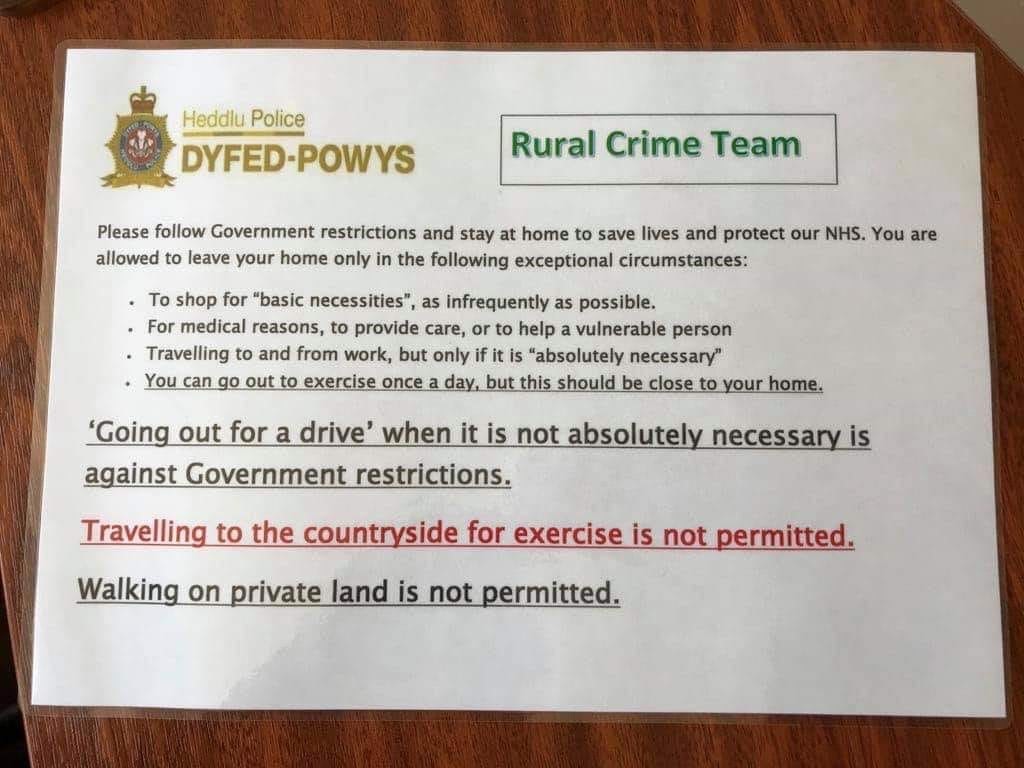
As were personal facebook messages:
“Caravans and campers going down the road from England like RAF stealth aircraft”
“Vans in every layby and car parks full of motor homes”
“So today has been rather busy in town, Much more traffic and people…What is it tourist and second-home owning refuges don’t understand about this?”
However by the spring 2021 “lockdown” focused more on tourist taking recreational drives than on holiday makers staying in the area.
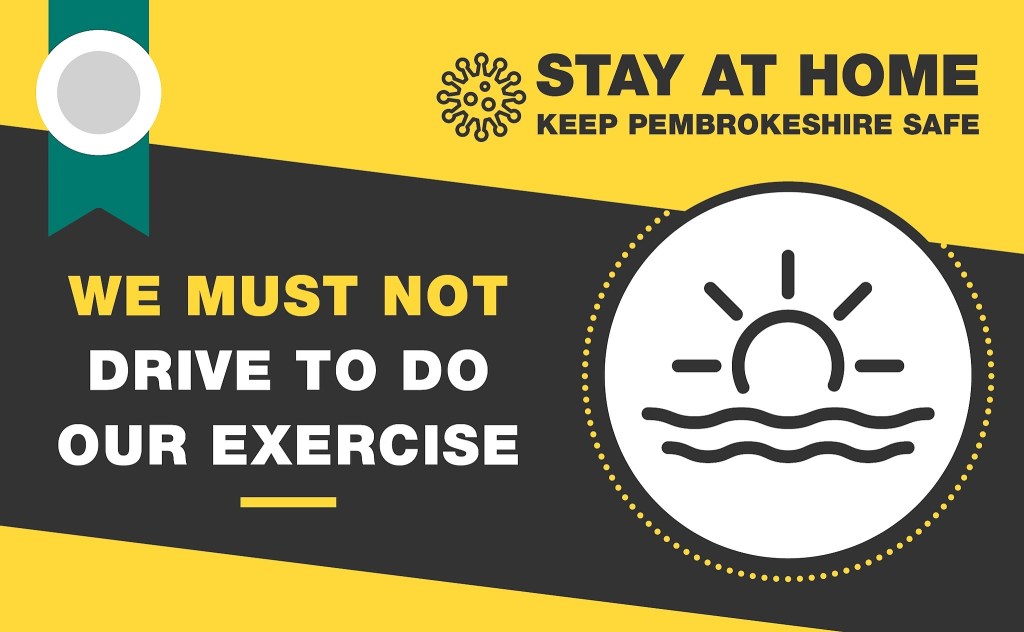
Coastal car parks at beauty spots remain closed: Movement is restricted to your local area. Alert Level 4 in Wales means that even us locals cannot drive to our favourite spots for exercise. We can exercise outdoors but our exercise must start and end at home. Thank you. (Pembrokeshire County Council, 2021).
Mark Drakeford the first minister of Wales said in a press conference “I want to thank everyone for their continuing support in reducing the spread of coronavirus in Wales – by sticking to the rules, we are all helping to protect each other and our NHS and we are saving lives”. (Drakeford, 2020). And has been generally positive that people have been abiding the temporary rules. During the lockdown in 2021 there has still been some local “noise” about tourists visiting but less so. This shift a year into the pandemic I believe was caused by, holiday makers understanding restrictions and not attempting to stay in holiday accommodation, and by the local residents realising that those infringements were in fact rare.
SECOND HOME OWNERS TRAVELLING TO PEMBROKESHIRE DURING LOCKDOWNS AND AFTERWARDS.
In Newport tensions ran high and their feelings and facebook posts made it to the the local then the national press in March 2020. Wales online reported at the beginning of March 2020, how in the early days of the coronavirus pandemic, locals painted messages on wooden boards:
“Your holiday, our lives – turn around” There was resentment and anger that second homeowners and holidaymakers were choosing to travel to self-isolate in the countryside (Clements,2020).

This was then reported in the national press, ‘Total stupidity’: Welsh town hits out at Londoners escaping to the country to avoid coronavirus’ (Clark, 2020). It was explained that as there are almost 4,000 second homes in Pembrokeshire, it could mean an additional 9,600 people living in an area with a high number of vulnerable elderly people, depending on a hospital ½ an hours drive away with only 7 intensive care beds and ventilators.
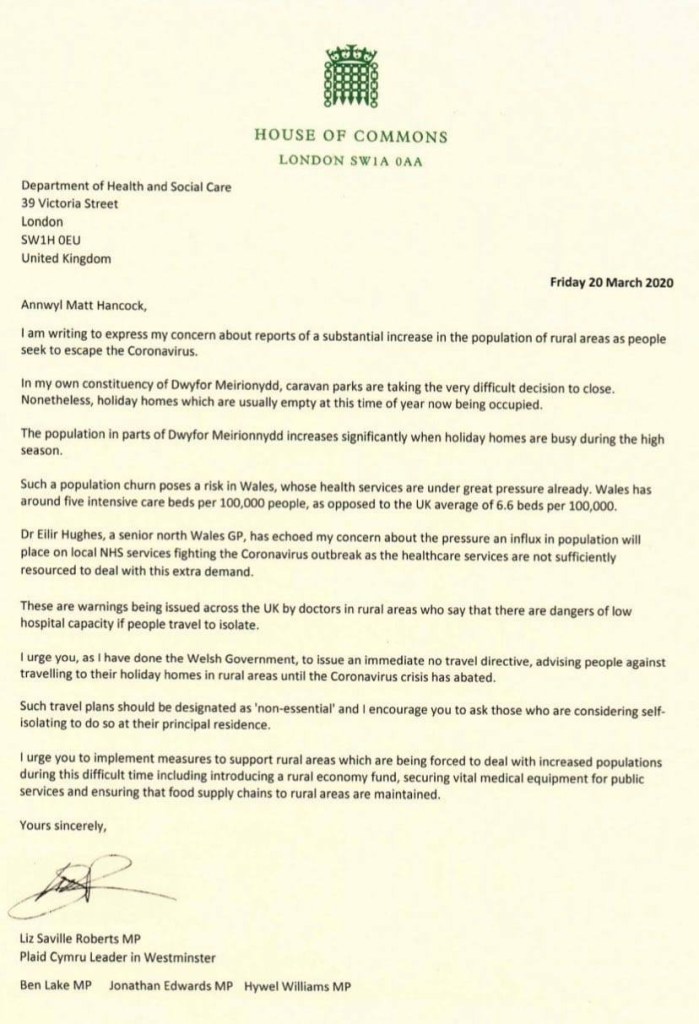
A local MP (Roberts, 2020) wrote to Matt Hancock, underlining that warnings are being issued across the UK by doctors in such rural areas, that there are dangers of low hospital capacity, as people travel to isolate, and asking the UK Government to issue a no travel directive:
However as the Wales online article also described “in a small close-knit place like Pembrokeshire- everybody knows everybody else and visitors stick out like a sore thumb. But rural life is also renowned for vicious rumour” (Clements,2020).This played out when local residents wrote an anonymous letter to the local paper the Herald ‘We can’t cope with second-home owners’’ (Letters, 2020), naming names of those thought to be breaking the law.
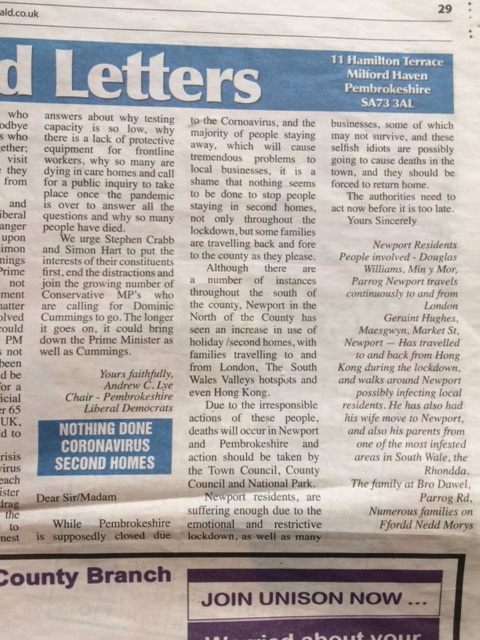
There was also a letter published in the local paper the Western Telegraph:
“So, you can forgive me for being concerned about the number of people fleeing their contaminated cities and towns and seeking sanctuary in their second homes in Pembrokeshire. Don’t they realise that we lack the facilities to deal with such a sharp influx of possible contaminated people? I say ‘possibly contaminated’ because the vast majority of them will have not been tested for coronavirus.
They’ve seemed to have ignored the importance of self-isolating within their own communities, or perhaps they’re thinking that this policy doesn’t apply to the wealthy”.
Resident Trefdraeth
(Western Telegraph, 2020)
Following this the local authority carried out a programme of visits to 68 properties to establish whether the properties were breaking the Welsh Government rules. The Leader of Pembrokeshire County Council reported that 36% were found to be unoccupied, 54% were either the primary residence of the occupant or they were second homes in which the owners had taken up residence prior to the lockdown, and that only 5% (or3-4 houses) required follow up by the Public Protection Division (Newport Town Council, 2020). The Parish council responded in a statement by a County Councillor that: “A number of visits have been carried out in the Newport area but no Local Authority enforcement was required because they were either empty, occupied as a primary residence or they were occupied by second home owners who arrived before lockdown (a situation which is permitted by the regulations)” (Newport Town council, 2020). However reports of holiday businesses receiving visitors and second homes being occupied locally continued.
This placed a great strain on the relationship of the local population and the second home owners. In particular there was a tendency by the press to report infringements by the English, rather than by Welsh second home owners. There were also occasional frustrated murmurs from second home owners in 2020 that they were paying council tax and for services that they weren’t able to access.

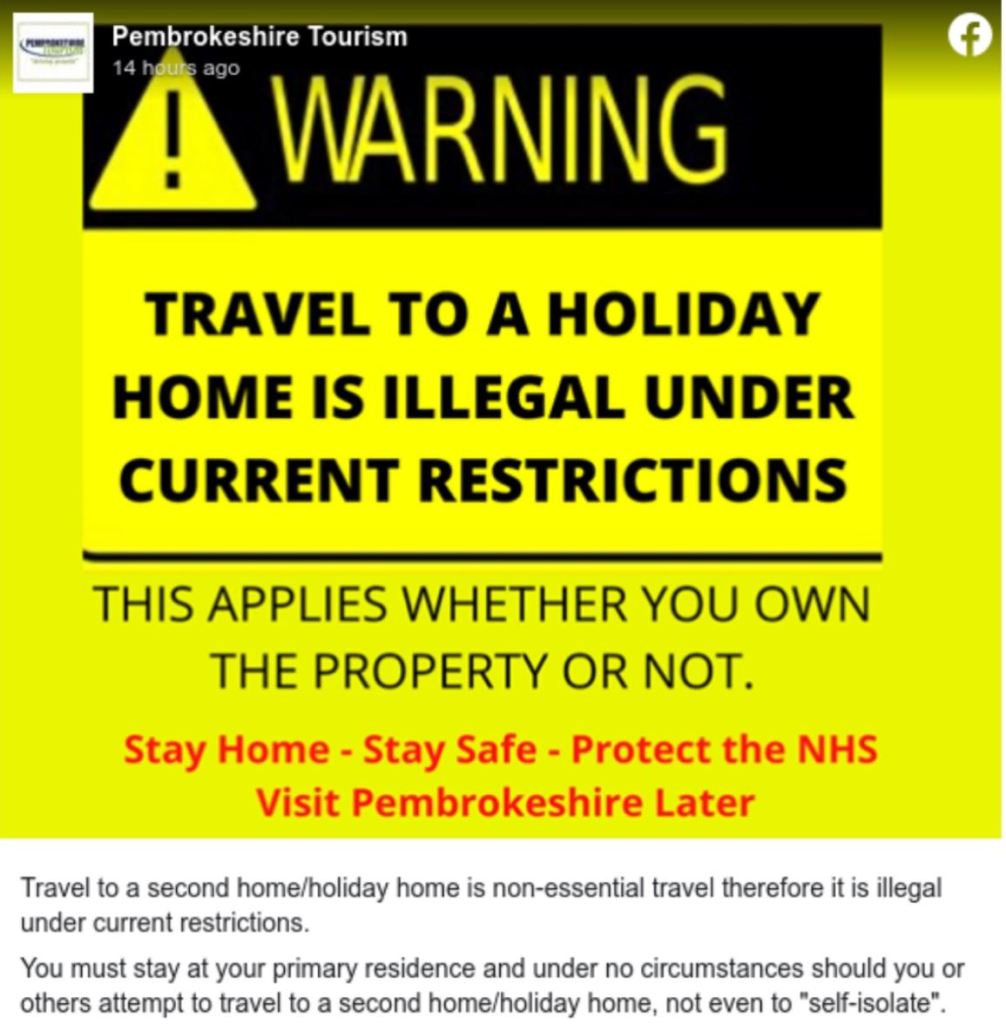
(Facebook March 2020)
Tourism
Pembrokeshire visitor surveys show a marked increase in visitors between 2004 and 2011. The same data shows that the majority of visitors are from Wales (over 50%) and that less than 10 % are from the South East of England and London, see below:

There is no doubt about the dependence of Newport Pembrokeshire on tourism.
On its main street, the main road along the west coast of Wales in the space of ¼ of a mile there are 5 pubs and 5 restaurants, and many gift shops . To example the dependence of the local economy on tourism at Newport Boat Club, a members bar and sports club, 84% of its members are not local but returning holiday visitors, and it takes 56% of its annual takings in 3 months only (June to August). The local chemist that has a resident customer base and 80% NHS business still takes 33.5% of its business in those 3 summer months and even they say “to a degree we have become a seasonal business like the hospitality businesses, but it’s not such a steep tourism takings curve as bars and restaurant as they are protected by NHS work” (Mather, 2021).
There were varied social media postings during and after various lockdowns, reflecting both the dependence on tourism and the tensions caused by it:
“The consequences of an influx of tourists into West Wales is a serious risk that there will be an overwhelming, unnecessary pressure on our services and supply chains”.
“We are serving locals only. .. we ask that everyone who respects our fabulous community & businesses to please stay at home as were all doing”
“My heart says I don’t want anyone here really but my head says we need the spending here in order to support ourselves”
“Thank you to all our loyal customers who supported the small businesses here, we couldn’t have got through these difficult months without you”
“As strong supporters of tourism and hospitality industry here in West Wales we fully understand the huge and grave challenges facing the sector and why some businesses may want to take this opportunity to bring in visitors at this time”
“If visitors don’t feel welcome they’ll not come back, we need to be careful not to undermine the economy we have here in rural Wales”
“We can’t wait to catch up with our customers and welcome new ones”
Second homes
Pembrokeshire is also a mecca for people owning second homes for holiday.
3% of second homes in the UK are in Pembrokeshire (Reuben, 2015). This amounts to approximately 3,600 in Pembrokeshire (Sinclair, 2021). This does not include the static caravans in holiday parks of which there must be thousands, though I have found it impossible to obtain data on the quantity of their ownership. Many of these are second homes but are not rated as so by the council so do not appear on the statistics. It should be noted also that anecdotal information points to them being predominantly owned by Welsh people and rarely by English. Even without this 37% of houses in Newport Pembrokeshire are second homes “Rowe, 2018). Estimates do seem to vary however at the 2011 Census the Pembrokeshire Coast National Park has “one of the highest percentages of households with “no usual resident” in England & Wales. This is indicative of second residences or holiday homes” where there are 28% in the Pembrokeshire coastal National Park, 13% in Pembrokeshire, and only 6% across Wales.
There has been much both written and said about the impact of second homes on rural areas but the following are widely acknowledged:
Advantages:
- Holiday cottages “are essential to the success of local businesses… A huge number of local companies and livelihoods depend on the tourism trade”.
- “They give work to builders and to people employed by the properties”.
- Regeneration – “Old historic homes can be a bit of a burden if they are just owner occupied” they tend to be more renovated as second homes/holiday lets.
- Price out local people- Only 8% of affordable housing stock is in rural areas. Second home owners tend to have significant resources so are happy to pay the premiums. Holiday lets are popular and this pushes prices up.
Disadvantages:
- Winter ghost towns, depopulating areas.
- Younger populations leaving areas. (Rowe, 2018)
Local business are well aware of their dependence on tourist trade, “My heart is saying we don’t want people here, just to safeguard ourselves but my head says we need them here, we need people spending here in order to support the jobs of the people I employ at the moment“(Jones, 2020), “if people are getting the message coming into rural Wales that they’re not welcome, they’re not going to come back” (Woods, 2020).
HOUSING MARKET
Locals talk a lot about the impact of second home ownership on the housing market, especially on face book:
“English people are driving the prices up”
“We need more living here, less second homes”
“I would like to see more affordable homes to buy”
“Each day more and more people posting on social media that they are looking for a rental… increasing the council tax for second homes does not help the housing shortage. Limiting the number of second homes may help”
“Don’t go buying a home which prevents a young local person/family from getting one, like so often happens”
“These people drive up the prices of houses”.
House prices are comparatively high in Newport, consistently higher than Pembrokeshire as a whole and Wales. Comparing them to Crymch a town just 11 miles inland these are the average sold prices 2019:
Newport: detatched 370K semi-detatched 225k Terraced 340 k
Crymch: ‘’ 208K ‘’ 137K ‘’ 125K (Jones, 2020)
Median house prices in June 2020 for these and Fishguard (a coastal town 13 miles south) are:
Newport £350K Crymych £182K Fishguard £170K (Jones, 2020).
Rental stock is much lower in Pembrokeshire generally than in Wales:
Wales: 70% owner occupied, 15% privately rented, 10% Social rentals, 6% rental local authorities
Pembrokeshire: 87% Owner and private rentals, 10% social housing 5% LA (Welsh Government, 2019). And “commitments to affordable housing have been low” (Pembrokeshire coast national park authority, 2018), though it must be remembered that local authorities set their own thresholds for affordable housing.
Various measures have been put in place in the UK with similar housing problems caused by tourism.
An additional 3% stamp duty is taken on second homes across the UK to try to dampen the demand for second homes. In St Ives where in 2016 25% of properties were second homes it was ruled that new homes should be reserved for full time residents, and housebuilding has continued without the incentive to build second homes and holiday lets (Rowe, 2018). Lynton and Lynmouth new builds have to be affordable to local people and if sold on the open market they must be primary residences. It has also been suggested that planning permission should be required for change of use from a house to a holiday let.
In Pembrokeshire the council tax has for some time applied a 50% surcharge on second homes.
This has now been doubled to 100% surcharge, which on the 3,600 second homes in Pembrokeshire it is said will net £4m (Sinclair, 2021). This second home funding does give a boost to local causes such as Age Cymru outreach services, and volunteering support. Last year Newport town council reported it would receive grants for community projects of £13,000 (Philips, 2020). I learnt at a local meeting about ECO housing that the extra taxes had been used to build affordable 18 houses in Solva Pembrokeshire.
Although some measures have been taken, there is no doubt that holiday home ownership has become an issue for residents inflates the price of homes in their area, often forcing them to move away from the towns or villages where they were born and raised. The suggestion of the Pembrokeshire Coast National Park data (2018) is that the migration from the area of the 15-30 age group who predominantly move out of Pembrokeshire might be driven by educational, employment or cultural opportunities available outside Pembrokeshire. Whilst the Pembrokeshire migration of the over 30s which is mostly to the rest of Pembrokeshire is probably is motivated by difficulty in accessing appropriate housing within the national park (Pembrokeshire coast national park authority, 2018).
REFLECTIONS:
Having spent the first lockdown as a second home owner away from Newport and then the later lockdowns on Newport as a resident I believe I am in a unique position to see different perspectives to the tensions. I understand the attitudes of residents of this rural area particularly during the time of the pandemic when they may feel they are having their safety threatened by outsiders, however I do think they exaggerate any outsider’s infringements.
Local businesses are very aware that their livelihoods depend on the tourism and want a quick return to trading and opening once lockdowns are lifted, whilst many locals want the visitors to continue to stay away. I do think that many of the resident underestimate the breadth of the community’s reliance on tourism; that it extends beyond the money that the pubs and restaurants take, to the work there is for local trades people, and other service industries, particularly those supporting the many holiday rental houses. There is also a tendency to point the finger at the English visitors when the majority of visitors are actually Welsh. However there are some English visitors, who can when they visit not be as respectful as they should to the local community. Though they are few this exacerbates the tension.
Whilst the proportion of second home owners economically regenerates the area and the housing, it is true that they have pushed house prices up considerably. This means that youngsters find it impossible to buy in the Town, though often they chose to move out for work and a younger culture. The second homers pay a high price in taxes, which some resent as they are paying for services they may only use for a tenth of the year. However some of the various taxes on second home owners do go to local communities, it would be good if a high proportion of this is returned to the Town. Certainly more could be done to invest in rental and affordable housing for locals who want to stay or return here.
A sense of perspective is needed on both sides but this is especially hard to find when people are feeling vulnerable, as has been the case for the past year.
References:
Clark, E. (2020) ‘‘Total stupidity’: Welsh town hits out at Londoners escaping to the country to avoid coronavirus’ In: The Independent 23/03/2020 At: https://www.independent.co.uk/news/uk/home-news/coronavirus-london-countryside-lockdown-locals-wales-pembrokeshire-a9418696.html (Accessed 09/03/2021).
Clements, L. (2020) The smouldering anger in West Wales as second home owners keep coming from Nottingham, Manchester, London and Glasgow. At: https://www.walesonline.co.uk/news/wales-news/people-caught-travelling-second-homes-18161506 (Accessed 06/03/2021).
Drakeford, M (2020) Welsh Government Press release. Fines increased for repeat coronavirus lockdown breaches in Wales (2020) At: https://gov.wales/fines-increased-repeat-coronavirus-lockdown-breaches-wales (Accessed 10/03/2021). 20.5.20
Jones, N. (2020) House price statistics for small areas in England and Wales – Office for National Statistics. At: https://www.ons.gov.uk/peoplepopulationandcommunity/housing/bulletins/housepricestatisticsforsmallareas/yearendingjune2020 (Accessed 08/03/2021).
Newport Town Council (2020) Town Council Information. At: https://www.newport-pembs.co.uk/newport-town-council/ (Accessed 06/03/2021).
Pembrokeshire coast national park authority (2018) ‘Replacement local development plan Sustainability Appraisal Deposit-Appendix-E-Baseline.pdf’ At: https://www.pembrokeshirecoast.wales/wp-content/uploads/2019/12/Deposit-Appendix-E-Baseline.pdf
Pembrokeshire County Council. (2021) Stay at home At: https://www.facebook.com/PembrokeshireCountyCouncil/photos/a.10150380900480505/10159035645080505/?type=3 (Accessed 10/03/2021).
Phillips, F. (2020) Second homes tax gives boost to good causes in Pembrokeshire. At: https://www.tivysideadvertiser.co.uk/news/18825356.second-homes-tax-gives-boost-good-causes-pembrokeshire/ (Accessed 06/03/2021).
Reuben, A. (2015) ‘Reality Check: How many people have second homes?’. BBC 21/04/2015 At: https://www.bbc.co.uk/news/election-2015-32393222 (Accessed 06/03/2021).
Rowe, M. (2018) What is the impact of second-home ownership in rural Britain?. At: https://www.countryfile.com/news/what-is-the-impact-of-second-home-ownership-in-rural-britain/ (Accessed 07/03/2021).
Saville Roberts, L (2020) Letter to Matt Hancock. Shared on facebook.
Sinclair, B. (2021) ‘Double council tax rate call for Pembrokeshire second home owners’ In: Western Telegraph 11/02/2021 At: https://www.westerntelegraph.co.uk/news/19079120.double-council-tax-rate-call-pembrokeshire-second-home-owners/ (Accessed 06/03/2021).
Welsh Government (2019) Dwelling stock estimates for wales. At: https://gov.wales/sites/default/files/statistics-and-research/2019-09/dwelling-stock-estimates-april-2017-march-2019-225.pdf (Accessed 08/03/2021).
Welsh Government (2020) Fines increased for repeat coronavirus lockdown breaches in Wales. At: https://gov.wales/fines-increased-repeat-coronavirus-lockdown-breaches-wales (Accessed 09/03/2021).
Western Telegraph (2020) ‘Coronavirus letter: ‘We can’t cope with second-home owners’’ In: Western Telegraph 18/03/2020 At: https://www.westerntelegraph.co.uk/news/18314841.coronavirus-letter-we-cant-cope-second-home-owners/ (Accessed 22/03/2021).
Woods (2020) cited in: Jones, T. G. (2020) ‘Coronavirus: Tourism tensions ‘could put industry at risk’’ In: BBC 19/08/2020 At: https://www.bbc.co.uk/news/uk-wales-53824412 (Accessed 10/03/2021).




 Photography 2: Documentary