VISUAL STORY TELLING WITH NGOS, FOUNDATIONS AND NON PROFITS WITH ED KASHI – vii Insider
Ed Kashi is a photojournalist, filmmaker, speaker and educator of 40 years. I found this talk on the Vii website when researching for my assignment 4 essay.
INTRO: PAUL LOWE: on Ed, he’s always thinking about his audience when working, who is he trying to reach and what’s the best way.
ED KASHI:
His motivation as a visual storyteller is to engage with the world and issues that he cares about. He choses the projects that he engages with underreported issues or to take new angles with issues that we think we know about. Suggests that
“we ask ourselves if we want to create work that has positive impact on the world work that has meaning outside of the media landscape” and says that “Sometimes its more important to reach a few thousand important people than 40 million people through the general media if you want to make change” (viiphoto.com).
He has learnt there were different outlets to get his work out, he’s a story teller not an activist ultimately but wants to effect change; so it’s important to partner yourself with the right organisations/people to effect change.
Nigeria: Niger delta 2004-2007 consciously partnered with NGOs and international organisations like, Oxfam Amnesty International, non-profit and academia, that could really make a difference to oil exploitation in West Africa; Oxfam used images from his book Curse of the Black Gold (2010) its work to advocate for a bill to create more transparency in gas and mining industries that was pending in the USA, a bill that was passed.
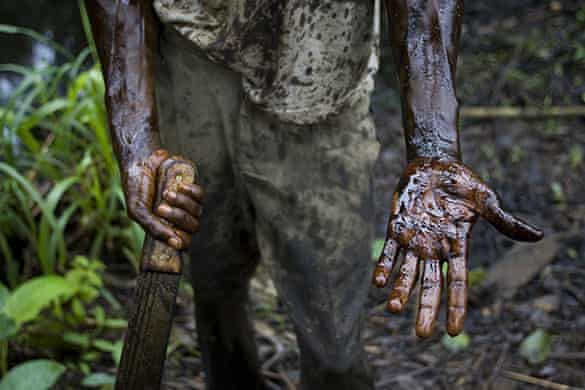
A report by Amnesty International suggests in the past 50 years at least 9m barrels worth of oil have leaked into land and rivers in the region

An oil spill, polluting groundwater and ruining cropland, from a well owned by Shell that had been left abandoned for over 25 years
(Tregaskis, 2010)
Vietnam: Commissioned by the Vietnam Reporting Project in San Francisco as they wanted to report on Agent Orange; this is passed down genetically. Made a film paid for by Ford which compelled the congress to give 4 million dollars to a city to clear up a contaminated pond.
As editorials budgets started to shrink and opportunities changed so he worked more with organisations like National Geographic but with a more deliberate focus on advocacy.
- The open society foundation in New York commissioned him to work on police force profiling in several European countries, and how people were being impacted. He took portraits and their testimonies, which he believes is an efficient and powerful way to share a story.
- Landmines in Afghanistan commissioned by UNICEF to make 3 short videos for social media
- Work on the Kurds for National Geographic.
- Malnutrition in Afghanistan, for UNICEF.
- 2013 He decided he wanted to do a project on mental health in Syrian refugee youth, as it was an issue he was aware and upset about. He knew International Medical Corporation were operating in the region; he pitched his idea to them, they financed his trip for his work and once it was done he got it published in Time magazine – an example where the paradigm was turned upside down as usually he would go to a magazine to ask if they’ll commission and finance a story; later it might filter down into non profit and NGOs to use. However some won’t publish work financd by an NGO because they think there may be a political agenda or it might not be objective.


(Kashi and Winokur, 2013)
- A personal project on worldwide Chronic kidney disease around the world (CKDu a plague on the rural poor), that the Guardian have recently commissioned him to do a new piece; now there are some solutions happening.
Kashi says that when working with collaborative clients on advocacy work shine a spotlight an issue but also show how its being solved, which he sees as a more constructive form of journalism, “ solution journalism”.
He was asked whether NGO work could be seen as abandoning your journalistic stance or be biased; Kashi suggests that this can be countered by keeping your radar up for any pushing of an agenda or amplifying a problem for their fundraising, and if so making an ethical decision on whether to do the work. He’s never experienced that, and points out that there are many problems that don’t have two sides and simply exist.
Asked whether there is tension between working with different types of clients, that puts off editors commissioning him, he says he hasn’t noticed. He’s happy as long as he maintains a truthful ethical approach to his work.
The cornerstone of his work is to initiate his own ideas, but to do this he has to go after grants.
He suggests that you think/feel what you care about and immerse in that and from that work will flow. As an already successful photograher it maybe that he can afford to be less money focused in his work, but he does believe that better paid work will come from less well paid work, “If you make the work the work will come to you”.
“People out there care, and if you create powerful imagery it can make changes” (viiphoto.com).
He believes “deeply believe in the power of still images to change people’s minds. I’m driven by this fact; that the work of photojournalists and documentary photographers can have a positive impact on the world” (about- Kashi, 2021).
My learning:
- It was good to hear how Kashi has suceessfully managed to work on issues that he finds important to create impact, especially with non-traditional editorial type clients.
- His focus on authorship and maintaining creative independence.
- How it is possible to effectively use the new paradigms for producing and financing projects and of expanding one’s skillsets to include audio and video as well as still photography. (viiphoto.com).
- In a nutshell:
“It took me years to understand how my work was already having an impact, and that I could translate it more directly into collaborative relationships with NGOs, foundations, and nonprofits, and then utilize the media to reach a broader audience” (viiphoto.com).
References:
Kashi, E and Winokur, J (2013) Syria’s Lost Generation — Talking Eyes. At: https://talkingeyesmedia.org/syria-info (Accessed 09/02/2021).
Tregaskis, S. (2010) ‘In pictures: Curse of the Black Gold: 50 Years of Oil in the Niger Delta’ In: The Guardian 10/03/2010 At: http://www.theguardian.com/environment/gallery/2010/mar/05/curse-black-gold-nigeria (Accessed 09/02/2021).
Visual Storytelling with NGOs, Foundations and Non Profits with Ed Kashi (2021) At: https://viiphoto.com/resource/visual-storytelling-with-ngos-foundations-and-non-profits-with-ed-kashi/ (Accessed 27/01/2021).
Bibliography:
about — ED KASHI (s.d.) At: https://www.edkashi.com/about (Accessed 28/01/2021).
‘Curse of the Black Gold’ by Ed Kashi – VII Agency (s.d.) At: https://viiphoto.com/resource/curse-of-the-black-gold-by-ed-kashi/ (Accessed 28/01/2021).
During my research for assignment 4 critical review I listened to an interview with Ed Kashi on a podcast (Smith, 2018) and would like to add the following notes:
- Kashi states that he is driven by the issue “how can I contribute something to the world that is meaningful?”, “I want to have impact”. If asked to go somewhere wants it to be something he has an impact with.
- Kashi says he’s fuelled by either “an anger or belief that there’s an issue or injustice that I want to learn more about, I wanna find a way to tell a story about, to raise awareness and now increasingly to be a part of that change”.
- Tries to be smarter with decisions and strategies.
- He enjoys proposing ideas and getting them accepted by editorial, NGOs or others.
- He knows that he must have the right partners advocate for change.
- Must be open to broad range of commissions that can take his work and advocate for change.
Kashi suggest that for those starting out as a storyteller you need to create a body of work that you care about and also shoot video and collect audio. He suggests finding a grant award or crowd funding or own publication, as media is the dissemination tool but not where you’re going to make much money.
Reference:
Smith, B.(2018) A Small Voice Podcast – 083 – Ed Kashi. At: https://bensmithphoto.com/asmallvoice/ed-kashi (Accessed 04/02/2021).
Next Post: https://nkssite5.photo.blog/category/research/a4-research/danziger-mendel-bleasdale/
 Photography 2: Documentary