When researching for my assignment, amongst others I identified the photographers below who I have researched in more detail to analyse where their work and practices would fit into my critical review.
Nick Danziger (b1958) is a British photographer and film maker.
He has photographed disadvantaged across the world and has been recognised as “raising public understanding of contemporary social, political and environmental issues through documentary films and photography”(Danziger, 2021). Whilst doing this he often steps away from impartial reporting in order to “give a voice to those who rarely feature in the media” (Widewalls, 2021).
In 2001 he made a photographic study of people living in extreme poverty in eight countries to share the impact of armed conflict on women; this was to see what progress was being made towards meeting the eight ‘Millennium Development Goals’ set by the United Nations to eradicate poverty, end hunger, save lives and improve education by 2015. This work “Eleven Women Facing War” provided a powerful insight into the world of women caught up in vicious conflict in Bosnia, Kosovo, Israel, Gaza, Hebron (West Bank), Sierra Leone, Colombia and Afghanistan. Danziger said
“We often talk about the victims of war,…I hope these images and stories are a tribute to these women’s indomitable spirit, endurance and bravery” (Imperial War Museum, 2016).
The International Red Cross (and promoter of international humanitarian law) called the images “incredibly powerful and a true testament to the horrors of war and the power of the human spirit” (Imperial War Museum, 2016). His images are illuminating:


10 year-old Mah-Bibi, Ghor Province, Afghanistan, 2001
(Widewalls, 2021) (Danziger, 2021)
However the power comes from their testimonies that he provides alongside his images. It is not clear from his images how other than by raising awareness, he has created impact; but there is evidence of impact. 10 years later he followed up the subjects to reveal their stories on short films and stories. One, Mariatu, whose hands were amputated by guerrilla soldiers in Sierra Leone, is now safe and well and living in Canada and has fulfilled her dream to be a Mother. Mahu Bibi, a 10 year old from Afghanistan, looking after her brothers against all odds, unfortunately was not found. He originally shot in black and white and shot a decade later in colour to show the passage of time, a useful idea.
In 2018 Danziger photographed substance-users and treatment centres around the world, focusing on issues surrounding substances that are often not illegal. His work was exhibited at the commission on Narcotic Drugs event in Vienna. He hopes that policy makers will be affected by the images “because of the people within the pictures…I think it’s really important to understand how …it shows a variety of individuals that have been users, or currently are dependent and receiving treatment” (anyoneschild, 2018), as a greater understanding could bring possibilities of rehabilitation through treatment centres where those are available – He hopes his pictures and the exhibition may lead to policy changes.
References:
anyoneschilddrugs (2018) Can photos lead to policy change? An interview with Nick Danziger. At: https://anyoneschild.org/2018/04/nick-danziger-interview-cnd/ (Accessed 29/01/2021).
Danziger, N. (2021) Biography. At: http://www.nickdanziger.com/nick-danziger/biography (Accessed 29/01/2021).
London’s Imperial War Museum (2016) Eleven Women Facing War: Exhibition at London’s Imperial War Museum. At: https://www.icrc.org/en/event/eleven-women-facing-war-danziger-exhibition-london-imperial-war-museum (Accessed 29/01/2021).
Rear Window (2017) – Eleven Women Facing War. At: https://www.youtube.com/watch?v=WFzwoZ01vlY (Accessed 29/01/2021).
Widewalls (2021) Nick Danziger. At: https://www.widewalls.ch/artists/nick-danziger (Accessed 29/01/2021).
Gideon Mendel (b1959)
I have reported on Mendel before when I attended an AOP breakfast Club meeting in June 2020 (South, 2020). My subsequent research has shown Mendel to use visual activist alternative ways of storytelling. When discussing his work he said he still believes that photography “has the ability to make positive change in the world”. His photographic projects have challenged apartheid in South Africa, perspectives on AIDS/HIV globally and latterly climate change (Tank Magazine, 2012).
His work Drowning World begun in 2007 which he describes as an art and advocacy project about flooding, his personal response to the climate crisis (Mendel, 2021). This work has been used in climate change activism in collaboration with Greenpeace and Extinction Rebellion, exhibited in galleries and published in magazines. Interestingly Mendel combines conceptual and metaphorical photography with activism. Initially he shot images of two floods, one in the UK and one in India, but has since captured flood zones worldwide, poor and affluent. His work includes “submerged portraits”, symmetrical liquid reflections, water damaged photographs, video footage, as well as photographs of his images in actual demonstrations.
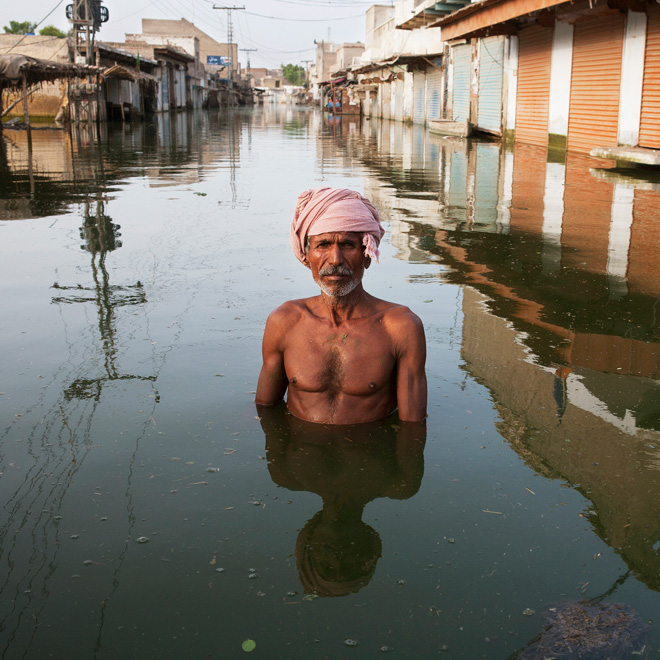


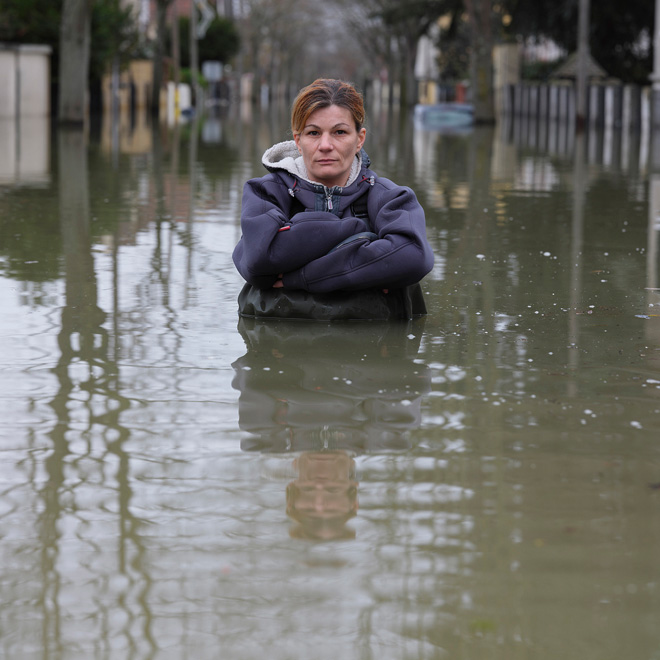
(Mendel, 2021)
In his video installation The Water Chapters explores individual, family and community responses to flooding, which also gives environmental context.
In the 1990s Mendel used an award to help him fund his work “Broken Landscape” documenting HIV/AIDS. He says that just as his ways of story telling broadened so he shifted from photojournalist to visual activist; in particular including individual’s stories in their own words with their own images.
A chapter of this work “Framing aids” was made into 13 posters which were used by organisations to raise awareness about HIV issues. Part of this project “We are living here” documents the effect of lifesaving antiretroviral treatment on poor rural communities, one of the key projects that established a model for widespread rollout of HIV treatment across South Africa. Mendel’s showcase of the positive impacts of the Anti-viral program set up by NGOS and the local health department, “provided a model that others could learn from and a reason to expand similar programs” (Ritchen, 2013).
In 2003 he was approached by the HIV/AIDS alliance to photograph some of their projects world-wide, where he made documentary images to show their works including, testing, counselling, providing clean needles to injecting drug users and educational programs. The final chapter of this work “Through Positive Eyes” was a collaborative global advocacy project; here he gave the camera to HIV subjects, in seven cities around the world, so they could tell their own stories and add another layer to their representation to try to reduce the stigma which stops many from accessing medication.


(Mendel, 2021a)
Mendel says “I feel a personal responsibility to make this project speak as loudly as possible” (Mendel, 2021b). He shows long term commitment in his work and uses alternative ways of story telling to reach audiences, raise awareness o issues and stimulate others to take action.
References:
Mendel, G.(2021) Submerged Portraits – Gideon Mendel At: http://gideonmendel.com/submerged-portraits/ (Accessed 29/01/2021).
Tank Magazine (2012) Tank Magazine. At: https://tankmagazine.com/tank/2019/08/gideon-mendel/ (Accessed 30/01/2021).
Mendel, G.(2021a) Living Proof – Gideon Mendel At: http://gideonmendel.com/living-proof/ (Accessed 29/01/2021).
Mendel, G.(2021b) Biography – Gideon MendeAt: http://gideonmendel.com/biography-2/ (Accessed 29/01/2021).
South, N. (2020) AOP Breakfast club 23.6.20 – Photography 2: Documentary. At: https://nkssite5.photo.blog/category/learning-log-research-and-reflection/photographer-talks/aop-breakfast-club-23-6-20/ (Accessed 06/02/2021).
Ritchin, F. (2013) Bending the frame: Photojournalism, Documentary, and the Citizen. (s.l.): Aperture New York.
Marcus Bleasdale (b1968)
A British documentary photographer who increasingly uses his work to influence decision makers and global policy makers worldwide. He focuses on human rights issues using photographs to highlight issues and engage people, the issues are more important to him than the photographs (Durbanova, 2017).
His work on the conflict in the Democratic Republic of Congo, highlights the effects on the people of the exploitation of natural resources in a book “One Hundred Years Of Darkness” (2002). “The Rape of the Nation” (2009) documents his work on the issues around minerals, their use in technical products and how they finance conflict. “The Unravelling” (2015) documents the brutal conflict in the central African Conflict.
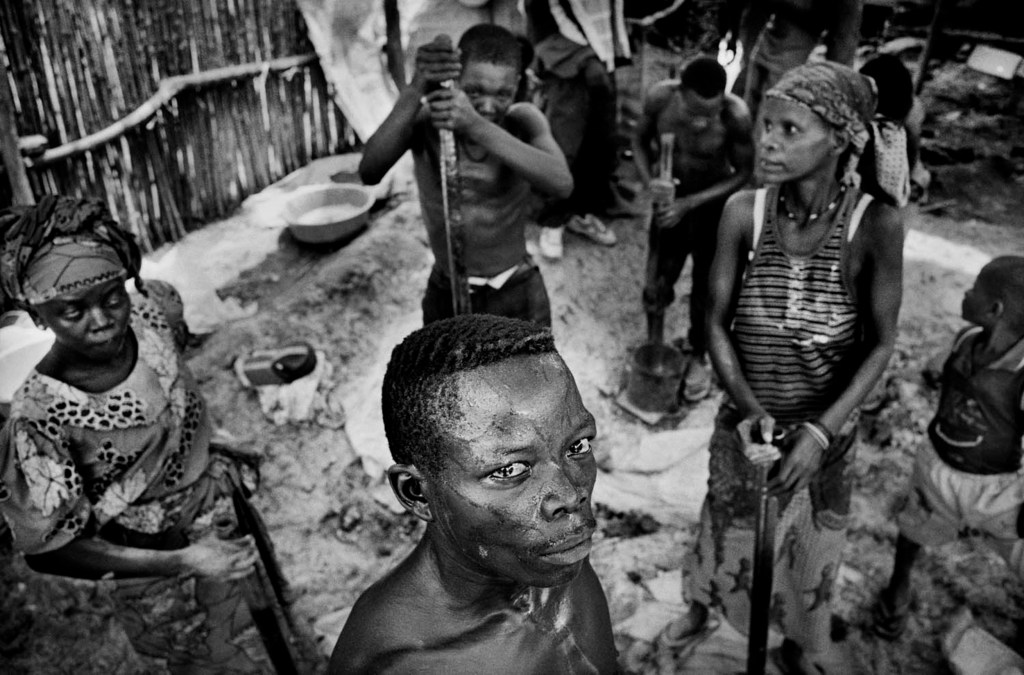
The rape of the Nation, 2004 (Bleasdale, 2021)
Bonded workers crush rocks in Mongbwalu, eastern Congo. Whole families work in slave conditions for warlords, controlling huge amounts of land, where gold is extracted to finance their military campaigns.

Gold at a mine near Mabari. The rebels claim a share for “security”. Gold is plentiful in the Central African Republic, but corruption and political instability have kept the profits from benefiting the people.(Bleasdale,2021)
The Unravelling, 2005 (Bleasdale, 2021) A Muslim rebel stands guard as men and boys dig for
He is a frequent collaborator with NGOS such as, Human rights Watch, Medecins Sans Frontieres. His previous profession in banking gives him useful insight into audiences, he gave up his half a million pound a year job to pursue photojournalism. When Bleasdale worked with Human Rights Watch on the exploitation of Gold Miners In the Democratic Republic of Congo he exhibited it in Geneva to the financiers of the industry (Ritchen, 2013:105). He believes its important to work with Human rights lawyers and advocacy groups and that the media should have a complementary relationship with them (Durbanova, 2017); then use social media and other avenues to communicate with impact.
He is great example of a photographer who knows how to target hie audiences effectively. His work on human rights and conflict has been shown at the US Senate, US House of Representatives, The United Nations and the Houses of parliament. Ritchen points out that such collaboration with NGOs helps to provide information and logistical access and credibility, “They can amplify the impact of what is produced” (Ritchen, 2013:105). In an e mail to Ritchen he explained “The work I have done over the past twelve years for Human Rights Watch is not about financial reward but about how effective we can make the work we produce” (Ritchen, 2013:105). He believes that photographers and NGOs/advocacy groups together can influence policy makers.
References:
Bleasdale, M. (2021) Marcus Bleasdale – Photographer At: http://www.marcusbleasdale.com/unravelling-gallery (Accessed 30/01/2021).
Durbanova, A. (2017) Conversation about conflicts and human rights with Marcus Bleasdale – Impakter. At: https://impakter.com/interview-marcus-bleasdale/ (Accessed 30/01/2021).
Ritchin, F. (2013) Bending the frame: Photojournalism, Documentary, and the Citizen. (s.l.): Aperture New York.
My learning:
This research has helped me to see different elements that exist in making impact with documentary photography.
Danziger’s work shows the power of the context, personal testimony from subjects and the text accompanying images. Mendel’s work speaks of the power of alternative ways of story telling to make impact and that of sharing positive actions. Bleasdale’s work exploits his networks and understanding of the business world to create collaboration and impact. All of these photographers believe in photographing to raise awareness of issues and collaborate with NGOS, advocacy organisations and then seek ways to communicate with impact.
 Photography 2: Documentary