RESEARCH AND REFLECTION: ASSIGNMENT 4

When researching for my assignment, amongst others I identified the photographers below who I have researched in more detail to analyse where their work and practices would fit into my critical review.

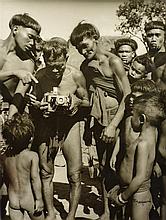
Nick Danziger (b1958) is a British photographer and film maker.

He has photographed disadvantaged across the world and has been recognised as “raising public understanding of contemporary social, political and environmental issues through documentary films and photography”(Danziger, 2021).  Whilst doing this he often steps away from impartial reporting in order to “give a voice to those who rarely feature in the media” (Widewalls, 2021).

In 2001 he made a photographic study of people living in extreme poverty in eight countries to share the impact of armed conflict on women; this was to see what progress was being made towards meeting the eight ‘Millennium Development Goals’ set by the United Nations to eradicate poverty, end hunger, save lives and improve education by 2015. This work “Eleven Women Facing War” provided a powerful insight into the world of women caught up in vicious conflict in Bosnia, Kosovo, Israel, Gaza, Hebron (West Bank), Sierra Leone, Colombia and Afghanistan. Danziger said

We often talk about the victims of war,…I hope these images and stories are a tribute to these women’s indomitable spirit, endurance and bravery” (Imperial War Museum, 2016).

The International Red Cross (and promoter of international humanitarian law) called the images “incredibly powerful and a true testament to the horrors of war and the power of the human spirit” (Imperial War Museum, 2016). His images are illuminating:

(Widewalls, 2021)                  (Danziger, 2021)

However the power comes from their testimonies that he provides alongside his images. It is not clear from his images how other than by raising awareness, he has created impact; but there is evidence of impact. 10 years later he followed up the subjects to reveal their stories on short films and stories. One, Mariatu, whose hands were amputated by guerrilla soldiers in Sierra Leone, is now safe and well and living in Canada and has fulfilled her dream to be a Mother. Mahu Bibi, a 10 year old from Afghanistan, looking after her brothers against all odds, unfortunately was not found. He originally shot in black and white and shot a decade later in colour to show the passage of time, a useful idea.

In 2018 Danziger photographed substance-users and treatment centres around the world, focusing on issues surrounding substances that are often not illegal. His work was exhibited at the commission on Narcotic Drugs event in Vienna. He hopes that policy makers will be affected by the images “because of the people within the pictures…I think it’s really important to understand how …it shows a variety of individuals that have been users, or currently are dependent and receiving treatment” (anyoneschild, 2018), as a greater understanding could bring possibilities of rehabilitation through treatment centres where those are available – He hopes his pictures and the exhibition may lead to policy changes.

References:

anyoneschilddrugs (2018) Can photos lead to policy change? An interview with Nick Danziger. At: https://anyoneschild.org/2018/04/nick-danziger-interview-cnd/ (Accessed 29/01/2021).

Danziger, N. (2021) Biography. At: http://www.nickdanziger.com/nick-danziger/biography (Accessed 29/01/2021).

London’s Imperial War Museum (2016) Eleven Women Facing War: Exhibition at London’s Imperial War Museum. At: https://www.icrc.org/en/event/eleven-women-facing-war-danziger-exhibition-london-imperial-war-museum (Accessed 29/01/2021).

Rear Window (2017) – Eleven Women Facing War. At: https://www.youtube.com/watch?v=WFzwoZ01vlY (Accessed 29/01/2021).

Widewalls (2021) Nick Danziger. At: https://www.widewalls.ch/artists/nick-danziger (Accessed 29/01/2021).

Gideon Mendel (b1959)

I have reported on Mendel before when I attended an AOP breakfast Club meeting in June 2020 (South, 2020). My subsequent research has shown Mendel to use visual activist alternative ways of storytelling. When discussing his work he said he still believes that photography “has the ability to make positive change in the world”. His photographic projects have challenged apartheid in South Africa, perspectives on AIDS/HIV globally and latterly climate change (Tank Magazine, 2012).

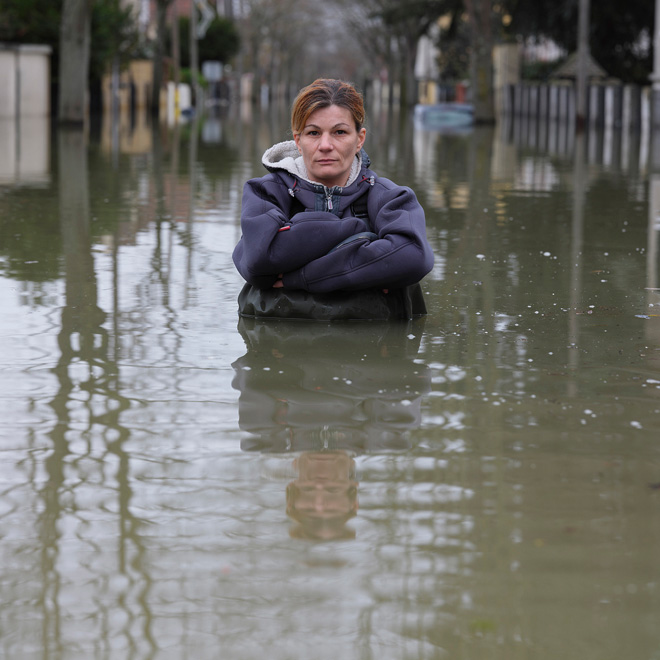
His work Drowning World begun in 2007 which he describes as an art and advocacy project about flooding, his personal response to the climate crisis (Mendel, 2021). This work has been used in climate change activism in collaboration with Greenpeace and Extinction Rebellion, exhibited in galleries and published in magazines. Interestingly Mendel combines conceptual and metaphorical photography with activism. Initially he shot images of two floods, one in the UK and one in India, but has since captured flood zones worldwide, poor and affluent. His work includes “submerged portraits”, symmetrical liquid reflections, water damaged photographs, video footage, as well as photographs of his images in actual demonstrations.
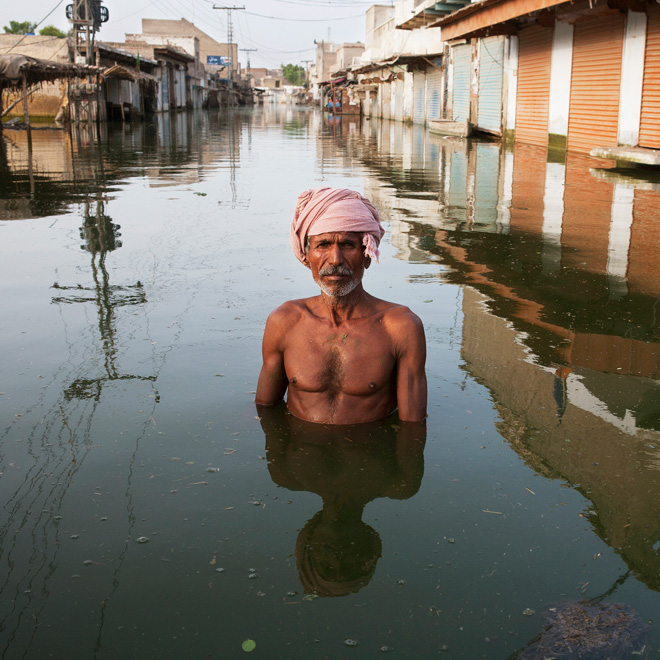
(Mendel, 2021)

In his video installation The Water Chapters explores individual, family and community responses to flooding, which also gives environmental context.

In the 1990s Mendel used an award to help him fund his work “Broken Landscape” documenting HIV/AIDS. He says that just as his ways of story telling broadened so he shifted from photojournalist to visual activist; in particular including individual’s stories in their own words with their own images.

A chapter of this work “Framing aids” was made into 13 posters which were used by organisations to raise awareness about HIV issues. Part of this project “We are living here” documents the effect of lifesaving antiretroviral treatment on poor rural communities, one of the key projects that established a model for widespread rollout of HIV treatment across South Africa. Mendel’s showcase of the positive impacts of the Anti-viral program set up by NGOS and the local health department, “provided a model that others could learn from and a reason to expand similar programs(Ritchen, 2013).

In 2003 he was approached by the HIV/AIDS alliance to photograph some of their projects world-wide, where he made documentary images to show their works including, testing, counselling, providing clean needles to injecting drug users and educational programs. The final chapter of this work “Through Positive Eyes” was a collaborative global advocacy project; here he gave the camera to HIV subjects, in seven cities around the world, so they could tell their own stories and add another layer to their representation to try to reduce the stigma which stops many from accessing medication.

(Mendel, 2021a)

Mendel says “I feel a personal responsibility to make this project speak as loudly as possible” (Mendel, 2021b). He shows long term commitment in his work and uses alternative ways of story telling to reach audiences, raise awareness o issues and stimulate others to take action.

References:

Mendel, G.(2021) Submerged Portraits – Gideon Mendel At: http://gideonmendel.com/submerged-portraits/ (Accessed 29/01/2021).

Tank Magazine (2012) Tank Magazine. At: https://tankmagazine.com/tank/2019/08/gideon-mendel/ (Accessed 30/01/2021).

Mendel, G.(2021a) Living Proof – Gideon Mendel At: http://gideonmendel.com/living-proof/ (Accessed 29/01/2021).

Mendel, G.(2021b) Biography – Gideon MendeAt: http://gideonmendel.com/biography-2/ (Accessed 29/01/2021).

South, N. (2020) AOP Breakfast club 23.6.20 – Photography 2: Documentary. At: https://nkssite5.photo.blog/category/learning-log-research-and-reflection/photographer-talks/aop-breakfast-club-23-6-20/ (Accessed 06/02/2021).

Ritchin, F. (2013) Bending the frame: Photojournalism, Documentary, and the Citizen. (s.l.): Aperture New York.

Marcus Bleasdale (b1968)

A British documentary photographer who increasingly uses his work to influence decision makers and global policy makers worldwide. He focuses on human rights issues using photographs to highlight issues and engage people, the issues are more important to him than the photographs (Durbanova, 2017).

His work on the conflict in the Democratic Republic of Congo, highlights the effects on the people of the exploitation of natural resources in a book “One Hundred Years Of Darkness” (2002). “The Rape of the Nation (2009) documents his work on the issues around minerals, their use in technical products and how they finance conflict. “The Unravelling” (2015) documents the brutal conflict in the central African Conflict.
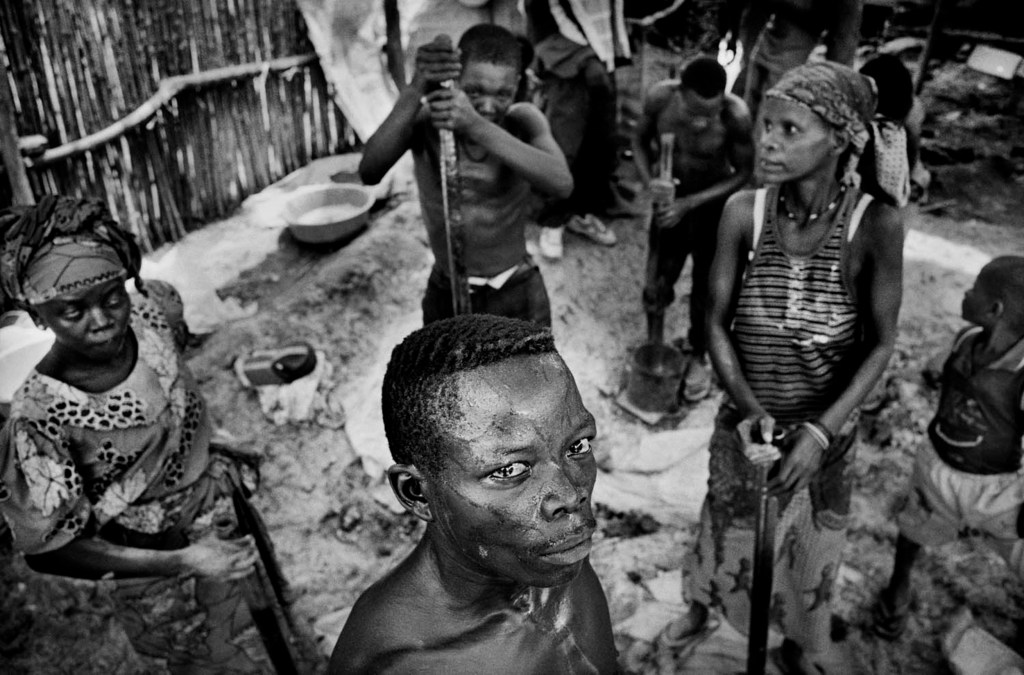
Bonded workers crush rocks in Mongbwalu, eastern Congo. Whole families work in slave conditions for warlords, controlling huge amounts of land, where gold is extracted to finance their military campaigns. 2004

The rape of the Nation, 2004 (Bleasdale, 2021)

Bonded workers crush rocks in Mongbwalu, eastern Congo. Whole families work in slave conditions for warlords, controlling huge amounts of land, where gold is extracted to finance their military campaigns.

Gold at a mine near Mabari. The rebels claim a share for “security”. Gold is plentiful in the Central African Republic, but corruption and political instability have kept the profits from benefiting the people.(Bleasdale,2021)

 The Unravelling, 2005 (Bleasdale, 2021) A Muslim rebel stands guard as men and boys dig for

He is a frequent collaborator with NGOS such as, Human rights Watch, Medecins Sans Frontieres. His previous profession in banking gives him useful insight into audiences, he gave up his half a million pound a year job to pursue photojournalism. When Bleasdale worked with Human Rights Watch on the exploitation of Gold Miners In the Democratic Republic of Congo he exhibited it in Geneva to the financiers of the industry (Ritchen, 2013:105). He believes its important to work with Human rights lawyers and advocacy groups and that the media should have a complementary relationship with them (Durbanova, 2017); then use social media and other avenues to communicate with impact.

He is great example of a photographer who knows how to target hie audiences effectively. His work on human rights and conflict has been shown at the US Senate, US House of Representatives, The United Nations and the Houses of parliament. Ritchen points out that such collaboration with NGOs helps to provide information and logistical access and credibility, “They can amplify the impact of what is produced” (Ritchen, 2013:105). In an e mail to Ritchen he explained “The work I have done over the past twelve years for Human Rights Watch is not about financial reward but about how effective we can make the work we produce” (Ritchen, 2013:105). He believes that photographers and NGOs/advocacy groups together can influence policy makers.

References:

Bleasdale, M. (2021) Marcus Bleasdale – Photographer At: http://www.marcusbleasdale.com/unravelling-gallery (Accessed 30/01/2021).

Durbanova, A. (2017) Conversation about conflicts and human rights with Marcus Bleasdale – Impakter. At: https://impakter.com/interview-marcus-bleasdale/ (Accessed 30/01/2021).

Ritchin, F. (2013) Bending the frame: Photojournalism, Documentary, and the Citizen. (s.l.): Aperture New York.

My learning:

This research has helped me to see different elements that exist in making impact with documentary photography.

Danziger’s work shows the power of the context, personal testimony from subjects and the text accompanying images. Mendel’s work speaks of the power of alternative ways of story telling to make impact and that of sharing positive actions. Bleasdale’s work exploits his networks and understanding of the business world to create collaboration and impact. All of these photographers believe in photographing to raise awareness of issues and collaborate with NGOS, advocacy organisations and then seek ways to communicate with impact.
Next Post: https://nkssite5.photo.blog/category/learning-log-assignments-2/assignment-4-critcal-review-learning-log-assignments/assignment-4-draft/

RESEARCH AND REFLECTION: PART FOUR

VISUAL STORY TELLING WITH NGOS, FOUNDATIONS AND NON PROFITS WITH ED KASHI – vii Insider

Ed Kashi is a photojournalist, filmmaker, speaker and educator of 40 years. I found this talk on the Vii website when researching for my assignment 4 essay.

INTRO: PAUL LOWE: on Ed, he’s always thinking about his audience when working, who is he trying to reach and what’s the best way.

ED KASHI:

His motivation as a visual storyteller is to engage with the world and issues that he cares about. He choses the projects that he engages with underreported issues or to take new angles with issues that we think we know about. Suggests that

we ask ourselves if we want to create work that has positive impact on the world work that has meaning outside of the media landscape” and says that “Sometimes its more important to reach a few thousand important people than 40 million people through the general media if you want to make change” (viiphoto.com).

He has learnt there were different outlets to get his work out, he’s a story teller not an activist ultimately but wants to effect change; so it’s important to partner yourself with the right organisations/people to effect change.   

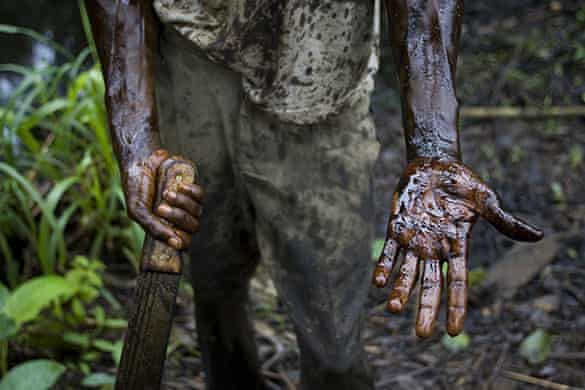
Nigeria: Niger delta 2004-2007 consciously partnered with NGOs and international organisations like, Oxfam Amnesty International, non-profit and academia, that could really make a difference to oil exploitation in West Africa; Oxfam used images from his book Curse of the Black Gold (2010) its work to advocate for a bill to create more transparency in gas and mining industries that was pending in the USA, a bill that was passed.

A report by Amnesty International suggests in the past 50 years at least 9m barrels worth of oil have leaked into land and rivers in the region

An oil spill, polluting groundwater and ruining cropland, from a well owned by Shell that had been left abandoned for over 25 years

(Tregaskis, 2010)

Vietnam: Commissioned by the Vietnam Reporting Project in San Francisco as they wanted to report on Agent Orange; this is passed down genetically. Made a film paid for by Ford which compelled the congress to give 4 million dollars to a city to clear up a contaminated pond.

As editorials budgets started to shrink and opportunities changed so he worked more with organisations like National Geographic but with a more deliberate focus on advocacy.

  • The open society foundation in New York commissioned him to work on police force profiling in several European countries, and how people were being impacted. He took portraits and their testimonies, which he believes is an efficient and powerful way to share a story.
  • Landmines in Afghanistan commissioned by UNICEF to make 3 short videos for social media 
  • Work on the Kurds for National Geographic.
  • Malnutrition in Afghanistan, for UNICEF.
  • 2013 He decided he wanted to do a project on mental health in Syrian refugee youth, as it was an issue he was aware and upset about. He knew International Medical Corporation were operating in the region; he pitched his idea to them, they financed his trip for his work and once it was done he got it published in Time magazine – an example where the paradigm was turned upside down as usually he would go to a magazine to ask if they’ll commission and finance a story; later it might filter down into non profit and NGOs to use.  However some won’t publish work financd by an NGO because they think there may be a political agenda or it might not be objective.

(Kashi and Winokur, 2013)

  • A personal project on worldwide Chronic kidney disease around the world (CKDu a plague on the rural poor), that the Guardian have recently commissioned him to do a new piece; now there are some solutions happening.

Kashi says that when working with collaborative clients on advocacy work shine a spotlight an issue but  also show how its being solved, which he sees as a more constructive form of journalism, “ solution journalism”.

He was asked whether NGO work could be seen as abandoning your journalistic stance or be biased;  Kashi suggests that this can be countered  by keeping your radar up for any pushing of an agenda or amplifying a problem for their fundraising, and if so making an ethical decision on whether to do the work. He’s never experienced that, and points out that there are many problems that don’t have two sides and simply exist.

Asked whether there is tension between working with different types of clients, that puts off editors commissioning him, he says he hasn’t noticed. He’s happy as long as he maintains a truthful ethical approach to his work.

The cornerstone of his work is to initiate his own ideas, but to do this he has to go after grants.

He suggests that you think/feel what you care about and immerse in that and from that work will flow. As an already successful photograher it maybe that he can afford to be less money focused in his work, but he does believe that better paid work will come from less well paid work, “If you make the work the work will come to you”. 

“People out there care, and if you create powerful imagery it can make changes” (viiphoto.com).

He believes “deeply believe in the power of still images to change people’s minds. I’m driven by this fact; that the work of photojournalists and documentary photographers can have a positive impact on the world” (about- Kashi, 2021).

My learning:

  • It was good to hear how Kashi has suceessfully managed to work on issues that he finds important to create impact, especially with non-traditional editorial type clients.
  • His focus on authorship and maintaining creative independence.
  • How it is possible to effectively use the new paradigms for producing and financing projects and of expanding one’s skillsets to include audio and video as well as still photography. (viiphoto.com).
  • In a nutshell:

“It took me years to understand how my work was already having an impact, and that I could translate it more directly into collaborative relationships with NGOs, foundations, and nonprofits, and then utilize the media to reach a broader audience” (viiphoto.com).

References:

Kashi, E and Winokur, J (2013) Syria’s Lost Generation — Talking Eyes. At: https://talkingeyesmedia.org/syria-info (Accessed 09/02/2021).

Tregaskis, S. (2010) ‘In pictures: Curse of the Black Gold: 50 Years of Oil in the Niger Delta’ In: The Guardian 10/03/2010 At: http://www.theguardian.com/environment/gallery/2010/mar/05/curse-black-gold-nigeria (Accessed 09/02/2021).

Visual Storytelling with NGOs, Foundations and Non Profits with Ed Kashi (2021) At: https://viiphoto.com/resource/visual-storytelling-with-ngos-foundations-and-non-profits-with-ed-kashi/ (Accessed 27/01/2021).

Bibliography:

about — ED KASHI (s.d.) At: https://www.edkashi.com/about (Accessed 28/01/2021).

‘Curse of the Black Gold’ by Ed Kashi – VII Agency (s.d.) At: https://viiphoto.com/resource/curse-of-the-black-gold-by-ed-kashi/ (Accessed 28/01/2021).

During my research for assignment 4 critical review I listened to an interview with Ed Kashi on a podcast (Smith, 2018) and would like to add the following notes:

  • Kashi states that he is driven by the issue how can I contribute something to the world that is meaningful?”, “I want to have impact”. If asked to go somewhere wants it to be something he has an impact with.
  • Kashi says he’s fuelled by either “an anger or belief that there’s an issue or injustice that I want to learn more about, I wanna find a way to tell a story about, to raise awareness and now increasingly to be a part of that change”.
  • Tries to be smarter with decisions and strategies.
  • He enjoys proposing ideas and getting them accepted by editorial, NGOs or others.
  • He knows that he must have the right partners advocate for change.
  • Must be open to broad range of commissions that can take his work and advocate for change.

Kashi suggest that for those starting out as a storyteller you need to create a body of work that you care about and also shoot video and collect audio. He suggests finding a grant award or crowd funding or own publication, as media is the dissemination tool but not where you’re going to make much money. 

Reference:

Smith, B.(2018) A Small Voice Podcast – 083 – Ed Kashi. At: https://bensmithphoto.com/asmallvoice/ed-kashi (Accessed 04/02/2021).

Next Post: https://nkssite5.photo.blog/category/research/a4-research/danziger-mendel-bleasdale/

PART 4: ETHICS AND LOOKING AT THE OTHER

PROJECT POST-COLONIAL ETHNOGRAPHY

RESEARCH POINT

Do your own research into the bodies of work discussed in this project. Can you find any examples of work carried out amongst indigenous peoples that, in your view, honestly document the lives of their subjects without falling into some of the traps that we’ve been discussing here? If so, how has the photographer achieved this? (Open College of the Arts, 2014:64)

The “traps” that have been identified in Post colonial ethnographic photography:

  • Nostalgia – Romanticism of primitive beauty
  • Imbalances of power between photographer and subjects
  • Disciplinary cataloguing and comparing
  • Primitivism
  • Decontextualising
  • Infantising of non-industrial people

Peter Lavery’s work in “of humankind” does decontextualise his subjects; this seems to enhance the stereotyping, the power imbalance, cataloguing and comparing traps suggested above. Indeed even in the foreword of the book ‘Of Humankind’ by Robin Muir (2000) says that Lavery’s portraits remind us that photographers deal in things which are continually vanishing and which no contrivance on earth can bring back”, underlining the nostalgic element of his photography.

(Of Humankind, 2000)

Conversely David Bruce’s work though sometimes posed against a backdrop is aesthetic, shot with dignity, and his subjects look empowered and generally look to be enjoying themselves.

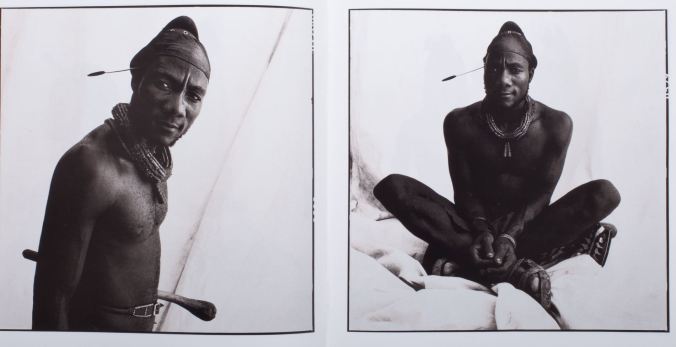
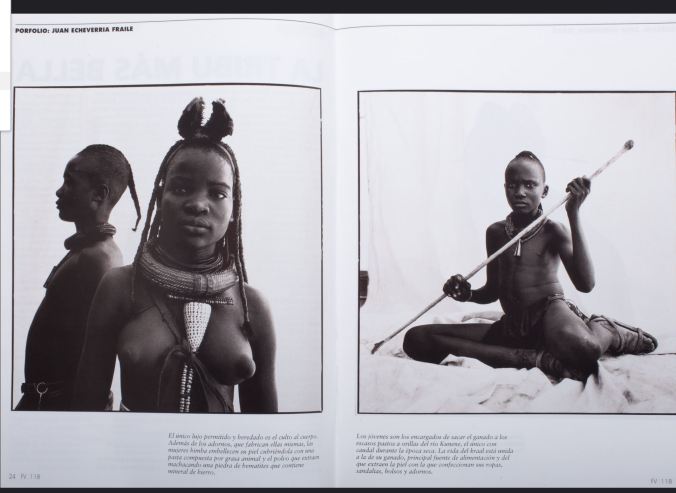
Juan Echeverrria’s images of the OvaHimba tribe in Namibia could be interpreted as voyeuristic and decontextualised; whilst they are taken out of context they do have a realism about them and the subjects share some character and assertiveness.

Namibia_Paisajes_desde_el_tren (2021)

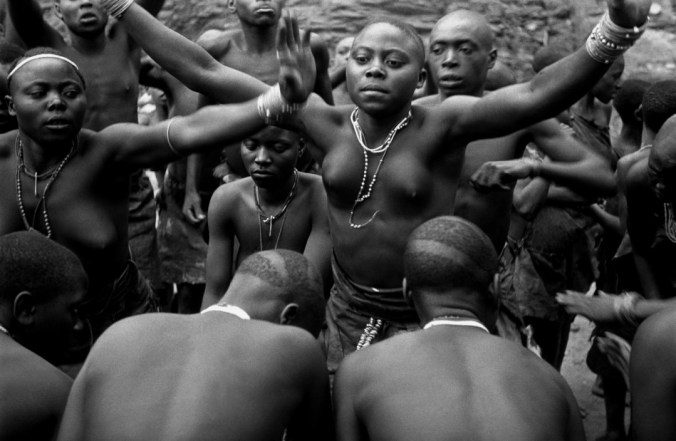
When searching for examples of work which don’t fall into the “traps” I returned to the work of George Rodger who took the image that struck me on the front of the Tribal Portraits catalogue. I was pleasantly surprised that although his work En Afrique was taken between 1947 and 1979 it avoids the pitfalls mentioned above; the nudity is in context, subjects are photographed in context and are certainly not romantised; indeed he gives detailed context with each image.

(En Afrique by George Rodger, 2016)

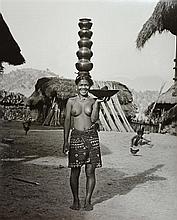
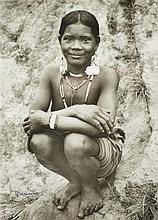
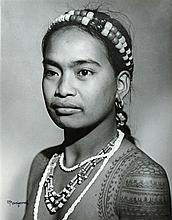
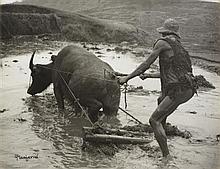
I also thought back to a photographer whose work I came across when in the Philippines a couple of years ago, Eduardo Masferré (1909 – 1995) a Filipino-Catalan who made documentary reports about the lifestyle of native people in the region of the Cordillera of the Philippines in the mid 1950s. I was very struck with his work at the time, which is contained in his book people of the Philippine Cordillera (1988) and was interested how I would view it now I have studied these aspects of tribal photography.

Eduardo Masferre Paintings & Artwork for Sale (2021)

I was pleased to see that although there is a fascination with subjects smoking pipes, most of his images are shot with context in a documentary style which gives information about their way of life. Where there is partial nudity it appears as a natural part of their dress and the emphasis of the photograph is clearly not on this but another aspect, such as the girl with the pots on her head and the smoking woman above. Though there is the occasional image which seems to have been shot simply for the beauty of the subject female, male, old or young, there is no suggestion of imbalance of power between him and his subjects or infantizing of them. For work which was shot between 1947 and 1959. I would say the work is sensitive to the people and a good documentary record and agree with the review from the book cover that the people are shown with “strong faces that meet one’s gaze with great integrity – Masferre preserved all of these in timeless images that transcend ethnography and imbue documentary fact with deeper meaning.” (Masferre and Devilla, 1988).

References:

Eduardo Masferre Paintings & Artwork for Sale (s.d.) At: https://www.invaluable.com/catalog/searchLots.cfm?scp=m&ad=DESC&alf=1&issc=1&artistref=3tvi2dj9ip&shw=50&ord=2&row=51 (Accessed 14/01/2021).

En Afrique by George Rodger (2016) At: https://www.magnumphotos.com/arts-culture/george-rodger-en-afrique/ (Accessed 13/01/2021).

Ju/’hoansi Bushmen (s.d.) At: https://davidbrucephotography.co.za/juhoansi-bushmen/ (Accessed 12/01/2021).

Masferré, E. and De Villa, J. G. (1988) People of the Philippine Cordillera: Photographs, 1934-1956. (s.l.): Devcon I.P. Incorporated.

Namibia_Paisajes_desde_el_tren (s.d.) At: https://www.flickr.com/photos/juan_echeverria_reportajes/sets/72157629307741656/show/ (Accessed 13/01/2021).

Namibia_Paisajes_desde_el_tren (s.d.) At: https://www.flickr.com/photos/juan_echeverria_reportajes/sets/72157629307741656/show/ (Accessed 13/01/2021).

Of Humankind (2000.) At: https://www.peterlavery.com/of-humankind (Accessed 13/01/2021).

Open College of the Arts (2014) Photography 2: Documentary-Fact and Fiction (Course Manual). Barnsley: Open College of the Arts.

Next Post: https://nkssite5.photo.blog/category/learning-log-research-and-reflection/reflection/a4-reflection/my-learning-part-4/