Research point Charley Murrell and Hannah Starkey
Investigate Murrell’s Constructed Childhoods and Starkey’s Untitled series. How do these photographers employ imaginative and/or performative elements to construct their narratives? In what sense is the end result ‘real’? What aspects of their work might you consider adopting in your own practice? (Open College of the Arts, 2014:81)
Hannah Starkey
Hannah Starkey’s photographs reconstruct everyday scenes with actors, usually of women pictured in banal daily routines, often placed as lonely figures “segregated with metaphoric physical divides such as tables or mirrors” (Saatchi, 2020). She repeatedly turns her subjects backs to viewers or puts them in heavy shadow, clouding identity features.
Starkey uses a filmography approach, large scale photographs carefully constructed with film lighting; though constructed her images are dynamic “their charge comes from the possibilities and surprises only a still image can yield, from the pleasures and challenges of looking carefully at an arrested moment” (Strong Women, 2020). The images are best seen at the scale she intended, approximately 4 by 5 feet, when you can see the small details they contain.
Her work is mostly “untitled”, with a date only which connects to a memory. Starkey says that she reimagines what she has observed and by carefully reconstructing them she can capture “the small gestures and glances of everyday experience while also subverting traditional notions of documentary and street photograph” (O’Hagan, 2018). She explains that she combines “documentary with the slickness of advertising and the observational style of street photography. I think I’ve become more reflective and considered, but the performative element has been a constant” (O’Hagan, 2018).
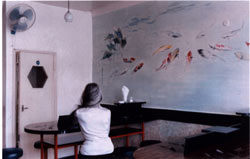
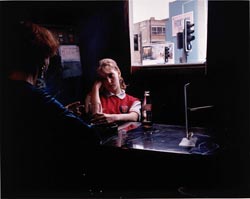
Is her work real? Her work blurs fiction and reality. Starkey says that she is more interested in psychological truth than the photographic truth (O’Hagan, 2018). Like Wall she is using the opportunity to recreate moments real and imagined in her own time so that she can present them in a controlled way. Like Wall she is honest about her manipulation, angled mirrors, perspective, acting, placing small details and post digital manipulation after the fact.
I feel much the same way about her work as I do Wall’s. It provokes questions about whether it is documentary, which for me rests on whether they are accurate reconstructions or seductive interpretations; from what I read they are the later and therefore for me not documentary.
Charlie Murrell
In her work Constructed Childhoods she explores the impact of images that surround children’s everyday lives, found in magazines, on TV, the Internet, adverts, and even products. All these images constantly present ideals and can negatively impact on their self-image and esteem.
Murrell’s images are Tableaux constructed in her and the children’s homes. The children are acting in adult roles, in adult poses, she reinforces the gender roles in her images by the use of pink and blue. The images are a mixture of children acting in a studio shot and manipulated exterior shots, but both are strange and cause you to look hard to interpret them.
Are these manipulated images real? The idea or problem of the projection of ideals is a reality, however these images are constructed. These images are documenting a reality but I believe are over manipulated to be documents; they too are images that provoke thoughts about truth, they may expose realities, but the photographs are fictional representations.
So with regard to the work of Starkey and Murrell:
They use imaginative and performative elements to construct their narratives. Though based in varying degrees of reality they are constructed stories, which may have a place on the edge of documentary as they point viewers towards real issues, I classify them as performative photography rather than documentary photography.
I’m not at this stage interested in using performative approaches in my photography, however I will consider some of the elements that they carefully employ, perspective, signs and symbols, small details when constructing my “real-time” images.
References:
Constructed Childhoods (2020) At: http://charley-murrell.co.uk/childs-play/ (Accessed 27/10/2020).
O’Hagan, S. (2018) ‘Photographer Hannah Starkey: ‘I want to create a space for women without judgment’’ In: The Guardian 08/12/2018 At: http://www.theguardian.com/artanddesign/2018/dec/08/hannah-starkey-photographer-interview-space-for-women-sean-ohagan (Accessed 27/10/2020).
Open College of the Arts (2014) Photography 2: Documentary-Fact and Fiction (Course Manual). Barnsley: Open College of the Arts.
Strong Women (2020) At: https://aperture.org/editorial/hannah-starkey/ (Accessed 27/10/2020).
Saatchi Gallery (2020) Hannah Starkey At: https://www.saatchigallery.com/artists/hannah_starkey.htm (Accessed 26/10/2020).
 Photography 2: Documentary