The brief for our 1st assignment tells us to read the section entitled ‘The Photographic Brief’ in Short, M. (2011) Creative photography: context and narrative. Lausanne: AVA Publishing, pp.20–26.
THESE ARE MY NOTES:
The brief defines the context of the final output
May contain relevant information regarding the conceptual approach
It can be simple: what you are taking a photograph of, where and why.
Give yourself time to develop your idea through practice
The Student brief:
Usually a defined period, possibly loose briefs to enable personal responses.
They should initiate, develop and articulate ideas translating them into photography.
Research and take photographs soonest to share with peers to get feedback – this encourages
Read brief carefully
Clarify own learning aims
Reference:
Short, M., 2011. Context And Narrative. Lausanne: AVA Publishing SA.
Preparing for assignment one I looked at photographers who had photographed the home as well as those who had photographed through windows.
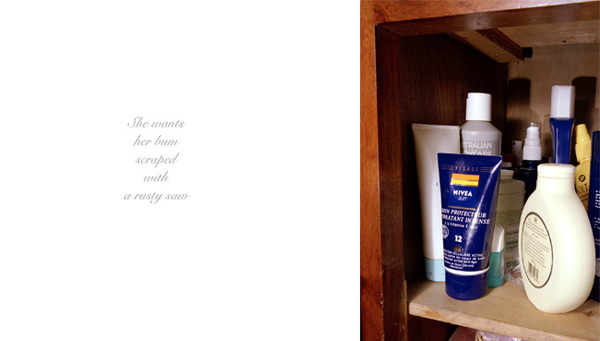
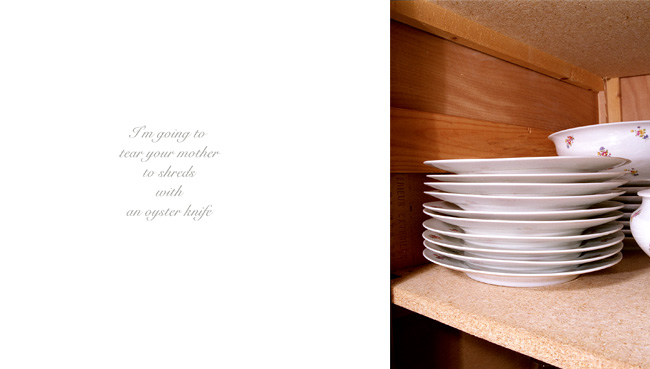
ANNA FOX My mother’s cupboard’s (1999)
I have looked at this work before but returned to it as I thought of it whilst preparing for my assignment 1 work on safety at home where I intend to photograph everyday objects.
(Anna Fox 1999)
(Anna Fox ,1999)
This was originally designed as a miniature book using images and texts with “My Father’s words” as a way of narrating about family relationships. The juxtaposition of her Father’s harsh words next to her mother’s collection of ordinary household objects in her cupboards forms an intimate sharing of her family life. Fox describes her work as “Colour photographs of my mother’s tidy cupboards together with excerpts from my father’s rantings” (Fox, 1999).
I am particularly interested in how Fox has framed the objects in the cupboards; it seems that they are all portrait orientated and shot from a slight angle including either a shelf or the floor each time and mostly a part of the cupboard roof interior. I notice that in her work “Cockroach diary”(Fox, 2000) she similarly maintains the same perspective in each shot (this time a downwards, squeeued perspective).
I was lucky to open issue 238 of Aperture 2020 and find it dedicated to HOUSE AND HOME a consideration of the meanings and forms of domestic spaces, this was very timely. It formed a starting point for research on a number of photographers who have used the home as “an emblem of the moment”.
FUMI ISHINO – LOOM (2018)
“In Japan, a Photographer finds there’s No Stanger Place than Home”
On returning from college in the US Ishino describes a feeling of “zure”, lop-sidedness, slippage – that his locality of Tokyo was neither home or foreign “a frame on the wall ever so slightly crooked”.
This series are all predominately shaded a cold white but interrupted with bursts of colour in the debris left by people.
(Fumi Ishino, from the series Loom, Japan, 2018)
Fujii (2020) beautifully describes the image above as an “aethethics of suspension, a gentle balance upheld amid buffeting forces”. It is the feelings that he is trying to express in his images that interests me, and this reminds me that I should consider what feeling I’m tryingto convey in my assignment 1.
The images do have an Edward-Hopper like emptiness and sense of abandonment and therefore those without humans in particular give a sense of a room left behind by humans and the atmosphere and feelings. Says that “absence can fill us up as much as presence does” and that Adams taped into the something that remains even as we come and go” (Iyer, 2020).
Adams apparently said that he “wanted just to show what lay within the houses that were a part of my primary subject…I also hoped, however, to find evidence of human caring”. In this work of Adams again it is the emotion of the scenes that he captures that interests me.
Minimal. Messy, or Melancholic? The many faces of home in Japanese photography
Lena Fritsch
I was interested in this article as a follow on from the work of Ishino as it explains some of the words and concepts attached to Japanese homes as well as the beauty of the images of the ordinary.
The Japanese idea of home depends on the context:
Furusato defines a nostalgic sense of one’s own home
Katei defines the house spatially
Kazoku defines the family and household
An example of Furusato is Ishiuchi Miyako’s Apartment #50 (1978) below:
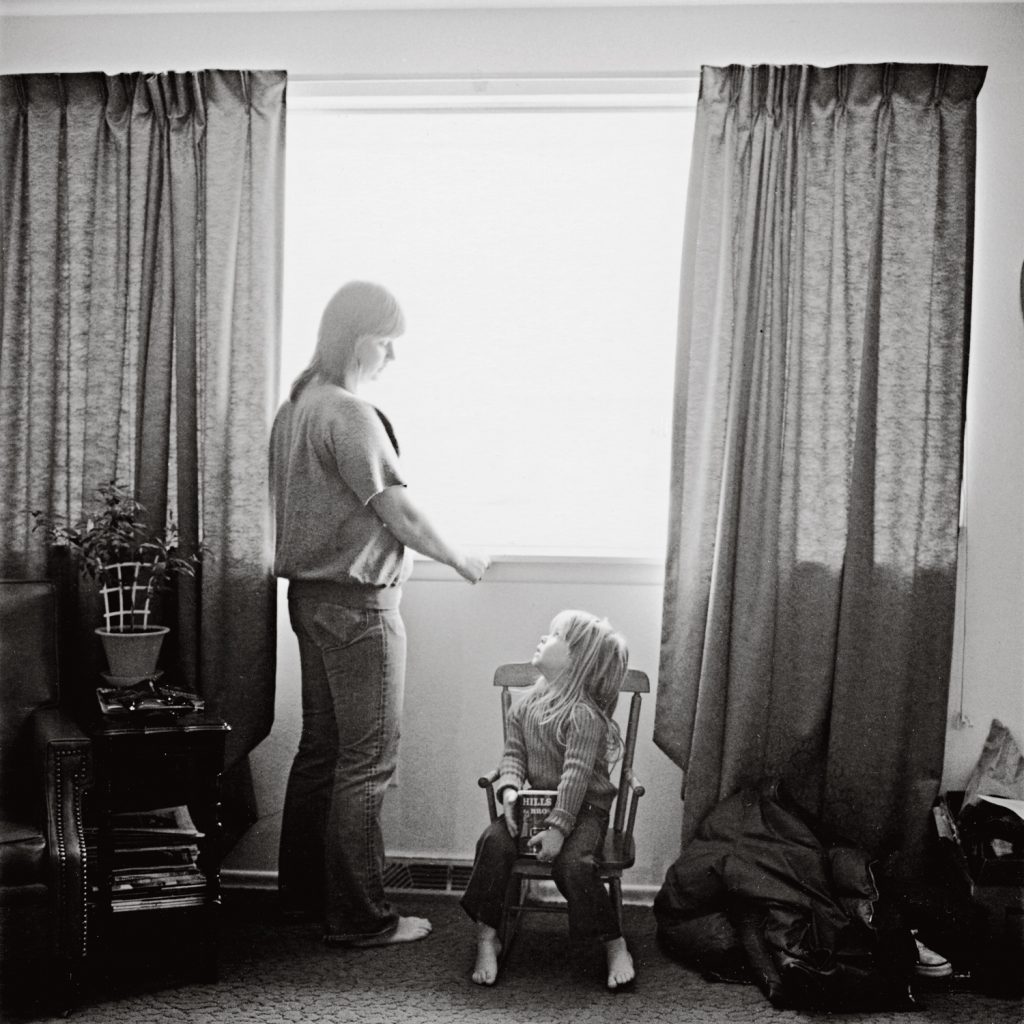
Her apartment photographs are linked to her childhood memories and are human as they show visible traces of their inhabitants, stains, cracks, fingerprints:
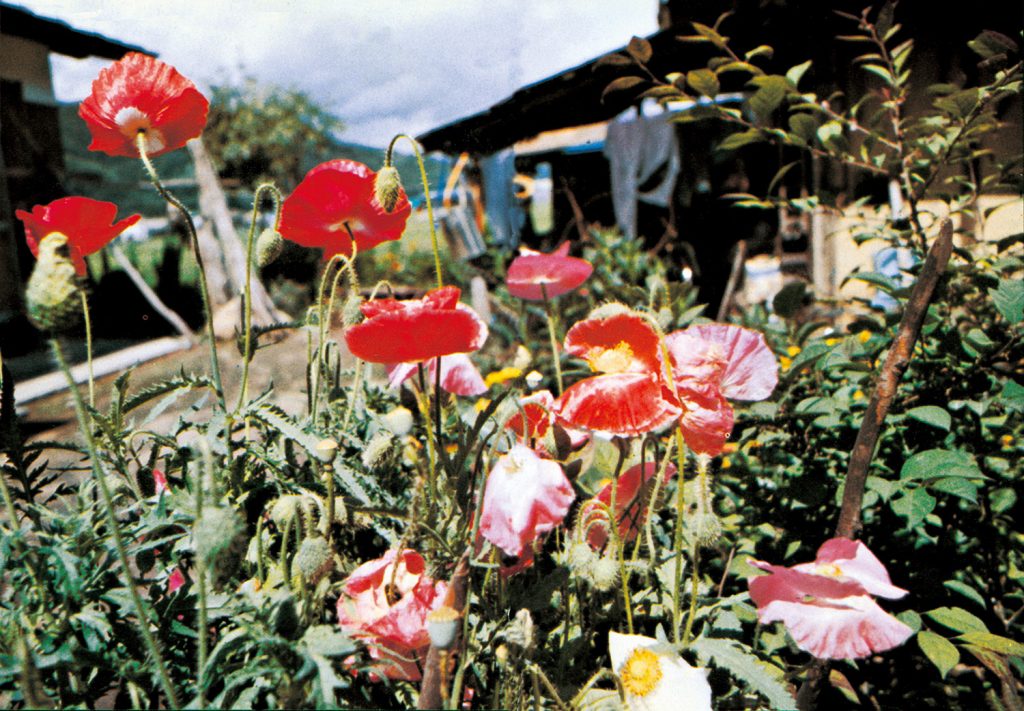
Another example of Furusato is shot by Moriyama in Tales of Tono (1976) reflects Japan’s interest in folklore, blurry, grainy, mysterious, suggesting that the scenes appear quickly and then disappear rather like nostalgic memories.:
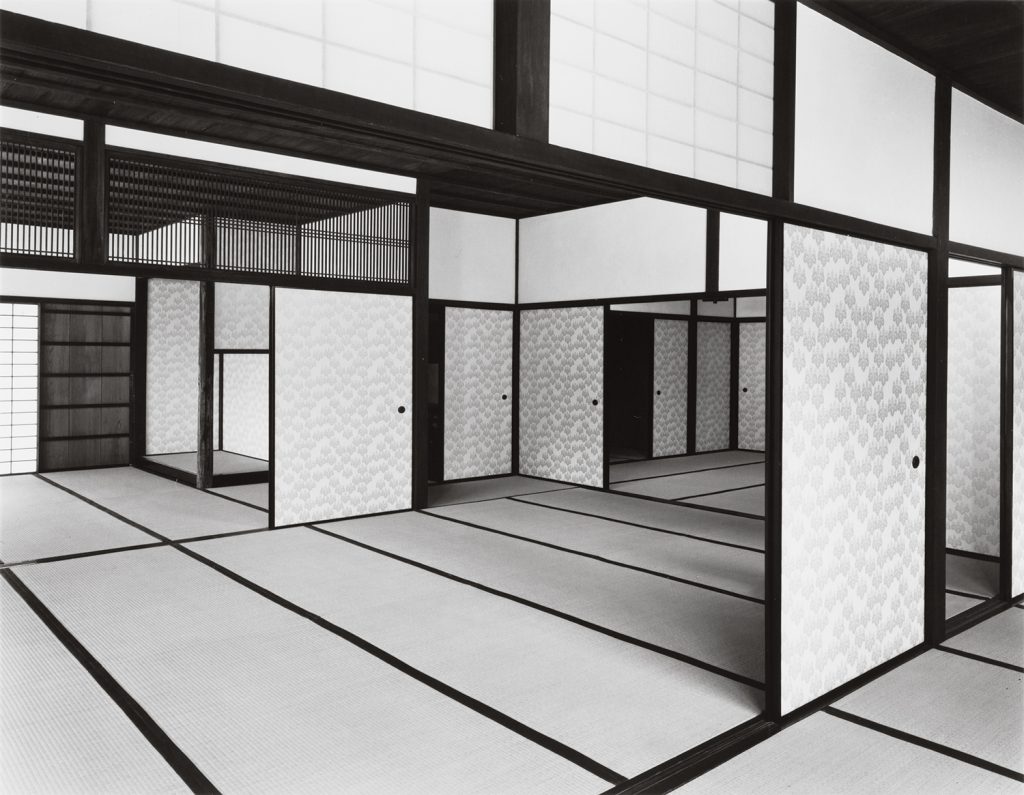
Yasuhiro Ishimoto’s photographs of carefully framed abstract architectural spaces, with clear lines and geometric forms illustrate the concept of Katei Home as a space:
Untitled, 1981-82 from the series Katsura Imperial Villa
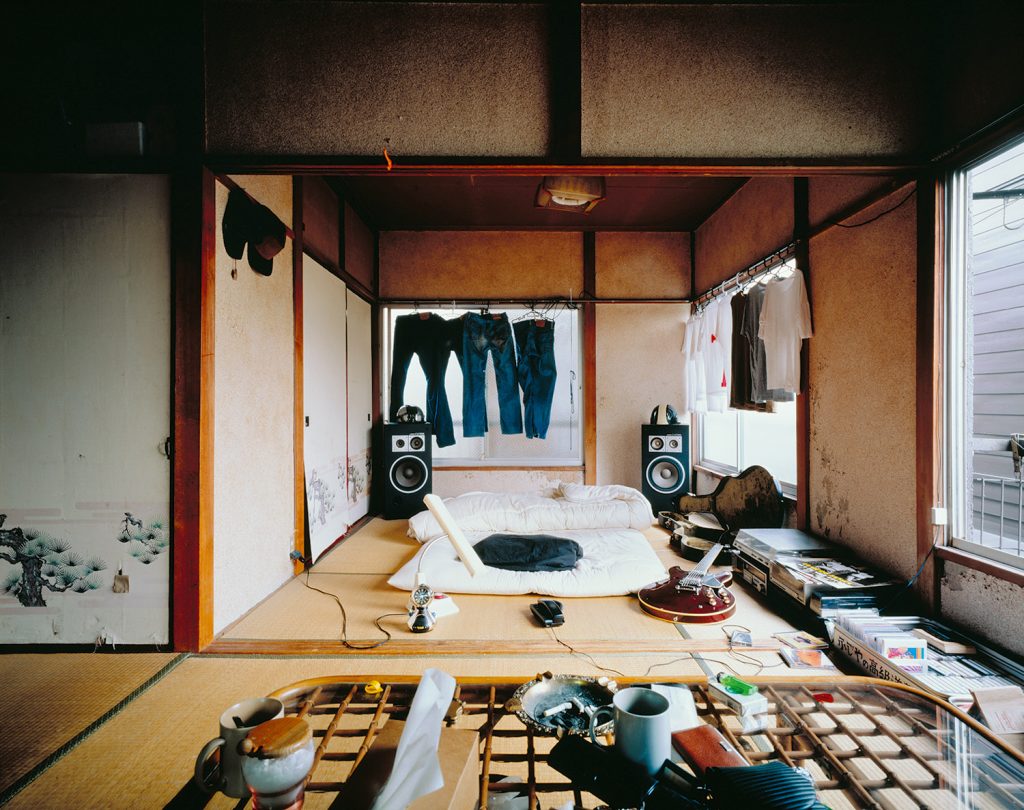
Tsuzuki’s photographs Tokyo Style Japan (1993) are more of an example of Kazoku, realistic interiors of small homes.
Kazoku where home means family are shown in images where there is a narrative quality describing people’s homes and domestic habits such as Takashi Homma:
Tokyo and my Daughter (2006)
This article and the information on the different concepts surrounding a home made me reflect on what part of home I was sharing in my assignment one “Staying safe at home”.
I ALSO CONSIDERED PHOTOGRAPHERS WHO HAD WORKED WITH OR THROUGH WINDOWS:
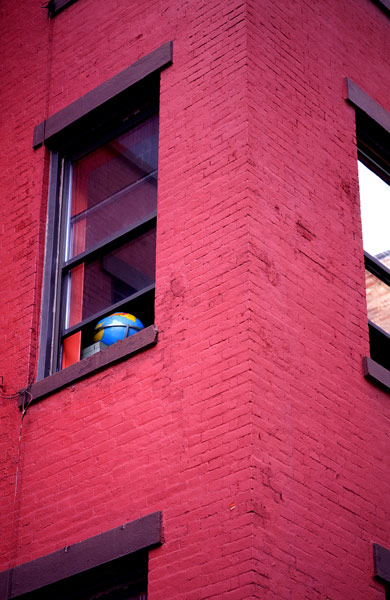
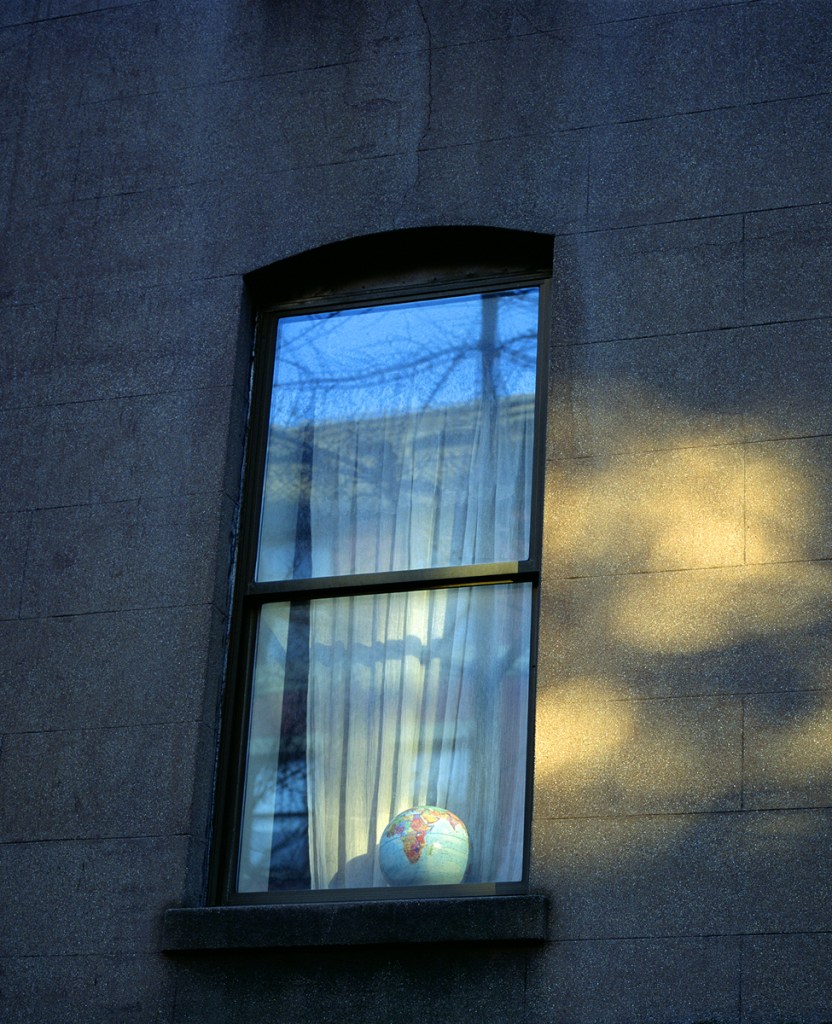
JENNIFER BOLANDE – Globe sightings (begun 2001)
Bolande photographed globes that she spotted in windows; I found this an interesting concept for work, rather like collecting but not everyday occurrences – or maybe they are when you are looking for them? The work is also a map of her physical journey and is a topological inquiry also.
(Globe Sightings, 2000)
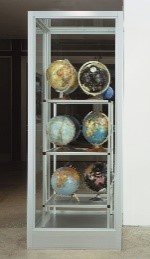
Bolande followed this up with her sculpture Mountain (2004) where she used ‘Globe Sightings’ images as the foundation for a three-dimensional topography; in this she removed the globes from their original context, this magnifies the differences between the globes, as does the work below Global Tower:
The work shows me how even when collecting like items as they viewed from different vantage points, different perspectives will appear unless you remove the context as she has in her sculptures of the work. The continuity in these photos are the globes, whilst the focal distance, the window being open or closed, the time of day, curtains blinds or no window dressing changes and the series seems the stronger for the variables.
I will definitely return to look at more of her work, her concepts look fascinating.
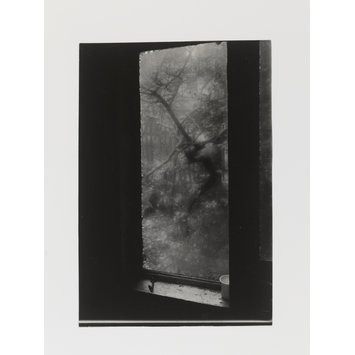
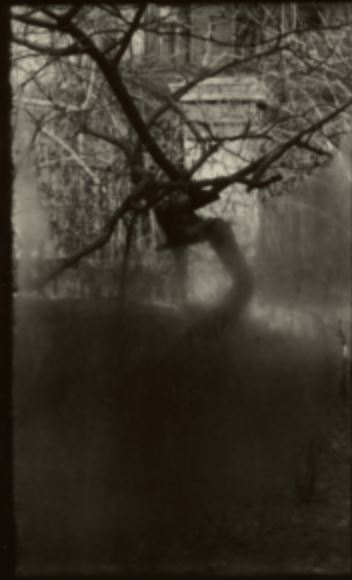
Sudek’s work combines 20th century photographic styles of Pictorialism, and Modernism with Surrealism. He was know as the poet of Prague, and apparently his images are “primarily poetic statements, to be read as a metaphor for the boundaries between the exterior and interior world, thought and observation, clarity and mystery and the material and the ephemeral” (V and A Collections 2020), he was injured in the war and his work also reflects his feelings about immobility and disconnection from the outside world. This reminds me of the work of Edward Westin and Alfred Stieglitz.
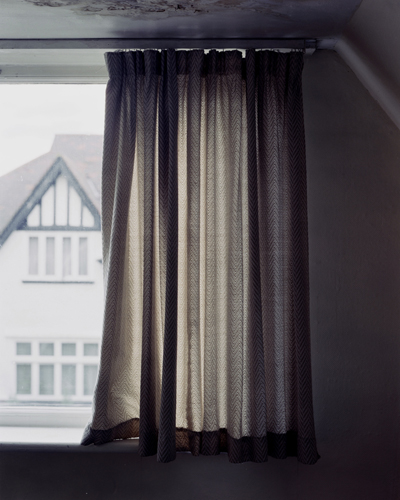
This series “From the window of my studio” of twilight scenes and images of windows, showcases this concept. The shadowy areas and low-key prints enhance the expressiveness of the images. He did explain the motive behind his work “I like to tell stories about the life of inanimate objects, to relate something mysterious: the seventh side of a dice,” (Shankar, 2016), this strikes me as same as the objective of my assignment 1.
There were two windows in his studio, one overlooking an unimpressive line of buildings the other a more scenic small courtyard, with a twisted apple tree. He photographed these views over 14 years at different times of day, seasons, and weather. There are an amazing amount of variations and the work shows how ultimately photography is all about light. He was obviously fascinated about how glass reflects and bounces light, as well as creates shadows. His images also often include vases with water and reflective table-tops.
Scaldaferri, G. (2020)
(Getty Museum, 1940)
(Josef Sudel, 1944-1953)
(Josef Sudel, 1944-1953)
Reviewing Sudek’s ideas and work makes me realise why my explorations shooting through windows have been so challenging, maybe I should go with the reflections rather than try to minimise them?
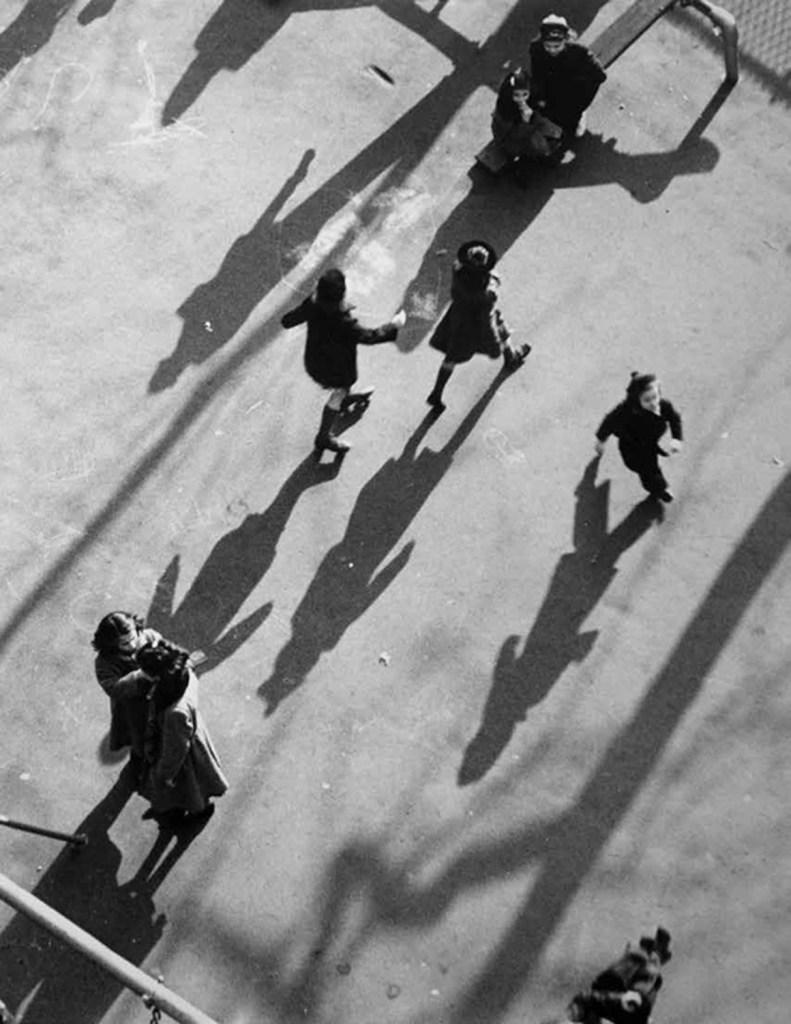
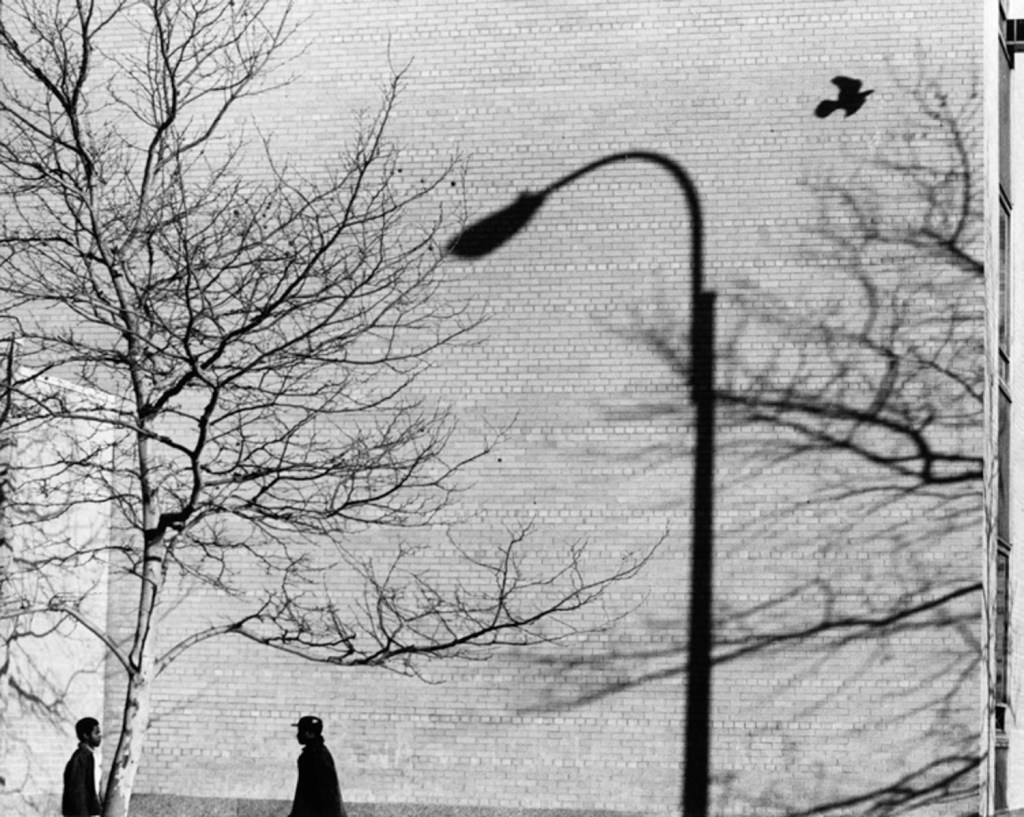
He shares many similarities with Sudek; born in Hungary, he was also injured in the war took psychic scars and spent some years recovering in therapeutic military facilities. Kertesz like Sudek during WW2 photographed from the inside to the outside, and from 1952 from his 12th story apartment overlooking Washington Square Park, began a series of modernist masterworks shot from his window that he continued until his death in 1985. His work shares Sudek’s sense of isolation but more so has a Voyeuristic quality. His vantage points were higher than Sudek’s and I’m guessing more windows, and he was able to capture a wider variety of subjects. Kertesz also liked to photograph objects against the inside of his window, particularly those that reminded him of his wife after her passing. This is another photographer who I should study further and it would interesting to do this in conjunction with studying Sudek.
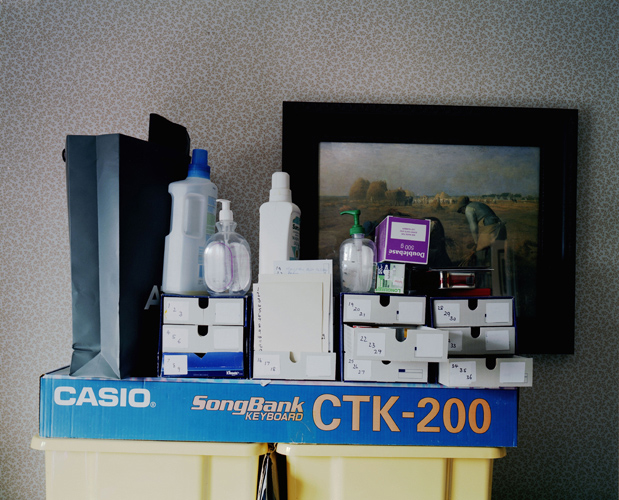
I revisited Nigel Shafran’s work for he everydayness of it:
NIGEL SHAFRAN
Nigel Shafran’s was initially known as a fashion photographer, yet his observation-led photography became influential in the 1980s. He is most known now for his photographs narrating everyday life. Even though his photographs are of everyday things he finds beauty in the ordinary and he likes us to accept things for the way that they are. He communicates his ideas in a simple way, and asks why complicate something as you might mess it up? (Smyth, 2018). In presenting things in a straightforward way he seems to emphasis both their detail and their ordinariness. Interestingly he calls himself a family photographer, though of course not the usual sort of one!
Anna Fox: Consistent angled perspective, clarity, good d of f.
Ischino: It is the feelings that he is trying to express in his images that interests me, and this reminds me that I should consider what feeling I’m trying to convey in my assignment 1, I particularly identify with “a frame on the wall ever so slightly crooked” and a what happens when a house becomes unfamiliar.
Robert Adams: bring to our attention the ordinary and often overlooked in a sympathetic way, also the sense of abandonment and the sense of a room left behind by humans and the atmosphere and feelings with it. it is the emotion of the scenes that he captures that interests me.
Fritsch article on Japanese photographs of home: the different concepts surrounding a home made me reflect on what part of home I was sharing in my assignment one “Staying safe at home”.
Jennifer Bolande: That subjects viewed from different vantage points/perspectives will (which you usually have unless you remove context)appear unless you remove the context The continuity can be the subject itself even if the focal distance, the window being open or closed, the time of day, curtains or blinds or no window dressing changes and the series may be stronger for the variables.
Josef Sudek: What interest me was that this work is “primarily poetic statements, to be read as a metaphor for the boundaries between the exterior and interior world and that his work also reflects his feelings about immobility and disconnection from the outside world. He used photography to tell stories about the life of inanimate objects, this strikes me as same as part of the objective of my assignment 1. Reviewing Sudek’s ideas and work makes me realise why my explorations shooting through windows have been so challenging, maybe I should go with the reflections rather than try to minimise them?
Kertesz: A sense of isolation and photographs of objects against the inside of his window.
Nigel Shafran: Beauty in the ordinary, by presenting things in a straightforward way he seems to emphasis both their detail and their ordinariness.
in Understanding a Photograph, Chapter appearances (Berger, 2008)
Whilst responding to the below exercise I was directed in one of the blogs to Berger’s chapter Appearances in his book Understanding a Photograph (2013). This book is a collection of essays across 40 years. These are some of the interesting points the chapter raised for me:
All photographs are of the past and “give us two messages: a message concerning the event photographed and another concerning a shock of discontinuity” (p86) as there is a large gap between the taking and the viewing.
The ambiguity of a photograph is because of this discontinuity as they preserve a moment in time as a disconnected instant; yet meaning isn’t instantaneous but contextual and historical.
For a photograph to have meaning it must have a duration beyond itself, both a past and a future.
So all photographs are ambiguous as they are taken out of a continuity; though this can give them a unique means of expression.
Berger asks whether photographs are an artefact, or a trace left by light that has passed through an object?
A photographer only choses an instant to take the image in the present and therefore has weak intentionality. The photographer does choose the event to capture and how to represent it, this roots the intention it the context of his life and experience. But this doesn’t alter the fact that a photograph is actually just a trace of light passing through a lens and imprinting on a film.
Berger points out some differences between photographic representations and drawn ones:
Photograph
Drawing
Instantaneous
Made over time
Time is uniform across all elements in the photograph
The artist can apportion time as they wish to different elements of the image
It’s representation is not impregnated by consciousness or experience – they supply information without a language of their own
So it seems that the camera cannot lie and a photograph cannot although paradoxically the truth it tells may be limited by the photographer. Berger cites some different purposes for photographs and how this can affect their truthfulness: Scientific investigation, public communication, the media. In science the photograph supplies missing detail, where as in communication and media the truth is more complicated.
Photographs “quote from appearances” (p128), are discontinuous and therefore ambiguous though this can be reduced by text/information. You can use this discontinuity to make photographs expressive, as broken narrative causes viewers to ascribe meaning.
If I take Berger’s assertion that “a photograph is actually just a trace of light passing through a lens and imprinting on a film”, then even if taking account their context and discontinuity from the moment they are shot they are documents.
RESEARCH POINT 1: HISTORICAL DOCUMENTARY PHOTOGRAPHERS
We were asked to research some of the historical developments in documentary photography outlined above.
I have begun my documentary research with an overview using the book The Documentary Impulse (Franklin, 2017)
Franklin talks of the documentary impulse being evident 10,000 to 50,000 years ago as self- representation, evidenced by cave drawings and inscriptions in pyramids and other tombs. As captured by Sebastiao Salgado in 1986 when he took photographs of the documentary accounts of gold mining in Brazil’s Serra Pelada dating back to 700 BCE. So before photography this “documentary impulse was sutained by representations in painting, mosaic, ceramics and sculpture (Franklin, 2017, p14).
However it was photography that became the preferred way to capture scientific discovery and exploration in the 1900s. It evolved from the photographic keepsakes of the Victorian times (miniature portraits, postcards) and franklin points out that even work by some of the 20th century documentary photographers such as Sally Mann, Eugene Smith and Elliott Erwitt were in fact f their families (Franklin, 2017, p26).
Photography made the documentation of scientific exploration more objective than the romanticised representation of paintings, these were some of the early documentary photographs:
Tromholt’s photographs of both the Northern Lights and the peoples of northern Norway.
Francis Frith’s photographs of the Suez Canal at Ismailia (c.1860)
Timothy O’Sullivan (1867-9) images of Clarence King’s geological expeditions.
Carleton Watkin’s daguerreotype stereoviews for the US Geological surveys in the Yosemite Valley.
Herbert Ponting’s photo essays of China, Japan, Korea and Burma and magic lantern slides of Captain Scott’s first expedition to the Antarctic
Franklin suggests that the term documentary was first used by Grierson in 1926 referring to a film, but had been used in France to describe films about travel and exploration as far back as 1911.
Reference:
Franklin, S., 2017. The Documentary Impulse. London: Phaidon Press.
SELECTED EARLY DOCUMENTARY PHOTOGRAPHERS
I’ve chosen at this point to research two photographers mentioned in the OCA handbook that to this point that I’ve not researched before:
Felice Beato (1832–1909)
Was among the first photographers to provide images of newly opened countries such as India, China, Japan, Korea, and Burma. As a war photographer he captured several conflicts: the Crimean War in 1855–56, where he took photographs in difficult conditions.
He photographed the aftermath of the Indian Mutiny in 1858–59, and set up studio in Calcutta and travelled behind The Army throughout India. Typical of his work is this photograph of devasted buildings in Lucknow after the Indian rebellion of 1858; in some images like the one below, adding corpses and arranged bones to heighten the dramatic effect of the massive slaughter that occurred at Lucknow.
Interior of the Secundrabagh after the Slaughter of 2,000 Rebels, Lucknow, Felice Beato, 1858 (Getty Center Exhibitions)
He also documented the Second Opium War in 1860, entering Hong Kong with British forces en-route to invading china, carrying for the 8 months the heavy equipment needed for the albumen process (chemicals and large, fragile glass plates). Once again many of his images post battle scenes were very graphic. This one of the Fort Taku captures senseless slaughter.
(Beato, The Met 2020)
The Fort was stormed following an explosion, captured as part of a long struggle by Western nations to open China to trade. Beato’s photographs, from inside the fort, shows the bloodbath carnage with a brutal directness (The Met, 2020).
Beato worked in a variety of ways including topographical and architectural views, including panoramas, as well as portraits and costume studies of the countries he visited or in which he resided. In China he photographed both Chinese and British notables and also made architectural views of the cities of Peking and Canton like the on ebelow of the shops of Treasury Street.
Treasury Street, Canton, Felice Beato (Getty Center Exhibition
Beato took probably the only photographs ever made of the interior of the summer palace north of Peking, before it was destroyed by fire, by order of Lord Elgin.
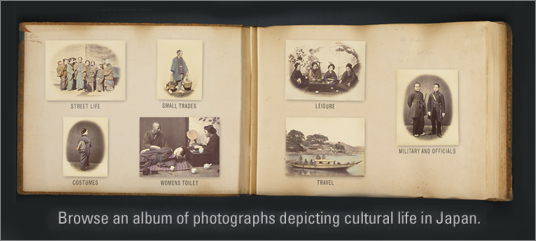
Beato then spent more than 20 years in Japan (1863–84), where he opened a gallery. Here he used the wet-collodion method, reducing the length of exposure to seconds and made the first hand-coloured photographs and albums:
Beato (Getty Center Exhibitions)
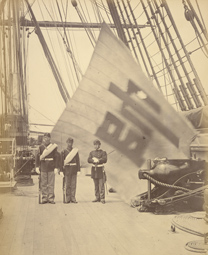
Beato accompanied the American expedition to Korea in 1871 to negotiate after an international incident; the country had been “closed”. The negotiations resulted in violence, killings and captures; Beato documented the successes of the American in the campaign like this image captures American military officers posing in front of a captured Korean flag they captured at Fort McKee.
The Flag of the Commander in Chief of the Korean Forces, Felice Beato, June 1871 (Getty Center Exhibitions)
Beato worked in Burma (1887–1905)which was a province of British India and a tourist destination for Westerners. He established himself by finding then capturing the interesting landscapes and architectural views, and combined this with portrait studies.
The Forty-nine Gautamas in the Sagaing Temple, Felice Beato, 1887–95 (Getty Center Exhibitions)
His brother Antonio Beato also a partner of james Robertson photographed Constantinople, Athens, The Crimera, Malta, and the Holy Land (1851-57). Antonia had a studio in Luxor was best known for his photographs of the Middle East whilst working with archaeologists on excavations and making views for tourists.
My reflections:I am particularly struck with the variety of his portfolio. His photographs were very varied, battle fields, architecture, portraits and records of overseas life at the end of the 19th century. Felice Beato was one of the first professional photographers to extensively document Japan and China. His style of photography of battlefields, were shockingly innovative, not only because he was the first to show images of the dead, where he pioneered a new style of war photography in a graphic way.
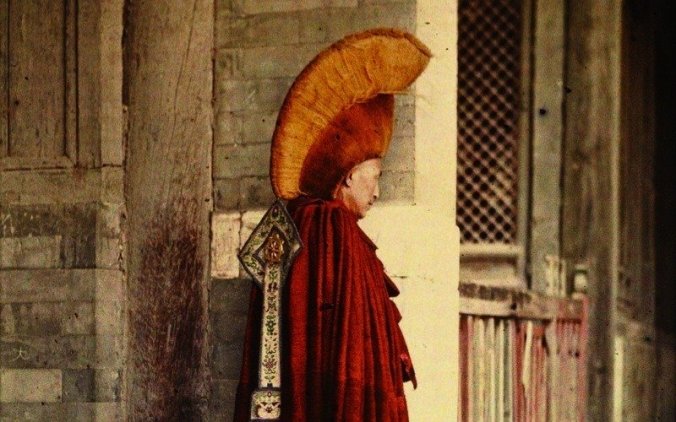
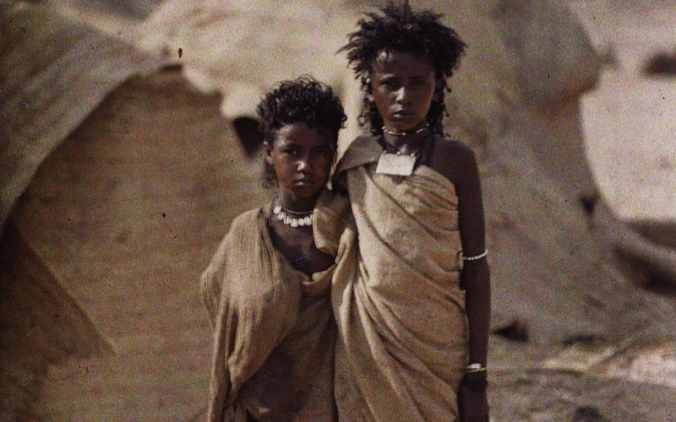
He was a French Banker and Philanthropist who from 1909 started documenting every culture of the global human family. He financed and sent a team of photographers and cinematographers to take pictures of everyday life and it’s peoples from 50 countries around the world, until 1931 an ambitious project. He used the autochrome process, the first industrial technique for coloured photographs developed by the Lumière brothers in 1907, to record 72, 000 images of cultures around the world. He kept very organised records in files at his home, now called “The Archives of the Planet” containing both films and pictures. Unfortunately, his work ended when he became bankrupt in the Great Depression.
Macedonian men photographed by Auguste Léon in 1913. Stéphane Passet’s autochrome of the Boat of Purity and Ease in Beijing, China in 1912 A Buddhist monk in Beijing, photographed in 1913 by Stéphane Passet. A Buddhist monk in Beijing, photographed in 1913 by Stéphane Passet. An autochrome plate of a Senegalese soldier made by Stéphane Passet An autochrome of the Eiffel Tower included in “Archives of the Planet.”
My reflections: Again I am most surprised at the variety of work that he commissioned and collected, although his images were more controlled and pictorial than Beato’s.



















 Photography 2: Documentary