Seeing Vs Looking What does it mean to be a photographer and other topics – Tutor led by Andrea Norrington 16.9.20
This topic has become of increasing interest to me particularly since I started level 2. Andrea shared a blog post from Grant Scott on the difference between looking and seeing:
“I believe that it is the photographer’s responsibility to define the difference between someone who looks and someone who see’s. Looking is relatively easy and therefore open to all, seeing is more difficult and requires the eye to be trained and regularly exercised.” (Scott,2020).
We discussed “Slow looking” and I shared my experiences with the photograher’s Gallery which I’ve already documented on my blog. Maria Gainza, a 43-year-old Argentinian art writer, whose writing is sometimes compared to John Berger also writes about slow looking; she writes about how we are never looking at just one thing: we are always looking at the relation between things and ourselves, “As Thoreau wrote, ‘It’s not what you look at that matters, it’s what you see’ (Haig, 2020)
In letters from Toven, Jansson the writer of Momins suggest how you should look slowly:
“ In a church say, don’t go systematically round the walls casting an eye on every Madonna or crucifix and find you remember none of them. But just stand where it is at it’s most beautiful and drink in the feeling of the church.” (Letters from Tove, 2019)
As a photographer:
Learn to see through the clutter
Take one subject and really focus on it
Have a familiar place or subject that you photograph
So how do we see differently?
Beau Lotto Deviate book was suggested again! I have it – I must read it!
Mona Lisa’s smile film! Watch! Where the students learn to really see.
Think about emotionally experiencing as well looking.
David Suchet photographs and describes how his father taught him Photography:
The most important lens on your camera is your eye
Don’t take what you see, take your emotional reaction
Note how you react to what you see and see if you can replicate what you feel when you see it.
You need to keep exercising the visual muscle by taking images; indeed I was listening to a podcast by David Hurn (FfotonWales, 2016) where he said exactly the same thing.
The session underlined the view that I’d already developed, but was useful.
PHOTOGRAPHY DURING A GLOBAL PANDEMIC. Facilitator Arpita Shah OCA Tutor: 11.9.20
AIM: To explore the creative ways contemporary photographers have been working to make inspiring and meaningful photography work in these unprecedented times.
Some of the photographer’s work that we explored was similar to work that I’d already come across, what I found interesting here are their methods and motivations:
This work I found less innovative, inspiring:
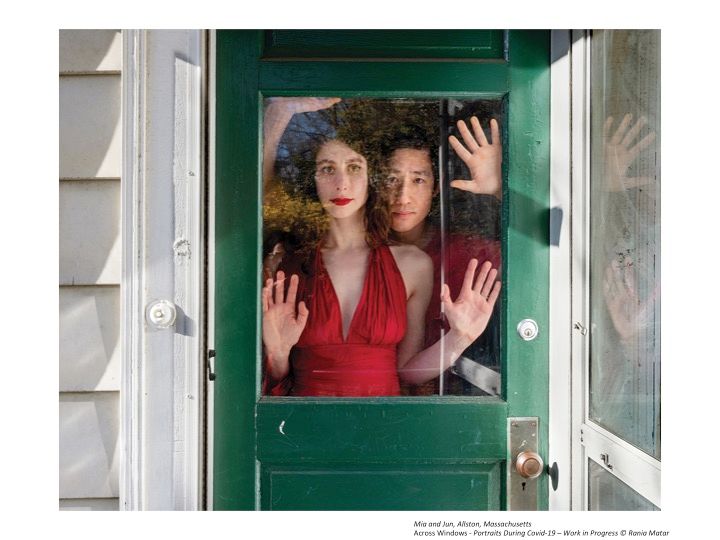
Rania Matar a Lebanese/Palestinian and American photographer she straddles cultures and identities. “Across windows” Portraits During Covid 19 – work in progress, this was shot through windows of people at home with the windows acting like a stage. It is interesting that she describes the connection between her and her subjects, a blurring between outside/and inside and “looking in, but seeing the outside reflected onto the person in front of me”.I didn’t find this work innovative.
(Across Windows (2020)
Clara Leeming “Levy lockdown portraits” (260 portraits over 38 days) similarly has shot through windows documenting communities, migrants, travellers. In her case she likes the surreal visual metaphor that the glass gives and that she can get close to them as the glass is between them. She has to work fast as she is shooting while walking with her kids; this gives the unstaged look that they have. The style here is a little different to other’s I’ve seen.
(Locked down, 2020)
Eleanor Carucci’s work “A Photographer’s Diary of Life in Isolation” doesn’t do it for me. They are every day and intimate images of her daily lockdown life in New York, though I can appreciate the way she has used flash to create strong shadows and give the images a strong documentary feel.
(Carucci, 2020)
Jan Enklemann a documentary travel photographer began photographing March 23rd the evening lockdown was announced. She takes advantage of a city devoid of people , the images show the stillness of a city in artificial ambient lighting which makes them look like film sets to me.
(Lockdown London, 2020)
Reuben Radding Street photographer “Corona Diary 2” is B/W images, this is normal to him, but of people on the streets in masks. To me it’s a typical photographic take on the streets in the time of Coronavirus.
(Reuben Radding photographer, 2020)
Rinko Kawauchi’s‘ “Keeping the fire going: a visual response to coronavirus’ was to click the shutter when he felt like it as a response to the situation saying that his images drag her notions from his subconscious. The work seems very typical of her usual work to me:
(Kawauchi, 2020)
Celine Marchbank shot 70 images over 7 weeks of flowers blooming and dying giving them the appearance of old masters still lives (Shot in Isolation, 2020). it is one way of representing isolation in lockdown.
Amy Elkins an American self- portraitist, continued her work by photographing herself during the global pandemic wearing things gathered from her house, with lists of what she shot with and why alongside the images. This reminds me of feminist work I have researched previously.
(@thisisamyelkins)
These next works I found more original:
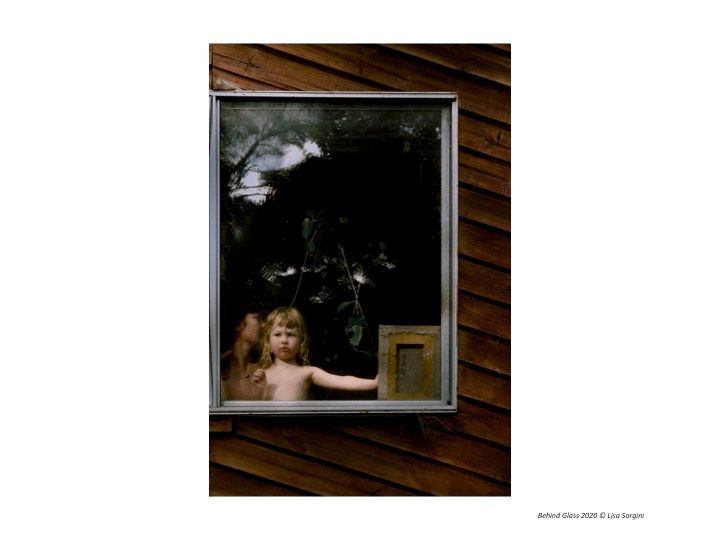
Lisa Sorgini an Australian whose work focuses on the relationships between mother and child and the notion of home. She prefers to work with natural light her images are dreamy, painterly and tender. Her work “Behind Glass”, documents 25 mothers and their children in home isolation. She says that she intends to make the invisible role of parenting visible”. I notice that she composes her images at angles and crops in an unusual way; is this her reflecting herself on the images? “
(Lisa Sorgini, 2020)
Don Ripper “In the time of corona virus portrait series, people in masks; in fact he was documenting the effect of social distancing on individuals and couples. It struck me that I’ve not seen much work in B/W in the time of Covid 19. They appear rather like Victorian posed portraits, which when you learn that he used a 2014 Petzal lens adapted for digital cameras derived from the first portrait objective lens of 1840. They do express alienation and uncertainty and isolation; he believes they also show unification, but I don’t see that, see much sadness and loneliness.
(A Pandemic Portrait, 2020)
Some of the photographers work took me back to photographers that I’ve been researching for assignment 3 such as Martin Parr, Simon Roberts, Anna Fox and Paul Reas:
Agnes Sanvito’s London Queues is very straight forward and is remenisant of the work of Martin Parr and Simon Roberts. I love the saturated colour images and wondered if and why not queues haven’t been shot in Britain before as it’s such a British thing. However I read that she was shooting queues before Covid, perhaps because as an Italian Queuing is alien, though now there is social distancing in the queues. Apparently she is fascinated by the behaviours in queues, and this makes me think about other behaviours Britsih or otherwise that would be interesting to shoot.
(Design Exchange, 2020)
Robert Ormerod shot his Edinburgh neighbours in their gardens using a drone for “It’s our Sanctuary”Gardens in lockdown as seen by a drone. The grass lawns are a common feature, but the drone perspective creates interesting juxtapositions. He says it’s a record of the time and symbols of recreation, relaxation and domesticity however I think it is also a showcase of Britishness.
(Cosslett, 2020)
Some of the work really inspired me, I found it aesthetically and conceptually appealing:
Neha Hirve is an Indian Photographer so that immediately got my interest. The work “both your memories are birds” was shot in his childhood home in Pune. He talks about the pressure cooker of life, the flow of misinformation and news and represents this time and his childhood memories with images of his home, mudane objects and settings interspersed with portraits and anatomy close ups. The mixture of black and white in a variety of tones with colour images works well and I find the images both evocative of India and a strong narrative of personal space.
(Hirve, 2020)
Alexia Webster a South African photographer also works with childhood memories. In “Contact tracing” she moved into her childhood home and projected archival photographs around her home exploring the relationship of her family with their house. I find this an interesting project, the method she has used. She also relates her work to exposing the deep inequalities inherited from Apartheid, so like Hirve is showing us on the inside of her home reflections of the outside world.
(Webster, 2020)
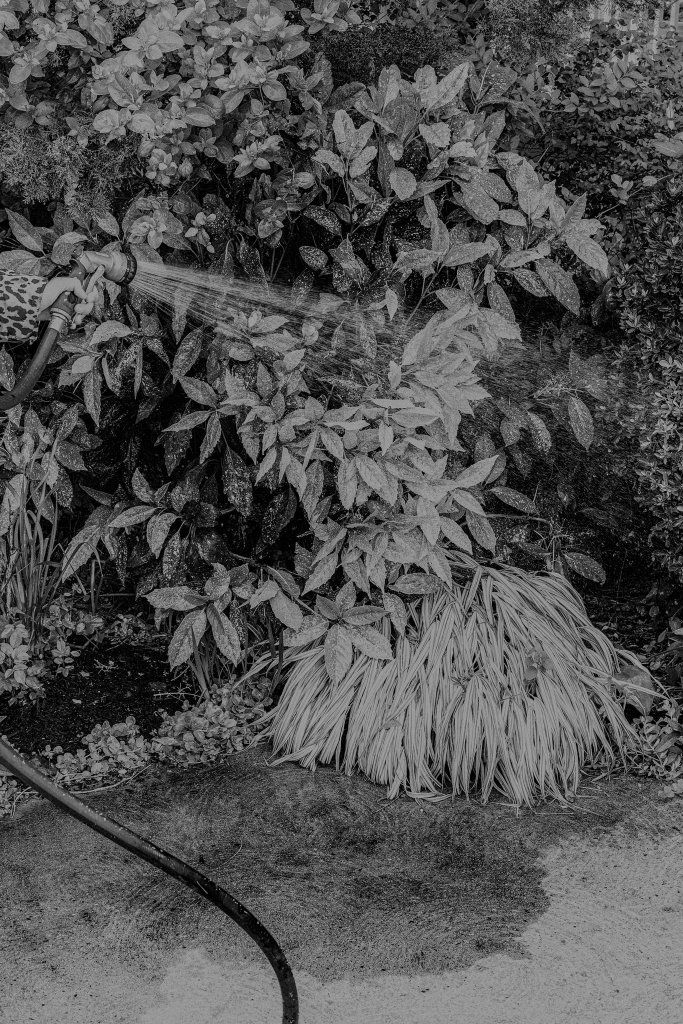
Devin Yalkin, another photographer we explored led me to this work. Yalkin spent lockdown in a house on the Jersey shore. I absolutely love the way that rather like Hirve he takes B/W photographs of the mundane, some with touches of people. He describes how he had time to photograph his surroundings constantly “There’s more clarity in being able to just look and watch things occur, especially in such a liminal space”. I find the work hugely evocative of time and place.
(Ruben, and Webster, 2020)
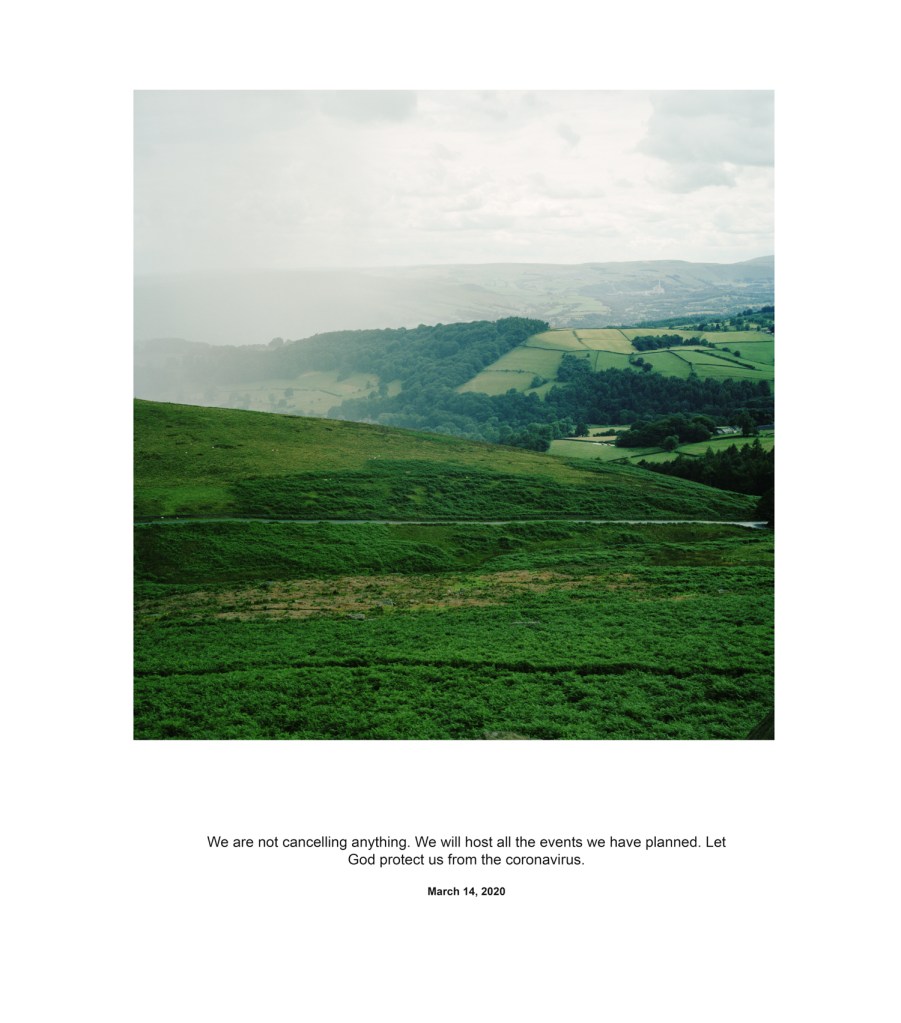
George Selley’s Lock down project “Pubs shut til Xmas” interests me in the way he combines image and sound from landscapes in what first seems an unlikely alliance-locations of where first human species were found in the UK with anonymous quotes from world leaders. I am considering what text I might put with my car park images so this is particularly interesting. He explains that the photographs and sounds demonstrate metaphorically and literally, our temporality.
(Warner, 2020)
My learning points:
This was a lot of photographers and work to look at in one sitting, however it was useful because while reflecting I was able to determine which had had an impact on me such as Yalkin, Hirve and Webster and why. With Yalkin and Hirve I was struck by their representation of consciousness through the mundane and their mixing of different focal lengths, the inclusion of humans sometimes and sometimes not – I find their work very evocative, and would like to explore and try something similar myself.
I was also helped by coming across the work of George Selly and his use of juxtapostioned text and images.
I was also able to filter out work that I consider more mainstream and less interesting, and feel that I used a critical eye.
Mock-ups of exhibition spaces, Ceramics, Fabrics, T-Shirts …. and other BUT must suit the message of the piece. Should not dilute the work.
Slideshow/Presentations:
Research other’s, and share examples in chat or on Forum thread.
How do they use titles, text, music/spoken word?
What works? What doesn’t? How long?
Be prepared to put in the time to edit BUT a worthwhile skill to learn.
Exhibition considerations:
Physical or online?
Think how to record digitally.
Research with galleries large and small showing work online; what works, what doesn’t? Make notes and bookmark/take screen shots/recordings of good examples.
Pace the work:
Get input into your work before you deem it ‘complete’.
Leave time to work on an assignment – it needs to breathe between shoots/edits.
Reflect on your work regularly and then action plan where next – use your learning log to record this.
My learning:
This was a really useful session, especially on book making which I need to do for assignment 3. I will also revisit the considerations on exhibitions when I need it.
Being Critical Tutor led by Andrea Norrington 20th July 2020
This was a really useful session, we discussed:
Bring critical on:
On the work you read – by peers and other academics/writers.
On the work you view – by peers and other artists.
On your own work in progress – use reflective practice to evaluate and move forward with projects.
On selecting work for assignment/assessment. Don’t rush decisions, it’s good to live with work before submitting. But when you submit be final in your choice, don’t leave it to tutor/assessor to decide on edits for you.
Being critical is not being negative. It is not designed to pick faults but rather to be a process where you engage with work and move forward:
How do particular texts work?
What effects do they have on the reader?
Who has produced the text, under what circumstances, and for which readers?
What’s missing from this account?
How could it be told differently?
Think: What? Who? Where? When? How? Why? And then move onto: • What if • So what • What next
This process allows to work through the following stages:
• Describe define terms: say exactly what is involved
• Analyse examine how parts fit into a whole: give reasons, compare and contrast
• Evaluate judgements: on success/failure, conclusions, recommendations
Critical thinking can also be used to ask questions about and assess other people’s writing. Try asking questions about a text to see how scholarly or scientific it is: What does it claim to be true? Can you believe its claims? Does it provide you with good reasons, evidence, or both to support its claims? And how ‘good’ are the reasons, or is it ‘good’ evidence?
Four questions to frame critique:
Describe- what do you see- explaining only what is in front of the audience
Analyse -how has it been done: techniques, formal elements
Interpret– what do the audience get from it, meanings, visual communication, mood, how do they feel about the work?
Judgement– now the audience know the facts what do they think? Does it work, what else can be done for it to be engaging?-
An important way to demonstrate the quality of your arguments, or evidence, is by referring to work by others:
“The status of work depends on how authoritative it is, look for ‘authority’ in references to relevant supporting work which has been published in academic journals, or text books (the content has been ‘peer-reviewed’, it should be independently evaluated by another qualified academic); this is unlike the material which may often be found in newspapers, magazines or from many online sources, where the content may not have been checked by anyone else, or where the work simply puts forward one person’s opinion.”
(Learning Development, 2010) The Critical Thinking PDF from Plymouth University is a very clear resource.
Suggestion: (Ossian Ward, writer on contemporary art)
(T) Time – stand still for a few minutes
(A) Association – can you relate to work
(B) Background – understanding context but no need to be an expert
(U) Understand – maybe you are just one step away from understanding
(L) Look again – second look, use background to inform
(A) Assessment –subjective but the process above allows for understanding and maybe appreciation
Make sure you have the whole picture before making judgments/conclusions
Have you got all the information you need?
How does the work fit as part of a series?
In evaluations/summaries you can highlight gaps in knowledge
My learning:
My notes from this session are now pinned to my wall, I shall try to integrate this line of thinking into my practice when researching and looking at photography – invaluable!
This was a virtual meeting. There were 6 of us at this meeting and 5 of us shared our work and personal projects.
Digital image and culture: one member is working on Identity and layers of digital information; what people can see, what someone lets others know, and what is available about them that they are not aware of. We discussed various ways of representing the information that there is on us.
A personal project that may be used later for digital image and culture. This is analogue work as she is interested in negatives as she feels they are neglected. She has been experimenting with crafting the sprocket holes of negatives. I commented that I prefer her curled images of negatives to her folded negatives; we discussed the impact on our senses and the aesthetics of negatives that are whole, curled, flat, folded or cut. This led to a discussion on box brownies and available film which made me think about using the old cameras that I have at some stage and using analogue film.
Another is just starting assignment 2 documentary. Her concept is isolation/solitude. Whilst looking at her images I was most interested in the visual interpretations people were making of her images and the discussion that ensued about what this might say about her feelings about her concept.
One shared a book cover he had created, and we talked about text and layout.
I shared my developing work for assignment 2 Documentary which I have moved on quite a bit since my documentary hangout 2 days ago: I cut the 8 images to 6 and placed 2 scars as punctuation between the images:
I asked for comments on the choice of images, including my rejects as well as thoughts about the inclusion of scars.
Again the images were said to be strong, especially the “Hollywood bowl”, it was suggested that I include the Aquadrome and the fairground image if I moved back to 8 images – This met with my thoughts and conformed that I was right to drop the “closed”café and pub garden. There was an observation that the vertical and horizontal lines are especially dominant, and I think I should look to enhance this.
Following the discussions, I am going to continue with 8 images but experiment punctuating them with smaller images of scars either body scars or physical ones on the landscape) possibly these in black and white. Whatever I produce I will explain on my blog that I would present this as a book and possibly simulate it or present it as a slideshow to show case this. I also need to do some written research on economic scarring.
Documentary fact and fiction hangout Student led 18.6.20
There were 5 of us at this meeting. We talked again about assessment and learning objectives. We also discussed the new OCA learning portal which I must look at. I was able to share my developing work for assignment 2.
I sent 8 images of my work to the shared google drive for discussion:
It was thought the strongest image is Hollywood bowl.
In my rejects the Aquadrome picture was thought to be strong, and the barriers lack of people and cars are enough to show that it is closed.
I was reminded that for digital assessment not al of the work is presented so I could if I liked just present I image, in fact it was suggested that I decide now on my top 3 images.
As for the scarring, we discussed how might incorporate it, as I talked about it but haven’t done it; by overlaying scars on the images?
Yes it might be interesting to see how these images compare to new ones taken when these premises have opened again, if they do.
Overall it has made me think about being very brutal on editing the images and to test out how things look if I incorporate scars into the set. I am still concerned as to whether the work will tick the conceptual box in the brief but I know that I want to present some of these images in some way.
Book “Creative calling” Chase Jarvis, take it step by step, “You don’t need experts. You probably don’t need school. What you do need is to Create, Learn and repeat”
Map your time out.
Look ahead to assignment briefs as it primes your mind as you complete coursework.
Its fine to go out of sync but discuss with tutor. Can do timelines on padlet.
EXPERIMENTATION:
Take the obvious photos first- then review & reflect– take a view of visual thinking that develops and pursue it – Or take a different strand.
Book Deviate Beau Lotto (I have on kindle) “Seeing differently – to deviate – begins with awareness, with seeing yourself see”
James Victore “Fuck perfection” (instagram) The things that made you weird as a child make you now, don’t worry about being different.
Don’t lose your creativity as you grow up or as you have a had a gap from photographing. Your creative muscle needs exercising. Side projects can keep your creativity going, these can be personal you don’t need to share and the I phone is great for this: “When you start making creative work regularly or return to it after a long gap, brilliance will not suddenly spill out of you. Quite the opposite. Picture turning on the kitchen tap in an old, long-vacant apartment. That brown water you see at first is totally normal. Public radio host Ira Glass refers to this disconnect as the creative gap; it’s the distance between when we see in our mind’s eye – what we want to create – and the work we are actually able to create with our current skill set. It’s a painful disconnect.” Chase Jarvis.
Grant Scott Book “New ways of seeing, Photo sketching on phones, “A passion for the medium of photography should be based upon a passion to communicate and create images. Therefore, the creation of personal projects should be a primary concern and occupation for any young photographer” Grant Scott.
Take photographs that feel like seeing. He wanted to take pictures that look like you see, why should there be a difference between how you see and how you photograph, that s seeing in a state of heightened awareness. Remember the experience of looking at the image. You tube: https://www.youtube.com/watch?v=Y5xAxqbtz9o&feature=youtu.be
Geoff Dyer “The ongoing moment” (Now have) On Tropes within photography.
RISK TAKING: Get honest feedback, remember work is not final until submitted for assessment.
PROCESS: Find subjects you are passionate about, then take the photographs. Don’t force work.
There were six of us on this hangout and we discussed a variety of topics:
Critical reviews: We shared our thoughts about a peer’s essay and discussed word counts.
Book making: For assignment 3 we are asked to make a pdf of a book and blurb is suggested; I learnt that this can also be done in lightroom and will check this out.
Use of archive images: we reminded ourselves that it is allowable to use our own archive images, which could be very useful at the moment.
Truth in photography: we asked ourselves if things are constructed more now because the expectation of audiences have changed. I wonder if this could be a critical review topic?
Assessment: Those applying for July assessment shared that it is a good idea to use one document to give links to everything else to help assessors find everything.
Learning outcomes: Apparently there are different learning outcomes now to those in the course book – I found the document “Preparing for digital assessment for photography units” which contains the learning objectives that we should evaluate and evidence against; I am not currently sure how I mesh these and the assessment criteria I currently evaluate against (doing this will make it easier for me at the end of the course?). I have now watched the session run by Dan RobinsonMay 13th in photography forum: https://discuss.oca-student.com/t/photography-specific-adaptations-to-covid-19/11641/140
Listening to this I learnt that another change is that assignment 1 can be assessed if you wish as can non assignment work, whereas previously assignment 1 wasn’t assessed but was a beginning benchmark.
I was able to share my initial ideas for assignment 2 (Economic scarring) and my peers had some comments and suggestions:
I could ask on the forums for images of scars to use
I could make scars – construction!
Bob suggested I look at a photographer that displays different images together to create a third message: https://www.zednelson.com/?TearsheetsStories:thumbnails This might be useful for ideas I am currently formulating to use for assignment 3 and 5.
Lynda suggested: https://www.theguardian.com/environment/2016/oct/24/industrial-scars-landscapes-of-south-wales-toxic-j-henry-fair . She also suggested that at an “armchair street photography” workshop with Head on Photo festival in Australia and the photographer (Natan Dvir) stated that it is photography as you still have to choose your focus point, line the shot up from a certain angle, choose to zoom in/out, etc. You are taking photographs of a “virtual world”. Other photographers mentioned were Doug Rickard, Jon Rafman, Mishka Henner, Clement Valla. Just a few more options to think about”. This could be useful going forward.
It also gave me some food for thought about what I could do for my assignment 5, personal project.
Photographer Rankin recreates a famous photographic image. He works alongside David Bailey on the famous 1963 Vogue picture of model Jean Shrimpton, using 1960s photographic technology.
Bailey brought energy, charm and Technical brilliance to fashion photography and produced iconic images. Here Rankin tries to cop’s Bailey’s image of Jean Shrimpton with his own girlfriend posing:
Uses a rolliflex the same backdrop, same cardboard flap for wind, same pose…Then shot digitally to compare. The point was that he learnt a lot by going through the copying process.
Also watch Richard Avelon: Contesian (2015) Richard Avedon 7 fashion photographs that Changed the world BBC: At: https://www.youtube.com/watch?v=kj5O0sRXSlQ (Accessed 18/05/2020).
HOW TO RESEARCH:
Think laterally and use other media poetry, music, art, tv, films
Look at lighting and the construction of photos
Delve deep but explore wide
Follow up references on what you’re reading
Read what’s interesting
Move on if something is not grabbing you – be selective
Remember to look at the stars not your feet – Stephen Hawkins
“So remember to look up at the stars and not down at your feet. Try to make sense of what you see and wonder about what makes the universe exist. Be curious, and however difficult life may seem, there is always something you can do, and succeed at. It matters that you don’t just give up.”
Professor Stephen Hawking from speech given at Cambridge University in 2017.
OCA librarian Helen Barrett – Students are welcome to contact for any help (e.g. using the Online Library) this was new to me that we can contact and use her, for referencing and even if looking for research outside of UCA/OCA). Contact details are: library@oca.ac.uk or Ask the Librarian on OCA Discuss. Helen works work Monday to Friday 8.30-14.30. Also as part of the OCA Learn launch, Helen has also created a Library guide for photography students https://ucreative.libguides.com/OCAPhotography
ON REFERENCING: Good to re find that UCA recommends paperpile
RESEARCH ACTION
Your response
30 second rule – take 30 sec straight afterwards only to record my response/important points
Key elements you take from a photographer’s work – As I do
Maybe I should keep an index of my photographers research across all courses – this would be good for work that’s not relevant at the moment or that I’ve not used.
SYSTEMS
Guilty of open tab syndrome. Maybe back them up on a draft sheet?
Check out Evernote for storing you tube links *** trellofor note taking notion for note taking
ALIVE V DEAD TIME
So much content online at the moment, share with others even if it’s poor
Be critical of your sources question everything
Think about the source of the story- context/angle
If you only read the books that everyone else is reading, you can only think what everyone else is thinking – be divergent
Note to self to make a personal index of research done on photographers across all courses
Checkout evernote for storing you tube links?
Be curious – don’t let the course work stifle my curiosity; so don’t feel guilty about taking time now to access all the virtual material available even if its slows me down
Look for Dan Robison q and A on new assessment under the forum photography under Covid 19.
References:
BBC Two – Bitesize Secondary, Creative and Media, Media, David Bailey – recreation of an iconic photograph (s.d.) In: BBC At: https://www.bbc.co.uk/programmes/p010wn00 (Accessed 18/05/2020).
We discussed the new submission system, particularly whether it will remain after COVID19. Then as usual we shared talks, books and research that we’d done.
Bob shared his tips on converting raws to BW in photoshop, his methods are very different to mine as I prefer to use lightroom but I made notes should I need to return to them:
Uses photoshop does a copy
For each process he makes a new layer
Then does an S curve
brings up sky by masking. When masking feathers to soften the edges.
When he’s got a punchy image the converts to BW by using a grad filter
Dodges working off of luminosity to create a contrast between dark and light
Sharpening uses high Filter- highpass and by changing the radius Can change the sharpness
Uses linear light and over sharpens slightly for printing
Adds a vinaigrette round the outside which emphasises the middle of the image
Uses Adobe camera raw to convert to jpeg
Prefers bridge for cataloging than lightroom
My takeaways to try with B/W conversions are:
When masking feathers to soften the edges.
Try converting to BW by using a grad filter
Try over sharpening slightly for printing
Try adding a vinaigrette round the outside which emphasises the middle of the image
Apparently there is an open zoom meeting 1pm 13th May on new assessment system which I will join.












 Photography 2: Documentary