How to be a creative learner. Facilitated by OCA tutor Andrea Norrington- 19th May 2021
I was asked by Andrea Norrington to be on the panel of 4 students at different points in their studies, to share our experiences of learning with other students -this was a new experience. Whilst preparing for the session and then when contributing to the discussions, and answering questions asked by OCA students, it caused me to reflect on my studies to date and I recorded items that I thought would be useful when I write my end of course reflections.
Below are the thoughts that I shared whilst on the panel:
Transitioning between courses/levels of study
Q Looking back at your studies, where do you think you noticed a shift in level of study?
Documentary assignment 2 & 3 where the levels of reading and research increased noticeably.
Approaching level 3, talking to students on level 3, I am aware that there is quite a change in approach and expectations at level 3.
Others mentioned essay writing, but I didn’t find this such a challenge.
Q Thinking particularly about Level 2 – how did you decide on courses?
Great to have more personal choice in level 2 than level 1.
I chose courses that I thought would challenge me and broaden my learning, not necessarily the ones that I naturally leant towards.
Peer support
Q Can you tell us about how useful peer support has been as you complete the final part of your degree?
Invaluable. It has been good to be a part of various groups, regional, module specific, and course specific.
Q Where have you found peer support most useful and when do you think it really started to appear as part of your study?
Though I realised its value during level 1 it was during my first level 2 course that I noticed the peer support feeding into my work and was helping to shape my assignments. This probably coincided with my growing confidence to share and challenge others to challenge me in my work.
Certainly, in level 2 tutors have frequently commented on the value that my working with peer support groups has added to my own work.
It has been useful in many ways: Critiquing of my work, learning how to critique other’s work, for technical support, and general support. The more you give the more you benefit.
Q Are there any pitfalls in peer support?How do you think OCA can assist here – is there also a place for self-sufficiency?
I have learnt to be discerning about peer groups. I initially found that level 1 groups were generally not challenging enough. However, as I have moved through my studies, I have found the peer support groups increasingly useful.
I have found being both general and specific when sharing work when asking peers questions about my work is effective.
The OCA could consider running facilitating courses for some and/or sitting in on occasional sessions to model facilitation.
Looking forward I should look to as the level 3 student suggested support groups outside of the OCA, locally and possibly professional groups.
Responding to feedback
Q – Have you had to deal with feedback either from a tutor or from formal assessment that you have been disappointed with? How do you move forward from this?
I have never had feedback that has been unfair. It always causes you to reflect, and thus move your work and practice forwards.
Feedback usually forces you out of your comfort zone which is good, and I think only then can you begin to find your own voice.
Q – When (if ever) do you think you understood the role of critical feedback in allowing your work to progress and evolve?
I have learnt to reflect on feedback at a general level for at least a few days before acting on it; this way I usually find that my brain slowly filters it and finds a way forward. Then I return to break the feedback down and address specifics.
Q – One top tip that you wish you had known when you started studying.
Have confidence and value your own ideas and opinions, don’t feel you should follow others, but at the same time be open to other’s ideas. The more you trust your instincts and experiment you will develop your own voice.
It was a new but valuable experience sharing insights with students that I don’t know, and an interesting exercise preparing with the rest of the panel and Andrea beforehand. The reflection it involved made me more aware of the journey that I’ve been on during the documentary course, and the experience that I’ve gained along the way. It was good to be in a situation where I was confidently giving to other students also, and I am well aware that I have benefited great from other students sharing their insights and experience with me in various forums along the way.
Plan, do reflect – record those thoughts capturing them before they’re gone
Plan act observe reflect – revise plan act observe reflect in a circular motion
This enables you to do the work and move forwards, documenting enables you to engage with the work at a deeper level.
Planning: Creating momentum
Remind myself to read Austin KLeon Steal like an artist which I haveand another of his: Keep Going: 10 Ways to Stay Creative in Good Times and Bad
Side projects are useful: keep you going and skills fresh
Photographing- think how you can regularly photograph – this is relevant to me
Reflection should happen throughout the course
It’s part of the planning process and can move your work forwards
Work will be more focused and structured
Use your learning log
Writing the end course evaluation will be easier
Invest in your practice by planning doing reflecting
My reflections:
Not anything new here as I attended Andrea’s sessions last year however it’s always good to remind myself of ideas for good practice. My takeaway was to photograph regularly especially as I come up to the end of this course and may have a summer break before starting level 3.
Keeping up Momentum is a student-led initiative designed to connect, inspire and motivate OCA students. This session features three students stories to inspire and motivate.
Speakers:
Jane Coxhill BA hons in painting:
There were lots of interruptions to her journey, personal circumstances but the OCA supported and encouraged her and she continued and has now achieved a first class degree.
Hugh Hadfield just completed level 2.
An illustrator with a practice rooted in observational drawing and an interest in reportage, documentary and “the slightly strange”.
Sarah-Jane Field 1st class degree in photography.
Sarah-Jane usually works as a photographer but also works for a local housing co-op, writing blogs She received marks of 90% for her last three modules; for Digital Image and Culture in 2019, and for Body of Work and Contextual Studies in December 2020. https://sjfsyp.wordpress.com/ and was the reason I signed up for this session flagged by course leader Dan Robinson. I have met Sarah Jane before on study events,
My notes on her practice:
Her work is a shift away from a western linear view of reality towards a more entangled and relational reality and a connected interest in mark making.
Works as a commercial photographer as well -suggests dissolving boundaries between research and personal life
Influenced by Judi Marshall “Living life as an inquiry” (1999), who talks about noticing if our actions end up reinforcing the systems we aim to interrogate, deconstruct and instigate change; and Sarah-Jane began to wonder if photography does this.
During self and other and digital image and culture made her explore the importance of other digital technology
Level 3: Her final project eschews the idea of a linear forward facing time arrow and the passing of time non-linearly. Her contextual study was on other types of photography to expanded moments of production.
An interesting quote shared: “Cartier-Bresson’s style of photography is still possible, still practical and celebrated, but its importance is marginal…other types of photography have become more culturally significant, ones which often involve a shift from the single moment of capture to the expanded moments of post-production” (Daniel Palmer, 2015)
Currently she is looking at mark making and makes work with other people’s photographs.
Reflections on the session:
Tips on assessment:
Explain about what you’ve done, overcome difficulties, thought processes, the complete journey – your work doesn’t stand alone.
Cross discipline work.
Difference between the pace and depth between level 2 and 3: Need to put the work in to get creative sparks, so commit to photographing.
On Problems with momentum:
Doesn’t hurt to take a break at times
Value of the OCA to their practice
Use lots of lines of enquiry to inspire work
Study whatever interests you
Use your personal experience in your work and ties this into your academic questioning
Palmer, D 2015 lights, camera, algorithm: digital photography’s Algorithmic conditions in Sean Cubitt, Daniel Palmer &:Nate, tKacz (eds), Digital Light (London: fibreculture Book Series, Open Humanities Press, 2015), 144-62.
This was a sharing and discussion with Jane Weinmann’s about her final year body of work for level 3 Climacteric, which has good examples of creating efficiencies in your work. The Climacteric A personal journey through the menopause.
Derek suggested that her journey was a good example of how to narrow down topics in self directed briefs:
She had no idea on what topic she would use when she started level 3. Advised to choose something that she could live with for 2/3 years. So she went out and just shot and explored. She found various strands she might follow, graffiti, paths, self portraits, mark making on images, notions of embarrassment and presented them to her tutor who told her she’d need to narrow it down.
Her images were personal and conceptual such as broken, dark, sombre objects. She realised her work was about her feelings and was going through the menopause and that she should go with this. Climacteric is the name for the menopause from the peri to the post menopause.
Her process:
Researched and read.
Created a survey posted in the OCA forum and to friends and colleagues asking about people’s feelings about the menopause. She wanted the work to resonate with people and asked them what visually came to mind for them.
Note the importance of referring to groups/peers. Jane presented to groups asking particularly about the use of colour, she was focusing on using the colour red.
She was then able to narrow down the strands
Looked at artists who had used colour in black and white work.
Used her contextual studies to study her ideas of using colour on black and white images.
Explored lots of ideas all the way through.
Explored beyondphotography; at one point emojs were an inspiration to her, and have appeared in her final images.
Experimented until she found something that worked.
Collaborated with others and tried to interact with the local press.
Found her own way of doing something. Her work contains a virtual exhibition, a book, video.
There was context to her work beyond the topic and ways it could be shared/of value to others. She wanted to bring awareness education and outreach and hence created a virtual exhibition and website (used billboards in the public space to bring people in). If it had been a physical exhibition, she would have used projection as well.
My Take aways:
It was useful to hear the process that Jane went through form not having a clear topic to her body of work to the final exhibition; especially as at the memonet have no ideas myself for level 3.
It was good to hear that through experimentation and research you can narrow down ideas and come to a worable and interesting focus.
I liked her Tutors suggestion that you should write an artist statement, what you want to do with it and why at the beginning/part way through and refer to it throughout to keep you focused. Maybe I should do this on my assignment 5 to help me keep my work/research relevant. Ask yourself: Is what I’m doing adding or distracting from my work?
It was good to hear her advice to find a group with good intent and ask for feedback throughout. I have 2 good OCA groups for this and should make sure I keep contributing to them, Documentary/level 3 hangout group and Thames Valley OCA group.
Derek Trillo shared that Simon Norfolk suggests that for a successful body of work you need to draw viewers in, keep them there for a while (possibly with humour), hold their attention and then they might linger and take something away with themselves. I need to remember not to make my work too dry.
Discovering images using Visual Arts Data Service (VADS) OCA: webinar 11.2.21
This session was run by the University for Creative Arts. I’d not heard of the VADs resource before. VADS is managed by the Library at the University for the Creative Arts (UCA).
Here is what I learnt:
Can be accessed by anyone for non-commercial use but must reference the images
1400 images form 300 UK art and design collections available , it is a service of the library ogUniversity of creative arts
Unique images (often not found elsewhere), specialist collections, detailed descriptions (reliable sources), British design, European paintings.
How to browse/search by collections
How to reference
J peg images not high resolutions but are suitable for essays etc.
Can save images to favourites
“Mirador” (right hand small box) can be used to open an image viewer and add others from other repositories/places to compare them.
Information given in the Q & A session was useful:
Am I allowed to use a VADS image in a non-commercial exhibition? Although in the UK it is not an infringement of copyright to put an artistic work on public display, it is likely for that you will need to reproduce images in high resolution for the purposes of an exhibition. We would recommend contacting the relevant collection owner to gain permission and obtain high quality versions of the images.
Can I use a VADS image in a Thesis? It is permissible to use VADS image in your thesis for educational purposes as long as it includes a full acknowledgement. However if you intend to make your thesis available online then it is considered a published work and you will to conduct some research to see if there are any commercial licences attached to the images. If you have checked and can’t trace any commercial licence, then it may be possible to rely on a legal exception.
Are students more likely to go to Google to find images? How is VADS ranking in the Google search results? It is an ongoing priority for us as librarians at UCA to promote the use of quality image collections that can be used in education, and not just searching via Google. Nevertheless, VADS is indexed on Google search results down to the individual item level. VADS has a lot of links from quality websites such as universities that should also improve its Google ranking.
Can the Getty Museum images be used for free? The J Paul Getty Museum website states that: “The Getty makes available, without charge, all available digital images to which the Getty holds the rights or that are in the public domain to be used for any purpose. No permission is required.” https://www.getty.edu/about/whatwedo/opencontent.html
A useful source to remember, especially if I want detailed information.
Reference:
University for The Creative Arts (2021) VADS At: https://www.vads.ac.uk/ (Accessed 11/02/2021).
Photography and Moving Image assessment advice drop in Zoom meeting: 26.1.21
I thought it was time that I engaged in preparing for assessment as I’ve not looked at submitting online assessment yet, as it has will be for my next assessment. I have heard peers discussing their online submissions and picked up some information.
Prior to this learning session I looked briefly at the digital assessment guideline.
Things that I noted:
Overall be intentional about what you share – self curate
The narrative about my assessment can be given in the learning log
On the creative 3 pieces of work: they can be across the course, no maximum of images
There was a question on the size of images (pixels) to submit which Dan couldn’t answer then – though apparently the G drive can easily cope with large image sizes.
Showing self-curation is important throughout the process; for instance you can share a body of work but cut down the number of images in it.
Upload images don’t give as links to learning log/blog, but then can link/ref to learning log; also could add relection/narrative why chosen these images in narrative presentation.
The learning log can be 12 entries, including 2-3 entries for each learning objective.
1 learning log entry can be a guide to what I’m presenting. Or I can upload a document in the creative work folder (word doc) to act as a guide.
Word count / time limit for reflective presentation or evaluation is 6 mins, or 750 words Actions:
It’s all in the edit: Narrative and storytelling Tutor led 28.10.20
This is the last of a series of OCA tutor led talks which have been really useful.
The act of taking a picture is an act of editing, “I think photography is the art of editing” (Alec Sloth)
“in the end creativity isn’t just the things we chose to put in, it’s the things we chose to leave out” (Austin Kleon Show your work)
How to approach:
Leave time between shooting and editing
Don’t edit in camera – can make really bad choices
Live with projects in process, small prints, dummy books (play with the order of things) use issuu.com, book wright, apple pages then print to pdf, lightroom book tsb is alongside develop and print
You have to have a body of work to be able to edit
Plan:
Think what is the primary nature of the project? Subject matter or how to present?
Do you need to reshoot to fill a gap or change presentation to fit with images that you have?
Write about your decisions in your learning log as you produce.
Go with the flow: A writer of crime dramas shared she doesn’t know who is the victim when she starts
Narrative: Can be personal, scripted/constructed, linear/geographical/chronological, visual, or other
Do the research: Look at how other photographers work- Make notes when you look at work: Is there more than one narrative going on? Was it a planned structure or did it evolve or come from the editing process?
Story telling – to use text or not? Look at how other projects use text: Does the text adjunct? Are the images and text separate entities sat alongside each other
Functions of storytelling can be :
Within the work
About the work
About the production of the work
Watch photography discussions online listen to the narrative they use to discuss
Examples:
For most of it I have no words – Simon Norfolk.
Survivor– Harry Bordon. Photographs of survivors of the holocaust. Their story in their own words and biographies of those photographed
Gregory Crewdson article and video on An Eclipse of Moths
Hart Island– Melinda Hunt and Joel Sternfield – Andrea wrote about this project here and the significance of the mass graves footage in 2020.
If you do nothing else: • Stay open to new ideas, Keep exploring, Disappear down the rabbit holes …
Seeing Vs Looking What does it mean to be a photographer and other topics – Tutor led by Andrea Norrington 16.9.20
This topic has become of increasing interest to me particularly since I started level 2. Andrea shared a blog post from Grant Scott on the difference between looking and seeing:
“I believe that it is the photographer’s responsibility to define the difference between someone who looks and someone who see’s. Looking is relatively easy and therefore open to all, seeing is more difficult and requires the eye to be trained and regularly exercised.” (Scott,2020).
We discussed “Slow looking” and I shared my experiences with the photograher’s Gallery which I’ve already documented on my blog. Maria Gainza, a 43-year-old Argentinian art writer, whose writing is sometimes compared to John Berger also writes about slow looking; she writes about how we are never looking at just one thing: we are always looking at the relation between things and ourselves, “As Thoreau wrote, ‘It’s not what you look at that matters, it’s what you see’ (Haig, 2020)
In letters from Toven, Jansson the writer of Momins suggest how you should look slowly:
“ In a church say, don’t go systematically round the walls casting an eye on every Madonna or crucifix and find you remember none of them. But just stand where it is at it’s most beautiful and drink in the feeling of the church.” (Letters from Tove, 2019)
As a photographer:
Learn to see through the clutter
Take one subject and really focus on it
Have a familiar place or subject that you photograph
So how do we see differently?
Beau Lotto Deviate book was suggested again! I have it – I must read it!
Mona Lisa’s smile film! Watch! Where the students learn to really see.
Think about emotionally experiencing as well looking.
David Suchet photographs and describes how his father taught him Photography:
The most important lens on your camera is your eye
Don’t take what you see, take your emotional reaction
Note how you react to what you see and see if you can replicate what you feel when you see it.
You need to keep exercising the visual muscle by taking images; indeed I was listening to a podcast by David Hurn (FfotonWales, 2016) where he said exactly the same thing.
The session underlined the view that I’d already developed, but was useful.
PHOTOGRAPHY DURING A GLOBAL PANDEMIC. Facilitator Arpita Shah OCA Tutor: 11.9.20
AIM: To explore the creative ways contemporary photographers have been working to make inspiring and meaningful photography work in these unprecedented times.
Some of the photographer’s work that we explored was similar to work that I’d already come across, what I found interesting here are their methods and motivations:
This work I found less innovative, inspiring:
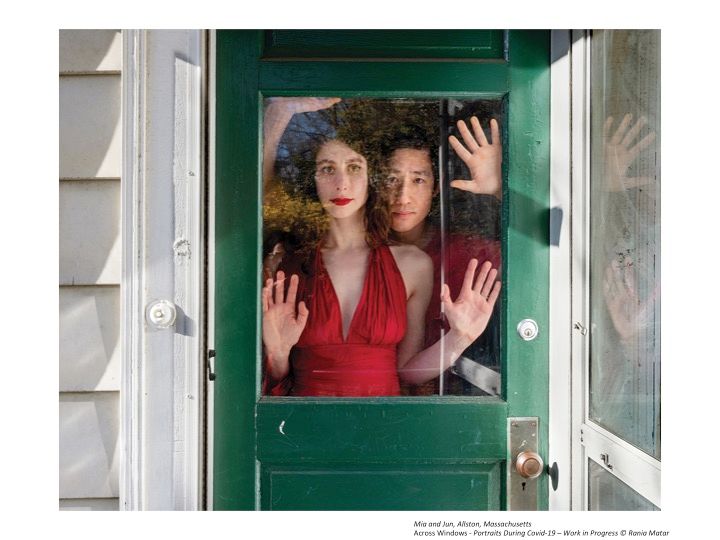
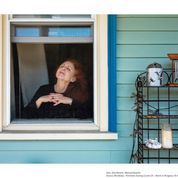
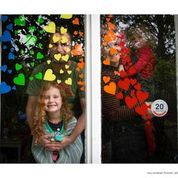
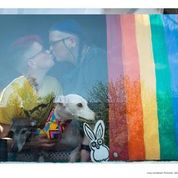
Rania Matar a Lebanese/Palestinian and American photographer she straddles cultures and identities. “Across windows” Portraits During Covid 19 – work in progress, this was shot through windows of people at home with the windows acting like a stage. It is interesting that she describes the connection between her and her subjects, a blurring between outside/and inside and “looking in, but seeing the outside reflected onto the person in front of me”.I didn’t find this work innovative.
(Across Windows (2020)
Clara Leeming “Levy lockdown portraits” (260 portraits over 38 days) similarly has shot through windows documenting communities, migrants, travellers. In her case she likes the surreal visual metaphor that the glass gives and that she can get close to them as the glass is between them. She has to work fast as she is shooting while walking with her kids; this gives the unstaged look that they have. The style here is a little different to other’s I’ve seen.
(Locked down, 2020)
Eleanor Carucci’s work “A Photographer’s Diary of Life in Isolation” doesn’t do it for me. They are every day and intimate images of her daily lockdown life in New York, though I can appreciate the way she has used flash to create strong shadows and give the images a strong documentary feel.
(Carucci, 2020)
Jan Enklemann a documentary travel photographer began photographing March 23rd the evening lockdown was announced. She takes advantage of a city devoid of people , the images show the stillness of a city in artificial ambient lighting which makes them look like film sets to me.
(Lockdown London, 2020)
Reuben Radding Street photographer “Corona Diary 2” is B/W images, this is normal to him, but of people on the streets in masks. To me it’s a typical photographic take on the streets in the time of Coronavirus.
(Reuben Radding photographer, 2020)
Rinko Kawauchi’s‘ “Keeping the fire going: a visual response to coronavirus’ was to click the shutter when he felt like it as a response to the situation saying that his images drag her notions from his subconscious. The work seems very typical of her usual work to me:
(Kawauchi, 2020)
Celine Marchbank shot 70 images over 7 weeks of flowers blooming and dying giving them the appearance of old masters still lives (Shot in Isolation, 2020). it is one way of representing isolation in lockdown.
Amy Elkins an American self- portraitist, continued her work by photographing herself during the global pandemic wearing things gathered from her house, with lists of what she shot with and why alongside the images. This reminds me of feminist work I have researched previously.
(@thisisamyelkins)
These next works I found more original:
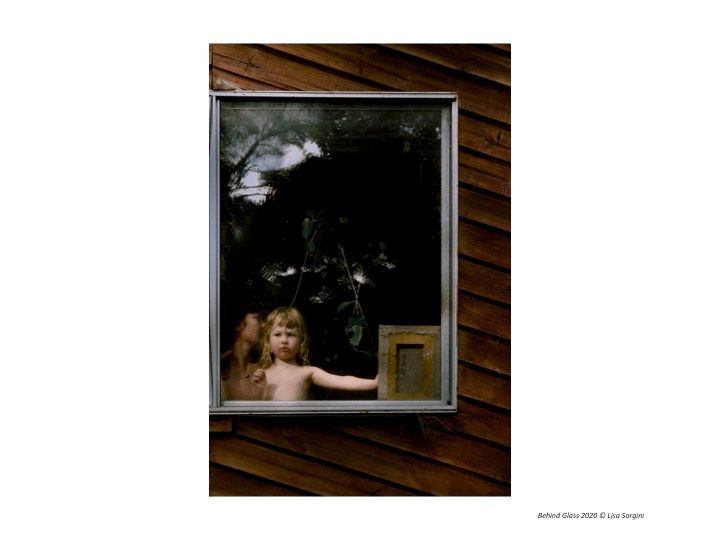
Lisa Sorgini an Australian whose work focuses on the relationships between mother and child and the notion of home. She prefers to work with natural light her images are dreamy, painterly and tender. Her work “Behind Glass”, documents 25 mothers and their children in home isolation. She says that she intends to make the invisible role of parenting visible”. I notice that she composes her images at angles and crops in an unusual way; is this her reflecting herself on the images? “
(Lisa Sorgini, 2020)
Don Ripper “In the time of corona virus portrait series, people in masks; in fact he was documenting the effect of social distancing on individuals and couples. It struck me that I’ve not seen much work in B/W in the time of Covid 19. They appear rather like Victorian posed portraits, which when you learn that he used a 2014 Petzal lens adapted for digital cameras derived from the first portrait objective lens of 1840. They do express alienation and uncertainty and isolation; he believes they also show unification, but I don’t see that, see much sadness and loneliness.
(A Pandemic Portrait, 2020)
Some of the photographers work took me back to photographers that I’ve been researching for assignment 3 such as Martin Parr, Simon Roberts, Anna Fox and Paul Reas:
Agnes Sanvito’s London Queues is very straight forward and is remenisant of the work of Martin Parr and Simon Roberts. I love the saturated colour images and wondered if and why not queues haven’t been shot in Britain before as it’s such a British thing. However I read that she was shooting queues before Covid, perhaps because as an Italian Queuing is alien, though now there is social distancing in the queues. Apparently she is fascinated by the behaviours in queues, and this makes me think about other behaviours Britsih or otherwise that would be interesting to shoot.
(Design Exchange, 2020)
Robert Ormerod shot his Edinburgh neighbours in their gardens using a drone for “It’s our Sanctuary”Gardens in lockdown as seen by a drone. The grass lawns are a common feature, but the drone perspective creates interesting juxtapositions. He says it’s a record of the time and symbols of recreation, relaxation and domesticity however I think it is also a showcase of Britishness.
(Cosslett, 2020)
Some of the work really inspired me, I found it aesthetically and conceptually appealing:
Neha Hirve is an Indian Photographer so that immediately got my interest. The work “both your memories are birds” was shot in his childhood home in Pune. He talks about the pressure cooker of life, the flow of misinformation and news and represents this time and his childhood memories with images of his home, mudane objects and settings interspersed with portraits and anatomy close ups. The mixture of black and white in a variety of tones with colour images works well and I find the images both evocative of India and a strong narrative of personal space.
(Hirve, 2020)
Alexia Webster a South African photographer also works with childhood memories. In “Contact tracing” she moved into her childhood home and projected archival photographs around her home exploring the relationship of her family with their house. I find this an interesting project, the method she has used. She also relates her work to exposing the deep inequalities inherited from Apartheid, so like Hirve is showing us on the inside of her home reflections of the outside world.
(Webster, 2020)
Devin Yalkin, another photographer we explored led me to this work. Yalkin spent lockdown in a house on the Jersey shore. I absolutely love the way that rather like Hirve he takes B/W photographs of the mundane, some with touches of people. He describes how he had time to photograph his surroundings constantly “There’s more clarity in being able to just look and watch things occur, especially in such a liminal space”. I find the work hugely evocative of time and place.
(Ruben, and Webster, 2020)
George Selley’s Lock down project “Pubs shut til Xmas” interests me in the way he combines image and sound from landscapes in what first seems an unlikely alliance-locations of where first human species were found in the UK with anonymous quotes from world leaders. I am considering what text I might put with my car park images so this is particularly interesting. He explains that the photographs and sounds demonstrate metaphorically and literally, our temporality.
(Warner, 2020)
My learning points:
This was a lot of photographers and work to look at in one sitting, however it was useful because while reflecting I was able to determine which had had an impact on me such as Yalkin, Hirve and Webster and why. With Yalkin and Hirve I was struck by their representation of consciousness through the mundane and their mixing of different focal lengths, the inclusion of humans sometimes and sometimes not – I find their work very evocative, and would like to explore and try something similar myself.
I was also helped by coming across the work of George Selly and his use of juxtapostioned text and images.
I was also able to filter out work that I consider more mainstream and less interesting, and feel that I used a critical eye.
Mock-ups of exhibition spaces, Ceramics, Fabrics, T-Shirts …. and other BUT must suit the message of the piece. Should not dilute the work.
Slideshow/Presentations:
Research other’s, and share examples in chat or on Forum thread.
How do they use titles, text, music/spoken word?
What works? What doesn’t? How long?
Be prepared to put in the time to edit BUT a worthwhile skill to learn.
Exhibition considerations:
Physical or online?
Think how to record digitally.
Research with galleries large and small showing work online; what works, what doesn’t? Make notes and bookmark/take screen shots/recordings of good examples.
Pace the work:
Get input into your work before you deem it ‘complete’.
Leave time to work on an assignment – it needs to breathe between shoots/edits.
Reflect on your work regularly and then action plan where next – use your learning log to record this.
My learning:
This was a really useful session, especially on book making which I need to do for assignment 3. I will also revisit the considerations on exhibitions when I need it.











 Photography 2: Documentary