One member who’d just started Documentary had taken photographs recently in Sicily and asked us to consider which assignment they would fit in; we did this however I wasn’t surprised that the tutor advice was to shoot images whilst working through the coursework. The course he’d been on in Italy was facilitated by Mimi Mollica and Martin Parr and he shared their thoughts that there no problem with mixing black and white or frame sizes within one series.
I was glad that Jayne Taylor re-emphasised that these sessions should be about uncompleted, unresolved work, when work is still in the developmental stage; as we can then be helped to reflect on our work and get support with the direction that we’ll go in.
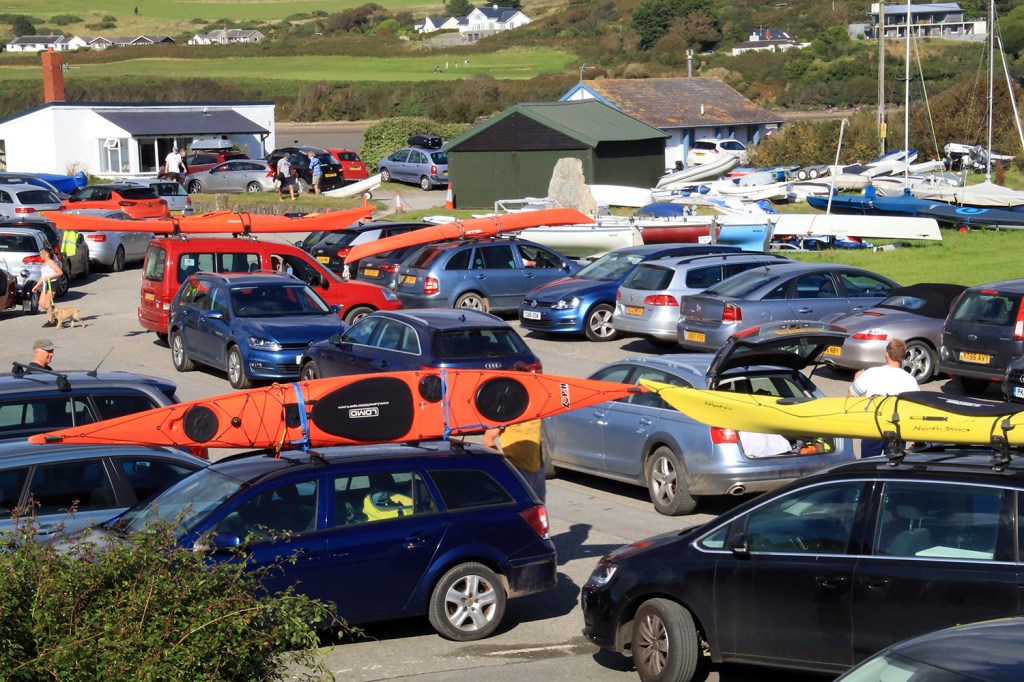
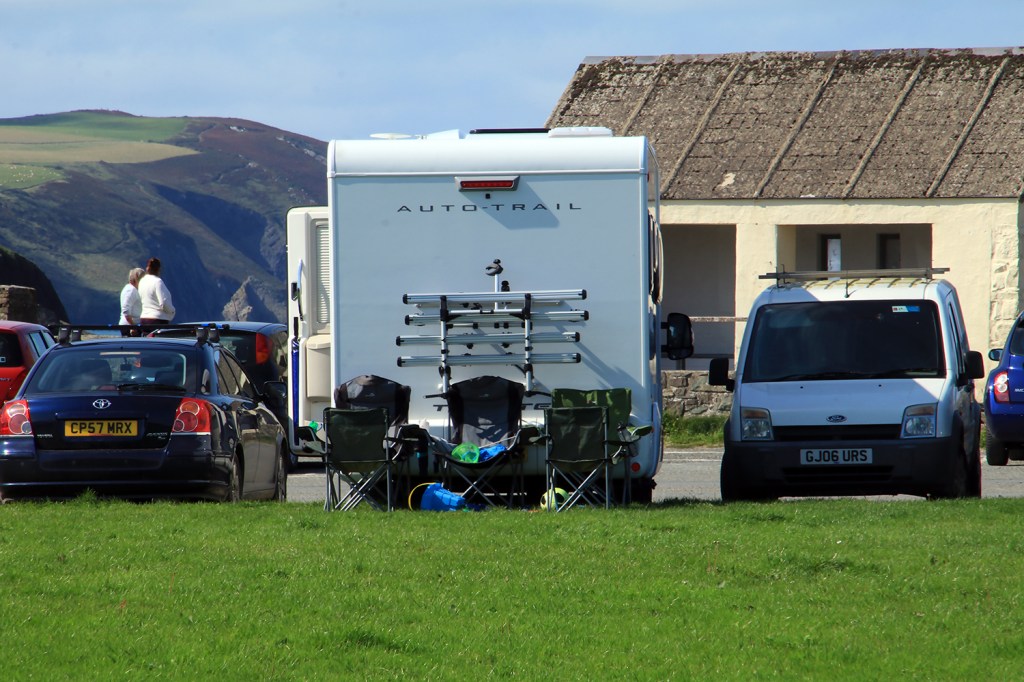
I shared my work for assignment 3 which is certainly still in the developmental stage. I explained that I began the project with one idea but am now being tempted by another. My original idea was to use the car park as a barometer of the business of a local area; but as I’ve been shooting I’ve strayed into the concept of tourists in a car park, what they’re doing and why they’re there. I have probably been swayed by my research into photographers such as Simon Roberts, especially “We English” where he looks at the relationship between a place, leisure and identity. I have also been influenced by the street photography of Peter Dench, Matt Stuart and Paul Reas. So when editing to share with this group I chose the set below:
I explained that my shooting wasn’t complete and I was waiting to get shots of a quieter carpark and a rainy or flooded car park. I asked my peers what they thought the images were about and was asked:
Is it about the car park as a platform for activities? What brings people to the car park?
Is it about conflict in their activities?
Is it about the mundane-ness of the car park?
They asked me, what is it I’m most interested in saying? What is my focal point? Having thought about it, I am most interested in the car park as a barometer and manifestation of how busy the location is as the tourist season comes and goes “Breathe in breath out”, because this is a point of conflict locally, being “invaded” by tourists. On reflection I may have tried too hard to shoehorn closeups and images with strong colour having been influenced by the photographers such as Peter Dench, Paul Reas and Matt Stuart, when this was not my intended approach/subject.
So I will now to take my focus away from the people in the car park and back to the car park itself, and look for the mundane whilst expressing evidence of visitors in varied amounts.
I also shared my thoughts about using text with the images, possibly taken from publicity material and/or coronavirus text. Though I could combine welcoming publicity text with anti-second home text, I am going to try to avoid using anti-second home text as I hope to use this in assignment 5.
Actions:
Review contact sheets
Consider mundane aspects of the car park, possibly close ups of things like the potholes
Exploit the flatness of coming the bad weather for shots of an emptier car park as a contrast to the vibrancy of the height of the season shots.
Return to a subject of Breathe in breathe out and make the car park not the people my subject – focus on the mundane but different perspectives eg pothole, and quiet to busy.
Remember to think about what’s outside the frame.
Think about how to capture different perspectives use wide angle? Prime? Tripod in low light
Must blur out number plates
I received this feedback from a peer on the padlet after our meeting:
It was really interesting to talk through your work in progress. I certainly relate to your struggle with the germ of an idea and how best to shape it. I think bringing more contrasts in (e.g Image 1 for me has a strong contrast to Image 5) and experimenting with text might help. Your draft title is strong and I think will also give direction – breathing is both banal and unnoticed but essential! Good luck with the next iteration.
One other thing that arose at the meeting was assessment:
Students will be asked to present work that they think meets the learning outcomes specific to each course, so keep learning outcomes in mind
Work will now be seen by a second assessor as well as tutor at assessment
New OCA learn site, I must check out but consensus at the moment is that its not very good.
This was a virtual meeting. There were 6 of us at this meeting and 5 of us shared our work and personal projects.
Digital image and culture: one member is working on Identity and layers of digital information; what people can see, what someone lets others know, and what is available about them that they are not aware of. We discussed various ways of representing the information that there is on us.
A personal project that may be used later for digital image and culture. This is analogue work as she is interested in negatives as she feels they are neglected. She has been experimenting with crafting the sprocket holes of negatives. I commented that I prefer her curled images of negatives to her folded negatives; we discussed the impact on our senses and the aesthetics of negatives that are whole, curled, flat, folded or cut. This led to a discussion on box brownies and available film which made me think about using the old cameras that I have at some stage and using analogue film.
Another is just starting assignment 2 documentary. Her concept is isolation/solitude. Whilst looking at her images I was most interested in the visual interpretations people were making of her images and the discussion that ensued about what this might say about her feelings about her concept.
One shared a book cover he had created, and we talked about text and layout.
I shared my developing work for assignment 2 Documentary which I have moved on quite a bit since my documentary hangout 2 days ago: I cut the 8 images to 6 and placed 2 scars as punctuation between the images:
I asked for comments on the choice of images, including my rejects as well as thoughts about the inclusion of scars.
Again the images were said to be strong, especially the “Hollywood bowl”, it was suggested that I include the Aquadrome and the fairground image if I moved back to 8 images – This met with my thoughts and conformed that I was right to drop the “closed”café and pub garden. There was an observation that the vertical and horizontal lines are especially dominant, and I think I should look to enhance this.
Following the discussions, I am going to continue with 8 images but experiment punctuating them with smaller images of scars either body scars or physical ones on the landscape) possibly these in black and white. Whatever I produce I will explain on my blog that I would present this as a book and possibly simulate it or present it as a slideshow to show case this. I also need to do some written research on economic scarring.
Anna Fox Photographer and Professor photography at Thames Valley OCA virtual meeting 16.5.20
Believes in FRICTION (fact a fiction in photography), she’s not an historian but reads history of photography all the time.
When she studied in 1980s, colour documentary was going on, she wanted to exhibit and publish it, and has done with many books including, Work stations, Blink, in many different designs and fabrics. Fox edits Langford’s basic photography The guide for serious photographers also Behind the Image Research in photography with Natasha Carvana (I have, however a new chapter is coming in the next edition). She has been teaching since 90s (Farnham University) which she says is one of the best in the world for documentary photography, and runs MFA at Farnham (2 year program); a collaboration with the National Institute of Design in India. I asked her about this.
Her Father was a keen amateur photographer, her mother was at art school, then publishing and graphic design, so her home was full of books, including those on photography. Both photography and fiction and comedy inspire Fox. She explained that stories teach you how to construct narrative, and how to use text and images. Fox says to think of text as you think of images, so it doesn’t feel like it’s image added to text, or vice versa, it should feel like one work (as Sophie Calle does); consider carefully, font, sentence breaks, to give the significance and the emphasis you want. Fox doesn’t like to see text added at the end of a project as it should take as much time to work out as the images do.
SHE TALKED MUCH ABOUT STAGED REALITIES:
Cartier- Bresson’s work which she described as broken fractions of a second and asks, is this reality, or is it the equivalent of staging and composing?
Fox talked about other examples of construction, such as payment for photographing people, like Edward Curtis when photographing native Indians in the early 1900s. She suggested that payment can lead to over exaggeration of the dress and character of subjects. Fox also cited the famous Dorothea Lange’s Migrant Mother, which we now know was posed; I didn’t realise that Lange had a big commercial career and was used to staging images
She asked us if a Robert Capa photograph “Fallen Soldier” from the Spanish Civil War was staged and explained that his editor in America put under one of his pictures “war doesn’t look like much”, and this could have led him to construct and dramatize his pictures more.
The book Falkland Road where the subject is a street of prostitutes in Mumbai, Mary Ellen Marks paid her subjects.
Philip Lorca decorcia paid prostitutes for his images in Hustlers, though he acknowledged this and titled the photos the price he paid each (which was what they would have earnt). The commissioners thought that ethically unsound, fox thinks otherwise.
“Everyone” (1994) https://sophie-ristelhueber.format.com/untitled-gallery inspired her book My Mothers Cupboards. The work with images of scars is presented alongside references to war in Yugoslavia so it looks like its injuries from the war then discovered that these pictures were from people post-surgery, it was not as Anna first thought when she viewed the work.
Fox also discussed Photo montage such as that of Blair in front of an inferno – more staging of photography that can aid fantasy.
Photographers who emerged out of American photography that make fabrication is viable such as Gregory Crewdson.
The Emigrants book by W G, Sebald where the narrator recounts his involvement with and the life stories of four different characters, all of whom are emigrants (to England and the United States). It includes many black and white, unlabeled found photographs and creates a reality about them inserting them in the story, so you feel like you’re reading a documentary.
Didier Massard whose book with strange animals in it had an ISPN that would place it in the natural History department and yet it was fabricated photographs; the animals and fauna looks like actual animals but as you proceed through the book you realise the photos are of imaginary creatures; it is both funny and fascinating,
Joan Fontcuberta (1997) project is a parody, where he becomes a journalist in order to tell the supposed history of the first initiative of the Foundation Sputnik. In order to give the story authenticity, the artist incorporates a large number of historical documents, but also if you look closely you can see that he is in each of the images; it’s both funny and fascinating.
Interestingly Fox asks why were people disappointed that sitters were paid? Someone suggested it might matter if a photographer claims the image is real. Fox answered that if they won’t say which, then the suspense can be useful, however if it’s relevant it is important to say whether staged or not.
Fox thinks of herself as an author with various different connections to truth.
She lists amongst her teachers: Karen Knorr, Martin Parr, Paul Graham; they influenced her in different ways, Knorr with her printing, lighting, Parr with lighting, flash and colour, and Graham with making banality and melancholy everyday interesting, and overall how to get these things into photographs, beauty, satire, and meaning, with an intelligent story and a sense of humour.
Her first body of work was Basingstoke 1985/86 (35 images) which hasn’t been published which means she can now add images. She chose this subject as it was a small town nearby and didn’t want to travel but did want to tell a story of thatcher’s Britain. In this work she describes the colour, flash and humour of Parr, the structure, image/text irony of Knorr, and the banality of subject from Graham. Making this she collected text at the same time as images not thinking about what goes with what at this time, editing as she went along, with just the feeling she wanted to inspire, be humorous, but no more, it was then she realised she had her own voice.
Workstations was her 2nd commission, the subject of Office life in London, again in Thatcher’s Britain; this showed aggressive pursuit of wealth and success. The text makes it look like it’s shot in one office (with the daily timings added) but it isn’t. After this she was then asked to emulate this style but couldn’t do it as the meaning of individual work is wrapped up in its style.
Cockroach Dairy (1996-99) a story of a real invasion of her house, using a real diary she’d kept. Fox kept the feeling of authenticity with the book design, though she had to rewrite diary so it would print well and then added in some real-time events. She used film and autofocus, as cockroaches moved quickly, and consequently had little control over framing. The cockroaches get bigger as go through book, then the cockroaches disappear, and the house is sold.
My Mother’s cupboards and my Fathers words (2000) -the information “my father’s words” is hidden on the back cover, is not just about her mother and her father, but about relationships in general.
Her father’s words were directed at all women in his house and pictures of her Mother’s cupboards. It is both nasty and funny; Fox secretly wrote down the words under the table , She explained how she choose which images with which text such as “She’s bloody rattling again” using wine glasses as the image as they rattle. Sometime the images are chosen as juxtapositions.
Q: As her father was ill at the time does this explain the narrative? A: no because he was always like this, though maybe it was exaggerated, though it may have made him less physically aggressive and more verbally aggressive. Apparently Her father thought it was funny but her mother was upset about the book. This is an example that work doesn’t always come out immediately, this work was made 20 years ago and is now being exhibited.
Fox talked of her Peers:
Hannah Starkey– fox suggests her work is about women in public spaces however Starkey doesn’t tell people about her images. These are constructed images with actors but linked to reality.
Tom Hunter who has emulated Vermeer and turned on head ways of photographing squatters making them look heroic. He works on the Hackney community.
Gillian Wearing, asking us to question her work with people holding texts, is this reality or not. Fox says that this shows you that portraits on their own don’t generally tell you much.
Goldfrapp the singer who Fox collaborated with on the book Country girls 1996-2001, she grew up in the same rural village. She posed for fox’s deliberately staged images as a dummy half-dead, using flash again. We discussed the meaning of Sweet FA; I was unaware that Fanny Adams was murdered at 8yrs at nearby Alton, chopped to pieces supposedly by a bank clerk; Apparently a tinned meat brought out for sailors which they named Sweet Fanny Adams but changed to “Sweet Fuck All” as it was so tasteless. There was a local fascination with the vulnerability of women.
Photographers who surprised her:
Roger Ballen a South African photographer who developed a style he describes as ‘documentary fiction’. His photography has a performance element to it as well as incorporating drawings, painting, collage and sculptural techniques to create elaborate sets; here there are no people altogether, replaced by photographs of individuals now used as props, by doll or dummy parts or but improvised scenarios’.
Trish Morrissey a fellow student at RCA, whose series Front, places herself in family photographs on beaches, replacing a family member.
Alison Jackson another fellow student at RCA, who uses spoof style of photojournalism on royals and celebrities. She published a series of satirical photos featuring spot-on Trump impersonator in a fake Oval Office, surrounded by scantily-clad beauty contestants and then caused a stir in New York by hiring the lookalike—and more underdressed models—to appear in headline-grabbing performance piece outside of Trump Tower.
Chris Dorley-Brown whose images are startling coloured and sharp; they look like they’re acted out but they’re not, they’re just taken over time (he stayed put for hours and photographed and added images together) to make narratives about city life.
Alex Prager, her work Face in the Crowd, features large-scale photographs of elaborately staged crowd scenes, often with the subject looking disarmingly straight at the photographer. Her work comes out of documentary but she’s deliberately working with the idea of fiction.
Susan Lipper, her workDomesticated Landabout the wilderness has becoming occupied with traces of human presence. Apparently she wouldn’t want it to be called a documentary but as artistic work that shed created as she likes to work with fiction. She spends a long time editing to order as series images and changes the order -so look at how she decides this and the meaning of one on another.
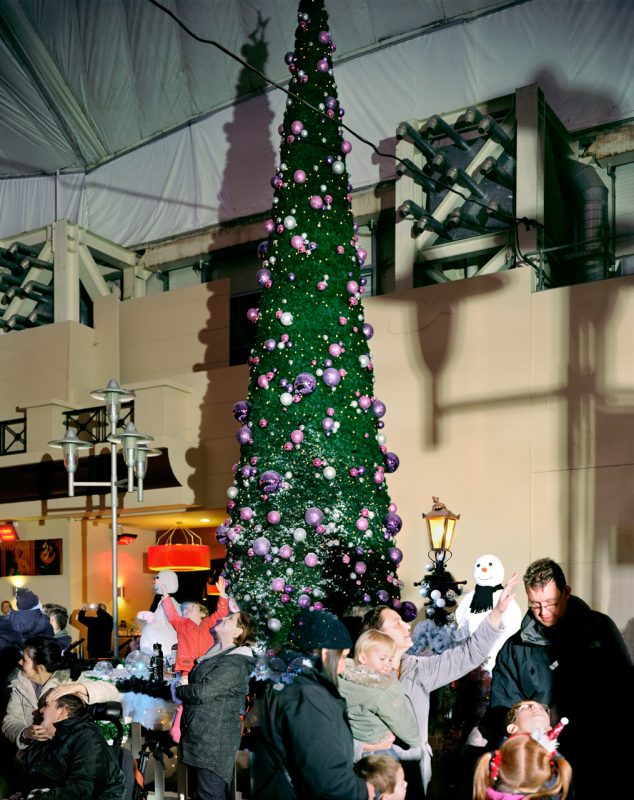
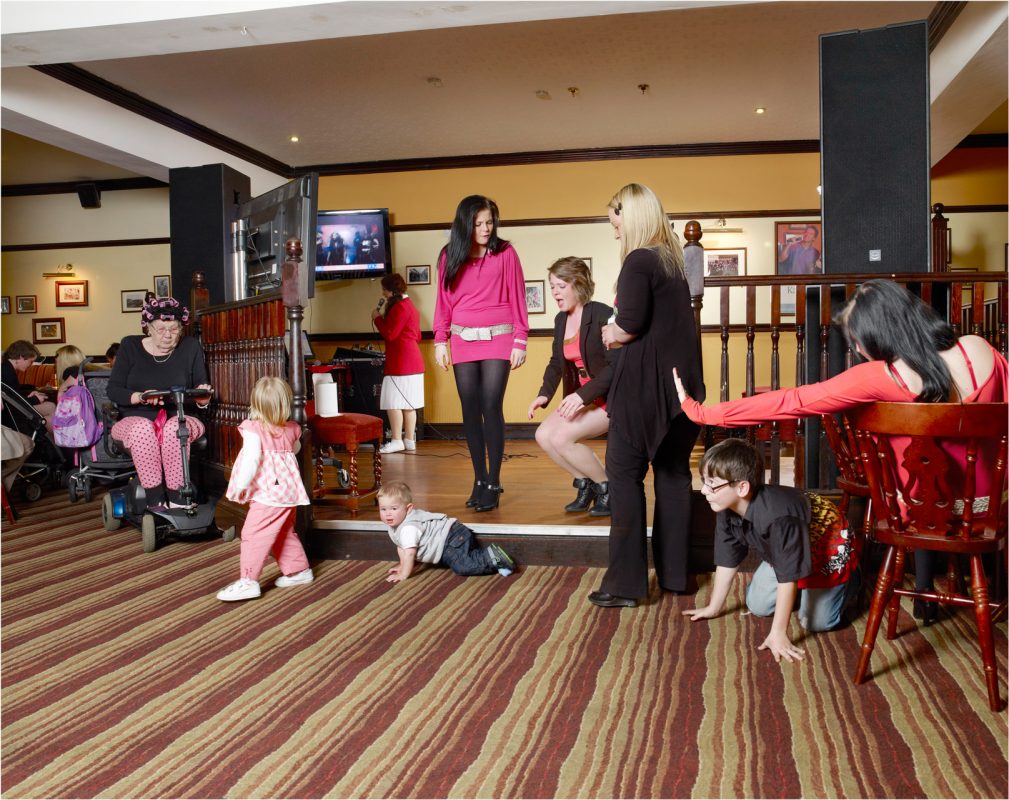
Fox then talked about her work Resort 1 and 2 made at Butlins with a Medium format camera and flash. Even she felt awkward as people were on holidays and not interested as they think you’re selling something and intruding. So decided to make documentary work with a lighting director and team which worked as people thought they were a film crew and liked being in the pictures. In the pictures that holiday makers were using flash at the same time as herself she made the same comments as Martin Parr did that as other lights were going off with hers, the lightening was wrong but she joined together to get the correct effect.
(Anna Fox, 2020)
It was useful to hear that when shooting a Karaoke image after 4 hours didn’t get one image she liked, so she stitched several images together. Butlins banned the image below from the exhibition as it wasn’t the image they wanted to promote – the woman on the mobility scooter.
(Anna Fox,2020)
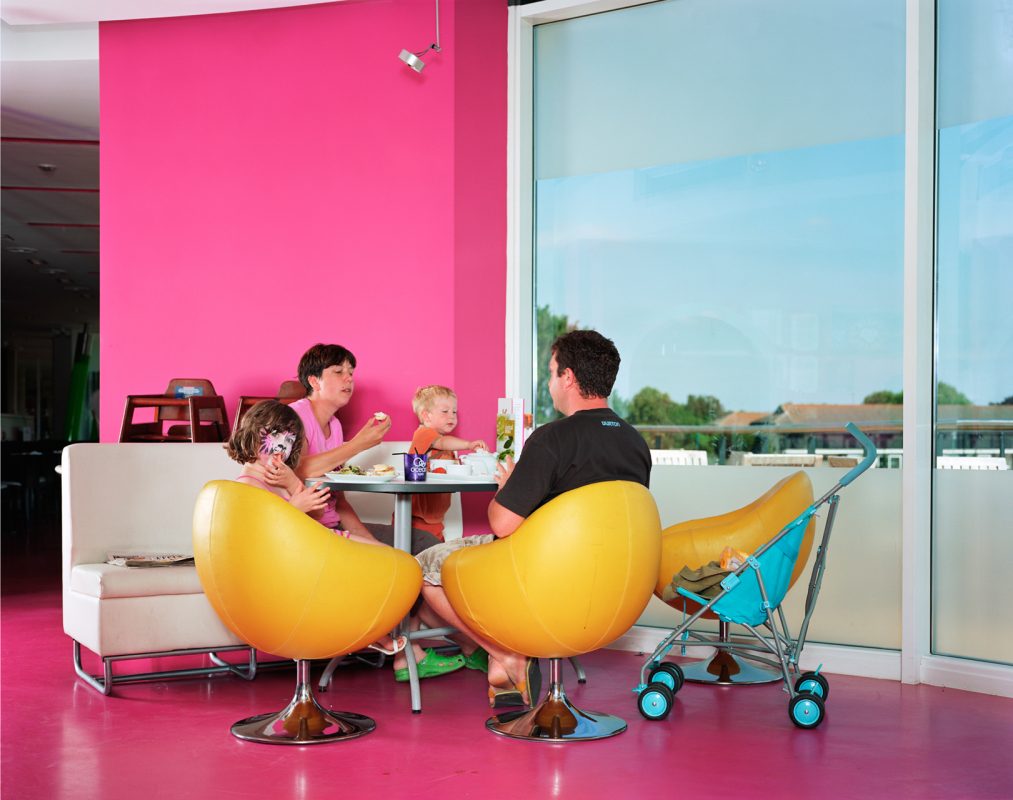
Similarly, an image of a family round a table took 3 hrs. for her to get and eventually she joined 3 images together.
(Anna Fox, 2020)
In her work “A moon and a smile” Fox took archive images of French leisure spaces and then took photos today of same leisure spaces now as they are accessible to more. She photographed over 8 hours and added people to the images.
(Anna Fox, 2020
Blink her new work was shot at central St Martins. When the students were asked afterwards they didn’t recognise the place – so it’s her fiction of the space. She shot this in digital because she was short of time, and is more convinced of it as a tool now as the quality so good. She says that analogue is expensive not used much, so maybe if going to use do most of the work on digital and the final on analogue – Digital has democratised the media,
(Anna Fox,2020)
On her involvement with the project Fast forward, began with conference at Tate modern (I tried to get tickets) there have now been 3 conferences. Fox believes that women in photography not been talked about or recorded enough and she thinks it has a lot to do with networking as they don’t seem to be able to do it in the same way as men.
Q & A:
How do you think men network? They promote and help each other as a group effort to move upwards for women more individual struggles to get on because not enough success. Women have networks were pushed into by the patriarchal society like domestic roles but not professional. We must take responsibility without blame. We need to do it ourselves and then work equally with men; not believing in yourself is a problem especially for women. Fox says that it’s important to see and understand the working practices of women photographers.
How do you decide which award opportunities are worthwhile? Look at reputation and don’t to enter pay except Taylor Wessing for instance where they’ll use the money to fund the prize. Do judges look at the name of the photographer? Look at judges and what their background, their criteria. It’s about exposing your work to people you want to know you Same as for portfolio reviews. Remember to get your work checked so you’re sure it’s not there because of an emotional attachment.
What extent does research play in your photography? It’s huge but don’t necessarily record it, it does play a big role in her photography, particularly fiction – likes to be informed, don’t forget to articulate your research.
Where is the line between documentary work to raise awareness, and pointing the camera downwards? You have to make yourself a good enough photographer to be telling the story in the right way, intention is important. It is important how you represent people, she doesn’t like to feel uncomfortable about work.
Regarding projects she suggests keep your proposals fluid, so that you can change it as it develops and then evaluate to justify your changes. Fox says context is everything; Work should give people space to think speak about something
LEARNING POINTS:
Overall I learnt a lot about the possibilities for “FRICTION” the fusion of fiction and documentary photography. I also picked up many other ideas:
Consider using fiction to support ideas for my photography
When using text and images integrate as one body of work. Consider carefully, sentence breaks, font and emphasis.
Be aware of the variety of types of staging possibilities.
Think about all possibilities of book design, suit the design to the project.
Remember that even for experienced photographers it can take a long time to get an effective shot.
Don’t forget to fully articulate your research.
Intention and integrity in your work is important
Ensure your work gives people something to speak about.
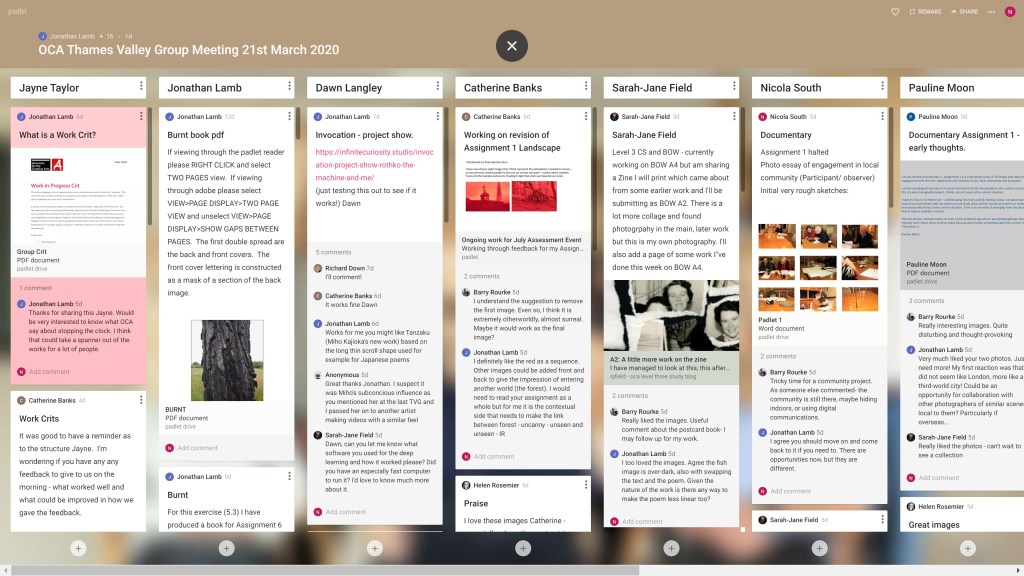
This meeting was held remotely via OCA’s Zoom account due to Covid19 Virus. There was no tutor present this month, but there were 8 of us attending. Work was loaded up to OCA’s Padlet in advance, so we had a chance to review and make comments or prepare questions before the meeting and were also able to exchange comments via the Chat facility, which was archived along with a video record of the meeting .Padlet allowed us to make comments on each other’s work along with general comments on how the meeting went and was archived and remains as a record of the meeting.
We discussed the current restrictions on photography and the benefits of working dicretly with I phones for those who can photograph whilst outside. 4 of us shared our work with our peers for their comments:
Jonathan is finishing landscape and shared hs land art project. We had some interesting discussions on how to present the work in a virtual gallery.
Miriam is beginning an assignment for digital image and culture. We reflected on what digital identity is and how to represent it photographically.
Pauline has just started documentary and shared her Covid 19 street photography. Most of our discussions revolved about how to pull it into a series, where would the emphasis be going forward. Unlike me Pauline is able to walk to built up places to photograph.
I shared my new attempt at assignment 1. My peers didn’t seem to find it as dull as I thought they would. The women seemed to identify the most with the images and thought that there was also a theme of being a Mum and a provider there. It was also commented that there was a feeling of barriers – so hopefully I have inspired some emotional reaction to the images.
Whilst I was preparing to share the work I reflected that the work is also a response to me withdrawing from the world not only for my safety but also as I feel isolated from my second home (which emotionally is my first home) which I am not allowed to visit currently and that I am not integrated as with the local community that I am living within currently I am feeling double isolated. Cathartic reflection!
Since my documentary hangout 9.4.20 I had re-photographed the laptop on a desk at closer range and had substituted the full bottles of wine taken through a window, for empty bottles outside (as I thought that this was more realistic). Once again the consensus was that the laptop on the desk was the image that didn’t fit the series, but the paracetamol close up image was said to fit well – this meshed with what I thought.
It was queried that I have a variety of perspectives on the windows but I explained that I photographed different viewpoints and experimented with keeping a flat or angled perspective but prefer the mixture.
Remembering the benefit of sharing with others to get an outsider’s perspective
There’s nothing wrong with a simple approach
Being able to finalise the series and the assignment
My post meeting reflections:
Thanks to everyone today – sharing my work gave me sometimefor extra reflection and I realised that I feel double isolated atthe moment; this is because I am not allowed to live currently inmy second home (which is emotionally my first home, especiallythis time of year) and I am not so integrated now in my localcommunity here, hence the double isolation! I think this comesacross in my work and my attitude towards it – I shall write thisinto my evaluation. Cathartic reflection!
This meeting scheduled was held remotely via Zoom due to Covid19 Virus. I wondered how we would manage via zoom for at least 4 hours but it was productive time and passed quickly.
The session was facilitated by OCA Tutor Jayne Taylor. There were 13 of us, including some who can’t normally attend because of geography or Children.
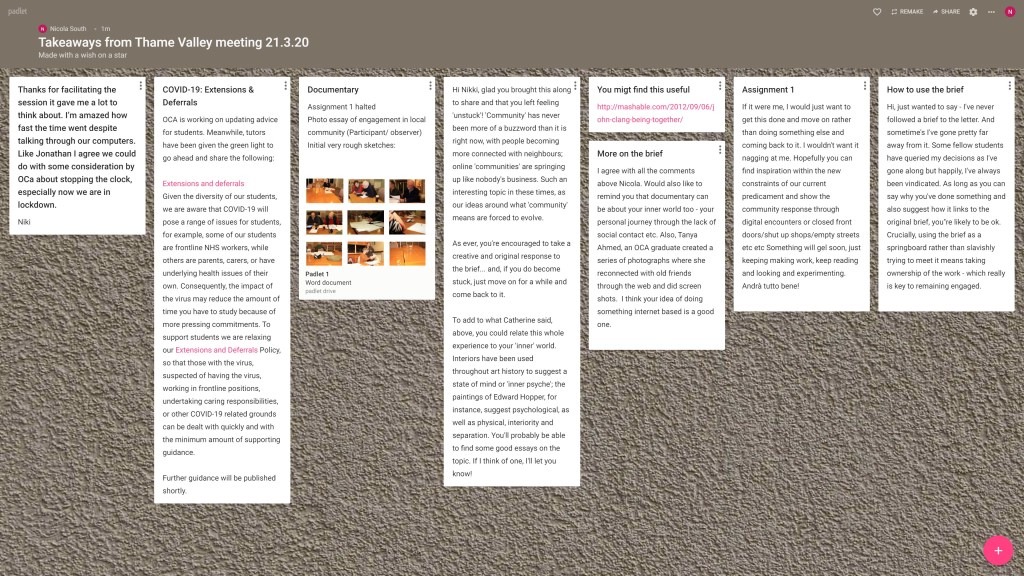
I shared that I had been working on a community project for assignment 1 which halted a couple of weeks ago because of Covid 19 and no longer having access to the people. I have dithered whether to stop, move on and return to the work later or start afresh. Generally my peers suggested moving on, and we talked about new ways in the current circumstances that I could capture community engagement (Traces of people, disruption in the community, changes in the community, barriers to engaging with the community).
My takeaways:
As usual I learnt a lot by peer sharing both their work and ideas as well as my own.
When editing consider whether weaker images dilute the strongest images
Check the narrative is clear
I learnt a lot about book making:
When placing images consider the white space around them, have more space at the bottom of the page than the top.
Consider making the space around images irregular throughout the book
Don’t use more than 80% black font
Leave most of the text until the end so that the viewers can engage with the images first.
Use some full page “full bleed” images
Explore the Cartesian perspective and photography: A separation between what’s inside and outside (see John Hall level 3 OCA)
Don’t necessarily conform to a linear narrative
That “Zine” is a type of magazine
We also discussed how we can continue to access artwork remotely during social distancing and lock down






 Photography 2: Documentary