The Photographers Gallery Slow Looking Mohamed Bourouissa 16.5.20
Mohamed Bourouissa (b. in 1978 Algeria) he works across photography, video, painting and sculpture. His practice often examines socio-economic processes, invisible tensions between different social milieus and the related cultural divisions. In his artist talk at the gallery he says his work is about identity, generation, resilience and the mechanisms of society. He uses photography as it is easy to capture everything quickly. He gives the subjects picture to help to create trust. He hopes it helps people to understand their own histories.
Slow looking virtual event
Bourouissa immerses himself in communities and the media he uses, the 3 images are from 3 separate projects over a 15 year period where he looks to communities at the margins.
Image 1: Shoplifters series

The slow looking description:
- Thin dark walnut covered frame, thick cream coloured border.
- Man facing photographer
- Man pan partially turned
- Dark skinned, facial features
- Wearing…
- Difficult to make out … because of the graininess of the photograph
- Facial expression
- Seems as he says to the photographer as the photograph is taken
- Tide bottles bleached bright light (flash me)
- Is standing in convenience store…description
- Description of shelves either side of the man
The series is made up of appropriated portfolio of polaroids of shoplifters the shop owner had already take. Each photograph depicts and individual who has been caught stealing items from the store. The store owner allows them to take the products free of charge if they agree to pose for a photograph. The artist says that it illustrates the mechanisms of power within photography. There is the sense of amusement in the portraits.
Comments/questions:
- I’m surprised he was a shoplifter. I thought to start with he was working there.
- Did the shop owner display the photos then?
- Where was the shop? Yes the shop is in Brooklyn.
- It makes explicit the transaction between photographer and subject.
Image 2: Le Prise: The catch –Periperique series (2005 & 9)
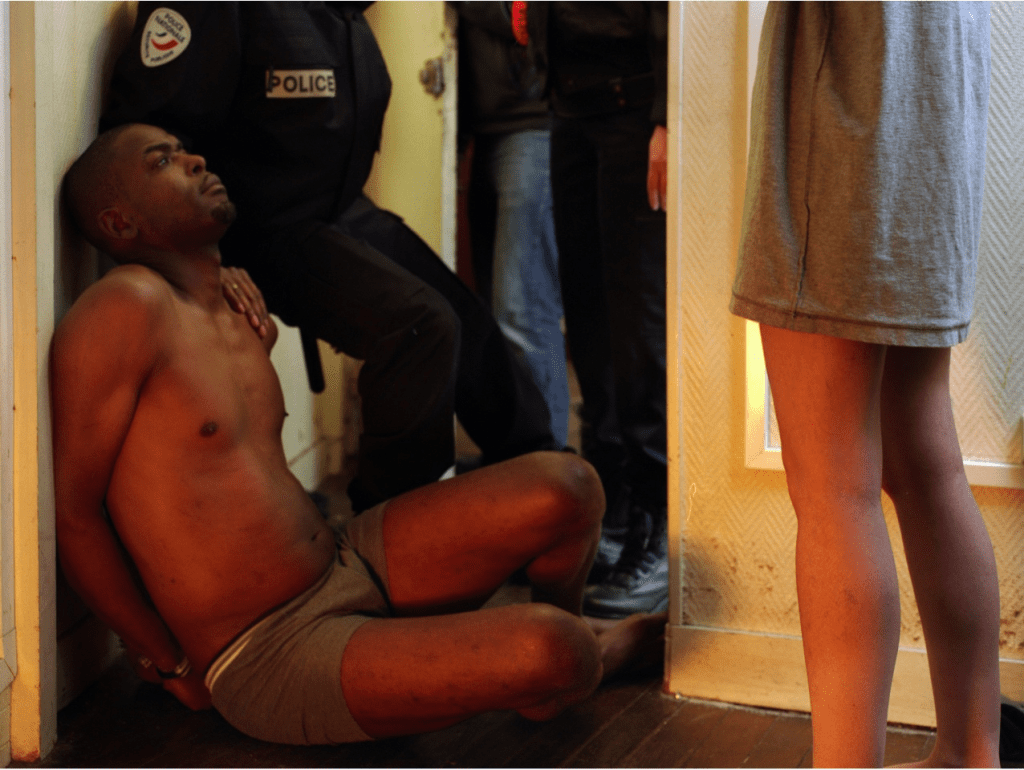
(Slow Looking, Mohamed Bourouissa, 2020) This image was taken 2008 and is currently on show at TPG
The slow looking description:
- Landscape framed with a thin white frame with a white border
- Around the size of a kitchen cupboard
- On the right
- Detail of wallpaper which is hard to see
- Door frame framing the left of the image
- Details in the background non human: The floor
- The figures, where they are supple
- The figure in the foreground description in minute detail, his expression
- The other figures starting with the one nearest him restraining him, then the other two sets of legs and what they suggest about the individuals.
- Back to foreground standing figure, raises questions about why we cant see their arms, are they held up?
- The lighting doesn’t look totally natural to tell what time of day it is, but looks like a warmly toned light behind
I didn’t realise on viewing this and listening to the audio description that this image was staged. Apparently this series sets out to subvert the common stereo types of youths, living in the infamous suburbs of Paris creating a sensitive depiction of an often demonised community. The title of the series references the ring road that defines central Paris from the suburbs as well as the peripheral stories of the populations living there. Bourouissa grew up in these suburbs, which have been known for fierce riots. He required the complicity of the subjects and he situated himself as both director and implicated witness in each image. Each is distinctly framed and considerately cropped with the character caught in a situation of disturbance, he said he wanted to represent those that are generally only portrayed by news photographer and lift them from social representation to a more classical realm of representation form social documentary into the field of aesthetics. The heart of this project is internal tension. Here he plays on certain ambiguities and play on poetic conventions
Peripheral suburbs and the lives of these people. They are based on art historical references placed against everyday events on the outskirts of Paris and reframe photojournalist approaches to change understanding of these situations
Comments and questions:
- Caroline comments that the images do have a religious feel to them
- I find his facial expression very interesting. You mentioned it looks irritated but for me he looks almost in despair -The restrained man looks extraordinarily dignified, almost resigned to his fate -It feels like a Christian/religious image to me – Yes it looks very biblical- Reminds me of Caravaggio like Italian Renaissance painting
- I think the way you described the sets of legs in the previous image was as the artist would have liked as it added to the ambiguity
Image 3: Nous Sommes “Halles”: We are Halles 2002-3

The slow looking description:
- Around the size of a dining table that seats 8, not framed but held by metal poles
- Describes the background, a central district in Paris
- Describes the background figures
- Describing the main foreground subject … looks confident as she stares into the lens the sun casts shadows on her eye
- Honesty as she describes the roll of fat
This is his earliest work which was exhibited in a building that was previously a department store, so the work returned to where it was shot. It was shot in collaboration and inspired by the book “Back in the days” by an African American fashion fine art and documentary photographer. The collaborating photographers decided to make a project in le Halles as it was very important place for the younger generation for shopping and hanging out. Bourouissa was connecting to his own habits of shopping and hanging out and probably knew some of the subjects, who were young people coming into the centre of Paris and claiming the space. It is presented as a glicee print at the gallery
They are arresting large photographs.
Comments/ questions:
- Are they staged? Not staged but shot people he knew as he encountered them – I agree it looks like they’ve stopped her mid shop- She would be unlikely to be able to smoke that photograph in that hand whilst holding the bags. So I feel its posed.
- I remember the area well from around 2006-2008 when a friend of mine lived there. There was a strong sense of community, it was very multicultural but it was also ‘gentrifying’ and property prices/rents were rising fast, so that locals were being squeezed out.
- I think there was a film called Les Halles I think it’s about conflict in that community
MY LEARNING:
- It can be difficult to tell whether a photograph is staged or not
- A reminder to look carefully and at details
- Examples of ways to act out your concepts including historical emulation
- A reminder to be creative about how to show exhibit your work and possibilities to do it in relevant local ways
- Interesting following the artist talk with Anna Fox and our discussions on whether its appropriate to stage images – in these cases it was integral to the concepts
- Can photographs by connecting to your own habits
- Your own locality can be a useful starting point and you can do something useful
- The impact of ambuguity
References:
Artist talk:Mohamed Bourouissa (2020) At: https://thephotographersgallery.org.uk/whats-on/talks-and-events/artist-talk-mohamed-bourouissa (Accessed 16/05/2020).
Slow Looking: Mohamed Bourouissa (2020) At: https://thephotographersgallery.org.uk/whats-on/tours/slow-looking-mohamed-bourouissa (Accessed 16/05/2020).
 Photography 2: Documentary