Slow art virtual session: The Photographers gallery 4.4.20
I was interested in this meeting as I have been to a physical event like this at the gallery, because of Covid19 the meeting became a virtual one via the Zoom platform.
Caroline Dawson who facilitated the meeting is an access and inclusivity consultant working with museums, galleries and artists to improve access to art for everyone.
We met to discuss 3 pieces of work by UK photographer Mark Neville (b. 1966) Deutsche Börse 2020 Nominee, for the publication Parade (2019). Neville merges art and social documentary photography, through community-based projects, where he explores social functions of the medium, using still and moving images as well as photo books, which are specifically disseminated to a targeted audience or ‘non-art’ demographic. Started in 2016, the same day Britain voted to leave the European Union, he began a three year project based in Guingamp, Brittany (“little Britain”). Mark says:
“Notions of utopia, or ecotopia, underpin these images of farmers, nuns, Breton dancers, baton twirlers, people breeding pigs, dogs, horses, supermarket shoppers, football supporters and football players, families on the beach or attending beauty pageants. Some of the photographs seem to express a real optimism about our chances to achieve that better world, whilst others display an anxiety about the gap between the ideal and the real.’
Mark Neville (TGP website, 2020)
Caroline Dawson gave an audio description of an image by Mark Neville, a black and white image:
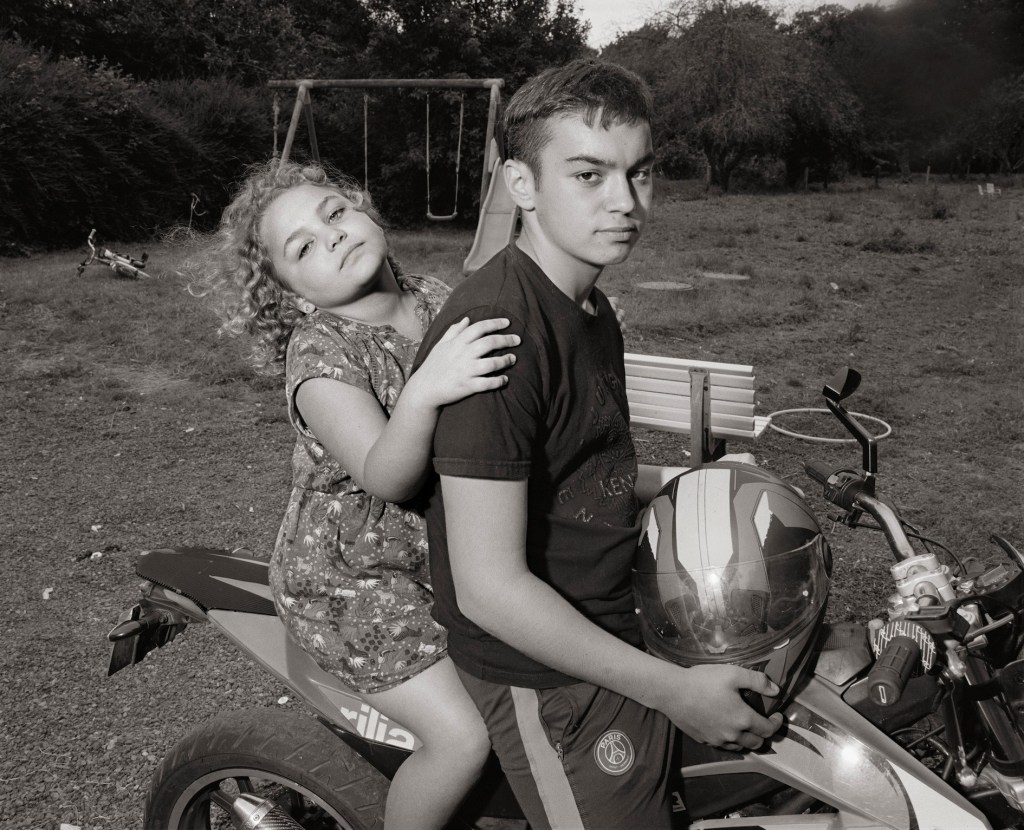
We then discussed:
- How the audio description given went from a general outlook from the background first and then to the foreground detail. Caroline was taught to Split the image into horizontal lines and read left to right and to start and finish on the part of the image focused on.
- Why the image is in black and white? We couldn’t reach a decision.
We commented:
- Looks like might have been lit with lights rather than taken spontaneously. I later learnt that this is very much his style to use infill flash from the side
- We like the movement in her hair although it looked like to image was posed.
- Thought it would be difficult to ascribe context without reading the background information first.
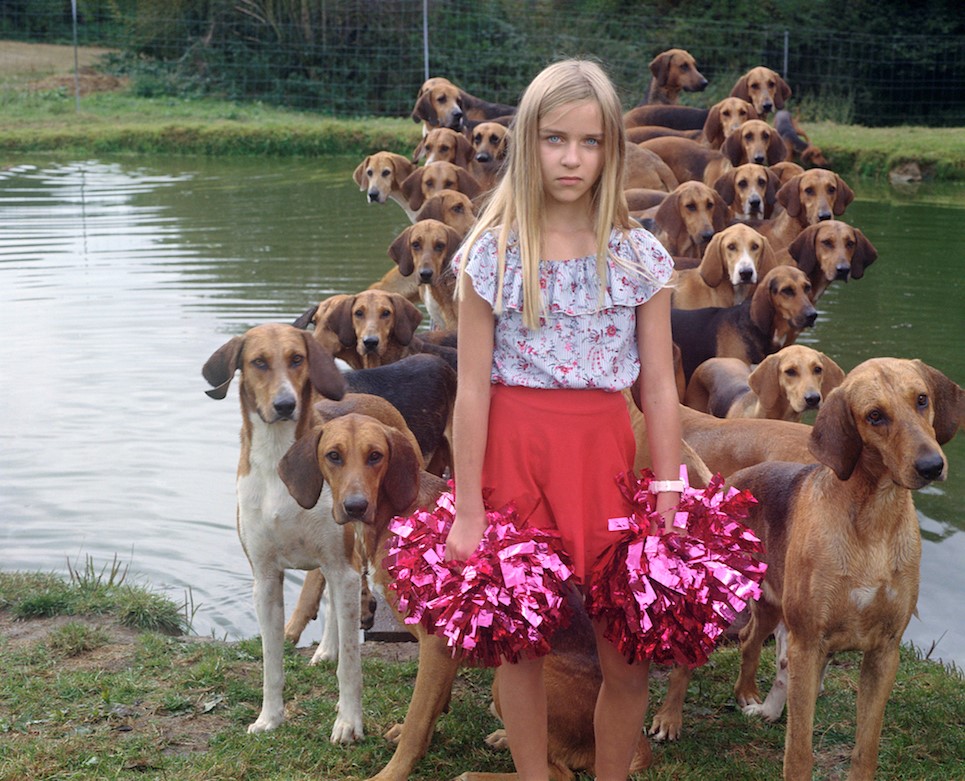
We asked and sought answers to the question:
- Why are the dogs on the pontoon?
We discussed:
- Interesting perspective
- That with her piercing blue eyes she looks like a model
- How would we have felt as a child posing?
- Why all the dogs?
- Is it always the person at the centre of the image that holds the photographers gaze?
We were told that it took 3 sessions to achieve to get them all looking in the same direction, and yet it is still unbelievable that he achieved it.

We discussed:
- Looked to me as if he valued the horse more that the car until pointed out it’s been there a while (as no tyre tracks).
- There is a difference about viewing the images in reality and as a copy, details easier to see – I hope to see the actual photographs after restrictions lift.
- A strong image, makes you want to ask so many questions.
We learnt afterwards that the man is a horse whisperer who works with abused animals.
My learning points:
- How to really look, dissect and correspondingly describe an image; try looking from the background first and then to the foreground detail and even to split the image into horizontal lines, then read left to right, and start and finish on the part of the image the focused is on.
- Really consider if it always the person at the centre of the image that should hold the photographers gaze?
- How difficult it is of be sure of an artist’s motive without knowing the context.
References:
Virtual Slow Art Day (2020) At: https://thephotographersgallery.org.uk/whats-on/tours/virtual-slow-art-day (Accessed 13/04/202
Deutsche Börse 2020 Nominee: Mark Neville (2019) At: https://thephotographersgallery.org.uk/content/db2020-mark-neville (Accessed 13/04/2020).
Mark Neville Artists Talk the photographer’s gallery 9.4.20
I was lucky to be able to follow the interest that this provoked for me in Neville’s work by attending his Artist talk to accompany his exhibition Parade at the Photographer’s gallery London; however it was also an event that was delivered by zoom, due to Covid19. This worked very well.
Mark discussed his work from a starting point of his first published photographic work PORT GLASGOW (2003) a ship building community.

This came from his desire to have a voice and visibility within the art world. He applied for a competition to make a public art project where he could make a public gift to the community of 8,000. This work is photographs of a community – a social documentary book, which tests notions of authenticity in photographs; some are staged, some sly on the wall, some fashion or staged, whilst some are based on Venetian paintings.
This was never commercially available as a book, but was produced as a book for the people in it instead of as was usual to middle class coffee tables; Neville gave the work back to the subject matter to justify it. The cost would have been £14000 to distribute 8000 of books to the community, but then asked the football club to distribute the book and gave them the money instead, which fitted with his ethos of benefiting the community a work is made in.
He asked for feedback from the community about the project; some was negative, indeed Catholics burned books as they thought there were too many protestant photographs (disappointing at the time, but it was actually a good indicator of sectarian tensions). Later outsiders asked for copies of the book but couldn’t give them it, although later unwanted copies were sold online by their owners for high amounts (Neville commented that this was good as it was a direct economic benefit for the community). Later he responded to requests from curators and exhibited however when he did so the money was again given back to Port Glasgow as were percentages of any picture sales.
Neville’s concept is that photography should always think about its local role. As it deals with reality it has to find a way to change things. His ethos is to find ways that you can use the photographs to service the community they are shot in.
Battle Against Stigma Volume One and Two (Afghanistan 2010)
Neville was chosen by the Imperial War Museum to go to the war zone as a war artist. He accompanied the troops to the war in Afghanistan after a month’s preparation. He had to carry his heavy camera kit, maintain 2m distance between soldiers, avoid mines; it was a very stressful and confined remit for taking photographs.
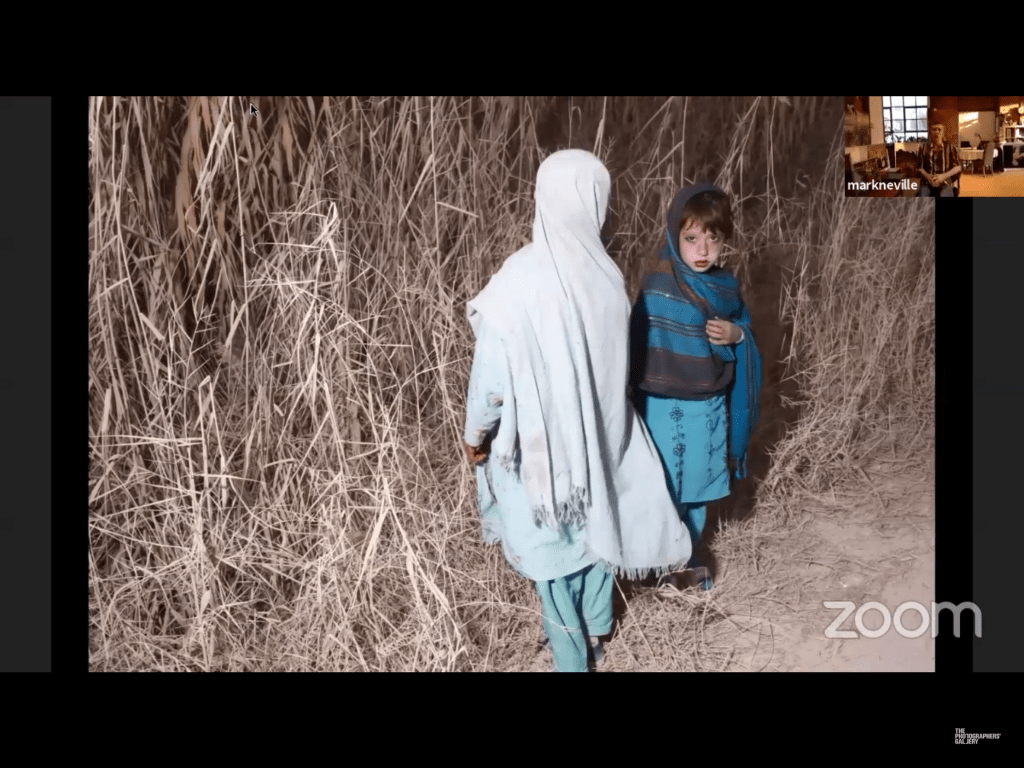
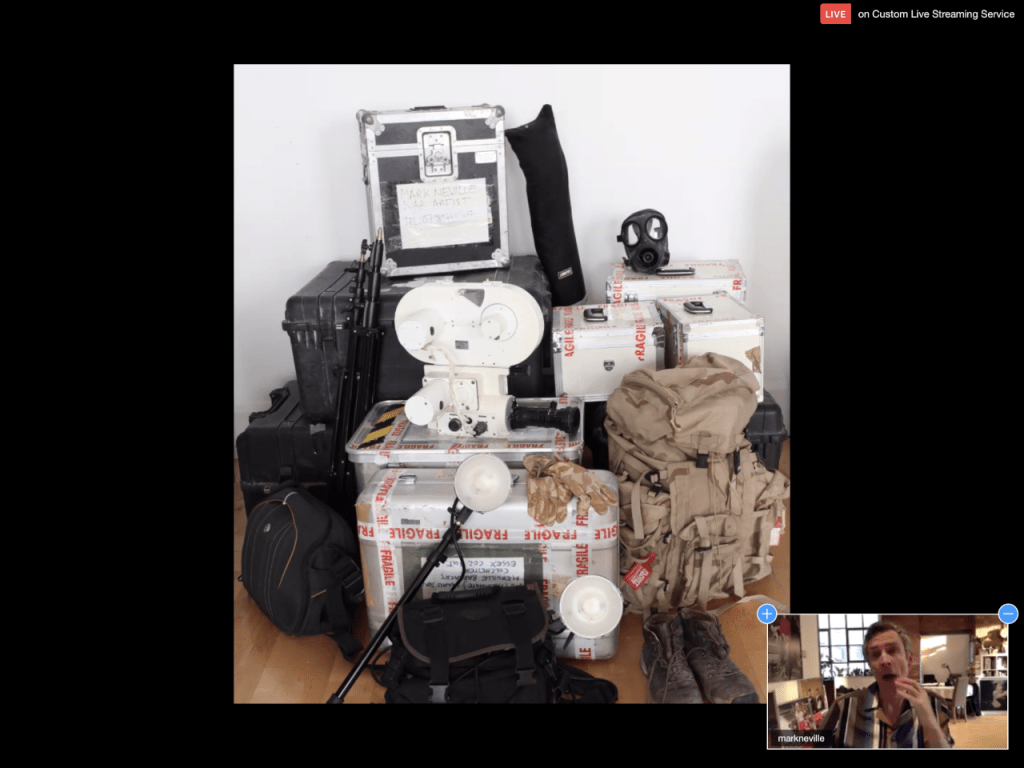
In particular he was shocked how young the soldiers were, and that it was bizarre that children would suddenly appear out of nowhere unaccompanied. He also recalled how he made friends made quickly and for life.
He wanted to use his work to encourage veteran troops suffering from PDSD to come forward (as Mark he suffered adjustment disorder). It took until four years after his return to get the various permissions, funding, images and text for Battle Against Stigma. He went to ministry of Defence for support, but after initial support they forbid his PTSD essay that he’d written, and accounts from the troops to be presented with the images from the war as it might imply that each photograph is someone with PTSD; so he made it as two separate volumes in one slip case.
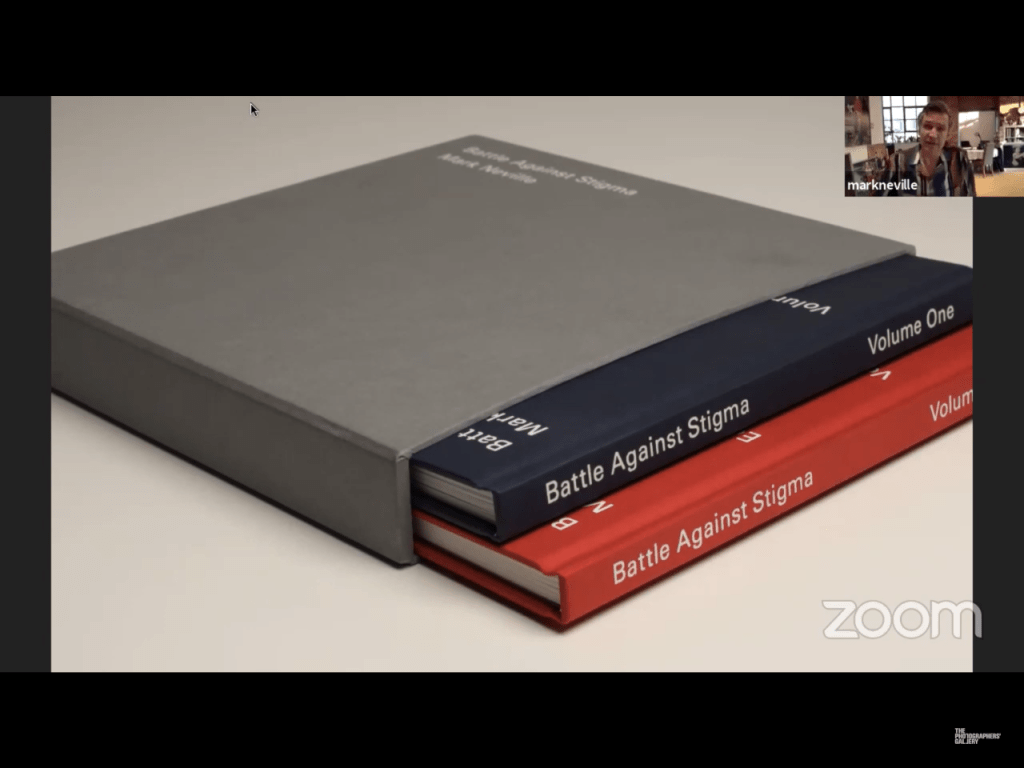
The first volume retells his experience when he was sent out to Helmand, the second volume contains written testimonies about PTSD and adjustment disorder from serving and ex-serving soldiers. Once published the UK border force seized the first edition of 500 in 2015; The 2nd consignment of 1000 arrived safely and he delivered them to mental health charities, homeless centres, Military Departments of Community Mental Health and Education Centres, veteran mental-health charities, probation officers, prison libraries, and directly to veterans themselves and so on to get to the veterans before the UK border forces wanted this consignment of books also.
In the Independant on Saturday 23 May 2015 Neville put the following message:
‘Battle Against Stigma’ is not being commercially distributed. If you are a former serviceman or woman who feels you may be suffering with adjustment disorder, or you know someone, a friend or relation, in pain, please write to Mark Neville in confidence at info@markneville.com, and he will send you a free copy (Neville, 2015).
Following this he received e-mails every 10 minutes asking him for copies. Neville said that this is the book that has had the most tangible effect of all his work, he believes because he tapped into hidden pain.
STOP TANKS WITH BOOKS due for publication this summer
His motive here is to try to stop the war in Eastern Ukraine with this book, where 2 million people have been displaced, one of the biggest displacement in the world. The work contains photographs, essays, sociological research into the war zone, as well as elements about life continuing, such as images taken for the New York Times of Odessa a resort in the Ukraine as well of those about displaced people. The book has been sent out to politicians and the publisher endorses this model that books can and should change lives and that people shouldn’t have to pay for them’.

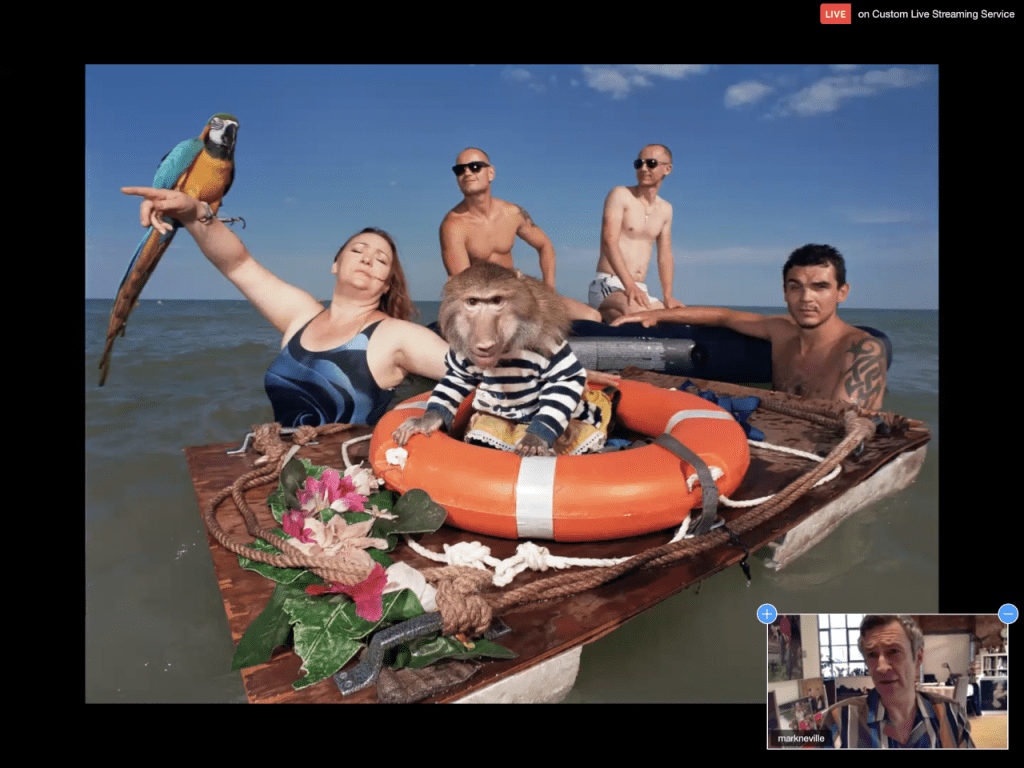
Neville says he is keen on the first image as it makes connections between the Church and the Mafia.
Parade 3-4 yr. project in Brittany
Neville was opening an exhibition there for his Port Glasgow book the same day that the UK’s departure from the European Union was announced. The work that began then also had an emotional connection with Brexit.
In his work Parade Neville made a portrait of a provincial agricultural region, through 6 visits (2016-19) mainly within a 30 km diameter of the small town of Guingamp. The work is about what a community means and Ecotopia – about our relationship with nature and animals. The Breton culture, the local football team and Breton dance Fêtes are their main cultural activities. They have a small but successful football team, and so the work is exhibited in the entrance to the football stadium so ever as part of his community based ethos. Every other Saturday there is an audience of 20, 000, so the images were delivered back to the community.

Illustrating how he connects art and social documentary practices, he also photographed different agribusinesses in the community – from small holdings to large industries. The photobook, is now accompanied by a publication of essays by Brittany farmers with pearls of wisdom articulating the need for a sustainable, humane, type of agriculture, and it was sent out to UK and European ministries of agriculture and food as well as key policy makers, calling for the urgent adoption of more ecological methods of farming. This free book that Neville co-wrote “Parade texts” a pdf published in 2 languages has been sent out to schools, community centres, libraries, schools, politicians, agricultural communities; it is all about the need for access to land to produce sustainable food, so produce isn’t substandard and to encourage subsidies for small sustainable farming.
During the work he combined planned, constructed photograph, and spontaneous imagery. Neville photographed the different agribusinesses in the community from small sustainable farms with only a handful of animals to large agricultural industries.
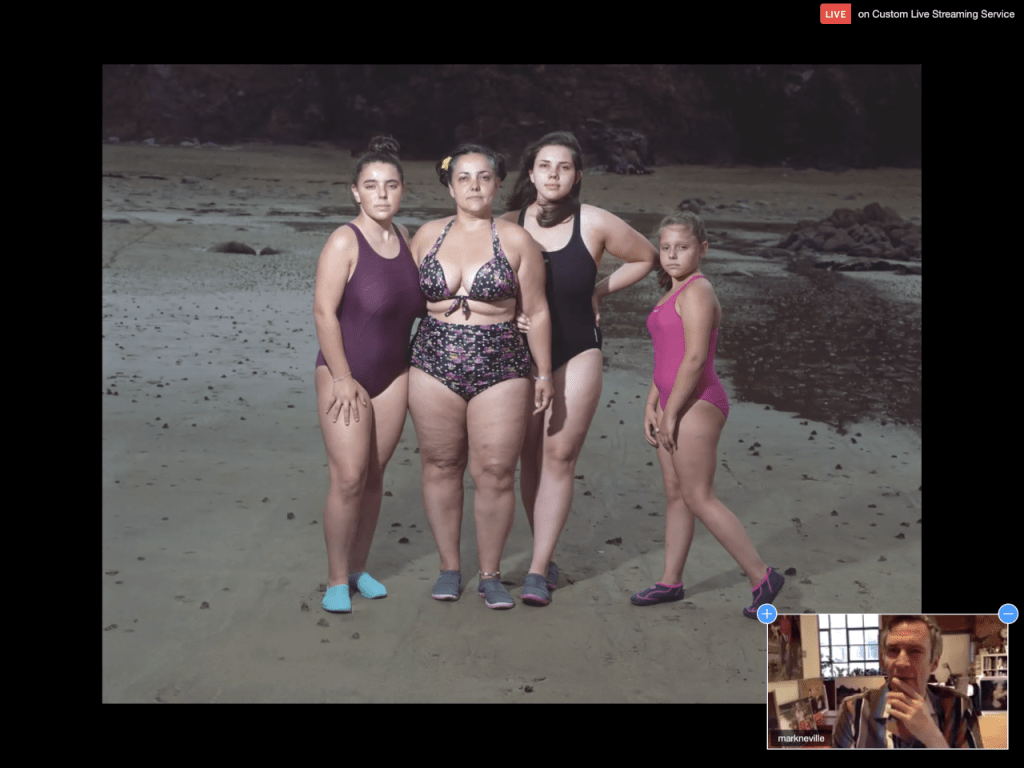
Due to his feeling about Brexit when he started the work there, he wanted the images to have a multilayered feel to them, as he viewed the work as therapeutic journey for himself rather than an end target. He thinks of terms of reference when photographing, such as new wave movies and the posture and the palette of these swimmers that are like Flemish paintings. Some images were constructed by re-visiting people and places whilst some dynamically or fluidly – there is a tension between chance and construction.
Neville talked about some of the images from Parade:
Parade#15 Man horse and car: This image already described portrays ahorse whisperer and is about establishing a bond. He trains them to stand on cars to develop this trust.
Parade #7 The baton girl and dogs previously described; he met her when she was baton twirling and asked her to pose, and he comments on her striking eyes. He also met a man who breeds hunting dogs and then chose his man-made lake as the location – which seems an odd association but was very effective. Neville thinks the image looks like a collage, as if it shouldn’t be happening; though if you look closely you can see the tension between the “construction and the moment” which he believes is essential for a good documentary image.

Here the girl that modeled stands in front of her portrait (Zoom session TPG 9.4.20)
NEVILLE THEN TOOK QUESTIONS AND WAS VERY GENEROUS WITH HIS TIME AND ANSWERS.
- Do you know where you’re going to end up when you start in a community?
Neville says he asks 3 questions of himself/the project before starting:
Q1: What do I really make work about? As projects have a long life take a lot of time and energy and have to sustain him as a subject matter (a demographic, an issue, a place, a group of people, an aspect of social documentary practice or society), he has to really believe in a project to begin it.
Q2: What can I do that will be of use here? How to honestly do some good, how can what I do have some kind of social value? How people are going to benefit from it? Should they get a copy of the book, if so who should get copies of the book: MP’s, the local community, the whole of the UK, really think who the audience is. It is a photographer’s responsibility to use whatever platform we have and to use this to chip away and effect change.
Q3: Fundraising, how to find the money to make this happen?
However work does develop as Parade did initially it was about the Breton V British culture but became more about Ecotopia – about our relationship with nature and animals
- What does community mean to you? It’s sort of a search for acceptance into a community he’s not of, so of course he’s never really accepted, so he goes on to the next search.
- Are you trying to put a spotlight on your childhood with your pictures of children? No not at all, just an intent to spotlight inequality in society. He explained that when making these projects as a sort of search for a family, though he’s not part of it he tries to immerse himself – likes to be accepted.
- How was Parade received by the community? They appreciated the work being exhibited at the stadium, but it’s been difficult to follow up on the text sent out, as the virus has halted it’s, there may be a reassessment of social values and ultimately ecology but he will chase it hard after the virus to ensure it has impact.
- Do you think your work will change after Covid19? Almost all his photos are of people however he thinks it’s slightly irresponsible of people to go out and take photos during Covid19, as photography has got to be safe and respectful.
- My Question: How do you finance these projects? This is difficult: grants (Like the welcome trust, The Arts Council of England), writing to charities and philanthropists, newspapers he does a lot of research to make the most from his fundraising and the networks it comes from, his own money, (Neville doesn’t benefit financially from the projects). He manipulates where he might be asked to be sent by assignments for newspapers like the New York Times, to places that he can legitimately use to fund issues that he wants to highlight.
- Tell us about your photographic style and use of flashlight and almost overexposure: he showed his medium format camera with the flash attached on the top from the side which doesn’t flatten the image and isn’t as harsh as when flashed from the front; this gives you a more painterly feel when on the move camera with flash attached. It is also about getting a good depth of field as documentary photography is about revealing detail. He takes references for his images from all sorts of sources, design, paintings and uses his lighting to make these references. Some images he just sees in colour some in black and white hence the mixture in his work.

- Explain the idea of the book changing the world: A book is different to the news or a print, as a book has a life and it has a value. A photobook is hard to ignore a photo book if as it has strong images in it, especially if no ulterior motive can be seen for the community; each book must have several captivating images.
MY LEARNING POINTS:
This was an amazingly interesting and thought provoking interview. I think it will help to give me some extra purpose going forward and especially working towards and possibly when choosing my level 3 project. These are points that I particularly intend to take away with me:
- Documentary photography can connect art and social documentary practices.
- Tension between the moment/chance and construction can be very effective in documentary images.
- That it is possible and can be effective to mix several visual and practical styles within one body of work: staged, some sly on the wall, fashion or classical painting in style.
- Consider many different types of references for your own work, design, painting, fashion, newspaper….
- Try using a fill flash from the top side when taking portraits on the go (I could do this with a strobe and small soft box – maybe I need to get a stick to attach it to.
- You can use lightening to align your work with your references for images.
- Consider that documentary photography may be about getting a good depth of field as documentary photography is about revealing detail.
- It reminded of something I have discovered myself, that photographic work can be therapeutic to yourself.
- Make sure you are really interested and believe in a project that will take a lot of time and energy before you start it.
- Don’t worry if I change my mind where I’m going with a project once I immerse myself in it.
- There is a difference about viewing the images in reality and as a copy, details easier to see – I hope to see the actual photographs after restrictions lift.
- There are many ways to exhibit work other than in a gallery.
- Ask yourself should the photographs to service the community they are shot in?
- Think about the local role of any project – if it is about reality should it seek to change or just highlight something?
- A huge variety of material can be contained with a photographic project: images, texts, essays, letters, eye witness accounts and so forth.
References:
Neville, M. (2015) ‘Battling stigma: The British war artist who suffered post-traumatic’ In: The Independent 23/05/2015 At: http://www.independent.co.uk/news/world/asia/battling-stigma-the-british-war-artist-who-suffered-post-traumatic-stress-after-stint-on-helmand-10267709.html (Accessed 12/04/2020).
Artist Talk: Mark Neville (2020) At: https://thephotographersgallery.org.uk/whats-on/talks-and-events/artist-talk-mark-neville (Accessed 12/04/2020).
NEXT POST: https://nkssite5.photo.blog/2020/07/04/research-and-reflection-photgrapher-talks/
 Photography 2: Documentary