LUMIX FESTIVAL VIRTUAL TALK 22.6.20 STORYTELLERS OF THE FUTURE
Live talk with FRED RITCHIN moderated by Karen Fromm
This was the another Lumix Festival talk that I found particularly inspiring, so much so that I may build on some of the ideas for my assignment 4 critical review. The questions that are at the heart of this festival are important to me going forwards:
- “How can visual storytellers be useful in the world?”
- “How can they make the right kind of impact with their photographs?”
- “How do the image-makers of the future create meaningful media?”
Ritchen is a professor in photography and a co-director of the New York University Magnum foundation photography program; he’s also worked as the picture editor of the New York Times Magazine. He co-founded PixelPress (1999) an online publication experimenting with new methods of storytelling and has recieved an award for ethicl behaviours in photojournalism.
The premise of his talk was that we should do things differently to get real responses to images. He pointed out that whilst digital media is fast changing in journalism image-based storytelling still largely consists of the single photograph, slide show, and short video. He asked:
- Can the visual storyteller act as an author who interprets issues and events with subtlety and depth, rather than be employed mainly to illustrate text or provide images to attract readers?
- Can the journalistic photograph be used to provoke important questions?
- Can the visual journalist be respond in addition to what they see, be proactive and aim to reduce suffering ahead of time.
- How can readers be encouraged to be come more engaged and given more complex narrative?
- How do we preserve what’s left of the credibility of the photograph?
To support this Ritchen gave lots of examples of good practice, rather than images that will win prizes – some of them follow below:
Images of death:
In June 1969 in Life magazine “The Faces of the American Dead, One Week’s Toll,” were published just as the simple identity card pictures only of fallen US soldiers in the Vietnam war that week. These Ritchen says provoked stronger impact than war pictures would have, saying that “it was no longer the repetitive recitation of statistics concerning each week’s dead that was sufficient, but the requirement that each person killed must be looked at and recognized as a unique individual.” (Ritchen, 2020).

This idea was also used more recently in the New York Times “Faces of the Dead” where you could click on one of thousands of squares to see images of a U.S. soldier killed in Iraq or Afghanistan and also search for the war dead by location which enabled readers to engage more proactively with the information.
On May 24, 2020 the New York Times created a front-page memorial for those Americans who have died from COVID-19 in a different manner, detailing just the names, age and hometown of the dead, and a short phrase describing something important about each individual’s life. Ritchen applauds the way this individualises those that died and worked against the fatigue with numbers. Ritchen suggest that in the Age of Image there may be more effect in the less that can be seen (Ritchen, 2020).

New York Times, May 24 2020 (Ritchin, 2020)
Ritchin also cited the work I have previously studied by Anton Kusters (https://nkssite5.photo.blog/category/learning-log-research-and-reflection/photographer-talks/anton-kusters-4-3-20/) where a beep on the soundtrack represents a death in a concentration camp, and an image of the sky above represents each concentration camp. I can see that Ritchen is promoting is methods of visually narrating that provoke thoughts of the normal lives of those dying in wars, to show that there was life beyond the image.
Ritchen also drew attention to the book “Nuclear nightmare: Twenty Years since Chernobyl” (2006)
with photos by knoth, this was particularly interesting as I’d heard a talk by Knoth the previous day (https://nkssite5.photo.blog/category/learning-log-research-and-reflection/photographer-talks/knoth-and-barnard-photography-in-a-fragmented-world-21-6-20/ ). In this work Knoth’s images supports documentation of the impact of nuclear accidents in eastern Europe, on the health of people.

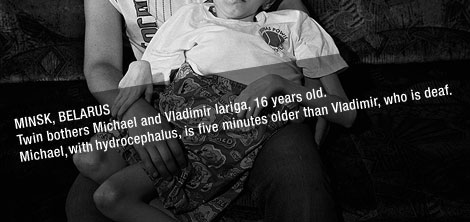
Nuclear NIGHTMARES (s.d.) At: http://www.pixelpress.org/chernobyl/ (Accessed 11/07/2021).
The idea of a “rollover” combined with an image for additional information was new to me.
I have also since explored the Four Corners Project” conceived and compiled by Fred Ritchin, supported by the International Center of Photography and the World Press Photo Foundation. The software is open-source and free for use by the public. Users can put information into the corners of photographs, eg code of ethics, backstory, image context, links or related images. This looks like a great resource that I must try out.
These examples above align with Ritchen’s belief that we need meta-photographers who think what to do with images and how to get good coverage from them. Interestingly he suggests that photo books are probably more respectful than the swipe cultures of social media photography.
This talk by Ritchen has been really inspiring.; the last time a photographer and panel impacted me so much was the Mark Neville talk 4.4.20 (https://nkssite5.photo.blog/category/learning-log-research-and-reflection/photographer-talks/mark-neville-4-3-20/ ).
MY LEARNING:
As a documentary photographer to make a difference:
- Be accurate, don’t add or subtract things from the visual elements or stage to make something look exciting
- Don’t revictimize people, by replaying negative, sordid or sad scenes.
- Contextualise accurately
- Don’t be reactive
- Think about the impact of work on the world
- Avoid stereotypical images
- Try Interactive photos” portraits
- Show images but the reveal information, such as “Rollovers” to give delayed information
- Value photo books
- Try using the template from The four corners
Generally it has made me think about how a visual storyteller should do things differently to:
- Remember I am an author when photoraphing and have a responsibility to understand properly what I am seeing/showing
- interpret with subtlety and depth
- provoke important questions and photograph to create reaction/response
- Respect and collaborate
- be proactive
- use diverse strategies available in the digital environment, to engage the reader and allow for more complexity in the narrative
References:
Four Corners Project (2020) At: https://fourcornersproject.org/en/about/ (Accessed 22/06/2020).
Nuclear NIGHTMARES (2020) At: http://www.pixelpress.org/chernobyl/ (Accessed 23/06/2020).
Ritchen, F. (2020) Remembering the Dead, Differently. At: https://www.fotodemic.org/features/remembering-the-dead-differently (Accessed 11/07/2021).
Storytellers of the Future | Lumix Festival für jungen Bildjournalismus (2020.) At: https://lumix-festival.de/en/themen/storytellers-of-the-future/ (Accessed 23/06/2020).
 Photography 2: Documentary