Slow Looking: Anton Kusters The Photographers Gallery –Virtual event 25.4.20
A session looking at and reflecting on the work facilitated by Caroline Dawson an access and inclusivity consultant working with museums, galleries and artists to improve access to art for everyone.
Anton Kusters Deutsche Börse 2020 Nominee who is shortlisted for his exhibition The Blue Skies Project exhibited at Fitzrovia Chapel, London, UK (15-19 May 2019). This is now exhibited at The Photographers Gallery London.
‘I employ a documentary approach to explore the limits of understanding, the difficulties of representing trauma, loss of the experience of place, and the act of commemoration. More often than not, I end up with no answers whatsoever. I’ve come to understand that answers are seldom there.’ – Anton Kusters (Deutsche Börse 2020 Nominee: Anton Kusters , 2019)
From TGP web site: Deutsche Börse 2020 Nominee: Anton Kusters (2019) At: https://thephotographersgallery.org.uk/dbpfp20-nominee/anton-kusters (Accessed 25/04/2020).
Anton Kusters (b. 1974 in Belgium) makes conceptual photographic projects often investigating the representation of trauma; “he proposes alternative ways of seeing and activating audiences to continue the process of memory” (Deutsche Börse 2020 Nominee, 2019). This work enables viewers to engage with trauma, human rights and genocide.
This is the information given at the gallery:
“His Blue Skies Project is an installation containing 1078 polaroid images. All the images show an upward view of a blue sky shot at the last known location of every former Nazi run concentration or extermination camp across Europe during WWII. Over six years, Kusters researched and photographed these often forgotten sites of violence using a simple analogue photographic process of peel-apart instant film. The resulting images were then blind-stamped with the number of victims at that side and its GPS coordinates.
The installation also features a 13 year-long generative audio piece by Ruben Samama, which recreates in sound and length, the period between 1933 and 1945 when the camps operational”.
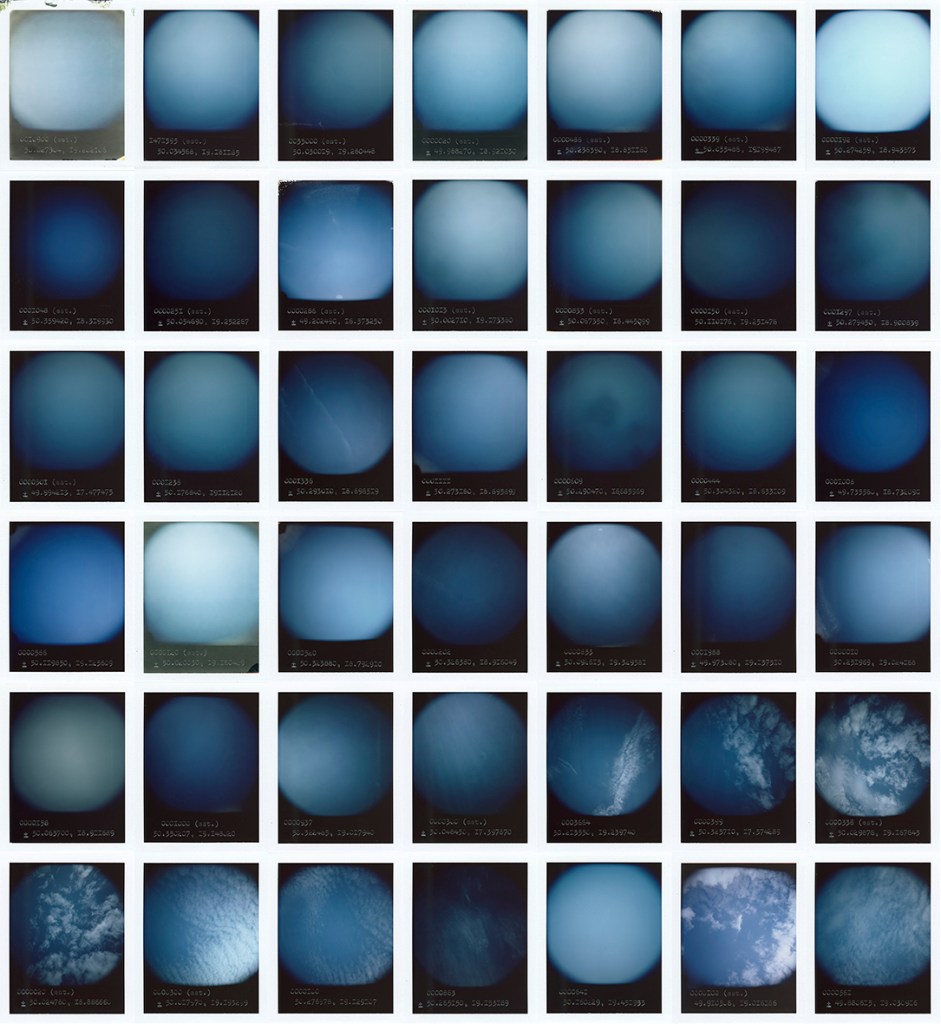
(Slow Looking: Anton Kusters, 2020)
Caroline gave fantastic audio descriptions, I include them here as this was the first part of my learning:
“The work is on a plinth painted the same colour as the walls so the images look as as they ae floating. The plinth is L 466.5cm, W 260.6 cm, H 90cm (nicely compared to the hieght of a kitchen work surface, the length of an estate car and the width of a London routmaster bus). There are 22 rows of 49 polaroids spaced 1 cm from each other. It feels as if the polaroids are floating in the middle of the space, each image 1 cm spaced from each and the edge, all identical 8.6cm x 10.8 cm in size around the same size as a greeting card”. The sound is an audio piece, it plays a single sound, a soft ping; the pitch changes depending on a pre-defined factors, the pattern of sounds are organically irregular. Each sound represents a victim of one of these camps”.
Each image is the tracking of 1078 blue skies from the 1078 camps of 1933 to 1945 when the concentration camps were open (nearly 13 years 4432 days). These images are reproductions of the originals. Each image is blind stamped with the number of victims and the GPS location.
This was a great introduction to the project. She then went on to describe some of the images:
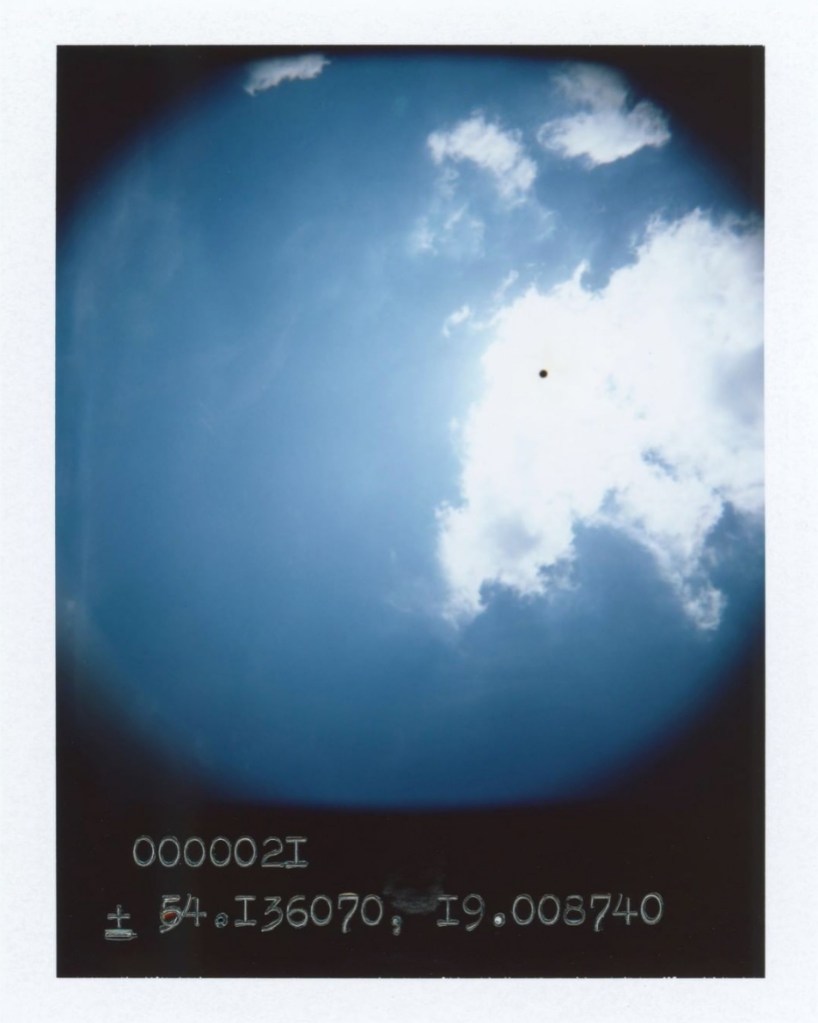
Work 1 – Anton Kusters, Neuteich 0000021 54.136070, 19.008740 (co) from The Blue Skies Project 2019
“Framed with a thin white border which is equal I cm depth all around. Within the border is a black rectangle, the majority is filled with an upshot of the sky, the corners of the rectangle is black and the coloured part of the image is roughly circular in shape, almost as if a fish eye lens has been used the corners are black, a blue summers blue sky roughly circular in shape, blue like light denim jeans, a collection of clouds are swirling around one larger cloud this cloud seems to be bleached white by the sun. The bottom of the polaroid is black where it has been blind stamped with information”.
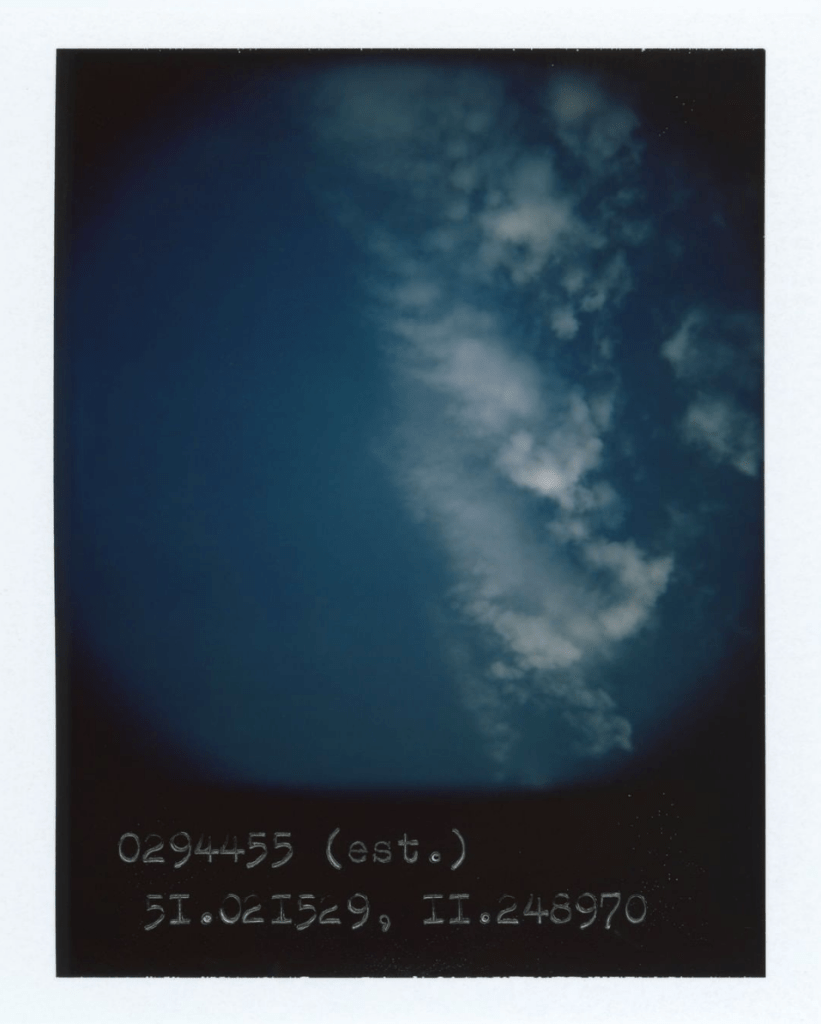
Work 2 – Anton Kusters, Buchenwald 0294455 (est.) 51.021529, 11.24897 (ex) from The Blue Skies Project, 2019
The description is similar except: “the sky within this circle is dark it looks almost unnatural almost like when there is about to be a thunderstorm and the sky turns an unusual dark shade of blue. Spreading across the right side of the image is a network of thread like misty clouds that all seem to be joined together by thin clouds and misty areas. The clouds themselves are so papery that they appear to be lighter versions of the sky in colour”.

Work four Antom Kusters, Thansau 0000050 (est.) 47.827194, 12.154291 (co) from The Blue Skies Project
“The majority of rectangle filled with an upshot of the sky. Unlike the other polaroids described the blue of this one is so dark that it fills the majority of the rectangle making it impossible to decipher the edge of the circle that frames it. The inky blue seamlessly merges with the black. There are no clouds, it looks like it was taken at dusk or perhaps even later, it is so concentrated that when I look at it reminds me of looking into a blue fountain pen ink cartridge”.
Missing image Work 4 – Anton Kusters, Poniatowa 0028000 (est.) 51.178257, 22.061046 (co) from The Blue Skies Project, 2019
A camp in south eastern Poland
“The sky within this circle is again an inky blue…almost the colour of dark denim, but unmistakably an image of the sky, due to the very faint wispy clouds across the top of the photograph, like flour dusted on a kitchen work surface. At the bottom left of the sky area a smaller more concentrated smaller area of white cloud I the vague shape of a triangle”.
Installation description:
“There is enough space between the walls and each side of the plinth to walk around. As I move around the space and try to take in the vast spread of polaroids I am struck by intensity of the project, 1087 polaroids is a lot of photographs and although visually the subject is simple conceptually there is a lot to take in. This sea of 1087 blue rectangles, each one representing a place of trauma, with each one recording the number of victims of each concentration camp, the sheer vastness of it, combined with the sound piece, which to me begins to feel like an assault of noise as I consider that each sound represents a victim, history comes very close. Here Kusters provides space for the audience to consider their own place in history and engage in with the evolving dialogue around trauma human rights and genocide”.
MY LEARNING FROM LISTENING TO THE AUDIO DESCRIPTIONS:
I have been fascinated by Caroline’s audio descriptions previously but what struck me here was how much audio description she was able to give of a simple image. I noticed that she gives useful comparisons to add her descriptions like: “like the height of a kitchen work surface, the length of an estate car and the width London routemaster bus” and “around the same size as a greeting card”.
She also uses lots of similes: “blue like light denim jeans”, “like flour dusted on a kitchen work surface”
And other visual comparisons: “so concentrated that when I look at it reminds me of looking into a blue fountain pen ink cartridge”
Overall I am reminded how one should look long and closely at an image to take in all parts of it.
THESE ARE THE QUESTIONS WE ASKED CAROLINE AND TGP:
Q: Why the blue skies? This was answered in the artist talk another day, he said he asked himself what his Grandfather have would seen if he had been taken The solace of the endless sky landscape.
Q: Was he on location or did he use google planet? He travelled to each location.
Q: Regarding the relationship between image and the spoken word, why does Caroline describe with equivalents and their pheromonal comparisons? When writing an audio description she writes as if writing for a visually impaired audience and says it’s important not to take authorship of the piece.
Q: Why are the numbers and coordinates blind stamped rather than written? A suggestion was that blind stamping is embossing and it is probably difficult to find an annotating process that will last on a polaroid. Apparently Kusters expectation is that in 13 years the polaroid’s will fade but the blindstamping will remain. Somebody suggested that it replicates the tattooing process in the camps.
Q: Why are the polaroids displayed on a table? Previously have been displayed on walls but was shortlisted from its appearance at another gallery which was a church space on a table and so was displayed here in a similar way. It was commented that it gives them a greater physical presence, like a memorial, also like the feeling of having an horizon.
Q: What has caused the vignette? Do you have any information on the camera used? No but it must be the lens masking part of the image as he takes the photograph. The artist later answered that He used a very cheap polaroid camera, hence the huge vinaigrettes.
Q: What do you think is behind the circular effect, in terms of feeling? These were some responses:
It looks to me almost like they are taken through a telescope, Like the sun? The moon? The universe? I find there’s something almost claustrophobic about them, it feels more intimate, It makes me feel like I’m captive and looking out, the idea of claustrophobia is interesting particularly in relation to the condition of the prisoners in the camp, like you’re trapped, it would make sense if it were a pinhole camera – the simplicity of the process also suggests a very direct connection to the site
Q: Is there any logic in the sequencing? Not known but Kusters answered this in his talk; he tried different ways of sequencing but none of those felt right, so he used a computer to generate 1078 random order and the images are always displayed in this way.
Q: Why is the size of these polaroids are different to the normal? Not known although they are described by the gallery as peel-apart instant film.
References:
Slow Looking: Anton Kusters (2020) At: https://thephotographersgallery.org.uk/whats-on/tours/slow-looking-anton-kusters (Accessed 25/04/2020).
Deutsche Börse 2020 Nominee: Anton Kusters (2019) At: https://thephotographersgallery.org.uk/dbpfp20-nominee/anton-kusters (Accessed 25/04/2020).
Anton Kusters – One Thousand and Seventy-eight Blue Skies, The Blue Sky Project (2020) At: https://soundcloud.com/the-photographers-gallery/virtual-slow-art-day-anton-kusters-one-thousand-and-seventy-eight-blue-skies (Accessed 30/04/2020).
This slow looking event was followed in a few days by a live artist’s talk which gave us to ask him some of our unanaswered questions
DEUTSCHE BÖRSE 2020 NOMINEE: ANTON KUSTERS: VIRTUAL TALK AT THE PHOTOGRAPHER’S GALLERY 30.4.20
‘I employ a documentary approach to explore the limits of understanding, the difficulties of representing trauma, loss of the experience of place, and the act of commemoration. More often than not, I end up with no answers whatsoever. I’ve come to understand that answers are seldom there.’ Anton Kusters (Deutsche Börse 2020 Nominee: Anton Kusters , 2019)
Kusters explained:
The work was inspired by the recent knowledge that his Grandfather was almost taken by the Nazi but had a narrow escape. Kusters doesn’t know which camp this was to so he visited them all over 5 ½ years travelling he visited every concentration camp, and to be there when there was blue sky, photograph and then move on. Often there were no visual remains of the camp sites he visited. There were 42,000 camps in Europe of a variety of types: extermination, ghettos, concentration, work… Only the location of 140 camps are known exactly, 250 known approximately, for only 200 the area but not the location was known.
The size of the camp hasn’t determined the voice of the victims so that they have an equal voice; however he did spend a whole day in each of the 23 main camps but a very short time in the others. Kusters was able to visit in excess of 15 camps per day because the camps were built in 23 clusters within 100km with 3-120 subcamps.
The fading of the images is significant to the work whilst the blind stamped numbers that fell within that particular sky and the GPS coordinates won’t. Kusters expects the abstractness will makes you uncomfortable because it isn’t telling you anything about the work. That viewers should make sense of the work in their own way and shouldn’t be pushed to think. It was noted that you cannot escape being seen in the work as you will reflect in the surface of the polaroid.
Kuster explained that he met Ruben Samama Music/soundtrack (writer artist and songwriter) after he had been working for a few years on the project already; they want to play the soundtrack for the 4432 days the concentration camps existed, in real time. Ruben thought about how to make the huge historic event and the idea of loss and trauma, into a soundtrack understandable for others, as everything should speak for itself; he stripped the hierarchy of the numbers and produced an organically irregular, electronic soundtrack which plays history in real time, over almost 13 years and every ping is one victim. Samama explained that he made sense of Kusters data in his own way, but wanted to help make it personal for everyone.
Kuster explained that he wants to make a collective memory of important events; if necessary he might help the images to fade so that the skies in the polaroid’s also fade over the time and there becomes an urgency to see the work as it is changing all of he time. Kusters says this change is important as every time you access something your memory changes. The blind stamping will remain. He always has a discussion with galleries so that they consider whether they use the originals and help them to age as they are engaged with, or do they use a replica which will not damage.
He was asked what went through his mind when he pressed the shutter on the last image? It was in the only camp on British soil in Alderney he drank a chocolate milk in honour of his grandfather, he still has the carton; this was the first time that he thought of himself rather than the work driving him.
I WAS ABLE TO LOOK AT LEARN IN DEPTH AT AN UNUSUAL PIECE OF CONCEPTUAL PHOTOGRAPHIC PRACTICE- This has encouraged me to:
- Consider alternative ways of seeing
- Give the opportunity for activating memory
- Consider ways of exploring the limits of understanding and things that are difficult to represent
- Not to expect answers
- Maximize the importance of a physical aspect of work and the possibility that this changes
- The importance of the presentation and the possibility of change in this to reactivate responses
References:
Slow Looking: Anton Kusters (2020) At: https://thephotographersgallery.org.uk/whats-on/tours/slow-looking-anton-kusters (Accessed 25/04/2020).
Deutsche Börse 2020 Nominee: Anton Kusters (2019) At: https://thephotographersgallery.org.uk/dbpfp20-nominee/anton-kusters (Accessed 25/04/2020).
Anton Kusters – One Thousand and Seventy-eight Blue Skies, The Blue Sky Project (2020) At: https://soundcloud.com/the-photographers-gallery/virtual-slow-art-day-anton-kusters-one-thousand-and-seventy-eight-blue-skies (Accessed 30/04/2020).
 Photography 2: Documentary