Single image narratives: Produce eight images that, individually, have a narrative and convey a specific idea. Rather than focusing on a theme or activity, work on a concept. The more abstract the concept the better.Delivery: For this assignment you need to publish a blog page. Thumbnails should link to high resolution images.Aims: This assignment aims to help you develop your ability to conceptualise your thoughts and communicate your ideas visually. The emphasis is on effectively translating concepts into visual products.Provide a short commentary explaining your ethos and rationale along with your images.(Open College of the Arts, 2014: 53)
Nicola South Student number: 514516
ECONOMIC SCARRING
COMMENTARY
This work is about scarring, the damage that is left behind after trauma; not wounds on body tissue but the long-lasting damage caused by the current recession on our economy.
Economic scarring though not a new phenomenon, is a new term. This recession has led to “scarring”, long term damage to individuals’ economic situations and the economy. Covid 19 is the cause of this recession, but this work is not about Covid 19. My images are a response to my current fear for our futures, particularly livelihoods, and the damage that is already apparent.
In this work I have run with a concept that is meaningful to me now. In my own hibernation I have had much time to learn and reflect. I have; been offered, mainly by zoom, considerable photographic advice and stimulus, this has seeped into me. My initial thought was to photograph in a surrealist style, there are some of those elements in my images, but from that beginning I worked in an intuitive way and found my own style.
My intention was to go out and look with heightened awareness. Photographers such as Brassai have inspired me to train my eye so that I can reveal my world. I was struck by Stephen Shore’s comment that there should be no difference between shooting and seeing; this is what I aim to present to my viewers. Integrity is also important in this work, there is no construction here; though I have used my eyes and framing, to show you what I want you to see – a sense of something not quite right.
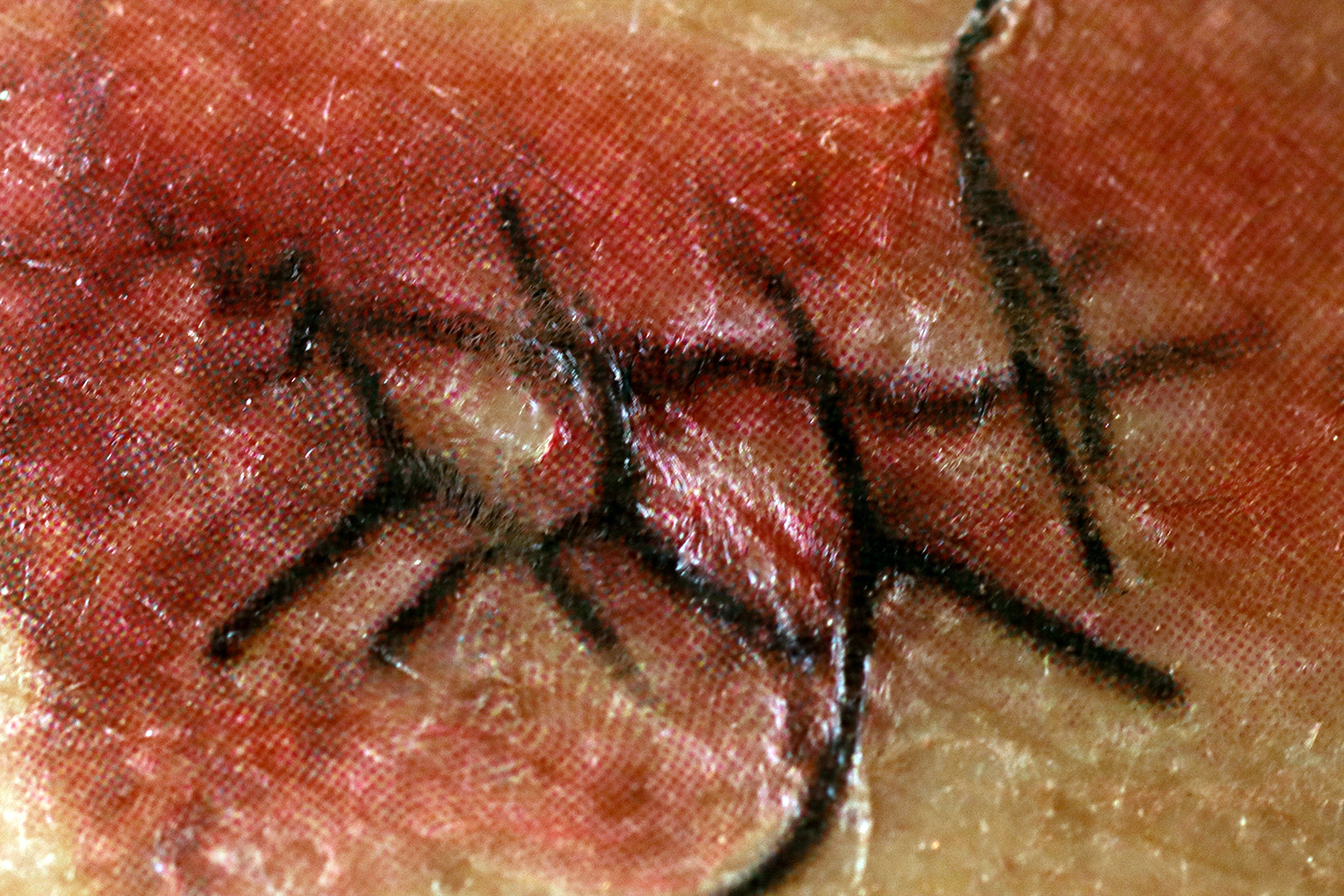
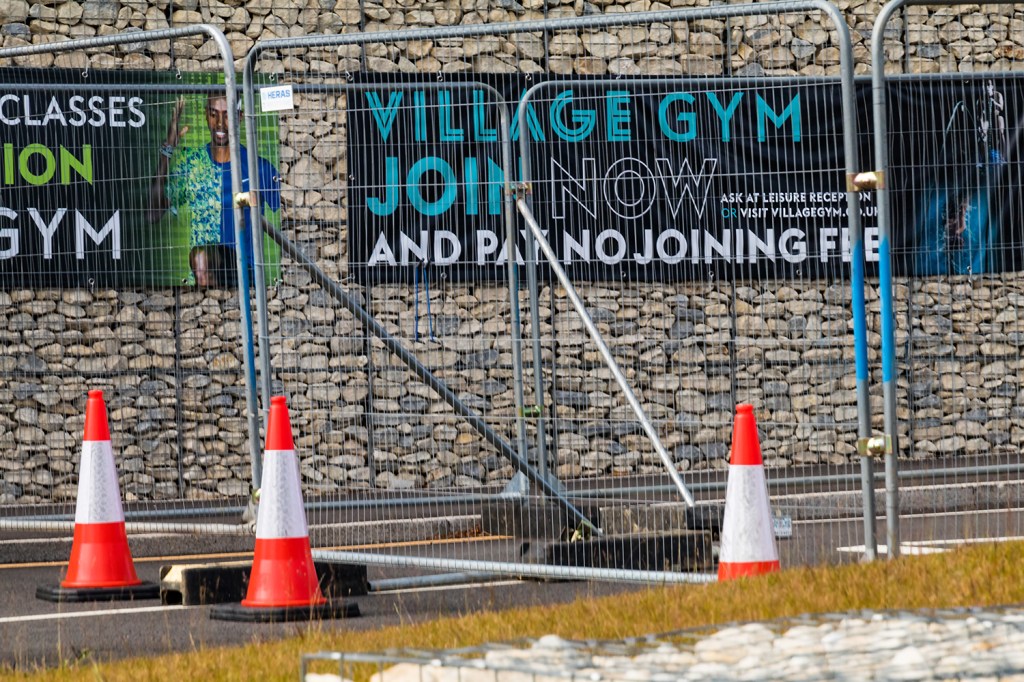
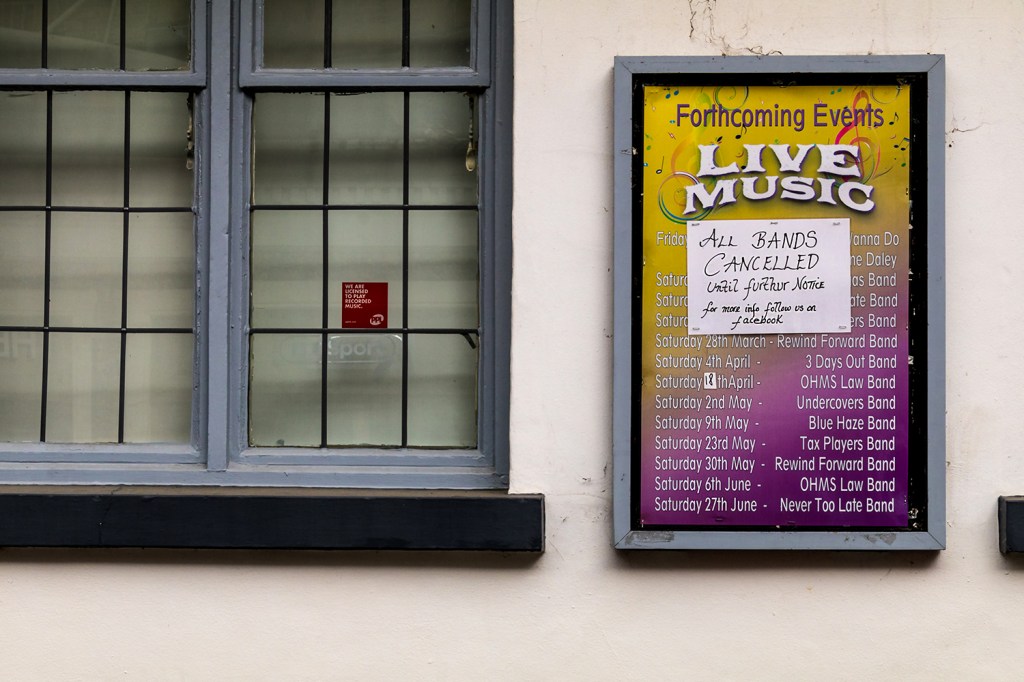
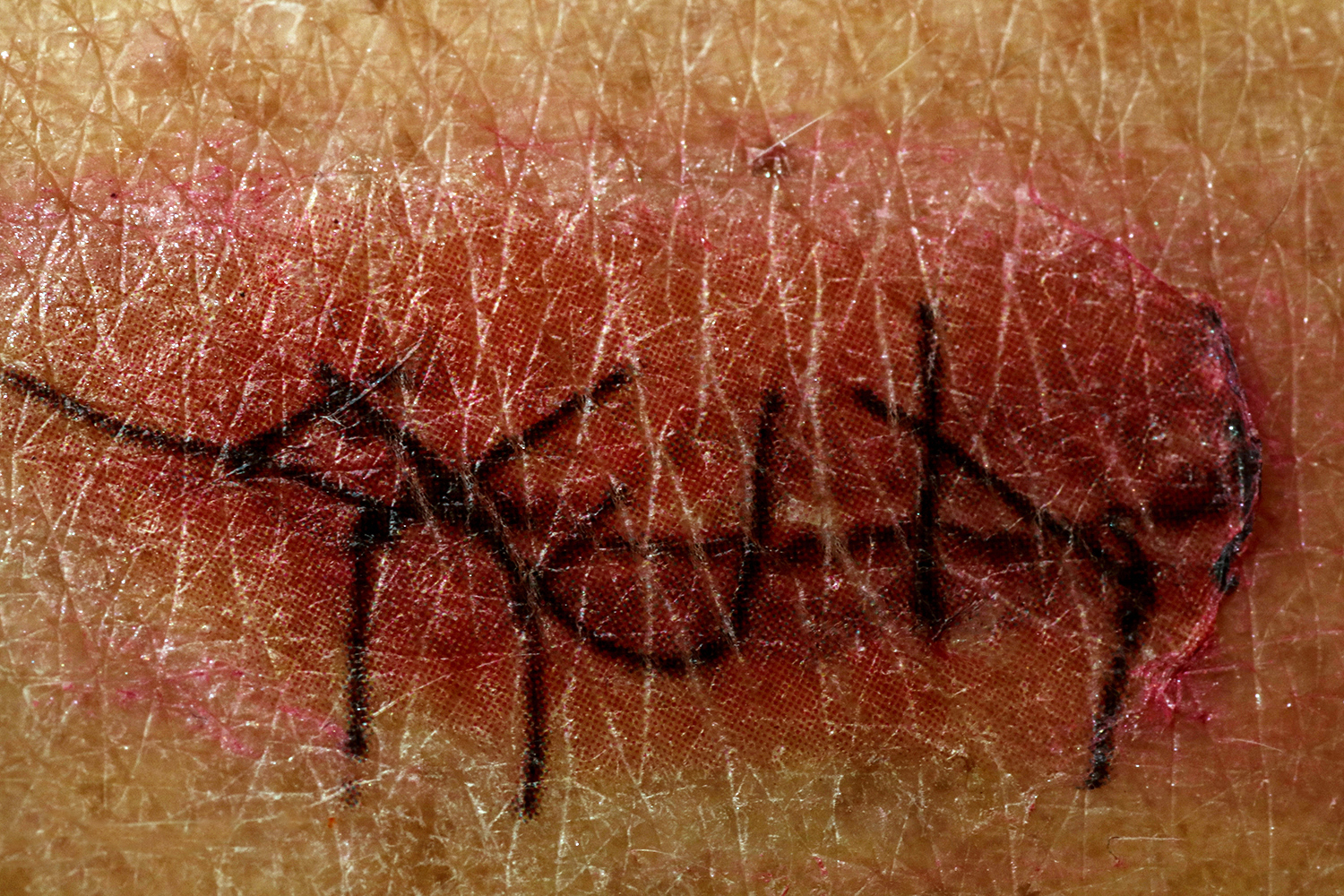
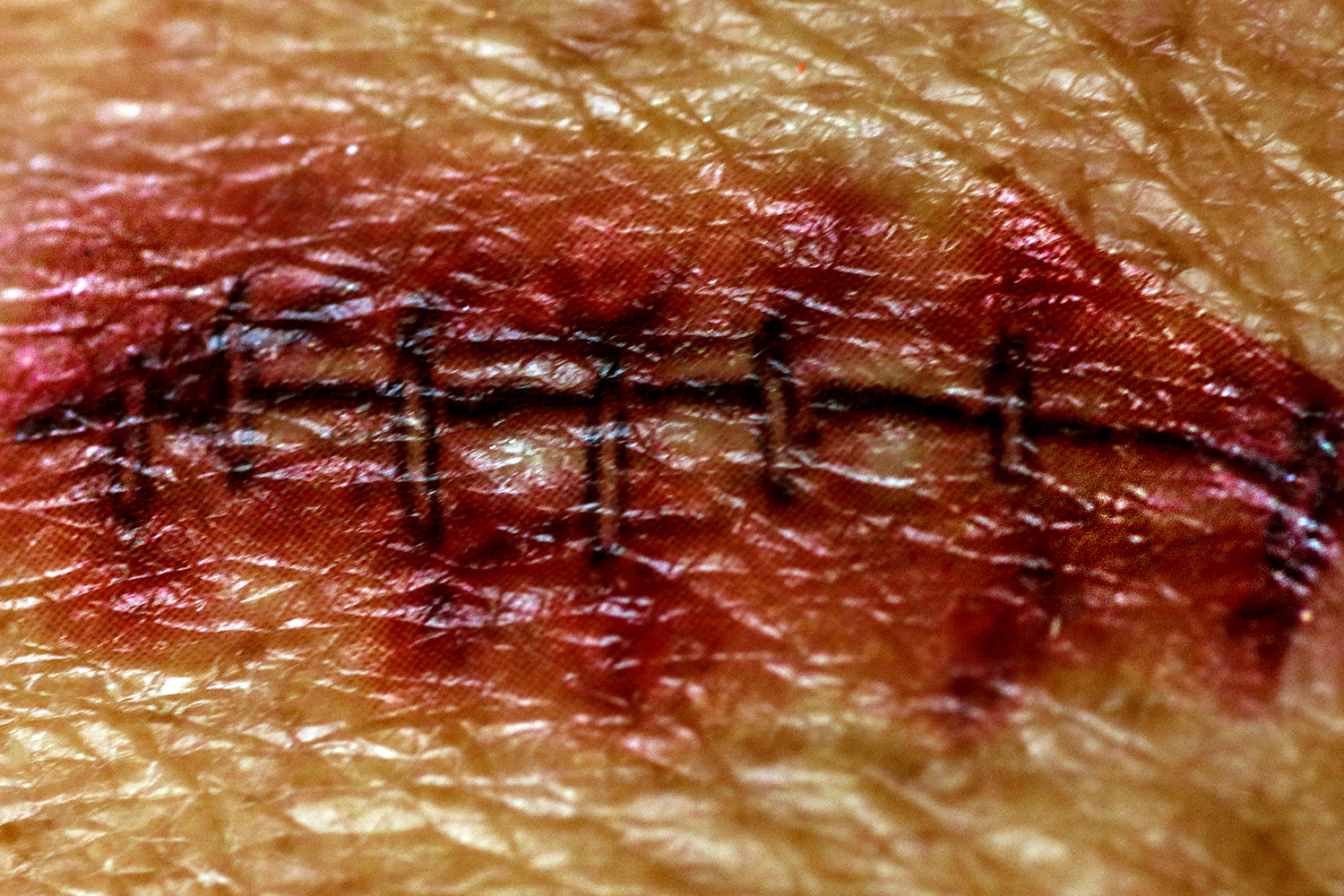
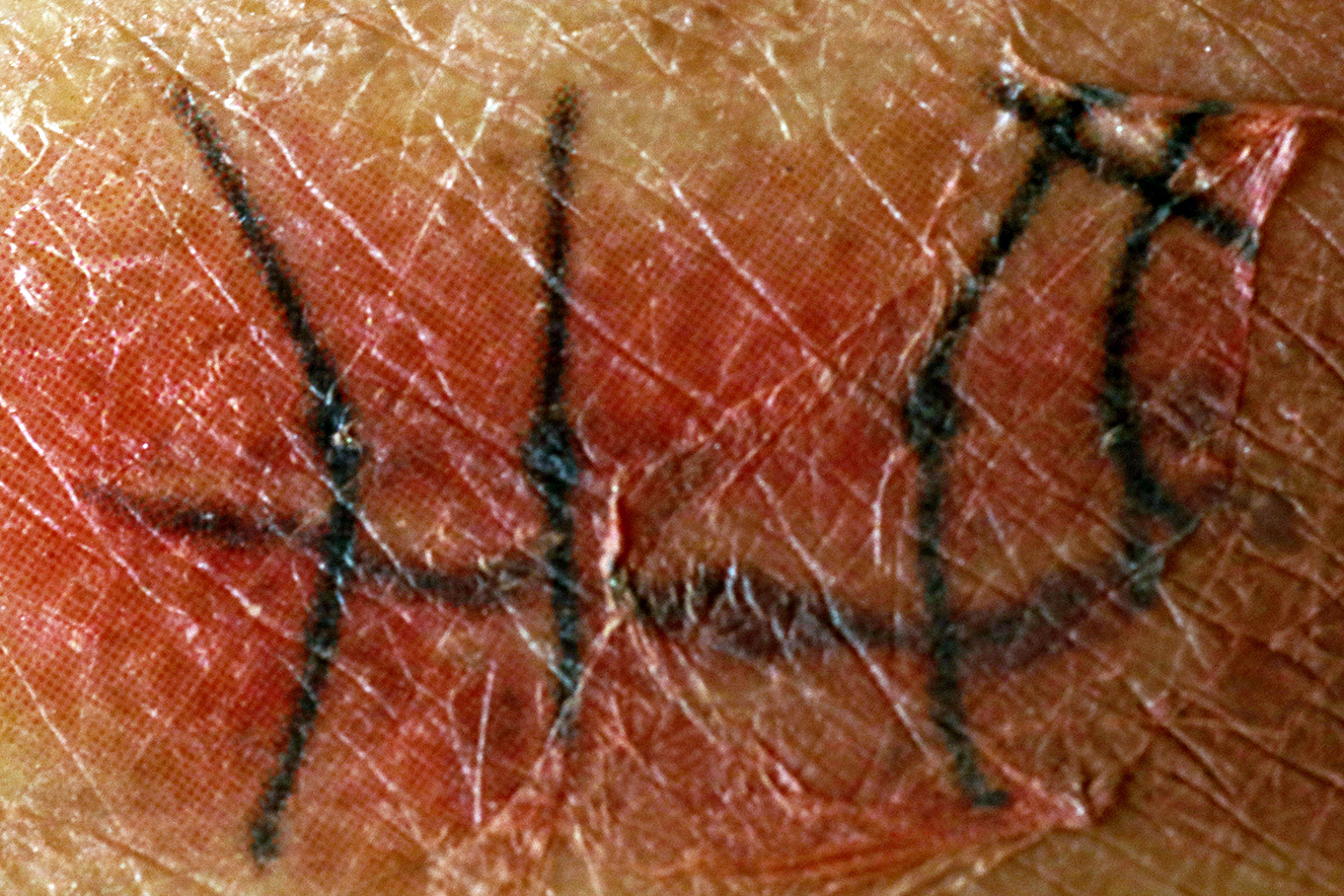
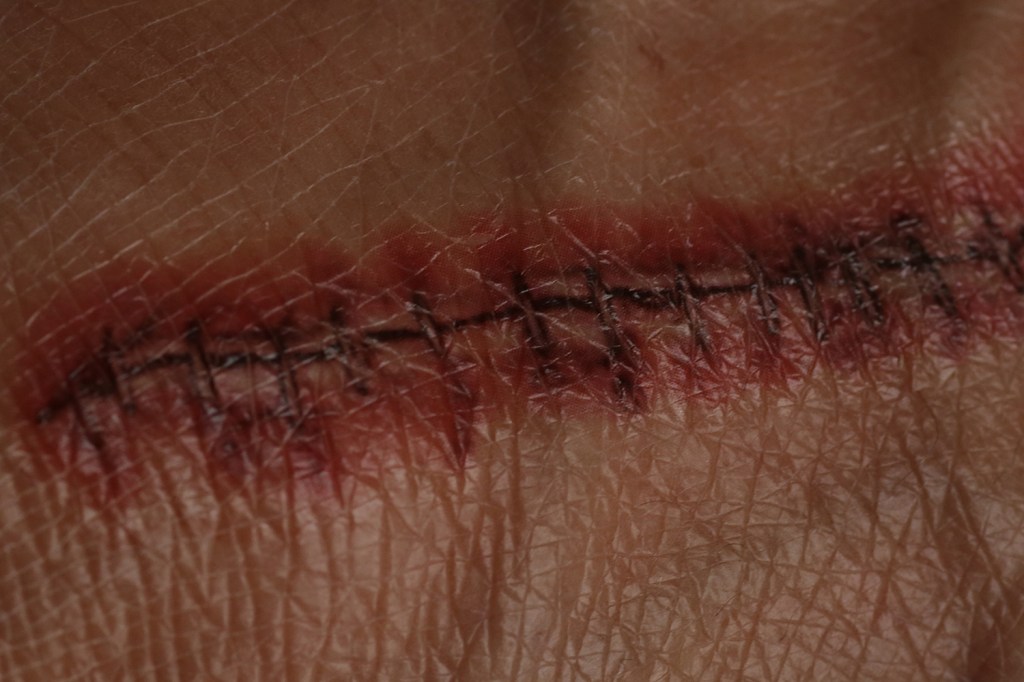
Every image has its own narrative, but together visually they anchor my concept. Each is accompanied by a flesh wound as a hashtag, to reinforce the human pain caused by the economic scarring. The stitching represents a holding together and hope of recovery. There are other signs and symbols within the work that are meaningful to me, however viewers will make their own meaning from what they see here.
ARTIST STATEMENT
The world has stood still, my world has stood still. I am concerned for our futures, our economic futures. When I emerged from my hibernation, I went looking to see how businesses were faring. Here is the damage I observed, scarring…economic scarring which will wound all of us.
ECONOMIC SCARRING
REFERENCES:
Short, M. (2011) Creative Photography: Context and Narrative. Lausanne: AVA Publishing
Open College of the Arts (2014) Photography 2: Documentary-Fact and Fiction (Course Manual). Barnsley: Open College of the Arts.
I went out looking and ready to shoot. with great curiosity, it was like looking with new eyes with a heightened awareness. It is possible that having been in hibernation my viewing was naturally enhanced.
Observation was everything to me in this project. I searched to find examples of economic scarring, that were accessible to me, and with time constraints with businesses able to open in 10 days, I made the most of every opportunity, looking carefully and at details.
I wanted to present images that a viewer would feel they’re looking themself rather than viewing a photograph; so once I found a subject I moved around a lot experimenting used framing, perspective, and depth of field to construct an image that showed only what had caught my attention.
Interestingly I have since done hardly any cropping, maybe just a bit of straightening on one or two images. I used the framing as I shot to control what I show the viewer.
I believe that each image has enough elements to communicate its own individual narrative.
Quality of outcome
One thing I picked up between assignment 1 and 2 is that when you’re feeling stuck or constrained it’s important to do work that’s meaningful for you.
Though “Economic scarring” is a concept, I was concerned whether it was abstract enough for the brief. However I felt strongly that this was something that needed recording, I could feel the scarring on this landscape myself when shooting and needed to share it; so I may have taken some licence form the brief but hope to anchor it by the way it’s presented.
I think there is also some discernment in the work because I stayed away from obvious Covid19 signs and clichés, though this introduces ambiguity and may mean that overtime there is some discontinuity,
Intention is important; I feel a huge concern for the future, especially the next generation and this brought an urgency to capture what I was seeing, and yet I had to combine this with patience to get it right.
I hope that these images will give the audience something to reflect on; I believe that they each show a sense of something not quite right, and I feel that this gives most some punctum.
When editing and forming the series I hope that the signs and symbols in the images along with the way I’ve presented them anchors my concept.
Demonstration of creativity
I was firm in my concept from the outset but kept my options on the style of the outcome fluid.
This was useful as I had taken on board so much photographic stimulus whilst in lockdown (mainly via zoom) that it gave it time to seep through me as I photographed.
Though I went out for my first shoot with the idea of using a surrealist style, I went with the flow and followed my instincts and my work developed its own style.
I have committed to my intuition this assignment, where normally I question myself and am not so confident in using my own style.
I had been keen following photographer talks such as Anna Fox to try some “FRICTION” (fact and fiction) but the only construction I needed here was in shaping the audiences view.
This was fortunate as something else I heard from photographers and the coursework across these weeks was the importance of integrity, and I’d managed to keep my photography honest.
I feel I have exercised my creative muscle.
Context
This was a very reflective period in my life, with so much changing all around me and this naturally carried into my work.
I engaged many times with students as usual but with wider networks as well, curtesy of zoom; in fact too much came to me via my laptop portal and in the end I had to call a stop to extra research and learning, so that I could post it and my work and my assignment.
I have digested and reflected on much extra research as well as the directed and my knowledge base has broadened considerably.
Hence the context for the concept here is current and topical but my thought processes behind the work has been broad.
Single image narratives: Produce eight images that, individually, have a narrative and convey a specific idea. Rather than focusing on a theme or activity, work on a concept. The more abstract the concept the better.Delivery: For this assignment you need to publish a blog page. Thumbnails should link to high resolution images.Aims: This assignment aims to help you develop your ability to conceptualise your thoughts and communicate your ideas visually. The emphasis is on effectively translating concepts into visual products.Provide a short commentary explaining your ethos and rationale along with your images.(Open College of the Arts, 2014: 53)
Nicola South Student number: 514516
ECONOMIC SCARRING
COMMENTARY
This work is about scarring, the damage that is left behind after trauma; not wounds on body tissue but the long-lasting damage caused by the current recession on our economy.
Economic scarring though not a new phenomenon, is a new term. This recession has led to “scarring”, long term damage to individuals’ economic situations and the economy. Covid 19 is the cause of this recession, but this work is not about Covid 19. My images are a response to my current preoccupation with our futures, people’s livelihoods, particularly for the next generation.
In this work I have run with a concept that is meaningful to me now. In my own hibernation I have had much time to learn and reflect. I have; been offered, mainly by zoom, considerable photographic advice and stimulus, this has seeped into me. My initial thought was to photograph in a surrealist style, there are some of those elements in my images, but from that beginning I worked in an intuitive way and found my own style.
My intention was to go out and look with heightened awareness. Photographers such as Brassai have inspired me to train my eye so that I can reveal my world. I was struck by Stephen Shore’s comment that there should be no difference between shooting and seeing; this is what I aim to present to my viewers. Integrity is also important in this work, there is no construction here; though I have used my ey,e and framing, to show you what I want you to see – a sense of something not quite right.
Each of these images have their own narrative but together visually they anchor my concept. There are signs and symbols within the work that are meaningful to me, however viewers will make their own meaning from what they see here.
ARTIST STATEMENT
The world has stood still, my world has stood still. I am concerned for our futures, our economic futures. When I emerged from my hibernation, I went looking to see how the commercial sector had fared. This is the damage I observed, scarring…economic scarring.
ECONOMIC SCARRING
REFERENCES:
Short, M. (2011) Creative Photography: Context and Narrative. Lausanne: AVA Publishing
Open College of the Arts (2014) Photography 2: Documentary-Fact and Fiction (Course Manual). Barnsley: Open College of the Arts.
In preparation I revisited Chapters 4 and 5 in Creative Photography: Context and Narrative (Short 2011) as directed; I will return to this later.
Initial thoughts:
I began thinking abut abstract concepts such as confusion. However, I had not long done an assignment, though in the Landscape module, where I made abstract equivalents from a concrete concept; I really enjoyed this but knew that I didn’t want to emulate it.
Whilst running every day I had taken to listening to podcasts, particularly on the economics and politics of the effects of Covid19. I had a “Eureka moment” when I heard the term “Economic scarring” and began to think about this as a concept that I could present visually. This is a new term, but not a new phenomenon; it is currently being used to describe the economic impact of Covid19. I thought that this could be the abstract concept that I could represent in a concrete way.
I remember Anna Fox (16.5.20) talked about the work of Sophie-Ristelhueber “Everyone” (1994) where she used images of real body scars to denote the scars of war; in fact these scars were not the product of war but those made accessible to her by a surgeon. It was constructed work. I was set in the early stages of this work on using scars as well as images of commercial subjects showing economics scaring. I thought also of using the organic scars on the landscape instead of body scars.
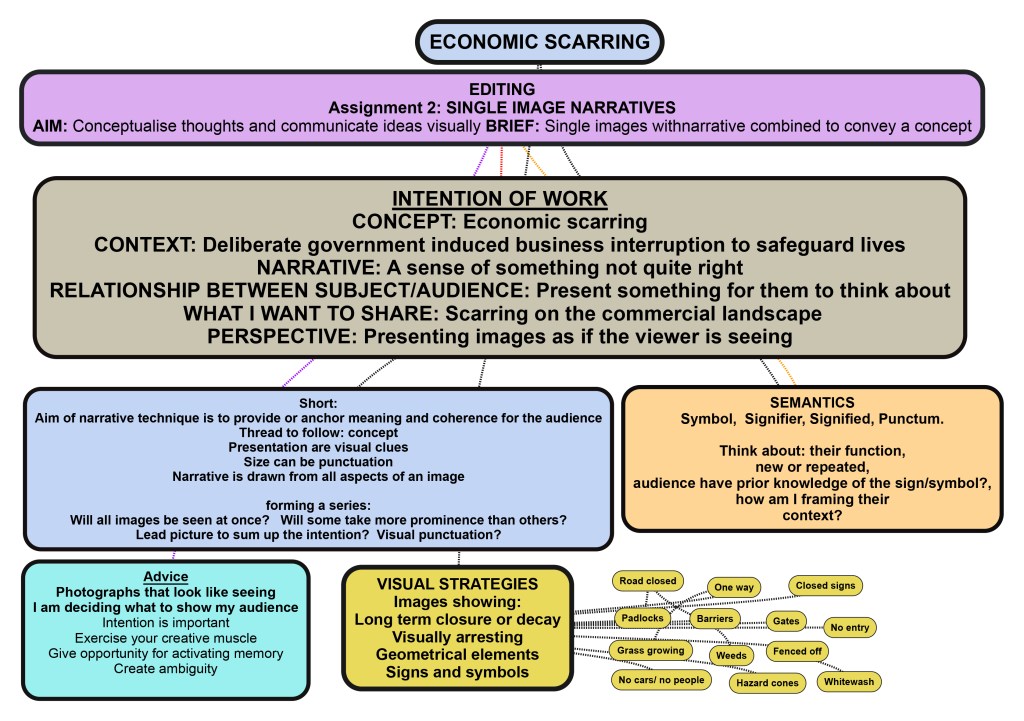
Initial Thoughts Mind map:
Development:
This assignment coincided with the end of “Lockdown” so I knew I would be able to go out and photograph, however I’d not been out for a couple of months except to run in the countryside. Before I went out exploring, I planned: Where would I go? What was I looking for? Would I be safe? Should I have preconceived ideas, or should I just go with the flow?
I went out in my car scouting, as well as on foot to see what the nearby urban and industrial landscape looked like now – I’d not seen it for a couple of months. I visited places that prior to lockdown were busy thriving business and retail areas. I was shocked, it looked like there’d been an apocalypse.
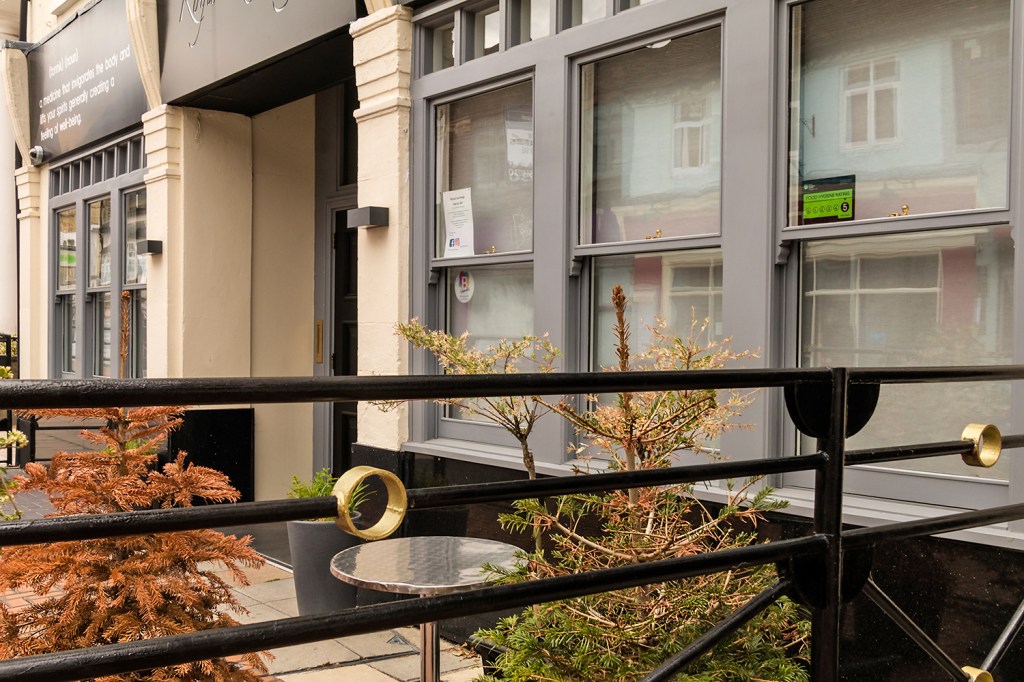
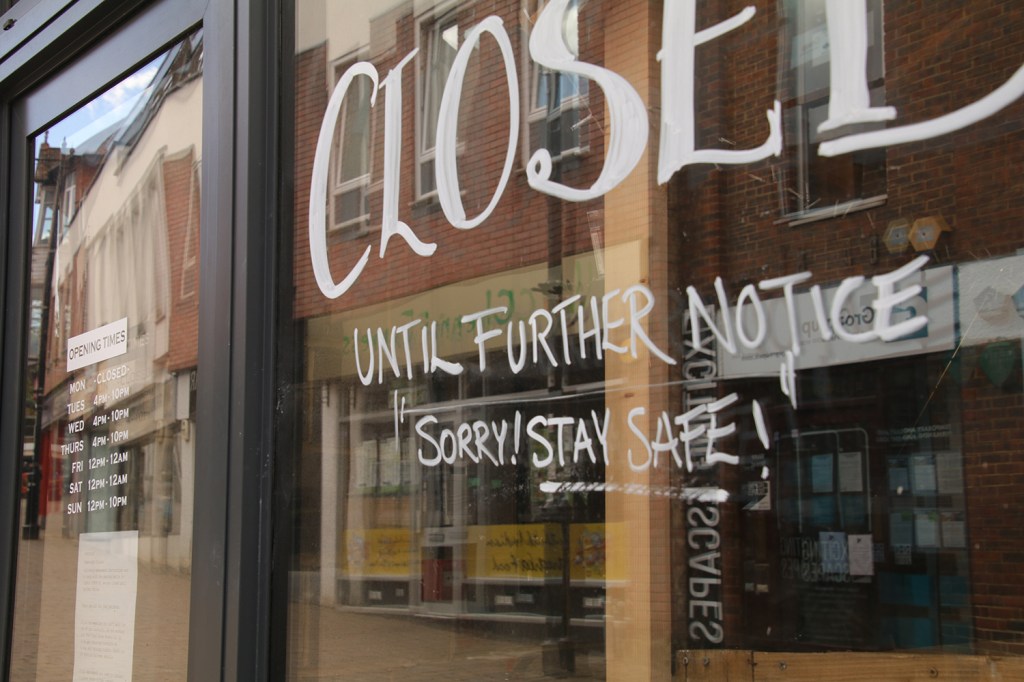
I found empty neglected streets and industrial estates, and lots of signs of hibernation, business interruption as well as plenty of indications of stagnation, decay, and financial problems: Economic scarring.
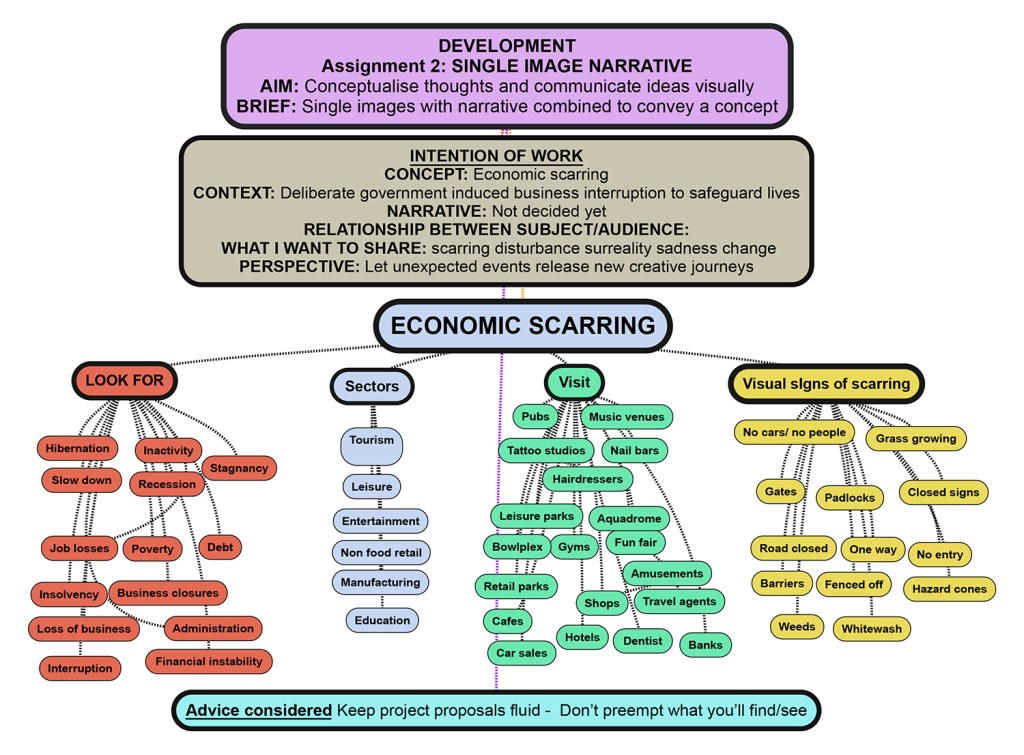
Development mind map:
Shooting
It had been announced that non -retail would be opening in 10 days, so I realised to capture what I had seen when scouting I would have to shoot a lot in the next week. I took advantage of all cloudy days and shot early and late in the days.
I considered what style I should shoot in.
I researched much different photography and photographers in the past 2 months, and collected a lot of advice, probably too much. I had been keen on the idea of friction and trying construction, but clearly none was needed here.
I set out with the idea that I would adopt a surrealist style of photography:
Sense of something not quite right, disturbing- with Punctum
Frame forcefully
Reflections
Shadows
Geometric patterns
Ambiguous images
Juxtaposition
Use of negative space
Unusual angles
Frame abruptly
Break traditional photographic rules of composition
See things differently and show us things differently
Disrupt our perceptions
Reveal the uncanny
Working with a concept and influenced by my research I was also keen to incorporate semantics visually, symbols, signs, and signifiers, which I knew I could use photographic techniques to bring into the frame:
Aperture
Shutter speed
Lighting
juxtapositions
I initially went out looking for black and white material but quickly realised that this project needed to be shot in colour; often a little colour against depressing neutrals was telling and jarring, and colour against grey subjects spoke to me of fading and deterioration. .
I made many visits and revisits to photograph:
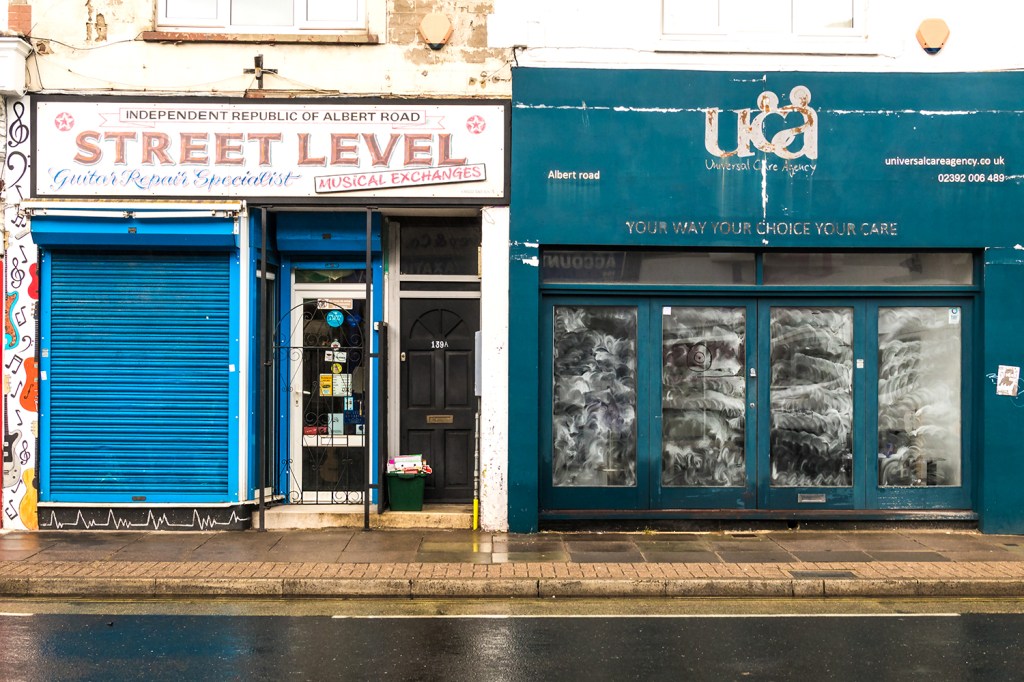
Top of town away from the shopping centre: Hairdressers, nail bars, tattoo bars, Travel agents, cafes.
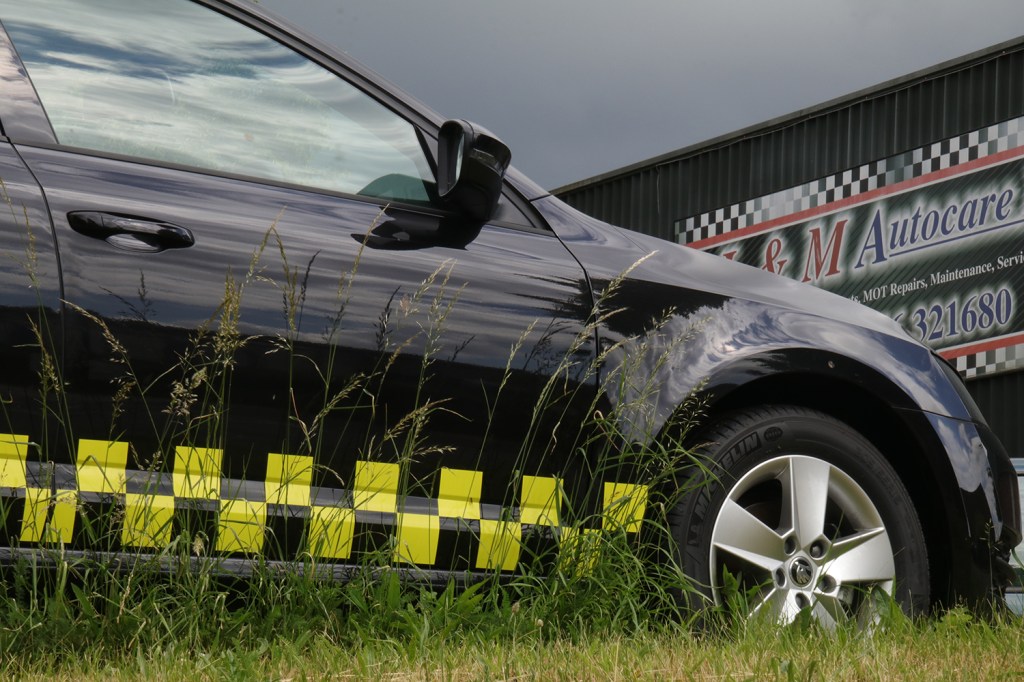
Industrial parks, and out of town gyms
Restaurants
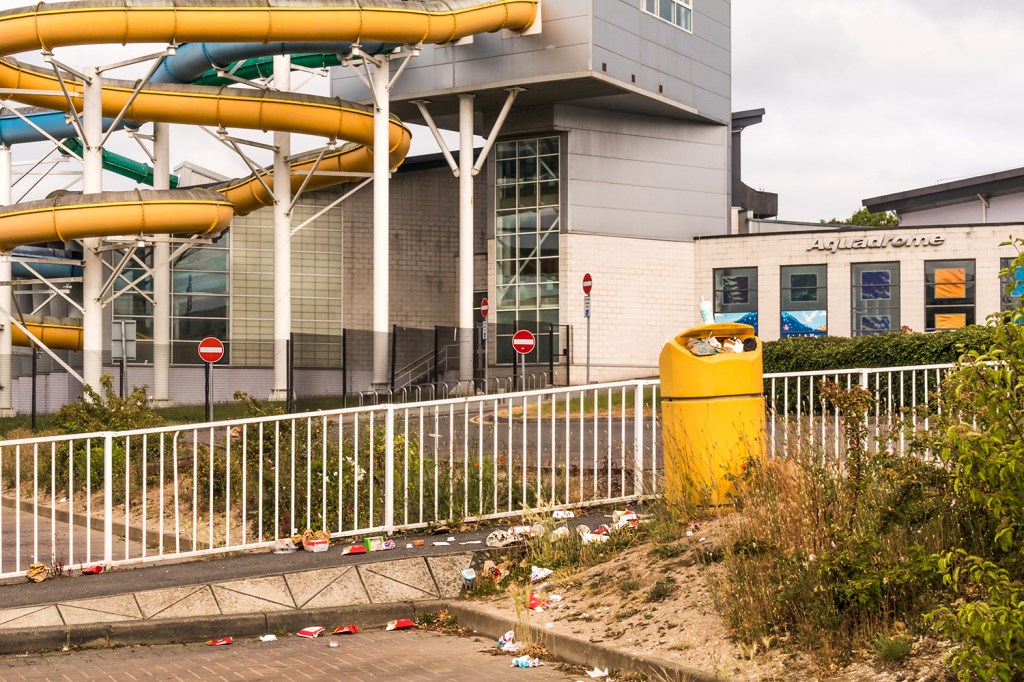
Leisure park, Aqua drome, Cinema, Bowl plex
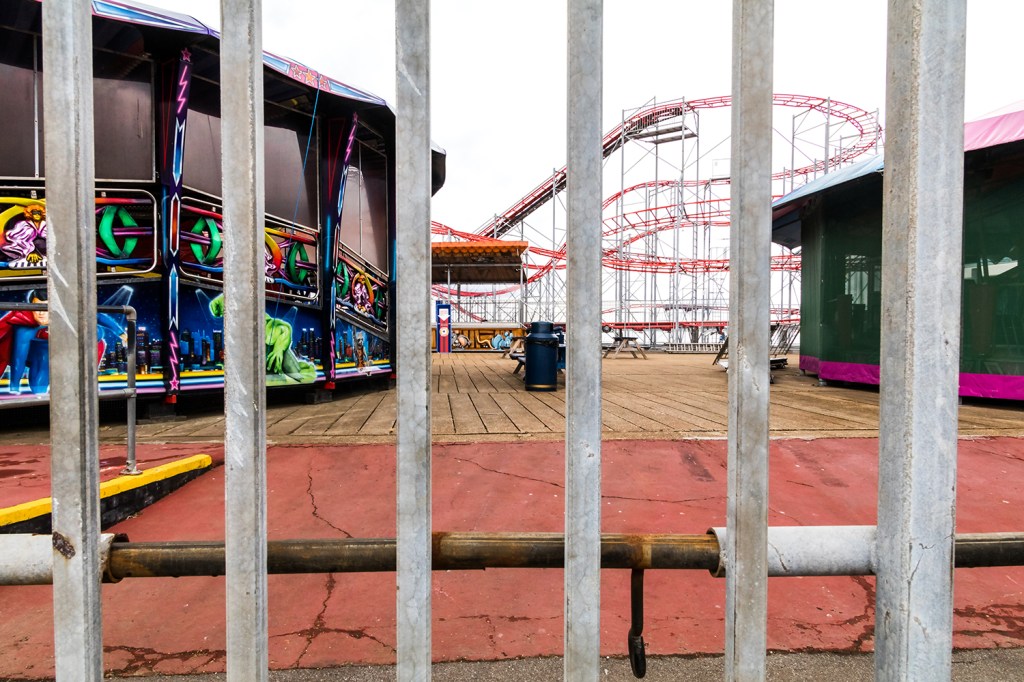
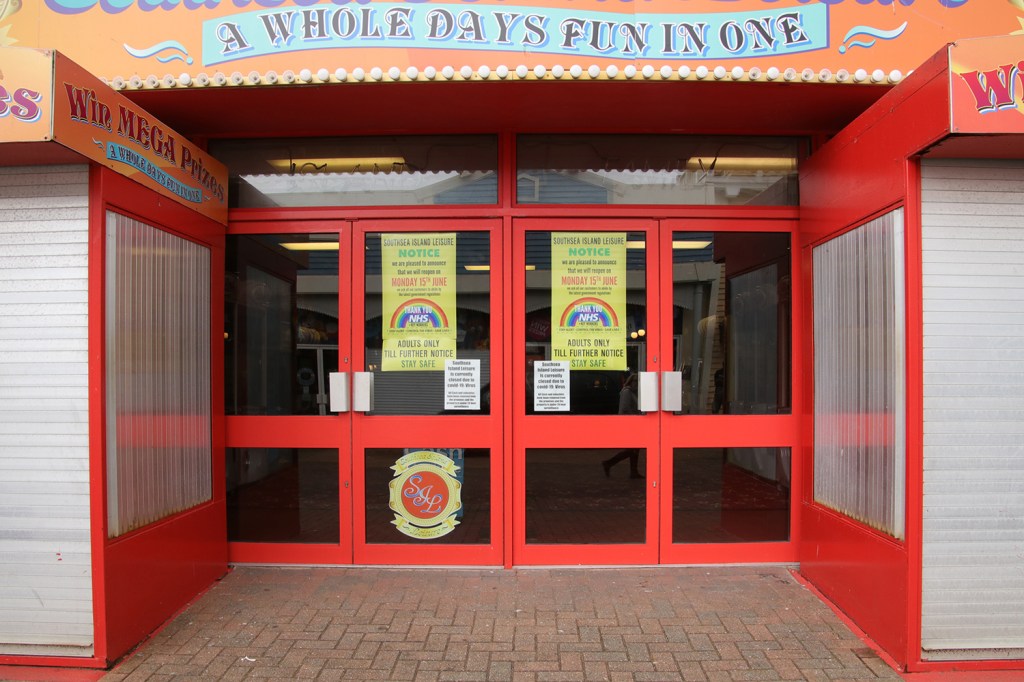
Funfair, piers, amusements
Local shops in a different locality
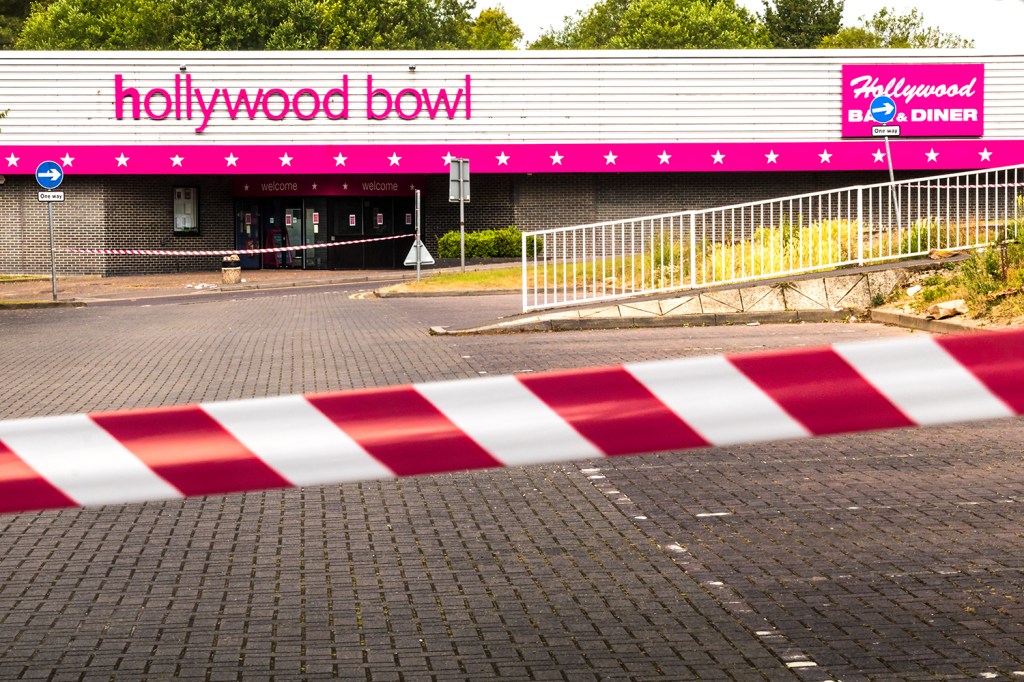
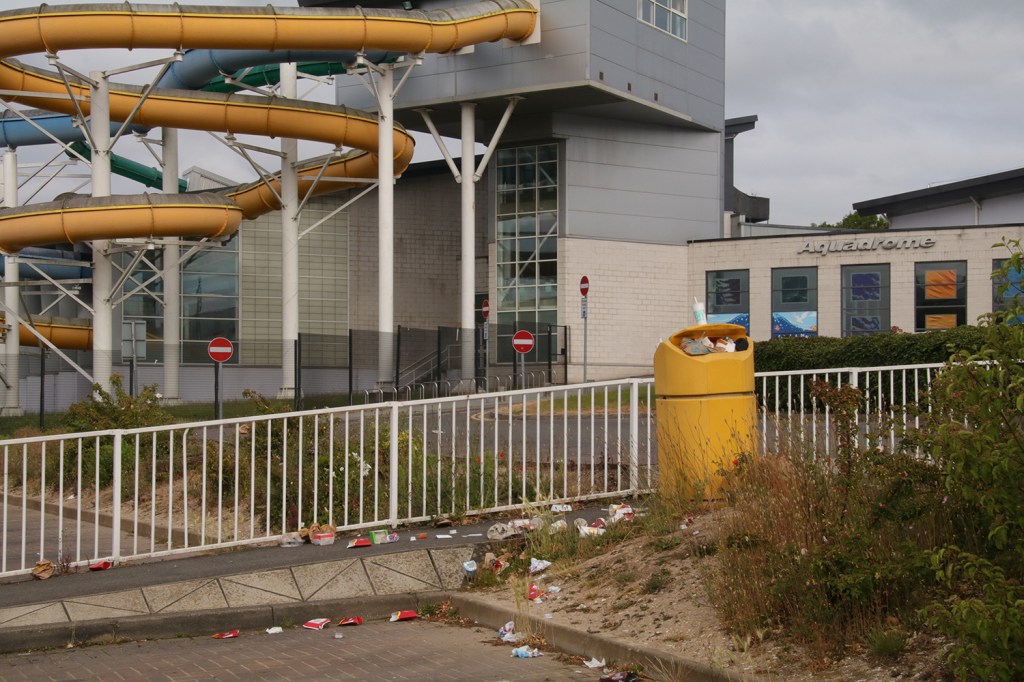
I returned to improve shots, which paid off. Shooting at the Leisure park was a good example of this; I first shot early evening and found lots of potential except there were cars parked with people eating takeaway food – they were in my way. I did like that there was lots of takeaway litter and overflowing bins. I made an effort to return very early the next morning before the rubbish was cleared, and to my delight found the car park not only empty but now cordoned off with hazard tape – this was now perfect for shooting; I was so glad I’d returned.
It was uncomfortable photographing, there was often police or security presence and I was frequently challenged or a least watched. This I think added some emotion to my photographs.
I began with a surrealist style in mind but ultimately went with my own instinct on stylistic devices and used my own developing voice.
Shooting mind map
Editing:
I kept in mind my concept, Economic scaring, and intention to present a sense of something not quite right.
I revisited my notes and thoughts from Short (2011) chapters 4 and 5 particularly those that apply to single image narratives:
Narrative is drawn from all aspects of an image
Aim of narrative technique is to anchor meaning and coherence for the audience
Have a thread to follow
Presentation is a visual clue
I revisited my notes on semantics: I was particularly aware of signs and symbols, their function, how I’d framed their context.
Viewing the images, I realised early on that I had a subset of images that were of windows, which I put to one side as I’d photographed looking through windows for assignment 1.
I narrowed my images down to:
show clear closure and decay – not just evening or weekend closure
General consensus was that the images were strong, the “Hollywood bowl”. Of my rejects the Aqua drome picture was thought to be strong, and the barriers lack of people and cars are enough to show that it is stagnating.
We discussed how I might incorporate scarring into my work, should I construct or collect scars? Should I transpose scars onto my work? Should I intersperse my images as scars as punctuation? Overlaying scars on the images? I decided afterwards I would use real body scars, if anything, to emphasis the actual economic scaring I was shooting.
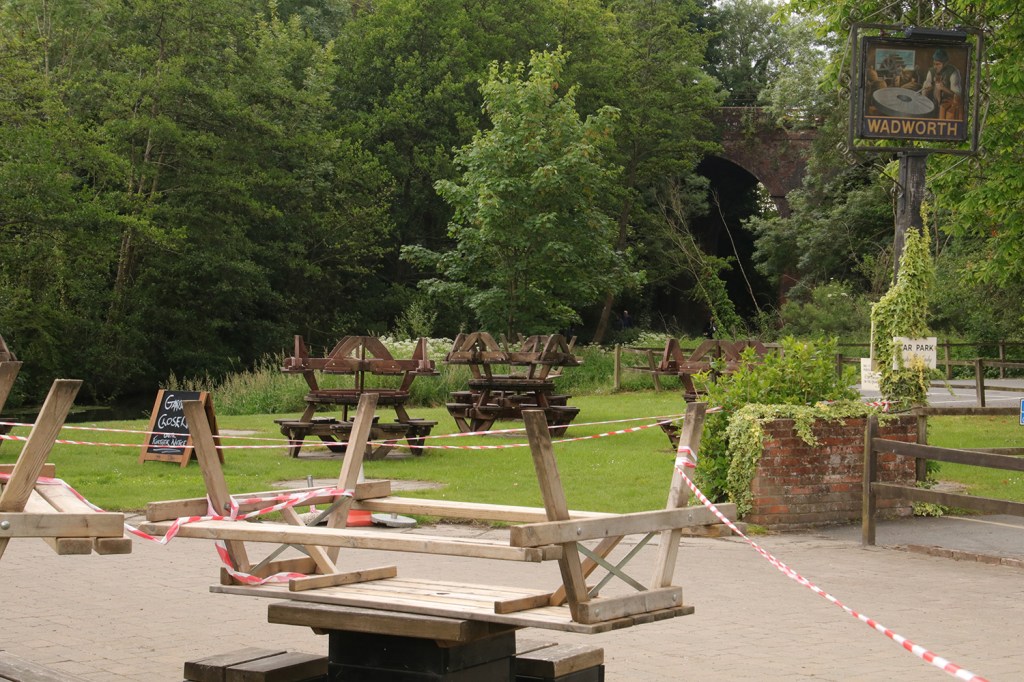
I decided to be very brutal on editing the images and to test out how things look if I incorporate scars into the set. I cut the closed shop and pub images:
And interspersed my 6 images with 2 scar images as punctuation:
Thames valley regional OCA student group (20.6.20):
I asked for comments on the choice of images, including my rejects as well as thoughts about the inclusion of scars.
The “Hollywood bowl” image was again their favourite and they suggested that I include the Aqua drome and the Fairground. This I have done; I also think it enhances the already dominant vertical and horizontal lines in the set.
There were further suggestions on how I could use the scars; I thought I would experiment punctuating the 8 images with smaller images of scars, these possibly in black and white or use the scars in black and white as hash tags for the images – I’ll have to see what I can achieve technically withing the confines of wordpress.
Forming a series:
So, I had my eight images and it just remained to order them, I revisited Short’s (2011) suggestions:
Q: Will the audience see all the images at once? No in sequence on a blog
Q: Do you want them to follow an identifiable sequence? Not necessarily
Q: Will some pictures take more prominence than others? No but some are more powerful
Q: Do you need a lead picture that sums up the intention? No just clarity in the first and last
Q: Do you want to use visual punctuation? Possibly
I have ordered them as I think gives the best visual flow but have deliberately put the most arresting image near the middle of the series.
Editing mind map:
Presentation:
I would prefer to present this work as a book with body scars as punctuation between the images in smaller scale. I thought seriously about saving this work to present for assignment 3 as the brief calls for a book, however the material won’t fit the brief and I want to work on this material now while I am immersed in it.
I may simulate the book, to show case this as an alternative presentation for submission.















 Photography 2: Documentary