Exercise 2.11
Read the information that accompanied August Sander’s exhibition People of the 20th Century at the San Francisco Museum of Modern Art. Write a 200-word reflective commentary on Sander’s seven-category system. Briefly discuss the implications of his classification system within the socio-cultural context of the time. Make connections with contemporary practice such as that of Zed Nelson, if appropriate. (Open College of the Arts, 2014:41)
Reflective commentary:
I saw 80 of Sander’s photographs from his same work “People of the 20th Century”, at an Exhibition at the National Museum Cardiff (13.12.19; it was great to see his work first hand, which I’d already studied when doing my Identity and place course.
Sandler made posed portraits of ordinary people from across society, who he grouped to occupational, social or familial types; he then put these into seven archetypal categories: The farmer, The Skilled tradesman, The Woman, Classes and Professions, The Artists, The City and The Last People (the elderly and disabled).
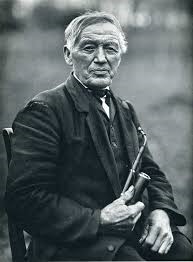

These images were taken by August Sanders in the early 20th century and published in 1929 as Antlitz der Zeit (Face of Our Time). They have been put online by various galleries or on Pin interest and are used here in an educational context only.
Walter Benjamin in his “A short history of photography” suggested that people use Sander’s work to increase “physiognomic awareness” in what he described as dangerous times (Jeffery, 1981:132.) The author Alfred Doblin said the work had evidence of social tensions in classes and generations (Jeffery, 1981: 133), calling Sandler a realist. Jeffery suggests that there was some subversiveness about the work, as it is a history of Germany in transition, and maybe that is what I caused the Nazi authorities to disapprove of his categorisation and stop his work. Now, and possibly more so in the wake of the “Black lives matter” campaign and focus on discrimination, this scientific objectivity, including the separating of women would be seen disapprovingly, I think.
It is suggested by the OCA, that Zed Nelson’s Disappearing Britain and Small Trades by Irving Penn have some connections to Sander’s work. Certainly, Small Trades does document common occupations and in a straightforward manner, but these are not across society as Sanders did.
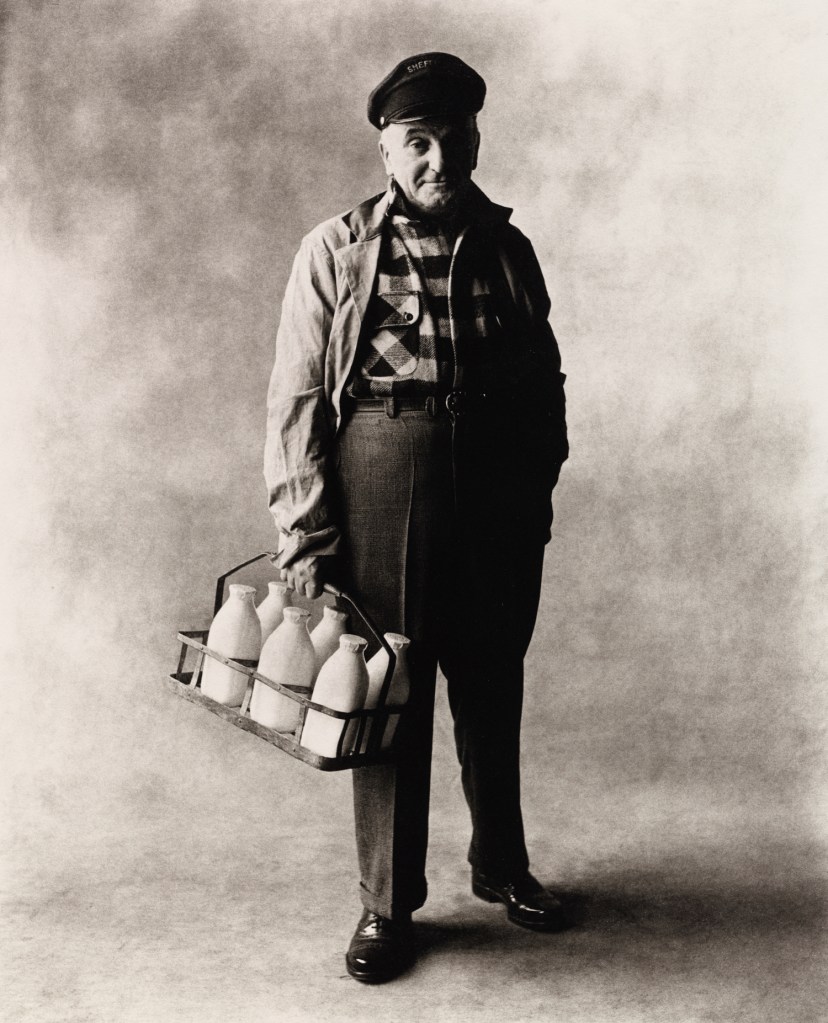

Milkman 1951 Pompier Paris 1950 (fireman) (The Irving Penn Foundation, 2020)
Nelson focuses on dying trades presenting them as art photography; his subjects usually stare into the camera proudly as do Penn’s. They have relevant props as Sanders portraits often did.


(Morrison, 2011)
Although contemporary with “Arty” lighting a sense of nostalgia pervades both of these works; they are both preserving the past rather than cataloguing the now as Sander did.
These photographers had different motives for photographing in what on the surface seems like a similar way.
References:
ASander (2002) At: https://www.oca-student.com/sites/default/files/oca-content/key-resources/res-files/asander_sfmoma_0.pdf (assessed 28.6.20)
Jeffrey, I. (1981) Photography: A concise history. (London): Thames and Hudson London.
Morrison, B. (2011) ‘Goodbye to all that’ In: The Guardian 12/03/2011 At: http://www.theguardian.com/artanddesign/gallery/2011/mar/12/goodbye-to-all-that-zed-nelson-photographs (Accessed 28/06/2020).
Morrison, B. (2011) ‘Goodbye to all that’ In: The Guardian 12/03/2011 At: http://www.theguardian.com/artanddesign/gallery/2011/mar/12/goodbye-to-all-that-zed-nelson-photographs (Accessed 28/06/2020).
Morrison, B. (2011) ‘Goodbye to all that’ In: The Guardian 12/03/2011 At: http://www.theguardian.com/artanddesign/gallery/2011/mar/12/goodbye-to-all-that-zed-nelson-photographs (Accessed 28/06/2020).
Open College of the Arts (2014) Photography 2: Documentary-Fact and Fiction (Course Manual). Barnsley: Open College of the Arts.
The Irving Penn Foundation (2020) At: https://irvingpenn.org/small-trades (Accessed 28/06/2020).
NEXT POST: https://nkssite5.photo.blog/category/exercise-2-12-in-the-american-east/
 Photography 2: Documentary