The ethics of aesthetics
Exercise 4.6
Read the, WeAreOCA blog post The ethics of aesthetics, (http://www.weareoca.com/photography/the-ethics-of-aesthetics/) including all the replies to it, and write a comment both on the blog page and in your blog. Make sure that you visit all the links on the blog post. (Open College of the Arts, 2014:88)
Rankin visited Turkana, Kenya for Oxfam’s Blog Action Day to meet some of the people facing drought and hunger in a region that has not had enough rain since 2005.
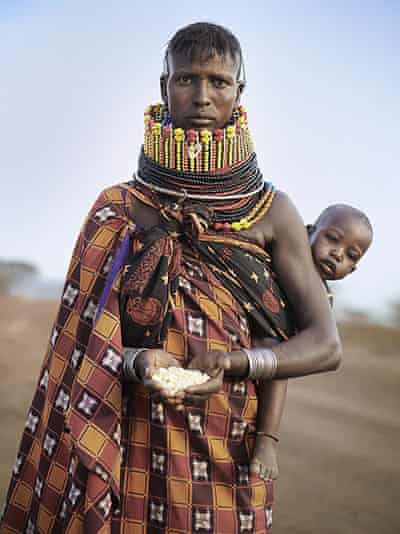
He also worked with Oxfam in the war torn provinces of the democratic republic of Congo, where he choose to photograph them against a white background out of their environment to focus on their expressions, humanity.

Chaskielberg’s photographs for Oxfam in the Horn of Africa were all taken in the moonlight with added flash lighting and have as has become his trademark style. It’s interesting that Oxfam itself ran an article titled “Alejandro Chaskielberg’s moonlight photos: Too beautiful”. Oxfam finds them memorable and distinctive but that not all agree with this. Chaskielberg himself suggests that his subjects may look stiff and detached because they have to hold their pose for a time. Some felt the pictures were too beautiful for their situations; however Chaskielberg would like to break the idea that an aesthetic image detracts from its message.

Elisabeth and her eight children live in the village of Natoo in Northern Turkana near Lokitaung. Elisabeth’s husband died from sickness, leaving her soley responsible for bringing up her children. “I appreciate pastoralism but animals are not sustainable anymore. When there is drought your animals die and you are left with nothing. If I could make one thing happen it would be to have my own business and earn money.” says Elisabeth 
Women pose for a photograph by Alejandro Chaskielberg in their gardens.
We are also referred to Mraz’s comments relating to Sebastiao Salgado. Mraz that a documentary photograph should strive to achieve a balance between expression and information. The blog author says that if that balance is not right then the effectiveness of a photograph for visually sharing information is changed. He gives an example of an effective combination of the two as Tom Stoddard’s image of an emaciated woman in Ajiep, Sudan which he describes as a document and a symbol, “specific to the events it refers to and universal”, here I can see the ethics and the aesthetics of the image are working together.

© Tom Stoddard 2004 (Tom Stoddart Archive, 2022)
I agree with Rob Harris (31.10.20) who asks the point in reading 70 odd blog post responses, as they become repetitive. This is my response to the original post rather than reactions to other’s posts. Although I appreciate the aesthetics in Chaskielberg’s images and they make a refreshing change, I feel they have the appearance of studio shots, seem theatrical and staged and lack authenticity as images that are to portray people experiencing hunger and drought.
I can relate much better to Rankin’s images, where the people look real, dignified, not distressed but taut, and the food in their cupped hands brings us back to the reason for the image. Rankin also wanted his portraits to do something different, as he felt the stereotypical images of disaster zones have produced anesthetised audiences; in his Congo images that he wanted to depict their humanity and I believe he has done this.
I have to ask myself have become too used to more direct images like Tom Stoppard’s representing famine, and is this why I find Chasleilberg’s images too beautiful? Possibly. However if I was using images to provoke interest in fundraising and action I would use Rankin’s more realistic but dignified images as a fresh alternative to the more traditional Tom Stoddard famine images. I don’t believe Chaskielberg’s images will for most convey the necessary message.
References:
Kramer, A. (s.d.) Alejandro Chaskielberg’s moonlight photos: Too beautiful?. At: https://firstperson.oxfamamerica.org/alejandro-chaskielbergs-moonlight-photos-too-beautiful/ (Accessed 09/01/2021).
Open College of the Arts (2014) Photography 2: Documentary-Fact and Fiction (Course Manual). Barnsley: Open College of the Arts.
Rankin in Congo: ‘Their humanity was what I wanted people to notice’ (s.d.) At: https://www.oxfamamerica.org/explore/stories/rankin-in-congo-their-humanity-was-what-i-wanted-people-to-notice/ (Accessed 09/01/2021).
Rankin photographs famine in east Africa (2011) In: The Guardian 14/10/2011 At: http://www.theguardian.com/commentisfree/gallery/2011/oct/14/kenya-rankin-famine-in-pictures (Accessed 09/01/2021).
Tom Stoddart Archive (2022) The emaciated legs of a girl at Ajiep, southern Sudan, during the. At: https://www.gettyimages.co.uk/detail/news-photo/the-emaciated-legs-of-a-girl-at-ajiep-southern-sudan-during-news-photo/57485003 (Accessed 09/01/2021).
 Photography 2: Documentary