PROJECT POST-COLONIAL ETHNOGRAPHY
RESEARCH POINT
Do your own research into the bodies of work discussed in this project. Can you find any examples of work carried out amongst indigenous peoples that, in your view, honestly document the lives of their subjects without falling into some of the traps that we’ve been discussing here? If so, how has the photographer achieved this? (Open College of the Arts, 2014:64)
The “traps” that have been identified in Post colonial ethnographic photography:
- Nostalgia – Romanticism of primitive beauty
- Imbalances of power between photographer and subjects
- Disciplinary cataloguing and comparing
- Primitivism
- Decontextualising
- Infantising of non-industrial people
Peter Lavery’s work in “of humankind” does decontextualise his subjects; this seems to enhance the stereotyping, the power imbalance, cataloguing and comparing traps suggested above. Indeed even in the foreword of the book ‘Of Humankind’ by Robin Muir (2000) says that Lavery’s portraits remind us that photographers deal in things which are continually vanishing and which no contrivance on earth can bring back”, underlining the nostalgic element of his photography.

(Of Humankind, 2000)
Conversely David Bruce’s work though sometimes posed against a backdrop is aesthetic, shot with dignity, and his subjects look empowered and generally look to be enjoying themselves.
Juan Echeverrria’s images of the OvaHimba tribe in Namibia could be interpreted as voyeuristic and decontextualised; whilst they are taken out of context they do have a realism about them and the subjects share some character and assertiveness.

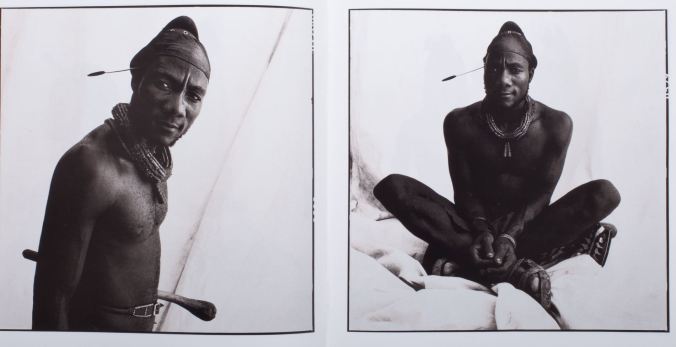
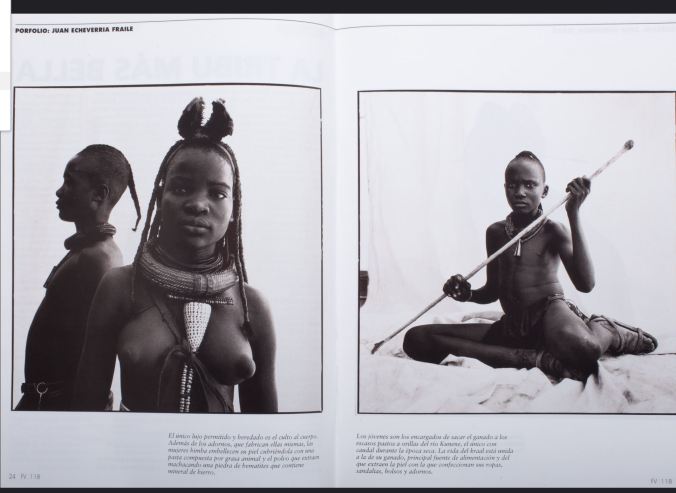
Namibia_Paisajes_desde_el_tren (2021)
When searching for examples of work which don’t fall into the “traps” I returned to the work of George Rodger who took the image that struck me on the front of the Tribal Portraits catalogue. I was pleasantly surprised that although his work En Afrique was taken between 1947 and 1979 it avoids the pitfalls mentioned above; the nudity is in context, subjects are photographed in context and are certainly not romantised; indeed he gives detailed context with each image.

UGANDA. Wagasero girls wear strings of beads around their foreheads. 1948 
KENYA. Masai Mara. Well befofe sunrise a young Masai candidate for circumcision stands the taunting of junior Moran who have already been circumcised at the age of 13 to 15. 1979. 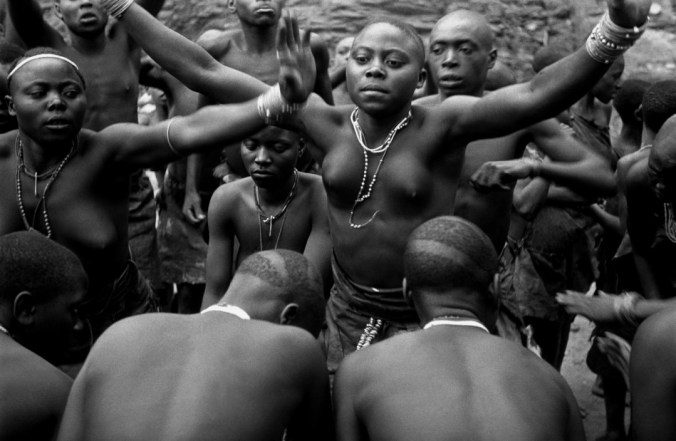
UGANDA. Pygmies. “Dance of the forest people”. The Bachimbiri and Wagasero dance their own version of a courting dance, the “Kamundere”, before a semi-circle of men of the tribes who kneel before them. 1948.
(En Afrique by George Rodger, 2016)
I also thought back to a photographer whose work I came across when in the Philippines a couple of years ago, Eduardo Masferré (1909 – 1995) a Filipino-Catalan who made documentary reports about the lifestyle of native people in the region of the Cordillera of the Philippines in the mid 1950s. I was very struck with his work at the time, which is contained in his book people of the Philippine Cordillera (1988) and was interested how I would view it now I have studied these aspects of tribal photography.
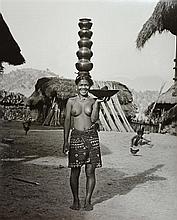

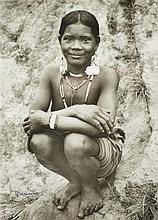
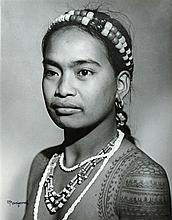
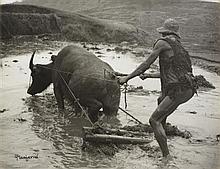
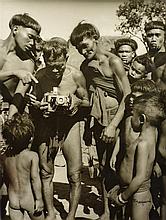

Eduardo Masferre Paintings & Artwork for Sale (2021)
I was pleased to see that although there is a fascination with subjects smoking pipes, most of his images are shot with context in a documentary style which gives information about their way of life. Where there is partial nudity it appears as a natural part of their dress and the emphasis of the photograph is clearly not on this but another aspect, such as the girl with the pots on her head and the smoking woman above. Though there is the occasional image which seems to have been shot simply for the beauty of the subject female, male, old or young, there is no suggestion of imbalance of power between him and his subjects or infantizing of them. For work which was shot between 1947 and 1959. I would say the work is sensitive to the people and a good documentary record and agree with the review from the book cover that the people are shown with “strong faces that meet one’s gaze with great integrity – Masferre preserved all of these in timeless images that transcend ethnography and imbue documentary fact with deeper meaning.” (Masferre and Devilla, 1988).
References:
Eduardo Masferre Paintings & Artwork for Sale (s.d.) At: https://www.invaluable.com/catalog/searchLots.cfm?scp=m&ad=DESC&alf=1&issc=1&artistref=3tvi2dj9ip&shw=50&ord=2&row=51 (Accessed 14/01/2021).
En Afrique by George Rodger (2016) At: https://www.magnumphotos.com/arts-culture/george-rodger-en-afrique/ (Accessed 13/01/2021).
Ju/’hoansi Bushmen (s.d.) At: https://davidbrucephotography.co.za/juhoansi-bushmen/ (Accessed 12/01/2021).
Masferré, E. and De Villa, J. G. (1988) People of the Philippine Cordillera: Photographs, 1934-1956. (s.l.): Devcon I.P. Incorporated.
Namibia_Paisajes_desde_el_tren (s.d.) At: https://www.flickr.com/photos/juan_echeverria_reportajes/sets/72157629307741656/show/ (Accessed 13/01/2021).
Namibia_Paisajes_desde_el_tren (s.d.) At: https://www.flickr.com/photos/juan_echeverria_reportajes/sets/72157629307741656/show/ (Accessed 13/01/2021).
Of Humankind (2000.) At: https://www.peterlavery.com/of-humankind (Accessed 13/01/2021).
Open College of the Arts (2014) Photography 2: Documentary-Fact and Fiction (Course Manual). Barnsley: Open College of the Arts.
 Photography 2: Documentary