RESEARCH AND REFLECTION: LEARNING PART 4

THIS IS A SUMMARY OF THE MAIN LEARNING THAT I HAVE TAKEN AWAY FROM PART 4

PROJECT GAZE AND CONTROL

Reading On Foucault: Disciplinary Power and Photography by David Green (Exercise 4.1)

  • I had not thought of photography as a mechanisms of surveillance to observe/and classify people in order to normalise disciplinary power.
  • As Green suggests if this is so, we should develop alternative ways of working with photography.

The Photograph as an Intersection of Gazes ((Exercise 4.2)  

The seven types of gazes identified gives me something to reflect on I my work going forward:

  1. The photographer’s gaze: the camera’s eye which structures the image.
  2. The magazine gaze: chosen by editing for emphasis.  
  3. The reader’s gaze: a reader’s interpretation, influenced by their experience & imagination.
  4. The non-western subject gaze: confrontational/distanced look/ absent gaze.
  5. Explicit western looking: which is unusual as westerners usually look off camera.
  6. Returned or refracted gaze: usually by mirrors or cameras
  7. Academic gaze: a subtype of the reader’s gaze.

It’s an interesting concept that some photographers are experimenting inviting viewers to interpret them rather than accepting the photographers gaze as their own. I will be more aware going forward of the interplay and relationships of the various gazes and their potential effect on the viewer, and the ambiguity in the work in particular.

PROJECT DOCUMENTS OF CONFLICT AND SUFFERING

Reading  the articles ‘Walk the Line’ (Houghton, 2008) and ‘Imaging War’ (Kaplan, 2008( (Exercise 4.4) raises issues such as:

  • How far should we go with publishing images of war and disasters?
  • What images are suitable?
  • Are there any lines to be crossed?
  • Are the answers defined by ethic, commerce, respect for individuals or their families, politics, relationships between media companies and governments, or are they simply personal?

It is the photographer who must be mindful of the way the images may by used. I believe whether an image should be used or not I think, comes down to if using it adds impact to the story.

THE ETHICS OF AESTHETICS

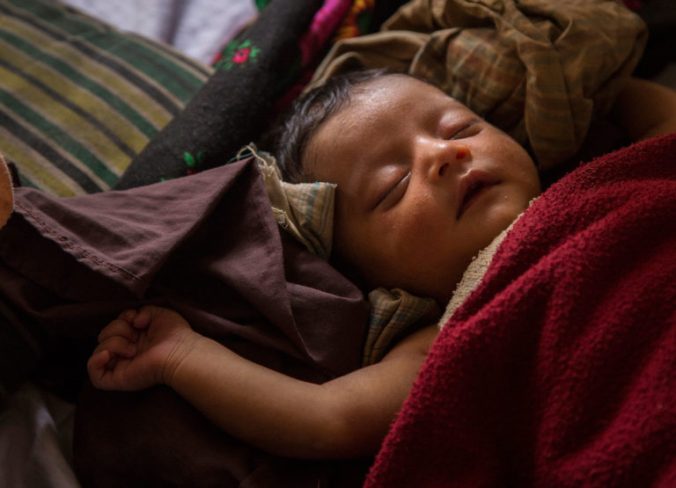
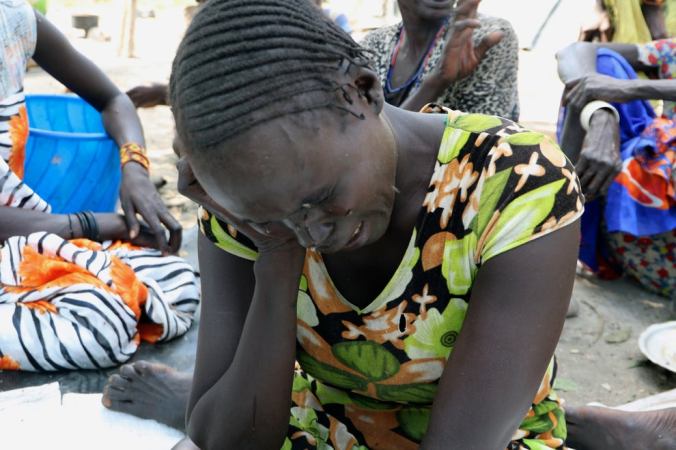
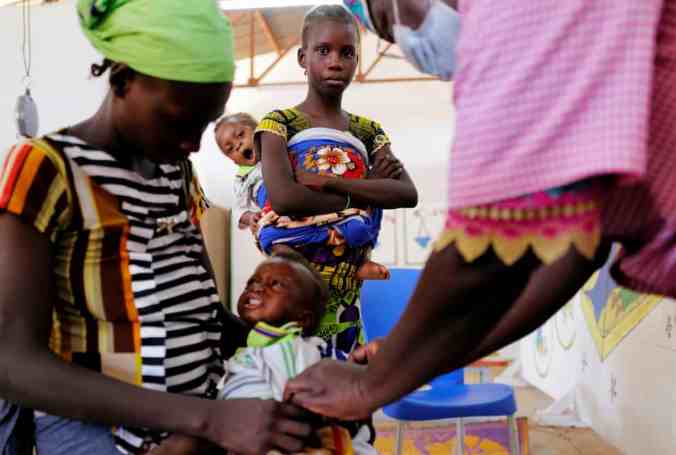
‘Imaging Famine’ (Exercise 4.5) This research project in 2005 highlights issues that persisted in images of famine:

  • Stereotypical images of victims
  • Could positive images of people in need be presented?
  • Can photographers provide images with context, understanding and explanation?
  • Does immediacy enabled by technology cause simplified compositions?
  • Can just one picture share a good understanding of issues?
  • Are photographers simply image makers or do they have wider responsibilities?

To print or not to print (Exercise 4.7)  

When choosing what to include in an image I would:

  • Think about what I consider decent, is there consent?
  • Consider privacy, is it a public occasion seems to be the crux of this
  • Ask would the presence of the camera invite violence?

This was the first time that I’ve read The National Press Photographers Association, code of ethics (2017), in particular it  states that our primary role is to report visually on the significant event and varied viewpoints in our common world….the faithful and comprehensive depiction of the  subject at hand”. When photographing as documentary I must remember this.

REFLECTING ON THE WAR PHOTOGRAPHS

Has made me consider topics such as journalist embedding, staging for cameras, rapid publishing, post camera manipulation and their effects on the quality of media images.

PROJECT POST-COLONIAL ETHNOGRAPHY

It was good for me to reflect on colonial and post-colonial world especially certain “traps” that have been identified:

  • Nostalgia – Romanticism of primitive beauty
  • Imbalances of power between photographer and subjects
  • Disciplinary cataloguing and comparing
  • Primitivism
  • Decontextualising
  • Infantising of non-industrial people

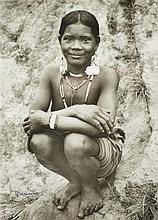
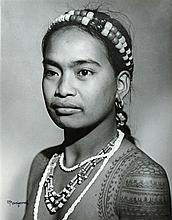
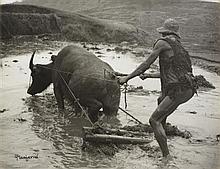
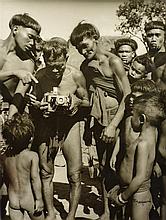
I was pleased to find photographer’s work such as David Ju/’hoansi Bushmen (2021), George Rodgers (En Afrique, 2016) and Eduardo Masferré (1909 – 1995) who had avoided most of these traps – I will now be alert to them when viewing such work again.

Next Post: https://nkssite5.photo.blog/category/learning-log-research-and-reflection/zoom-oca-meetings/oca-student-led/7-1-21-4-2-21/

PART 4: ETHICS AND LOOKING AT THE OTHER

PROJECT POST-COLONIAL ETHNOGRAPHY

RESEARCH POINT

Do your own research into the bodies of work discussed in this project. Can you find any examples of work carried out amongst indigenous peoples that, in your view, honestly document the lives of their subjects without falling into some of the traps that we’ve been discussing here? If so, how has the photographer achieved this? (Open College of the Arts, 2014:64)

The “traps” that have been identified in Post colonial ethnographic photography:

  • Nostalgia – Romanticism of primitive beauty
  • Imbalances of power between photographer and subjects
  • Disciplinary cataloguing and comparing
  • Primitivism
  • Decontextualising
  • Infantising of non-industrial people

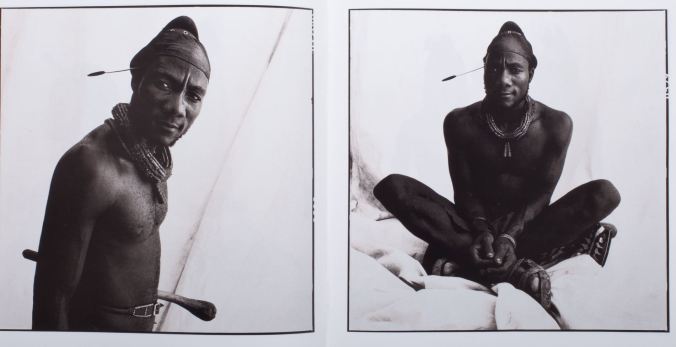
Peter Lavery’s work in “of humankind” does decontextualise his subjects; this seems to enhance the stereotyping, the power imbalance, cataloguing and comparing traps suggested above. Indeed even in the foreword of the book ‘Of Humankind’ by Robin Muir (2000) says that Lavery’s portraits remind us that photographers deal in things which are continually vanishing and which no contrivance on earth can bring back”, underlining the nostalgic element of his photography.

(Of Humankind, 2000)

Conversely David Bruce’s work though sometimes posed against a backdrop is aesthetic, shot with dignity, and his subjects look empowered and generally look to be enjoying themselves.

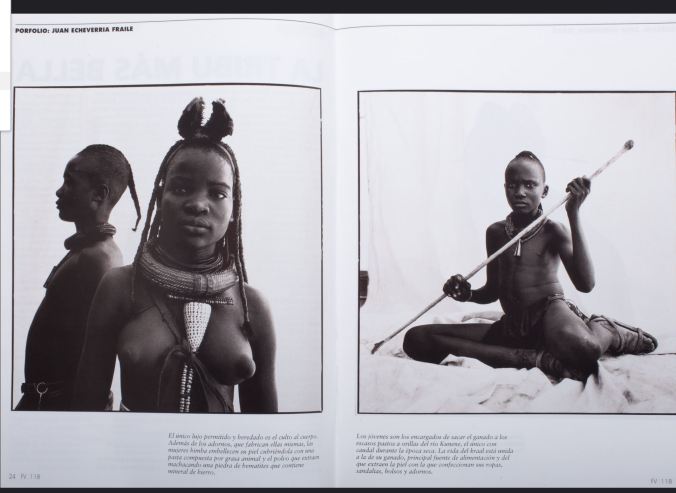
Juan Echeverrria’s images of the OvaHimba tribe in Namibia could be interpreted as voyeuristic and decontextualised; whilst they are taken out of context they do have a realism about them and the subjects share some character and assertiveness.

Namibia_Paisajes_desde_el_tren (2021)

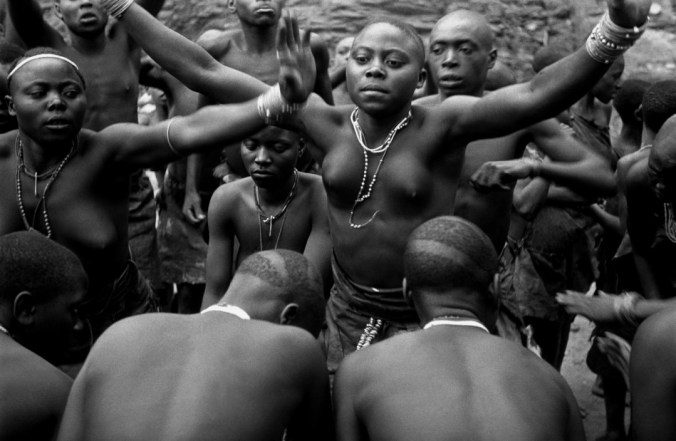
When searching for examples of work which don’t fall into the “traps” I returned to the work of George Rodger who took the image that struck me on the front of the Tribal Portraits catalogue. I was pleasantly surprised that although his work En Afrique was taken between 1947 and 1979 it avoids the pitfalls mentioned above; the nudity is in context, subjects are photographed in context and are certainly not romantised; indeed he gives detailed context with each image.

(En Afrique by George Rodger, 2016)

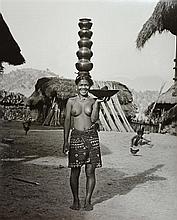
I also thought back to a photographer whose work I came across when in the Philippines a couple of years ago, Eduardo Masferré (1909 – 1995) a Filipino-Catalan who made documentary reports about the lifestyle of native people in the region of the Cordillera of the Philippines in the mid 1950s. I was very struck with his work at the time, which is contained in his book people of the Philippine Cordillera (1988) and was interested how I would view it now I have studied these aspects of tribal photography.

Eduardo Masferre Paintings & Artwork for Sale (2021)

I was pleased to see that although there is a fascination with subjects smoking pipes, most of his images are shot with context in a documentary style which gives information about their way of life. Where there is partial nudity it appears as a natural part of their dress and the emphasis of the photograph is clearly not on this but another aspect, such as the girl with the pots on her head and the smoking woman above. Though there is the occasional image which seems to have been shot simply for the beauty of the subject female, male, old or young, there is no suggestion of imbalance of power between him and his subjects or infantizing of them. For work which was shot between 1947 and 1959. I would say the work is sensitive to the people and a good documentary record and agree with the review from the book cover that the people are shown with “strong faces that meet one’s gaze with great integrity – Masferre preserved all of these in timeless images that transcend ethnography and imbue documentary fact with deeper meaning.” (Masferre and Devilla, 1988).

References:

Eduardo Masferre Paintings & Artwork for Sale (s.d.) At: https://www.invaluable.com/catalog/searchLots.cfm?scp=m&ad=DESC&alf=1&issc=1&artistref=3tvi2dj9ip&shw=50&ord=2&row=51 (Accessed 14/01/2021).

En Afrique by George Rodger (2016) At: https://www.magnumphotos.com/arts-culture/george-rodger-en-afrique/ (Accessed 13/01/2021).

Ju/’hoansi Bushmen (s.d.) At: https://davidbrucephotography.co.za/juhoansi-bushmen/ (Accessed 12/01/2021).

Masferré, E. and De Villa, J. G. (1988) People of the Philippine Cordillera: Photographs, 1934-1956. (s.l.): Devcon I.P. Incorporated.

Namibia_Paisajes_desde_el_tren (s.d.) At: https://www.flickr.com/photos/juan_echeverria_reportajes/sets/72157629307741656/show/ (Accessed 13/01/2021).

Namibia_Paisajes_desde_el_tren (s.d.) At: https://www.flickr.com/photos/juan_echeverria_reportajes/sets/72157629307741656/show/ (Accessed 13/01/2021).

Of Humankind (2000.) At: https://www.peterlavery.com/of-humankind (Accessed 13/01/2021).

Open College of the Arts (2014) Photography 2: Documentary-Fact and Fiction (Course Manual). Barnsley: Open College of the Arts.

Next Post: https://nkssite5.photo.blog/category/learning-log-research-and-reflection/reflection/a4-reflection/my-learning-part-4/

PART 4: ETHICS AND LOOKING AT THE OTHER

PROJECT POST-COLONIAL ETHNOGRAPHY

Primitive typologies

Exercise 4.9

Browse the catalogue Tribal Portraits: Vintage and Contemporary Photographs from the African Continent, Bernard J Shapero Rare Books. Core resources: TribalPortraits.pdf

Write a brief reflective commentary in your learning log. (Open College of the Arts, 2014:96)

Tribal Portraits Vintage and contemporary photographs from the African continent, a catalogue from a sale of photographs in 2008 by Bernard J Shapero; the images were taken from 1856 to 2008 and the text states that is presents the images as art.

The cover image is full of promise, offering a different perspective. However from that starting point most of the images are stereotypical portraits of African people. Mostly the women are presented a full frontals, naked from at least the waist up and the images ae predominantly women. Vincenti’s late 19th century images of men are one of the few exceptions. I was surprised to see Lehnert and Landrock African women photographed in obvious western style poses, but accept that these have their place in the history of tribal photography.

Its unfortunate that the images aren’t presented chronologically, as there is no progression or logic in the presentation. Contemporary photographers Malick Sidibe and Seydou Keita present a welcome relief to the stereotypical earlier photographs; but to call this a mixture of contemporary and historical tribal photography is misleading as most of the images are from 1856 to the 1950s and there are only a handful of 21st century images such as Graff’s and comparatively few late 20th century images.

I also take issue with some of the captions such as item 9 Portrait study billed as an “unusual informal grouping” when in fact the women are they are sitting on western chairs and have obviously been arranged to a degree.

My favourite image is item 18 by Riefenstahl, the Nuba Dancers of Kau (1975); it is full of life and skilfully captures a vibrant and realistic picture, the nudity appears as natural as obviously was, there is context and it is unposed. Ricciardi’s images of the late 1960s in Kenya also have welcome life to them.

My conclusions, that there is obvious documentary value in the collection but we could learn more easily from the catalogue if the images were present chronologically or by region or even with more context; if presented in the former way we would at least be able to ascertain if there has been any progression in the photography. I guess the motivation was simply to sell the images and I should not wish for anything beyond that; it is however a good source of tribal photographs.

References:

Open College of the Arts (2014) Photography 2: Documentary-Fact and Fiction (Course Manual). Barnsley: Open College of the Arts.

Shapero, B. J. (2008) ‘TribalPortraits.pdf’ At: https://www.oca-student.com/sites/default/files/TribalPortraits.pdf

Next Post: https://nkssite5.photo.blog/category/research/a4-research/research-point-post-colonial-ethnography/

PART FOUR: ETHICS AND LOOKING AT THE OTHER

Reflecting on the war photograph

Exercise 4.8

Read the two essays in the BPB 2008 programme and look at the work the curator selected for the exhibition. Core resources: BPB2008.pdf

Write a short press release of around 250 words in your learning log – in your own words. (Open College of the Arts, 2014:94)

Press release

Memory of Fire: The war of images and images of war. Curated by Julian Stallabrass. 3.10.08-16.11.08. Brighton Photo Biennial 2008

Through 10 curated exhibitions from across the South East, including work from the first World War pictures of Frank Hurley to the aestheticised, often depopulated aftermath war landscapes of Norfolk, Seawright and Ristelhueber, guest curator Julian Stallabrass presents us with images to reflect on. Bringing together coverage additionally from the Vietnam to the current wars in Iraq and Afghanistan, the material invites us to explore the approaches to photographing war, sharing images of war and their effects.

The biennial aims to provoke thinking about war images and the role that photojournalism plays in the media and democratic politics. As Sarah James points out “ the relationship between war and photography mirrors that crisis of representation synonymous with modern times”. Amongst the themes explored are the changing relationship between military strategy, the conduct of war, the media, and its associated technology. The variety of photographs, photojournalists as well as their period and chosen environments, cause us to acknowledge topics such as journalist embedding, staging for cameras, rapid publishing, post camera manipulation and their effects on the quality of media images. Another perspective is presented by the non-western mobile phone images and Iraqi journalist Ghaith Abdul-Ahad.

As viewers may not see all of the exhibitions, Stallabrass shares the direction and messages in the works in the free Biennial programme guide, retrospective book and the 2008 website.

References:

Brighton Photo Biennial (2008) ‘BPB supplement1.indd Memory of Fire The war of images and images of war’ At: https://www.oca-student.com/sites/default/files/oca-content/key-resources/res-files/bpb2008.pdf

Open College of the Arts (2014) Photography 2: Documentary-Fact and Fiction (Course Manual). Barnsley: Open College of the Arts.

Next Post: https://nkssite5.photo.blog/category/coursework/part-four-ethics-and-looking-at-the-other/project-post-colonial-ethnography/exercise-4-9-primative-typologies/

PART FOUR: ETHICS AND LOOKING AT THE OTHER

THE ETHICS OF AESTHETICS

Exercise 4.7

To print or not to print…

Read Claire Cozens’ Guardian article about Guerrero’s photograph: http://www.guardian.co.uk/media/2004/mar/12/pressandpublishing.spain

  • What would you have done had you been the editor of a British broadsheet newspaper?
  • A similar case revolving around a photograph of a dead Iraqi soldier in the Gulf War prompted Michael Ignatieff, the author of Magnum Degrees, to write and reflect on the ethics of photojournalism. Read ‘But Should You Print It?’ Core resources: ShouldYouPrint.pdf   (Open College of the Arts, 2014:89)

My response

Cozen’s article was a response to the various ways that a media photograph, by photographer Guerrero, for a Spanish newspaper of the Madrid train bombing was published; the controversy was about a severed limb which appeared in the original image. The British newspapers airbrushed, replaced with background stones or disguised it by bleeding the colour out; the Spanish newspaper published the image as taken.

Reuters say that they don’t like removals from photographs or anything that changes the editorial content. The Telegraph’s picture editor said it was a question of taste, removing the body part didn’t change the context and it didn’t add anything to the picture.

Michael Ignatieff in his paper “But Should You Print It?, mentions four areas of sensitivity:

  • Faking: the manipulation, which can’t be detected.
  • Decency: which is declining
  • Privacy: whether it’s is a public occasion seems to be the crux of this
  • Violence: would the presence of the camera invite violence?

Ignatief suggests we ask 4 questions and that 1 of them must be affirmed:

  • Is the event of such significance that the shock is worth it?
  • Is the objectionable detail necessary for a proper understanding of the event?
  • Does the subject freely consent?
  • Does the image express humanity?

He points out that despite all the wars we have seen and experienced “popular culture is still largely imbued with a romantic conception of war and resents a grimmer reality” (Ignatieff,nd).

The code of ethics (National Press Photographers Association, 2017) states that “our primary role is to report visually on the significant event and varied viewpoints in our common world….the faithful and comprehensive depiction of the  subject at hand”. In the detail it states that images should be accurate, unmanipulated, have context and shot with respect.

Having reflected on this my response would be to print the photograph I its entirety; as if you begin to manipulate images even to be sensitive, where do you draw the line; how much manipulation is ethical/correct? However from what I read in Cozen’s article it seems that the experience of the British papers is such that there would have been many complaints if the severed limb had been evident; as a British Newspaper I guess I would have stayed with the rest of the pack.

References:

Cozens, C. (2004) ‘Editors ‘clean up’ bomb photo’ In: The Guardian 12/03/2004 At: http://www.theguardian.com/media/2004/mar/12/pressandpublishing.spain (Accessed 10/01/2021).

Ignatieff, M. (s.d.) ‘But Should You Print It?’ At: https://www.oca-student.com/sites/default/files/oca-content/key-resources/res-files/shouldyouprint.pdf

National Press Photographers Association (2017) Code of Ethics. At: https://nppa.org/code-ethics (Accessed 10/01/2021).

Open College of the Arts (2014) Photography 2: Documentary-Fact and Fiction (Course Manual). Barnsley: Open College of the Arts.

Next Post: https://nkssite5.photo.blog/category/coursework/part-four-ethics-and-looking-at-the-other/reflecting-on-the-war-photograph/exercise-4-8-press-release/

PART 4: ETHICS AND LOOKING AT THE OTHER

The ethics of aesthetics

Exercise 4.6

Read the, WeAreOCA blog post The ethics of aesthetics, (http://www.weareoca.com/photography/the-ethics-of-aesthetics/) including all the replies to it, and write a comment both on the blog page and in your blog. Make sure that you visit all the links on the blog post. (Open College of the Arts, 2014:88)

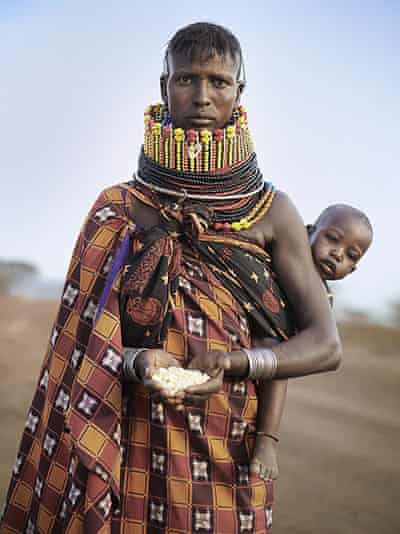
Rankin visited Turkana, Kenya for Oxfam’s Blog Action Day to meet some of the people facing drought and hunger in a region that has not had enough rain since 2005.

Rankin photographs famine in east Africa (2011)

He also worked with Oxfam in the war torn provinces of the democratic republic of Congo, where he choose to photograph them against a white background out of their environment to focus on their expressions, humanity.

Rankin in Congo: ‘Their humanity was what I wanted people to notice’ (2021)

Chaskielberg’s photographs for Oxfam in the Horn of Africa were all taken in the moonlight with added flash lighting and have as has become his trademark style. It’s interesting that Oxfam itself ran an article titled “Alejandro Chaskielberg’s moonlight photos: Too beautiful”. Oxfam finds them memorable and distinctive but that not all agree with this. Chaskielberg himself suggests that his subjects may look stiff and detached because they have to hold their pose for a time. Some felt the pictures were too beautiful for their situations; however Chaskielberg would like to break the idea that an aesthetic image detracts from its message.

We are also referred to Mraz’s comments relating to Sebastiao Salgado. Mraz that a documentary photograph should strive to achieve a balance between expression and information. The blog author says that if that balance is not right then the effectiveness of a photograph for visually sharing information is changed. He gives an example of an effective combination of the two as Tom Stoddard’s image of an emaciated woman in Ajiep, Sudan which he describes as a document and a symbol, “specific to the events it refers to and universal”, here I can see the ethics and the aesthetics of the image are working together.

AJIEP, SUDAN-JULY 1998: The emaciated legs of a girl at Ajiep, southern Sudan, during the famine of 1998. (Photo By Tom Stoddart/Getty Images)

© Tom Stoddard 2004 (Tom Stoddart Archive, 2022)

I agree with Rob Harris (31.10.20) who asks the point in reading 70 odd blog post responses, as they become repetitive. This is my response to the original post rather than reactions to other’s posts. Although I appreciate the aesthetics in Chaskielberg’s images and they make a refreshing change, I feel they have the appearance of studio shots, seem theatrical and staged and lack authenticity as images that are to portray people experiencing hunger and drought.

I can relate much better to Rankin’s images, where the people look real, dignified, not distressed but taut, and the food in their cupped hands brings us back to the reason for the image. Rankin also wanted his portraits to do something different, as he felt the stereotypical images of disaster zones have produced anesthetised audiences; in his Congo images that he wanted to depict their humanity and I believe he has done this.

I have to ask myself have become too used to more direct images like Tom Stoppard’s representing famine, and is this why I find Chasleilberg’s images too beautiful? Possibly. However if I was using images to provoke interest in fundraising and action I would use Rankin’s more realistic but dignified images as a fresh alternative to the more traditional Tom Stoddard famine images. I don’t believe Chaskielberg’s images will for most convey the necessary message.

References:

Kramer, A. (s.d.) Alejandro Chaskielberg’s moonlight photos: Too beautiful?. At: https://firstperson.oxfamamerica.org/alejandro-chaskielbergs-moonlight-photos-too-beautiful/ (Accessed 09/01/2021).

Open College of the Arts (2014) Photography 2: Documentary-Fact and Fiction (Course Manual). Barnsley: Open College of the Arts.

Rankin in Congo: ‘Their humanity was what I wanted people to notice’ (s.d.) At: https://www.oxfamamerica.org/explore/stories/rankin-in-congo-their-humanity-was-what-i-wanted-people-to-notice/ (Accessed 09/01/2021).

Rankin photographs famine in east Africa (2011) In: The Guardian 14/10/2011 At: http://www.theguardian.com/commentisfree/gallery/2011/oct/14/kenya-rankin-famine-in-pictures (Accessed 09/01/2021).

Tom Stoddart Archive (2022) The emaciated legs of a girl at Ajiep, southern Sudan, during the. At: https://www.gettyimages.co.uk/detail/news-photo/the-emaciated-legs-of-a-girl-at-ajiep-southern-sudan-during-news-photo/57485003 (Accessed 09/01/2021).

Next Post: https://nkssite5.photo.blog/category/coursework/part-four-ethics-and-looking-at-the-other/the-ethics-of-aesthetics/exercise-4-7-should-you-print/

PART FOUT: ETHICS AND LOOKING AT THE OTHER

The ethics of aesthetics

Exercise 4.5

Read the booklet ‘Imaging Famine’. Core resources: imagingFamine.pdf. Do some research across printed and online media and find examples that either illustrate or challenge the issues highlighted in the document. Add your findings to your learning log. (Open College of the Arts, 2014:87)

This research project in 2005 called for a debate and reconsideration of the power and purpose of disaster pictures. It highlighted issues that persisted in images of famine:

  • Stereotypical images of victims, that raise money but with short term benefits and long term disadvantage of embedding cultural and racial stereotypes?
  • Do negative images breed the sense that nothing can be done or are they necessary for fundraising?
  • Could positive images of people in need be presented?
  • Is an image negative if it produces a positive outcome?
  • Would such images be appropriate if they minimised the scale of suffering?
  • What is the purpose of text/captions?
  • Can photographers provide images with context, understanding and explanation?
  • Are foreign disasters only important if they are on a massive scale?
  • Is there compassion fatigue or do hard hitting images force governments to act?
  • Does immediacy enabled by technology cause simplified rather than impactful compositions?
  • Can one picture share a good understanding of issues?
  • Are photographers simply image makers or do they have wider responsibilities?
  • Does the ends justify the means?

My response:

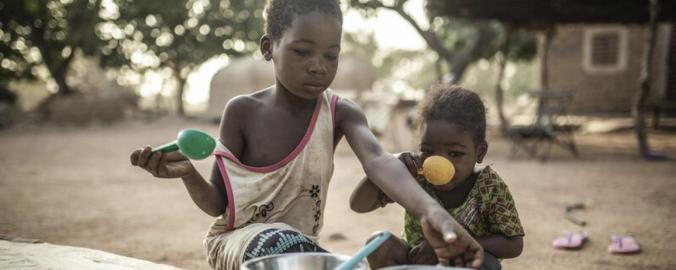
I began by looking at Aid Agency online posting. Oxfam International currently mainly uses positive single images with some smiling faces and a lot of context for its famine pages. They are certainly shot with respect, are not stereotypical and provide plenty of explanation.

Hunger crisis in South Sudan, 2020)
(Crisis in Democratic Republic of Congo, 2020)
(The fight against hunger must top the EU agenda for a fair and green recovery, 2020)

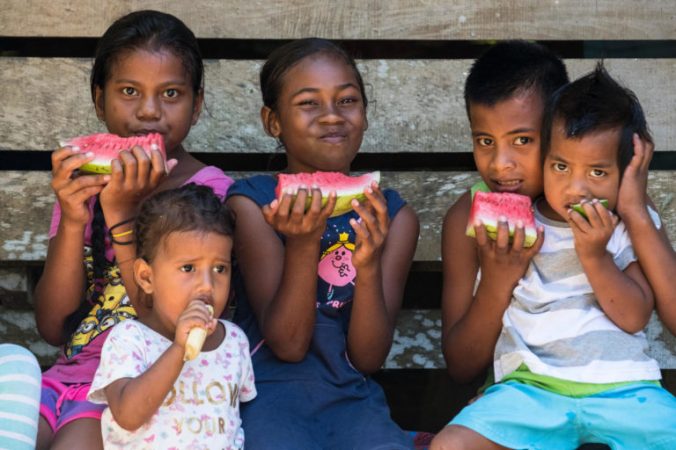
Feed the Children charity uses few images and those used are simply children’s smiling faces. UNICEF favours videos on its web site and where there are single images they are positive images such as the one below which is saying “look what we can achieve”:

Children eating watermelon and other fresh fruits in Lungga, East Honiara, Solomon Islands;

(Protecting Rohingya children in Bangladesh,2018)

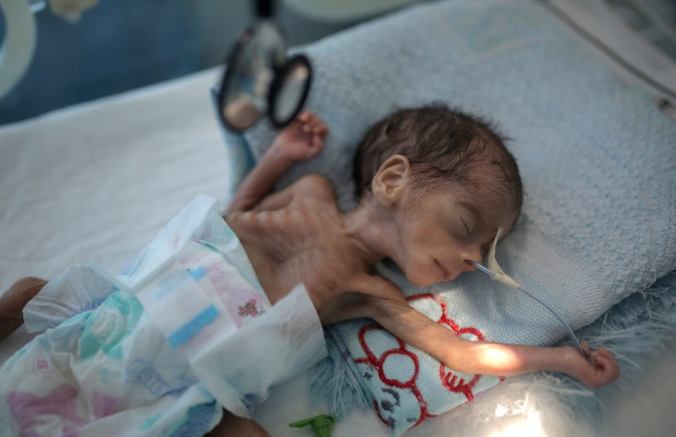
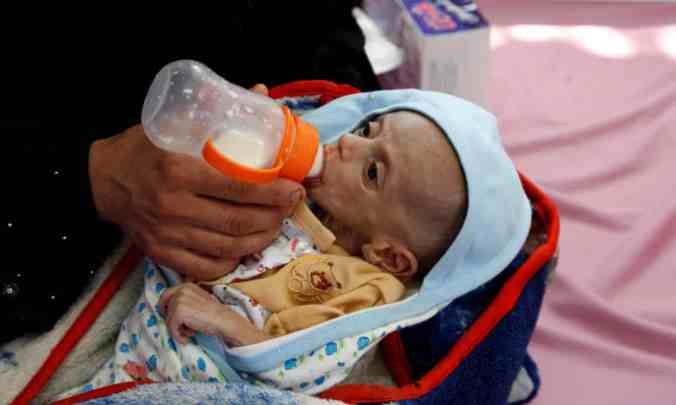
The tone of the images changed completely when I began to access media images of current stories; of which there were surprisingly few currently. In the Independent I found two recent articles about the hunger in Yemen. I was shocked that the first 2 articles I accessed used shocking images of babies with malnutrition in incubators. I am sharing one of these only as a contrast to the image used by UNICEF on the same topic:

The independent image (Via AP news wire, 2020)
The UNICEF image Nutrition and life-saving food (2021)

These two images also highlight the effect lack of control over the publishing of information is also the Independent image above was added by the Independent to an article about the launch by UNICEF of its Yemen appeal. This would surely not have been UNICEF choice of image for the story.

I did find some more positive, dignified and effect based images in the media, published with good context:

Via AP news wire (2020)

The BBC seems to use more videos than still images and I was surprised that there has been little recent coverage.

The paper Famine imaging by David Campany raised questions about ‘compassion fatigue’, iconic and stereotypical images, and the use of photographs for fundraising. From my current research it is obvious that different media use contrasting types of images to suit their consumers. Aid agencies are more respectful to their subjects and are keen to highlight the benefits of their projects particularly longer term. The images that I have found are less stereotypical than they were shown to be in the research paper of 2005, which is as you would expect, so approaches have moved on since that time. Whether this is because they have found that stereotypes have become less effective in raising aid and sympathy, or whether this is simply a response to increased ethics in photography and publishing I don’t know. I would assume that aid agencies have identified that it is not necessary to be forceful visually about the scale of suffering, as they can provide this in their accompanying text explanations.

References:

Ahmed, K. (2020) ‘UK pledges an extra £47m in aid as agencies warn of ‘catastrophic hunger’’ In: The Guardian 31/12/2020 At: http://www.theguardian.com/global-development/2020/dec/31/uk-pledges-an-extra-47m-in-aid-as-agencies-warn-of-catastrophic-hunger (Accessed 09/01/2021).

‘Imaging Famine’ (2005) At: http://www.imaging-famine.org/images/pdfs/famine_catalog.pdf (accessed 8.1.21)

Campbell, D.et al (2005) Imaging Famine, The Guardian. Available at:

Crisis in Democratic Republic of Congo (2020) At: https://www.oxfam.org/en/what-we-do/emergencies/crisis-democratic-republic-congo (Accessed 09/01/2021).

Hodal, K. (2020) ‘UN issues $100m emergency funding and calls for global effort to avert famine’ In: The Guardian 18/11/2020 At: http://www.theguardian.com/global-development/2020/nov/18/un-issues-100m-emergency-funding-and-calls-for-global-effort-to-avert-famine (Accessed 09/01/2021).

Hunger crisis in South Sudan (2020) At: https://www.oxfam.org/en/what-we-do/emergencies/hunger-crisis-south-sudan (Accessed 09/01/2021).

Nutrition and life-saving food (2021) At: https://www.unicef.org.uk/what-we-do/life-saving-food/ (Accessed 09/01/2021).

Open College of the Arts (2014) Photography 2: Documentary-Fact and Fiction (Course Manual). Barnsley: Open College of the Arts.

Protecting Rohingya children in Bangladesh (2018) At: https://www.unicef.org.uk/rohingya-refugee-bangladesh-myanmar/ (Accessed 09/01/2021).

The fight against hunger must top the EU agenda for a fair and green recovery (2020) At: https://www.oxfam.org/en/blogs/fight-against-hunger-must-top-eu-agenda-fair-and-green-recovery (Accessed 09/01/2021).

Via AP news wire (2020) ‘‘Mom, we need food’: Thousands in South Sudan near famine’ In: The Independent 24/12/2020 At: https://www.independent.co.uk/news/mom-we-need-food-thousands-in-south-sudan-near-famine-south-sudan-food-famine-children-government-b1778517.html (Accessed 09/01/2021).

Via AP news wire (2020) ‘Yemen ‘on edge of precipice’ as UNICEF launches aid appeal’ In: The Independent 07/12/2020 At: https://www.independent.co.uk/news/yemen-on-edge-of-precipice-as-unicef-launches-aid-appeal-yemen-unicef-children-sudan-edge-b1767542.html (Accessed 09/01/2021)

Next post: https://nkssite5.photo.blog/category/coursework/part-four-ethics-and-looking-at-the-other/the-ethics-of-aesthetics/exercise-4-6-the-ethics-of-aesthetics/

PART FOUR: ETHICS AND LOOKING AT THE OTHER

PROJECT DOCUMENTS OF CONFLICT AND SUFFERING

Exercise 4.4

Read the articles ‘Walk the Line’ by Max Houghton (Foto8, issue 23, pp.143–4) and ‘Imaging War’ by Jonathan Kaplan (Foto8, issue 23, pp.142–3). Core resources: Foto8#23_Kaplan&Houghton.pdf

Write down your reactions to the authors’ arguments. (Open College of the Arts, 2014:86)

My reaction to their arguments:

Kaplin has been a doctor and surgeon in hospitals and battlefields across the world as well as an author and photographer. He relates the learning of photojournalism to that of transforming from a doctor to a surgeon, after some learning from studying eventually you have to immerse yourself in the practice of it; this is something he is in a position to do but I feel that a medical professional will have more training and preparation for the later experiences than a photojournalist and it more likely to be shocked by what they encounter in the field. In exploring what kind of images of the human body are suitable for publication he concludes that this is whatever persist at the time of publication, though he says that you can be too close to a subject.

Houghton is a MA course leader in Photojournalism and documentary. Whilst picture editors have to grapple with which images are suitable for publishing, according to taste and ethics, she points out that taste and ethics are personal, just as are where we set our boundaries.  She quotes Sophie Batterbury, the picture editor of the Independent on Sunday, who believes that the goriest images aren’t the best at telling the story as the gore detracts from the emotion of the picture. Houghton conversely mentions Greg Whitmore picture editor of the Observer who used a graphic picture in black and white that was then reproduced in colour in the Telegraph in colour; he justified the use of the image partly because his first publishing inspired the observer journalist to investigate the story further. This investigation meant that the image was then combined with a narrative of the event. I’m surprised that there was only one complaint received about the image. Apparently the Observer draws the line at publishing images of severed heads, although there was a reason that this line was nearly stepped over recently so it is not sacrosanct. Houghton illustrates that when Kaplin was asked to contribute images to a book on the effects of landmines and their clearing, Kaplin then agreed when the images were dropped. The images were dropped as it was thought they might be off putting to buyers/readers and then value of the rest of the publication might then be missed; this points out that boundaries appear for different reasons – this was a commercial not ethical decision. Houghton explains that he was shocked when the decapitated heads of “Uday and Qusay” were displayed as trophies, in the Guardian 2003, which indicates that there is a line for him. He shares the various reactions at a conference to disturbing conflict images such as the “falling Man” and Luc Delahaye’s “Dead Taliban solider”; issues of respect for their families were raised but again the responses were personal.

Reading these articles raises issues such as:

  • How far should we go with publishing images of war and disasters?
  • What images are suitable?
  • What criteria should be used?
  • Are there any lines to be crossed?
  • Are feelings and emotions important?

Are the answers defined by ethic, commerce, respect for individuals or their families, politics, relationships between media companies and governments, or are they simply personal?

I am in the position that I can form and operate with my own standards but I acknowledge that it is hard for photographers/editors/publishers to set a line that is appropriate. No one person has control over the way images will be shared, but ultimately it is the photographer who must be mindful of the way the images may by used, and at the time of shooting I believe should act respectfully. Ultimately whether an image should be used or not I think comes down to whether using the image adds impact to the story, for me assuming it has been obtained ethically and respectfully. Reading these articles has brought more questions for me that answers at this stage, but will make me more reflective as I read and view such articles and images from hereon.

References:

Houghton,M. (2008) “Walk the Line” In: Foto8 (23) Spring/summer pp133-134

Foto823_KaplanHoughton.pdf (2021) At: https://www.oca-student.com/sites/default/files/Foto823_KaplanHoughton.pdf (accessed 2/1/21)

Kaplan, J. (2008) Imaging War. In: Foto8 (23) Spring/2008 pp132-133 At: https://www.oca-student.com/sites/default/files/Foto823_KaplanHoughton.pdf (accessed 2/1/21)

Open College of the Arts (2014) Photography 2: Documentary-Fact and Fiction (Course Manual). Barnsley: Open College of the Arts.

Next Post: https://nkssite5.photo.blog/category/coursework/part-four-ethics-and-looking-at-the-other/the-ethics-of-aesthetics/exercise-4-5-imaging-famine/

PART FOUR: ETHICS AND LOOKING AT THE OTHER

PROJECT DOCUMENTS OF CONFLICT AND SUFFERING

Exercise 4.3

Listen to Don McCullin talking about his exhibition Shaped by War on Radio 4’s Excess Baggage: www.bbc.co.uk/radio/player/b00qlgzg (Open College of the Arts, 2014:86)

  • McCullin is clear that the purpose of the war photograph is to enlighten the viewer who aren’t there what war is like.
  • When asked about the title of the exhibition “Shaped by war”, what effect has war had on you as a person? He answered that he wanted the photos to create a response; though he feels that the fact that he has to talk so much about his photos is slightly defeating as the images should be talking for themselves and if viewers need supplementing what, where, why, the what was their purpose?
  • In retrospect he realised that war photos should be about civilian suffering as they are those that are  done unto.
  • McCullin says wanted to be the voice of the people in these images, and sees the images as a window into other peoples lives, a form of communication. He sounds weary in the interview and it is clear that he is still very affected by his experiences and that is still suffering close to his mind whatever he is photographing now.
  • He believes that he gave his subjects some dignity by photographing alone
  • He notes that you need a reflective attitude towards the suffering you portray, a knowledge and personal investment, though the goriest images don’t necessarily tell a story well.

References:

Open College of the Arts (2014) Photography 2: Documentary-Fact and Fiction (Course Manual). Barnsley: Open College of the Arts.

Shaped by War, Photographs by Don McCullin (2010) At: https://www.youtube.com/watch?v=T5SLVAxt7NI&feature=youtu.be (Accessed 02/01/2021).

Next Post: https://nkssite5.photo.blog/category/coursework/part-four-ethics-and-looking-at-the-other/4-4-walk-the-line/

PART FOUR: ETHICS AND LOOKING AT THE OTHER

POJECT GAZE AND CONTROL

Exercise 4.2

Read the article ‘The Photograph as an Intersection of Gazes: The Example of National Geographic’ by Catherine Lutz and Jane Collins. Core resources: NationalGeographic_gaze.pdf

In what ways does the idea of the gaze apply to your photography? What are the implications of this for your practice? Write a short reflective commentary in your learning log. (Open College of the Arts, 2014:84)

Notes on reading:

This is a academic paper that analyses the way that they gaze appears in the images of the National Geographic magazine, where the captured view of another is also a place where many gazes intersect, and the significance of them. The authors identify seven types of gaze:

  1. The photographer’s gaze: represented by the camera’s eye and structures the image. There may be an alienation of the photographer from the subjects and an insecurity which the photographer overcomes by putting the camera between themselves. The photographer and the viewers gaze may overlap.
  2. The magazine gaze (institutionalised, cropped). The gaze chosen for emphasis and use which is directed by the commissions, editing choices, cropping, manipulation, presentation and captioning.
  3. The reader’s gaze: the reader’s interpretation. The reader’s gaze is affected by their experience and imagination, cultures, the form and the context of the reading (browsing or detailed reading).
  4. The non-western subject gaze: confrontational/distanced look/off centre look/ absent gaze. The direct look could acknowledge the camera, be aggressive, assent to the photographing, indicate intimacy and communication. The non westerner gazing at something within the frame or into the distance or where there is no visible gaze are also explored.   
  5. Explicit western looking– often framed with locals. It used to give an authenticity to an image but seems to occur less than in the past as westerners withdraw more to behind the camera.
  6. Returned or refracted gaze. In National geographic images this would usually be with mirrors or cameras which are described as tools of self-reflection and surveillance.
  7. Academic gaze which is a subtype of the reader’s gaze.

Reflections

The gaze is explored here through the example of the National Geographic and is reflected on by anthropologists who are particularly interested in the way people behave, especially how the westerner perceives the non-westerner.

I have long been interested in the photographic gaze, but had not realised how many types of them there actually were nor that “The multiplicity of looks in and around any photo is at the root of its ambiguity” (Lutz and Collins, 1991:146). I’d not thought either about the effect of these gaze relationships on power within a photograph. I was interested in the author’s footnote 6 where they point out that some contemporary photographers are experimenting with the conventions of point of view and framing, which invite viewers to interpret them rather than accepting the photographers gaze as their own – this is as I thought.

With regards to my own photography, I can first reflect on how I have used some of these gaze relationships and typologies in my Documentary assignments so far.

In assignment one where I represented my home in lockdown ”Provisioning and Protecting” as a viewer peering I from outside I assigned the camera and viewpoint of the photographer’s, a magazine’s and a reader’s gaze. The photographer’s gaze defined the viewpoint and content, whilst my editing and presentation was as a magazine’s institutionalised control over the output, however the reader’s personal gaze allows some room for their interpretation. My assignment two “Economic scarring”, I offered the same gazes, though with the artists statement and the “hash tags” of scarring I think I reduced the element of the readers gaze.

Assignment three “Breathe In Breath Out” offers more variety of gazes. The approach was voyeuristic and involved surveillance and involved human subjects; so it incorporated the gaze of subjects, though all western, unlike the National Geographic work. The presence of viewers certainly affected my photographer’s gaze in fact I feel that I lost some control/power to the subjects as I adjusted my perspectives around them. I also had to employ a stronger Magazine gaze to produce what I wanted to and allow for the subject’s influence on my viewing and capturing. This assignment may have a slightly anthropological approach but my photographer’s and academic eye is present so it is definitely not unbiased work.

In this assignment as in much of my work I am certainly aware of the issue of voyeurism and surveillance; however I will now be even more aware of the power play within the various types of gazes and am even more alert to the ethics of image capturing furtively. So there are different approaches in different projects but I will be more aware going forward of the interplay and relationships of the various gazes and their potential effect on the viewer, and the ambiguity in the work in particular.

References:

Lutz, C and Collins, J. (1991) the photograph as an intersection of gazes: the example of the National Geographic. Available at: https://www.oca-student.com/resource-type/nationalgeographicgaze (accessed 1st January 2020).

Open College of the Arts (2014) Photography 2: Documentary-Fact and Fiction (Course Manual). Barnsley: Open College of the Arts.

Next Post: https://nkssite5.photo.blog/category/coursework/part-four-ethics-and-looking-at-the-other/project-documents-of-conflict-and-suffering/4-3-don-mccullin/