PROJECT DOCUMENTARY IN THE GALLERY SPACE
Exercise 5.1
Look at the Cruel + Tender brochure for yourself. Core resources: Cruel &Tender.pdf Listen to interviews with two of the featured photographers, Rineke Dijkstra and Fazal Sheikh:
http://www.tate.org.uk/context-comment/video/rineke-dijkstra-cruel-and-tender
http://www.tate.org.uk/context-comment/video/fazal-sheikh-cruel-and-tender
Add relevant notes to your learning log. (Open College of the Arts, 2014:101)
Cruel and Tender
The brochure is a teacher’s guide to the exhibition Cruel+ tender: The real in the 20th century photograph (5th Jun –7th September 2003). The exhibition explores ways of representing “the real” through documentary photography including, portraiture, the notion of truth, the role of the viewer, using a series of images. There were 4 themes in the exhibition:
Occupied spaces– the way that photographers have selected specific people to photograph, and how and where they are shown affects our perception of the images, including the work of August Sandar, Walker Evans, and Paul Graham.
On the Road – Urban and rural space and travelling photographers, Walker Evans records of changing landscapes, Robert Frank’s snapshot style, and Stephen Shore’s attention to detail.
Exploring vulnerability – the cruelness of the intense scrutiny of the camera and the ethics, politics and morality of works. Rineke Dijkstra Matadors and the Mother’s series, Diane Arbus’s photographs revealing private lives and Boris Mikhailov’s series “Case History”.
Industrialisation and consumerism– Photographers who mapped the changing industrial landscape and decline such as the Bechers, Andreas Gursky, and Louis Baltz.
Life stories– Dignified portraits like Fazal Sheikhs.
It would have been good to have seen the exhibition, but I was able to discover more by reading the Tate post on the exhibition (Tate,2003). The photographers in the exhibition were chosen as they have a sense of “tender cruelty”, with a swaying between estrangement and engagement in their work which results in realistic observational photography.
References:
Cruel and Tender tool kit final (2003) At: https://www.oca-student.com/sites/default/files/CruelTender.pdf (accessed 16.2.21)
Open College of the Arts (2014) Photography 2: Documentary-Fact and Fiction (Course Manual). Barnsley: Open College of the Arts.
Tate (2003) Cruel + Tender: The real in the twentieth century photograph – Exhibition at Tate Modern. At: https://www.tate.org.uk/whats-on/tate-modern/exhibition/cruel-tender (Accessed 16/02/2021).
The links to the interviews with Rineke Dijkstra and Fazal Sheikh no longer work so I have instead watched interviews with them about their work elsewhere:
Fazal Sheikh: His interest in photographing refugee communities began in Kenya, South Africa in the late 80s; in his work “Ether”, he developed mode of expression he was comfortable with no preconceptions, stepping back, and remaining receptive about what the people and place has to offer. His was able to do this as he spent weeks living in the camps amongst the refugees. Making work that is politically. socially and otherwise helpful to the communities that create the work, a platform for them to speak. through and further a conversation. To encourage viewers to be open and to think more deeply about other communities. He treats subjects as individuals, giving text alongside images that offers their names and political circumstances.
Rineke Dijkstra: is known as portrait photographer who primarily uses a large format camera, so you see a lot of detail, though she minimises visual contextual details, this isolation make you focus on only the subject. She odes though provide a lot of contextual detail in text accompanying her portraits.
I have come across her work several times previously, but I’ve now learnt that she has also taken self- portraits; these were photographed immediately she had finished swimming and was exhausted, so that she would capture her raw emotional state. A useful reminder to use yourself to experiment with ideas. From this Dijkstra developed her work with photographs of Portuguese bull fighters straight after they have come out of the “ring”. She “finds rawness and vulnerability in people who are physically exhausted, such as mothers who have given birth, or matadors who have just left the bullfighting ring” revealing their fragility as human beings (Letson, 2016); she says it’s difficult to capture natural unguarded portraits normally. Her work emphasises the individual and her empathy for them.
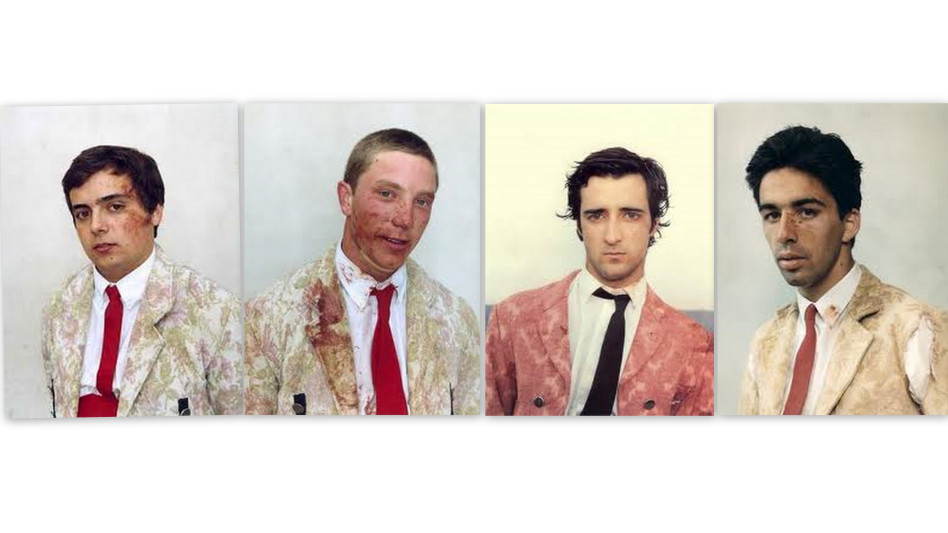
Both these photographers show respect for their subjects by acknowledging them as individuals and providing as context for viewers their stories.
References:
Letson, G. (2016) RINEKE DIJKSTRA, BULLFIGHTERS 1996. At: https://theincubator.live/2016/11/27/rineke-dijkstra-bullfighters-1996/ (Accessed 13/02/2021).
Open College of the Arts (2014) Photography 2: Documentary-Fact and Fiction (Course Manual). Barnsley: Open College of the Arts.
Photographer Fazal Sheikh Discusses Common Ground (2017) At: https://www.youtube.com/watch?v=vHUF0a7H9Wk (Accessed 13/02/2021).
Rineke Dijkstra: A Retrospective (2016) At: https://www.youtube.com/watch?v=uSAmkX26cdw (Accessed 13/02/2021).
 Photography 2: Documentary