PART FIVE: NEW FORUMS FOR DOCUMENTARY

POST DOCUMENTARY ART

Exercise 5.3

Listen to Jim Goldberg talking about Open See and his exhibition at the Photographers’ Gallery: http://vimeo.com/22120588

Visit Goldberg’s website http://www.opensee.org and reflect on how or if it works as a documentary project within the gallery space.  (Open College of the Arts, 2014:105)

The interview

This short clip shows preparation for an exhibition. He was part of a magnum team sent to photograph different aspects of Greece for the 2004 Olympics, his focus was immigrants. He talked of the immigrants he came across from various countries, some trafficked, some economic migrants, and some prostitutes. He shared his images and annotations of their stories, but with no idea given about the number of images and how they fitted into the final exhibition.

Goldberg’s website

This functions as a gallery space for images and text of displaced, economic migrants, illegal migrants, and refugees. The front page presents images in a compact montage, as if on gallery walls, guiding the viewer across them.

The side bar tabs:

Wilhelm-Hack-Museum: annotated images of immigrants and their stories.

Tate: A video how to fold a single sheet of images into a book, which is useful; probably an interactive activity at the Tate exhibition.

Deutsche Borse: Another video with a story about a refugee boat, and how to make a paper boat.

Objects: such as torture files to support obtaining amnesty, wallets of the dead, fake adverts and interviews.

Resources: with website links that informs about the issues of many of his subjects.

Reflections:

It is interesting but again lacks information for instance a summary and detailed context. The images are small, and I expected to be able to click on them and they would open in their own windows so I could have closer look, but this was not possible.

Overall, though fragmentated there is a lot of information presented: documents of people’s journeys. The work is collaborative, he uses a variety of media and has unusual narrative techniques. Though disjointed the work together tells a themed story and is a good example of a balance between expression and information in a gallery and could be shared and articulated in an art gallery space.

I can compare this with my viewing of his work see previously, “Raised by wolves” (1989) which documented the lives of runaway teenagers living on the streets of San Francisco and Los Angeles from 1987 and 1993. In this he used photographs, video stills, found documents, and handwritten texts by the subjects themselves. Here he also tells the story in different ways: a traveling art gallery exhibit, a book, a website, and an experience, though most of the book is photographic as even the handwritten notes are photographed using these texts and his imagery to share their experiences.

What struck me then was the huge variety of presentation that he has used in this project and the same is apparent in his website. The mixed media he uses adds an earthiness and reality to the narrative in the photojournalistic style.

 References:

A Completely True Work of Fiction: Jim Goldberg’s Raised By Wolves (2018) At: https://www.magnumphotos.com/arts-culture/art/jim-goldberg-raised-by-wolves/ (Accessed 20/2/2021).

AMERICAN SUBURB X. (2018). JIM GOLDBERG: [online] Available at: http://www.americansuburbx.com/2009/11/theory-raised-by-wolves-as-non.html (Accessed 20/2/2021).

Open College of the Arts (2014) Photography 2: Documentary-Fact and Fiction (Course Manual). Barnsley: Open College of the Arts.

OPEN SEE – JIM GOLDBERG (2021) At: http://www.opensee.org/ (Accessed 20/02/2021).

The Photographers’ Gallery (2011) ‘Interview with Jim Goldberg’ At: https://vimeo.com/22120588 (Accessed 20/02/2021).
Next Post: https://nkssite5.photo.blog/category/coursework/part-five-new-forums-for-documentary/post-documentary-art/exercise-5-4/

PART FIVE: NEW FORUMS FOR DOCUMENTARY

PROJECT DOCUMENTARY IN THE GALLERY SPACE

Exercise 5.2

Read the article ‘The Judgement Seat of Photography’ (in Bolton, 1992, pp.15–48)

Core resources: TheJudgementSeat.pdf

Add to your learning log the key research materials referenced in the text. (Open College of the Arts, 2014:103))

The essay describes The Museum of Modern Art’s (MOMA) evolving relationship with the photograph as art. Curators/directors of MOMA have strongly influenced attitudes to photography generally and the MOMA in particular. Phillips focuses on three influential people in the history of the MOMA and its photography department.

In Walter Benjamin’s essay “The work of Art in the Age of Mechanical Reproduction” (1936) he proposes the terms “cult value” (arts origins in magical or religious rituals) and “exhibition value” (the changing function of a work of art as it becomes portable and can be duplicated). This then leads to greater availability and a lessening of a work’s aura.

Theodor Adorno was sceptical about Benjamin’s arguments but in 1932 the MOMA showed photographs for the first time in “Murals by American painters and Photographers”.

It was Beaumont Newhall’s (the first curator of the museum) exhibition Photography 1839-1937 that was the first major acceptance of photography as museum art; he focused on the techniques that evolved rather than aesthetics. Barr’s “Cubisim and Abstract Art” (1936), and “Fantastic Art, Dada, and Surrealism” (1936) as well as “Bauhaus 1919-1928” (1938) also showed MOMA’s modernised thinking. Newhall’s catalogue essay articulates his judgement that photographs when taken out of the realms of documentary and journalism, should focus on the qualities of prints and techniques. Newhall suggested that photography should be looked at in terms of the Optical (details) and chemical laws (tonal fidelity). Newhall’s first exhibition as curator was “60 photographs: A survey of Camera Aesthetics’”, which concentrated on authenticity, and personal expression.

Moholy Nagy shared the same photographic vision as Newhall as did Ansel Adams. Later Newhall became the director of photography and Edward Steichen the head of the department; apparently Newhall failed to elevate photography to the status of fine art. Steichen’s approach was different, less the photographer as an autonomous artist and more curators as “orchestrators of meaning” with exhibitions “The impact of War” (1951), “The road to victory”, “The family of man” and “The bitter years” (1962). Steichen’s installations were more about design, and popularising photography, than the photographer’s eye or the individuality of images. I first looked closely at Steichen’s work at the Tate Modern exhibition The radical eye. Modernist photography from the Sir Elton John collection (November 2016). I was fascinated by his portrait of Gloria Swanson which looks almost 3 dimensional. Here Steichen shows how he evolved from photographing in soft focus to a modernist crisp focus.  As a curator he was responsible for showing that photography could be channelled into mass media, but weakened the “cult value” of photography as fine art.

John Szarkowski succeeded Steichen in 1962 as director of MOMA’s department of photography and returned to a more formal museum space and revives Benjamin’s “cult value” of photographic work. Szarkowski reconstructed a modernistic aesthetic for photography, photography in its own aesthetic realm; he presented his ideas on photography’s formal properties in his book The Photographers Eye (1964), and the individual qualities of photographers. I read his book a while ago when first studying how to read photographs.  Szarkowski set out his intention for his book as “an investigation of what photographs look like, and of why they look that way” (Szarkowski, 2009).

I found it interesting how he makes clear that photography invaded the territory of art, could not work to old standards and had to find its own ways of making its meaning clear. Photography was invented by scientists and painters but the professional photographers it produced were varied in their skills and had increased vastly by the early twentieth century. There was a deluge of pictures, describing new things and in new ways, most especially the ordinary. Szarkowski listed five issues he believed are inherent in photography and organised his selected images in these groups: the thing, the detail, the frame, the time, the vantage point. This gave me another way to look at images and I asked myself them whether any were more influential on a photographer than another. A few years on I realise that these will of course vary according to purpose, mood and inclination. Szarkowski prepared the way for a photographers “aestheticized authorial voice” and re-elevated photography as art in its own right.

Peter Glassi’s (curator at the MOMA) 1981 exhibition “Before Photography” supported Szarkowski’s idea that photography is its own entity.

My learning:

I have a greater awareness now of the impact of directors and curators of museums on the position of photography in art; I was surprised how much influence the MOMA had on isolating and culturally differentiating photography as an art form. It was also good to set in context some previous learning and reading. Today there are many more factors beyond museums and books, such as social media, the internet, that will determine the photograph’s place in the art world.

References:

Benjamin, W. (1935) Art in the age of mechanical reproduction

Newhall B. (1949) A history of photography from 1939 to the present day. The museum of modern art, distributed by Simon and Shuster, New York.

Open College of the Arts (2014) Photography 2: Documentary-Fact and Fiction (Course Manual). Barnsley: Open College of the Arts.

Phillips, C. (1982) The Judgement Seat of Photography. October, Vol22 9Autumn, 1932), pp27-63. At: http://www.jstor.org/stable/778362.The MIT Press. (Accessed 20/02/2021).

Szarkowski, J. (2009). The photographer’s eye. The Museum of Modern art. New York.

Next Post: https://nkssite5.photo.blog/category/coursework/part-five-new-forums-for-documentary/project-documentary-in-the-gallery-space/exercise-5-3-jim-goldberg/

PART FIVE: NEW FORUMS FOR DOCUMENTARY

PROJECT DOCUMENTARY IN THE GALLERY SPACE

Exercise 5.1

Look at the Cruel + Tender brochure for yourself. Core resources: Cruel &Tender.pdf Listen to interviews with two of the featured photographers, Rineke Dijkstra and Fazal Sheikh:

http://www.tate.org.uk/context-comment/video/rineke-dijkstra-cruel-and-tender

http://www.tate.org.uk/context-comment/video/fazal-sheikh-cruel-and-tender

Add relevant notes to your learning log. (Open College of the Arts, 2014:101)

Cruel and Tender

The brochure is a teacher’s guide to the exhibition Cruel+ tender: The real in the 20th century photograph (5th Jun –7th September 2003). The exhibition explores ways of representing “the real” through documentary photography including, portraiture, the notion of truth, the role of the viewer, using a series of images. There were 4 themes in the exhibition:

Occupied spaces– the way that photographers have selected specific people to photograph, and how and where they are shown affects our perception of the images, including the work of August Sandar, Walker Evans, and Paul Graham.

On the Road – Urban and rural space and travelling photographers, Walker Evans records of changing landscapes, Robert Frank’s snapshot style, and Stephen Shore’s attention to detail.

Exploring vulnerability – the cruelness of the intense scrutiny of the camera and the ethics, politics and morality of works. Rineke Dijkstra Matadors and the Mother’s series, Diane Arbus’s photographs revealing private lives and Boris Mikhailov’s series “Case History”.

Industrialisation and consumerism– Photographers who mapped the changing industrial landscape and decline such as the Bechers, Andreas Gursky, and Louis Baltz.

Life stories– Dignified portraits like Fazal Sheikhs.

It would have been good to have seen the exhibition, but I was able to discover more by reading the Tate post on the exhibition (Tate,2003). The photographers in the exhibition were chosen as they have a sense of “tender cruelty”, with a swaying between estrangement and engagement in their work which results in realistic observational photography.

References:

Cruel and Tender tool kit final (2003) At: https://www.oca-student.com/sites/default/files/CruelTender.pdf (accessed 16.2.21)

Open College of the Arts (2014) Photography 2: Documentary-Fact and Fiction (Course Manual). Barnsley: Open College of the Arts.

Tate (2003) Cruel + Tender: The real in the twentieth century photograph – Exhibition at Tate Modern. At: https://www.tate.org.uk/whats-on/tate-modern/exhibition/cruel-tender (Accessed 16/02/2021).

The links to the interviews with Rineke Dijkstra and Fazal Sheikh no longer work so I have instead watched interviews with them about their work elsewhere:

Fazal Sheikh: His interest in photographing refugee communities began in Kenya, South Africa in the late 80s; in his work “Ether”, he developed mode of expression he was comfortable with no preconceptions, stepping back, and remaining receptive about what the people and place has to offer. His was able to do this as he spent weeks living in the camps amongst the refugees. Making work that is politically. socially and otherwise helpful to the communities that create the work, a platform for them to speak. through and further a conversation. To encourage viewers to be open and to think more deeply about other communities. He treats subjects as individuals, giving text alongside images that offers their names and political circumstances.

Rineke Dijkstra: is known as portrait photographer who primarily uses a large format camera, so you see a lot of detail, though she minimises visual contextual details, this isolation make you focus on only the subject. She odes though provide a lot of contextual detail in text accompanying her portraits.

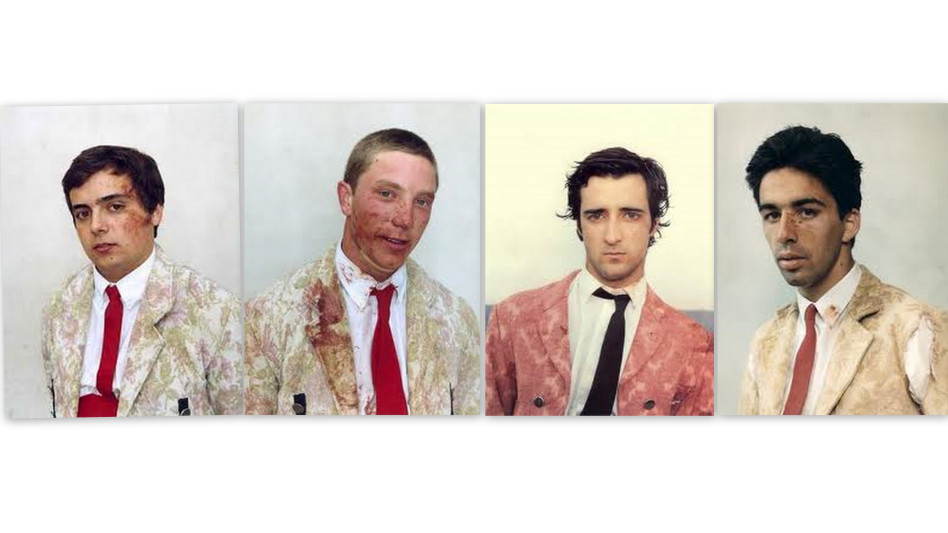
I have come across her work several times previously, but I’ve now learnt that she has also taken self- portraits; these were photographed immediately she had finished swimming and was exhausted, so that she would capture her raw emotional state. A useful reminder to use yourself to experiment with ideas. From this Dijkstra developed her work with photographs of Portuguese bull fighters straight after they have come out of the “ring”. She “finds rawness and vulnerability in people who are physically exhausted, such as mothers who have given birth, or matadors who have just left the bullfighting ring” revealing their fragility as human beings (Letson, 2016); she says it’s difficult to capture natural unguarded portraits normally. Her work emphasises the individual and her empathy for them.

(Letson, 2016)

Both these photographers show respect for their subjects by acknowledging them as individuals and providing as context for viewers their stories.

References:

Letson, G. (2016) RINEKE DIJKSTRA, BULLFIGHTERS 1996. At: https://theincubator.live/2016/11/27/rineke-dijkstra-bullfighters-1996/ (Accessed 13/02/2021).

Open College of the Arts (2014) Photography 2: Documentary-Fact and Fiction (Course Manual). Barnsley: Open College of the Arts.

Photographer Fazal Sheikh Discusses Common Ground (2017) At: https://www.youtube.com/watch?v=vHUF0a7H9Wk (Accessed 13/02/2021).

Rineke Dijkstra: A Retrospective (2016) At: https://www.youtube.com/watch?v=uSAmkX26cdw (Accessed 13/02/2021).

Next Post: https://nkssite5.photo.blog/category/coursework/part-five-new-forums-for-documentary/project-documentary-in-the-gallery-space/exercise-5-2-the-judgement-seat-of-photography/