2. Exercise: Environmental Portraits
Go to: http://www.insight-visual.com/paul-exhibition.html and look at Paul Close’s environmental portraits. Analyse his visual style and consider whether the images work as documentary photographs and, if so, why. (Open College of the arts, 2014, 68).
Paul Close’s Environmental Portraits
This project the Snakebox Odyssey is an exploration of people living in the Sahara. Close He photographed them against a white background, a sailcloth that he carried with him. Visually this is effective as it both frames them and separates them from their background, whilst leaving them in their context – a very interesting strategy. It remind me of August Sander’s “People of the 20th Century”. Visually I think Close’s use of colour gives the work more impact than if it had been shot in black and white
It could at this simple level have been a documentary of typologies or peoples, however Close asked each person he photographed as he travelled across Africa on his motor cycle “Is there one thing that could make your life better?” (Close, 2015). Conceptually the work then becomes more focused and interesting as we see individuals telling their own story as well as a series that shares the aspirations of these Africans with a wider world.
Close combines the images with captions, some, just words and some sentences; the texts add interest I think in particular as some are expressions of aspirations which from the context given you might expect, however some of the wishes they express would not be guessed from their photographs. It is interesting to see the contrasts between the simpler desires of subjects in more rural locations (some new clothes, have my own paddy, many camels, end to illness) to those in more built up places (to expand my business, my own petrol station, become a surgeon); it seems that everything is relative.
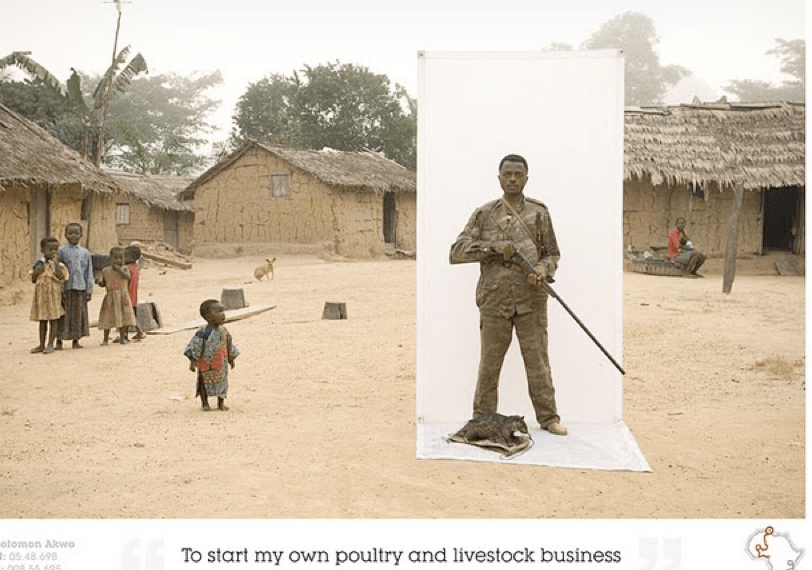

This series goes beyond “the tourist gaze”. Close provides the GPS coordinates and names of the subjects, with a map to give an idea of their location which adds to the authenticity of the work. It is real life, it appears honest, it is telling real stories and is sharing a message with an audience, it has been captured with a purpose. This is definitely documentary work.
Learning points
- Work that is interesting both visually and conceptually has a good chance of success
- Work that has impact, the possibility of effecting change or at least share a message is worthwhile.
- A simple execution and concept can be very effective.
References:
Close, P. (2015) The Snakebox Odyssey – Magazine Edition by Paul Close. At: https://www.blurb.co.uk/b/6733920-the-snakebox-odyssey-magazine-edition (Accessed 22/08/2020).
Duckrabbit, W. by (2009) The Snakebox Oddessy by Paul Close (where it’s at) — duckrabbit. At: https://www.duckrabbit.info/blog/2009/09/the-snakebox-oddessy-by-paul-close-where-its-at/ (Accessed 22/08/2020).
Open College of the Arts (2014) Photography 2: Documentary-Fact and Fiction (Course Manual). Barnsley: Open College of the Arts.
 Photography 2: Documentary