PART 3 A COLOUR VISION: PROJECT DOCUMENTARY, PERFORMANCE AND FICTION

Exercise: Seeing is Believing:

Read the WeAreOCA blog post ‘Seeing is Believing’: http://www.weareoca.com/photography/seeing-is-believing/

Read all the replies to it then write your own comment, both on the blog page and in your own blog. Make sure that you visit all the links on the blog post. Base your opinion on solid arguments and, if you can, refer to other contributions to the blog. (Open College of the Arts, 2014:82).

The post raises the question whether seeing is believing. This is done in the context of the assassination of Bin Laden and the challenges to it because of the lack of visual evidence at the time. Not all of the links work now, however it directs us to the work of Joan Fontcuberta “Deconstructing Osama” made prior to the event, where he distorts photographic truth as he photoshops himself into a disguised Bin Laden. In his work generally Joan Fontcuberta fuses fact and fiction, pushing viewers to doubt their own perceptions in a bid to dispel the myth that ‘the eyes do not deceive’; he challenges us to examine how images are made, exhibited and seen, and how their ‘truth valueʼ may be exploited (Bainbridge, 2014).

The work of photographer Pedro Meyer and his book Truth and Fictions is mentioned in the blog. Meyer a pioneer of digital contemporary photography, maintains that all photographs – manipulated or not – are equally true and untrue” (Pedro Meyer,2020). Interestingly he also argues that unseen elements such as memory or emotion present themselves with a physical reality equal to visible objects. In his photographs, these elements often appear with a clarify that connects his work to the tradition of “Magical Realism”.

So what are my thoughts about the blog post and posts which date from 2011 and are now 9 years long?

The vehicle raised in the blog for discussion about whether seeing is believing was the refusal to  release images of Bin Laden’s body, are met in various ways. Obama stated that he thought that it was morally wrong to display such a graphic image, and yet other bodies were shown; so was the decision really to prevent him being martyred by his followers or to prevent a larger retaliation? It is also strange that the photograph of Obama Clinton and advisors witnessing the assassination from their situation room was thought morally right. The reactions to this were varied at the time and those contained in this blog. Some accepted the event happened without visual evidence, whilst it caused some to question the reality.

Discussions in the blog are interesting and wide ranging:

Can we believe without visual clues? (nmonckton, 6.5.11).

Objectivity is always open to question (Richard, 8.3.15)

You don’t need to see to believe (Philoca, 6.2.16)

There is no longer blind faith in photographs (Michele, 24.2.19)

For my part I don’t need to see to believe, especially in this instance as I don’t believe the American government would have risked putting out false information that could later be disputed. In some things I might need to see to believe – it depends on the likelihood of something having occurred and the integrity of the source providing the information.

I am interested in Ian Shaw’s comment (5.11.20) asking has the belief in the truth of a photograph as a document changed since 2011? It probably has, and the photograph is less useful as a document of evidence than it used to be, now there is a shared understanding of how post processing and construction can be done.

For me the central question that I come away with is how should we best document reality?

References:

Bainbridge, S. (2014) Mind Games. At: https://www.bjp-online.com/2014/11/joan-fontcuberta-national-media-museum-bradford/ (Accessed 27/10/2020).

O’Hagan, S. (2011) ‘Osama bin Laden’s body: the world’s most incendiary image’ In: The Guardian 06/05/2011 At: http://www.theguardian.com/artanddesign/2011/may/06/osama-bin-laden-photograph-obama-body (Accessed 27/10/2020).

Open College of the Arts (2014) Photography 2: Documentary-Fact and Fiction (Course Manual). Barnsley: Open College of the Arts.

Pedro Meyer: Truth from Fiction (2020) At: https://luag.lehigh.edu/exhibitions/pedro-meyer-truth-fiction (Accessed 27/10/2020).

Seeing is Believing (2011) At: https://www.oca.ac.uk/weareoca/photography/seeing-is-believing/ (Accessed 27/10/2020).
Next Post: https://nkssite5.photo.blog/category/learning-log-research-and-reflection/photographer-talks/knoth-and-barnard-photography-in-a-fragmented-world-21-6-20/

PART 3 A COLOUR VISION: PROJECT DOCUMENTARY, PERFORMANCE AND FICTIONS

Exercise: Think Global act local

Read the article ‘Think Global, Act Local’ by Diane Smyth (Tom Hunter November 2012): http://www.tomhunter.org/think-global-act-local/

Research Tom Hunter’s work at http://www.tomhunter.org/html/news.php

Finally, listen to Tom Hunter talking about one of his most iconic images, Woman reading a possession order, on Radio 3: http://www.bbc.co.uk/programmes/b00zt7ky

Summarise your thoughts in your learning log or blog (Open College of the Arts, 2014:76).

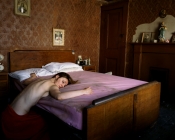
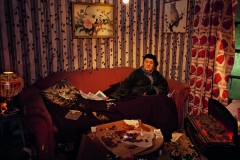
Tom Hunter explores local themes in Hackney with his photography, drawing on references from art and history. Hunter say that historical references are there to give gravity to his subjects; using fiction in his work, lighting, posing and staging, simply recreates real life stories. His image “Woman Reading a Possession Order” of a girl reading an eviction order was real, but restaged staging to accentuate the detail, the emotion, the moment.

In the interview he talks about the influence of Vermeer and the Dutch School of painting on his work which began whilst working his college degree. Hunter describes Vermeer as a revolutionary who with “release and social commentary raises ordinary people to a higher level” (Tom Hunter, 2011). Vermeer’s relationship to his local world, focus on minute details and emphasising them led Hunter to use large format photography to capture his locality. Hunter says that he aims to present local stories as Vermeer did with dignity, light, beauty, and space (Tom Hunter, 2011) and continues to use his approach and way of looking.

He has continued his adding historical (fictional) approaches/influences to his work. In Unheralded Stories (2008-2009) his images show the myths that have built up around his community and his photographs reference historical tableaux paintings.  

(Tom Hunter, 2011)

 His series of tableaux Living in Hell and Other Stories (2003-2004), was inspired by Thomas Hardy where Hardy interwove local newspaper articles into his novels; here Hunter interweaves headlines from the Hackney Gazette with images to create social commentary.

(Tom Hunter, 2011)

I don’t believe his use of fictional elements makes his work less truthful, and I think his reasons for using historical influences adds some gravity to the issues he is portraying. It does of course help him to market his work as Art and increases his commerciality; listening to him I don’t think this was his initial motivation and his social messages remain strong, his work is art with social impact.

My learning: Consider using fictional/historical elements, and in particular the use of newspaper articles in my documentary work to support my images with text.

References:

Open College of the Arts (2014) Photography 2: Documentary-Fact and Fiction (Course Manual). Barnsley: Open College of the Arts.

Think Global, Act Local (2020) At: http://www.tomhunter.org/think-global-act-local/ (Accessed 26/10/2020).

Tom Hunter (2011) In: BBC At: https://www.bbc.co.uk/programmes/b00zt7ky (Accessed 26/10/2020).

Gallery (2020) At: http://www.tomhunter.org/gallery/ (Accessed 26/10/2020).

Next Post: https://nkssite5.photo.blog/category/coursework/part-3-a-colour-vision/project-documentary-performance-and-fictions/exercise-hasan-and-and-husan-essop/

PERFORMATIVE DOCUMENTS

Exercise Constructed realities with Hasan and Husain Essop.

View the video on Hasan and Husain Essop at the V&A exhibition Figures and Fictions and write a short reflective commentary in your learning log or blog. http://www.vam.ac.uk/content/videos/f/figures-and-fictions-hasan-and-husein-essop/ (Open College of the Arts, 2014:80)

Living with the constraint that they may not put pictures of people on their wall, they have developed a performative art in its place. They debate and agree an idea, then construct a tableaux using themselves and a camera on a tripod, directing and performing in turn. Their work addresses Muslim identity and taboos. Its unfortunate that I can’t see their work on a website for instance but the examples shown are extremely realistic and could easily be media images.

That being said I wouldn’t endorse their work as documentary, because most often they are creating tableaux and then images of things they’ve not seen but have imagined. Their work is also heaviy processed and altered so that they can reuse themselves within one scene. Overall I would say they are brave and very creative but are making art rather than documentary images.

Reference:

Figures & Fictions: Hasan and Husein Essop – Victoria and Albert Museum (2011) At: http://www.vam.ac.uk/content/videos/f/figures-and-fictions-hasan-and-husein-essop/ (Accessed 26/10/2020).

Open College of the Arts (2014) Photography 2: Documentary-Fact and Fiction (Course Manual). Barnsley: Open College of the Arts.

Next Post: https://nkssite5.photo.blog/category/exercise-jeff-wall/