PART 3 A COLOUR VISION: PROJECT DOCUMENTARY, PERFORMANCE AND FICTIONS

Exercise: Jeff Wall  

Read the article on Jeff Wall in Pluk magazine. Core resources: pluk_JeffWall.pdf. Briefly reflect on the documentary value of Jeff Wall’s work. (Open College of the Arts, 2014:80).

I have researched Jeff Wall before in an earlier OCA course. This article is a review of Wall’s exhibition at the Tate of his works 1978-2004. It is a showcase of his “fakery” stitching images together, purpose made sets, huge images lit with massive lightboxes, and the cinematography which hallmarks his work. Wall insists that this is just a way of reassembling details after an event, as the pictures are made from his experience; though it’s suggested that the photograph’s meaning is in what is absent.

Wall’s cinematographic technique is described as “near documentary”, suggesting that his work The Invisible man (1999-2000) shows that Wall’s work sits between story telling and photography. Near photography is also the way Wall describes his work as recreations of moments made afterwards.

Wall explains that whilst some photographers like Winogrand or Frank capture moments as they happen he feels he has the licence to see/experience but recreate them carefully which he wouldn’t have been able to do at the time; in this way he doesn’t miss opportunities (Photography is still just evolving, 2020). His work could be mistaken for reportage, but in the spirit of what Anna Fox believes, he is partially honest about the way he fabricates his images, drawing attention to the fabricated nature of his images; and that being so, the mistake would be the viewers as he is not misleading them.

His work Approach (2014) shows a homeless woman standing by cardboard shelter, it’s contentious as he admits that this took a month to recreate but not whether the woman was an actor or not.
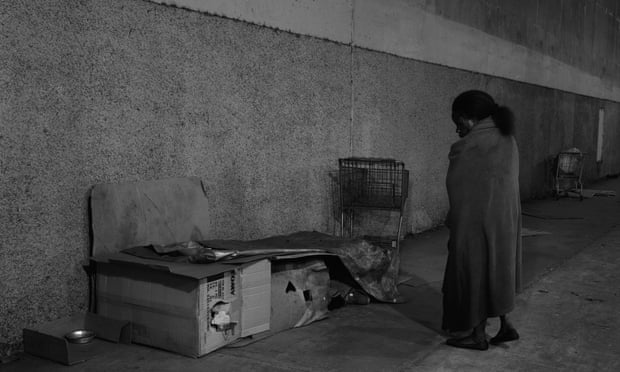
Approach 2014 (O’Hagan, 2015)

 Listener (2015) shows a kneeling, shirtless man speaking to the leader of a group gathered around him in a bleak, harshly sunlit place. Wall describes this as something you could see in reportage but omits to tell whether it is actually a moment that he’s seen previously.

  listener 2015 (O’Hagan, 2015)

I like the suggestion that “his practice is one that investigates the effects and meanings of documentary photographs” (Photography is still just evolving, 2020). His work certainly make you reflect on what is documentary and there is a value to this. Wall calls his work a “blend of actuality, reportage, performance, reconstruction and composition” an art form – but is it documentary, I’m not convinced, for me this rests on whether an image was rooted in reality and him being honest about all elements of it.

References:

O’Hagan, S. (2015) ‘Jeff Wall: ‘I’m haunted by the idea that my photography was all a big mistake’’ In: The Guardian 03/11/2015 At: http://www.theguardian.com/artanddesign/2015/nov/03/jeff-wall-photography-marian-goodman-gallery-show (Accessed 26/10/2020).

Open College of the Arts (2014) Photography 2: Documentary-Fact and Fiction (Course Manual). Barnsley: Open College of the Arts.

‘Photography is still just evolving’: Jeff Wall in conversation with It’s Nice That (2020) At: https://www.itsnicethat.com/features/jeff-wall-in-conversation-photography-270819 (Accessed 26/10/2020).

O’Hagan, S. (2015) ‘Jeff Wall: ‘I’m haunted by the idea that my photography was all a big mistake’’ In: The Guardian 03/11/2015 At: http://www.theguardian.com/artanddesign/2015/nov/03/jeff-wall-photography-marian-goodman-gallery-show (Accessed 26/10/2020).

Next Post: https://nkssite5.photo.blog/category/research/a3-research/research-point-murrell-starkey/

PART 3 A COLOUR VISION: PROJECT A BRITISH TRADITION

Exercise: Documentary dilemmas

Read Brett Rogers’ introduction to the online gallery of Documentary Dilemmas at: http://collection.britishcouncil.org/whats_on/exhibition/11/14136Unfortunately the link doesn’t work.

Follow the ‘Glossary’ link and look at the work of the photographers highlighted above and others. (Open College of the Arts, 2014:75).

This takes you to a history of Documentary photography and work we have mostly covered already in the coursework, John Grierson and the term documentary, Mass observation, independent photographers such as Bill Brandt, The Farm Security Administration, American Social landscape photgraphers such as Garry Winogrand. One area that I have yet to research are those such as Tony Ray-Jones, labelled here as the ‘snapshot aesthetic’, who portrayed subjects in a casual and objective way that allowed the viewer to interpret the work freely. I will research his work. in particular his book A Day Off (1974), which was a particular inspiration for the generation of documentary photographers who developed in the late 1970s and early 1980s.

You might find it useful to read the Arts Council document Changing Britain as a brief contextual background to Documentary Dilemmas. Core resources: ChangingBritain.pdf.

This is a publicity/information document about the history of the British Arts Council. It mentions many of the photographers that I’ve already covered putting them in context; these include Bill Brandt, Daniel Meadows, Paul Graham. And Martin Parr.

Next Post: https://nkssite5.photo.blog/category/coursework/part-3-a-colour-vision/project-a-british-tradition/exercise-martin-parr/

PART 3 THE COLOUR VISION: PROJECT DOCUMENTARY IDENTITY AND PLACE

1. Exercise: We English

Read the article on We English in Eight magazine (issue 25, summer 2009). Core resources: Foto8#25_WeEnglish.pdf . The full issue of the magazine is available to download at: http://issuu.com/foto8/docs/issue25

Download Stephen Daniels’ introductory essay to We English and the relevant contact sheets from: http://simoncroberts.com/work/we-english/ #PHOTO_0

Write a short reflective commentary. (Open College of the Arts, 2014:70).

Reflection;

  • Roberts took a risk when he shot his self-funded work “Motherland” in Russia.
  • For “We English”He had a bursary and could focus specifically on “The English at play”, a contemporary look at the English.
  • Roberts explored visually relationships between place and people, showing the English interacting with the landscape and using their leisure time; landscape is intrinsic to leisure activities.
  • Roberts shows us a sense of British identity, which he was particularly interested in as it seems lacking compared to other nations.
  • The focus is on the Landscape and he deliberately only gave 1\3 of the frame to people; they are small but large enough to see their expressions.
  • In the images you can see conflict as public spaces are shared, boundaries and limits are shown: Edges of places, fences.
  • Roberts was influenced by his traditional English background, and childhood English landscape holidays but wanted to broaden his outlook.
  • He used his website to involve the audience, for instance asking people to suggest locations and events that he might shoot; this also built the future audience. It also put a marker down that he was doing this work to other photographers.
  • Roberts talks about the benefits of immersing in the work as he did it on one “road trip”.
  • Daniels talks about several ways of characterising the relationship between land and leisure: untamed countryside void of people, historical homely countryside scenes, documentary style with people – its seems Roberts has opted for the later.
  • Surveyor of a scene, birds eye view, elevated positions gave him a greater sense of their interactions.
  • Formal composition, the idea of the collective in the landscape.
  • Large format wanted viewer to get lost in.
  • Influenced by 16th century Dutch and Flemish Landscape painters.
  • Layers of history in his work, the now of the doing on the historical landscape.
  • Sought out things he thought of as quintessentially English.
  • Not only his perception but what it means to the audience.
  • Blog became a living archive.
  • Editing was chronological, others input was critical to “kill my darlings”.
  • Documented everyday signs of Englishness.
  • Work should be about now, not introspective.

By listening to him being interviewed I also learnt:

  • Consider different timeframes, current, past and future work; make as much as you can out of previous work.
  • Don’t wait for commissions, go out and try out your own ideas.

Things I could take into my assignment:

  • Consider the English interacting with their landscape
  • Consider the British identity
  • Decide how much of the frame I want to fill with people
  • Be a surveyor of the scene, take elevated positions
  • Be aware of my background and locality influences

 References:

Daniels, S (2010) The English Outdoors At: https://www.simoncroberts.com/wp-content/uploads/2018/02/Stephen-Daniels-We-English-essay.pdf (Accessed 5.9.20)

Houghton, M (2020) Work in progress At: https://www.oca-student.com/sites/default/files/Foto825_WeEnglish.pdf (Accessed 5.9.20)

Open College of the Arts (2014) Photography 2: Documentary-Fact and Fiction (Course Manual). Barnsley: Open College of the Arts.

Roberts, S (2009) We Englush Book Commentary At: https://www.simoncroberts.com/wp-content/uploads/2018/02/We-English-Commentary.pdf (Accessed 5.9.20)

Smith, B. (2016) A Small Voice Podcast – 043 – Simon Roberts. At: https://bensmithphoto.com/asmallvoice/simon-roberts?rq=roberts (Accessed 13/09/2020).

We English (2020) Eight Magazine issue 25, summer 2009 At: http://www.simoncroberts.com/work/we-english/ (Accessed 05/09/2020).

We English by Simon Roberts “Banal Nationalisim” in Landscape?” (s.d.) At: https://www.simoncroberts.com/wp-content/uploads/2018/02/Karine-CHAMBEFORT-KAY.pdf (Accessed 5.9.20)

Next Post: https://nkssite5.photo.blog/category/research/a3-research/research-point-sense-of-place/