PART 3 A COLOUR VISION: PROJECT A BRITISH TRADITION

Exercise: Peter Dench  

Read the article on England Uncensored by the BBC Picture Editor Phil Coomes: http://www.bbc.co.uk/news/17190001.Dench talks about his “humorous approach with an underlying social commentary”. What do you think of this approach? Does it work? What are the ethical issues? (Open College of the Arts, 2014:77)

His book England Uncensored (2012) is described in the above article as a social commentary with a voice, Dench describes it the truth warts and all (Neon Sky Creative Media System, 2020). I was interested to read that it was his editor who pushed Dench to move away from his early pictures which are described as simply humorous.
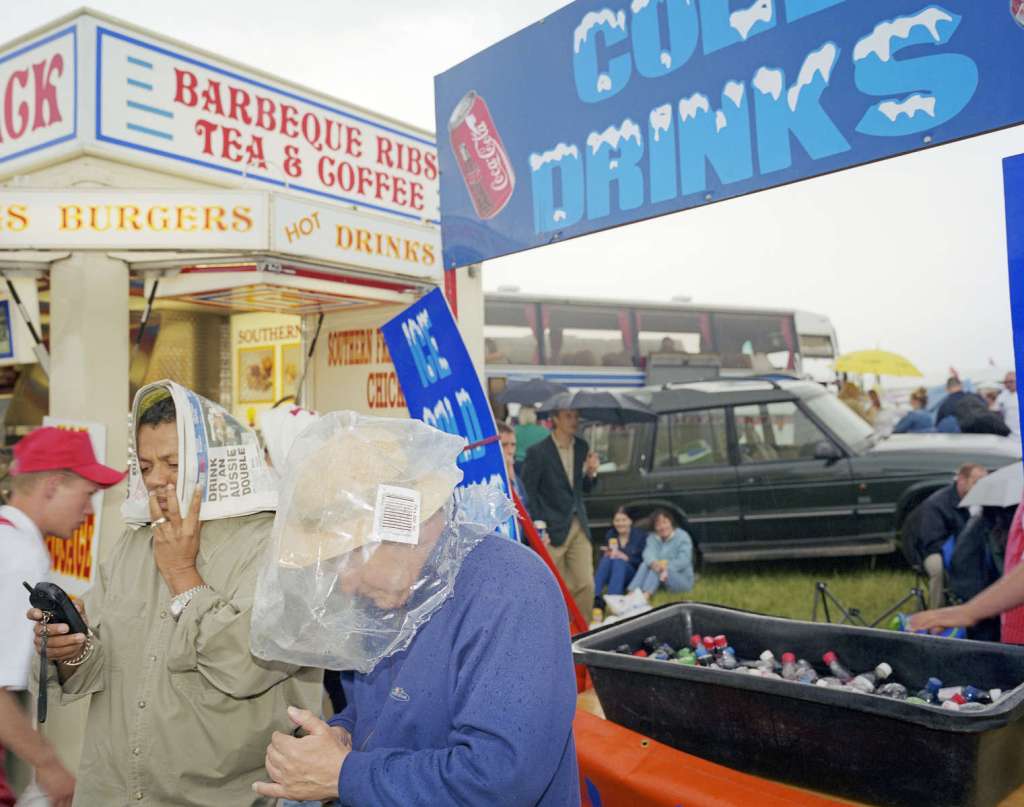
England uncensored (Neon Sky Creative Media System, 2020)

The success of his Drinking of England series encouraged him to to look for further social themes such as ethnicity, love, the weather, clothing and food. Dench believes he is documenting reality to preserve “the nations past” (Coomes, 2012).

The humour in his work comes from his upbringing by the sea and seaside humour; he recognises that pictures can’t be funny alone but should have an effect/message, Dench suggests this can be achieved by dropping images in between them that are different/serious/have impact. He thinks people respond favourably to his humour because most can identify with it.

In some of his work, in fact most if The English Uncensored I agree with his sentiments. I can see that most of his work follows the route of social commentary, though I think it lacks the conceptual nature of Parr, whose influence on his work he is open about. He also uses saturated images and flash in daylight but in a more “smash and grab” perhaps influenced by contemporary media photographers.

Whilst his approach works, selecting and presenting to us contemporary subjects isolated to highlight behaviour/situations, I do question his ethics in some of his work. In particular I find his series The English Summer Season (2019) and Alcohol and England (2014) contain images which are over-exposing and humiliating to individuals. Ethics is a difficult field but to my mind he presents some images where subjects though in public places, they were clearly not in possession of their faculties and are shown in compromising positions.

(Neon Sky Creative Media System, 2020)

Dench may argue that his pictures are honest and humorous, this may be so in the main however some I believe go beyond this and are potentially damaging to subjects and unnecessary.

References:

Ben Smith (2015) A Small Voice Podcast – 010 Peter Dench At:   https://bensmithphoto.com/search?q=dench&f_collectionId=558f13b0e4b0b62583b2124a (Accessed 13/09/2020).

Coomes, P. (2012) ‘England Uncensored by Peter Dench’ In: BBC 29/02/2012 At: https://www.bbc.co.uk/news/17190001 (Accessed 25/10/2020).

‘Drunkenness and debauchery!’: Peter Dench captures events of English gentility (2020) At: https://www.itsnicethat.com/articles/peter-dench-the-english-summer-season-photography-030919 (Accessed 26/10/2020).

Neon Sky Creative Media System (2020) england uncensored. At: http://www.peterdench.com/england-uncensored/England_Uncensored01/ (Accessed 25/10/2020).

Open College of the Arts (2014) Photography 2: Documentary-Fact and Fiction (Course Manual). Barnsley: Open College of the Arts.

Next Post: https://nkssite5.photo.blog/category/coursework/part-3-a-colour-vision/project-documentary-performance-and-fictions/exercise-think-global-act-local/

PART 3 A COLOUR VISION: PROJECT A BRITISH TRADITION

Exercise: Martin Parr  

Read the document ‘Martin Parr: Photographic Works 1971–2000’ by the National Museum of Photography, Film and Television. Core resources: Parr.pdf – It is disappointing that the images in the PDF are in black and white as Parr is so well know for his saturated colour images.

Watch an audio slide show of Martin Parr talking about his progression from B&W to colour photography and The Last Resort: http://www.youtube.com/watch?v=TJinAgBYaLs – Unfortunately this link doesn’t work due to copyright issues.

As the video link doesn’t work I have searched for places it is discussed. It seems that in the video Parr calls himself “A very big hypocrite” because the photograph he produces becomes a part of the thing he is preaching against, delightings in his own hypocrisy.

In this video Martin Parr acknowledges and defends what he calls the “hypocrisy and prejudice” in his work. What do you think about this statement? Write a short reflective commentary in your learning log. (Open College of the Arts, 2014:76).

Commentary:

Parrs work documents cultural peculiarities in society, he grew up in the post war years and saw many changes in consumerism and the class structure, including the emergence of the middle class. Suburbia is part of his upbringing, the dull sprawling mundane part of suburbia which fascinates him. It was suggested that his time living away from suburbia at Hebden Bridge was an attempt to find community that he’d been missing in suburbia; it is possible that this contrast opened his eyes to the surreal which is often not seen because of familiarity to things.

He says that when photographing Brighton he knew that he was exposing the hypocrisy of Thatcher’s Britain, “I like to create fiction out of reality” by taking societies natural prejudice and twisting it (Martin Parr: Objects of their affection, 2011). Parr is honest about his intentions. His priority is to make images that are entertaining and relate to peoples lives, but he does look for the surreal; humour is important.

Parr says that “to a certain extent all photography is exploitation” (Potter (2018). The Last resort (1985)was heavily criticised as being exploitive of working classes, and he says he was feeling rather guilty as he was flourishing as a photographer in Thatcher’ Britain which he disapproved of, and wanted to be fair to all classes. He hadn’t photographed the middle classes so he began a new project The Cost of Living (1985), and has followed this with projects on travel and parking spaces for instance; Parr is capturing and documenting the times we live in.

In everything that I’ve read of seen of him he does acknowledge the hypocrisy in his work, but I don’t think prejudice so much so; I think Parr believes himself now to be reasonably objective, merely showing us what he sees but in a colourful humorous way.

I have researched Martin Parr several times before but most recently in part one of this course, I also visited an exhibition of his work at that time : https://nkssite5.photo.blog/2020/05/03/research-and-reflection-photograper-talks/

My learning:

  • “It is the subjectivity rather than the subject matter that is important in photography”.
  • His suggestion that the challenge of photographing locally, rather than strangers is good.

References:

Open College of the Arts (2014) Photography 2: Documentary-Fact and Fiction (Course Manual). Barnsley: Open College of the Arts.

Potter (2018) ‘Martin Parr interview (The World According To Parr, 2003)’ At: https://www.youtube.com/watch?v=MCRyB2SFQZ4&feature=youtu.be (Accessed 25/10/2020).

Martin Parr: Objects of their affection (2011) In: The Independent 11/05/2011 At: http://www.independent.co.uk/arts-entertainment/art/features/martin-parr-objects-of-their-affection-2281960.html (Accessed 25/10/2020).

Next post: https://nkssite5.photo.blog/category/coursework/part-3-a-colour-vision/project-a-british-tradition/exercise-peter-dench/

PART 3 A COLOUR VISION: PROJECT A BRITISH TRADITION

Exercise: Documentary dilemmas

Read Brett Rogers’ introduction to the online gallery of Documentary Dilemmas at: http://collection.britishcouncil.org/whats_on/exhibition/11/14136Unfortunately the link doesn’t work.

Follow the ‘Glossary’ link and look at the work of the photographers highlighted above and others. (Open College of the Arts, 2014:75).

This takes you to a history of Documentary photography and work we have mostly covered already in the coursework, John Grierson and the term documentary, Mass observation, independent photographers such as Bill Brandt, The Farm Security Administration, American Social landscape photgraphers such as Garry Winogrand. One area that I have yet to research are those such as Tony Ray-Jones, labelled here as the ‘snapshot aesthetic’, who portrayed subjects in a casual and objective way that allowed the viewer to interpret the work freely. I will research his work. in particular his book A Day Off (1974), which was a particular inspiration for the generation of documentary photographers who developed in the late 1970s and early 1980s.

You might find it useful to read the Arts Council document Changing Britain as a brief contextual background to Documentary Dilemmas. Core resources: ChangingBritain.pdf.

This is a publicity/information document about the history of the British Arts Council. It mentions many of the photographers that I’ve already covered putting them in context; these include Bill Brandt, Daniel Meadows, Paul Graham. And Martin Parr.

Next Post: https://nkssite5.photo.blog/category/coursework/part-3-a-colour-vision/project-a-british-tradition/exercise-martin-parr/