Exercise 2.13
Read the article ‘Making Sense of Documentary Photography’ by James Curtis.
Curtis contextualises the work of the FSA photographers within a tradition of early twentieth-century social documentary photography and touches on the issue of the FSA photographers’ methods and intentions.
What is your view on this? Is there any sense in which the FSA photographers exploited their subjects? (Open College of the Arts, 2014:45).
I found the article very enlightening. Curtis gives examples of areas to look at when examining a documentary photograph to determine their objectiveness and usefulness as historical evidence. He also explains the methods which some of the FSA photographers used to achieve their images; this I found particularly illuminating.
Curtis suggests that documentary photographers posed as “fact gatherers” but were consciously persuading others, using as examples the work of the Farm Security Administration (FSA) photographers.
Curtis presents many examples of how these photographers manipulated their images and provides a useful framework for assessing a documentary photograph:
- Who is the audience? As images can be moulded to fit the expectations and prejudices of the audience.
- Why was the photograph taken? For example, if they are for a social reform agency their goals would affect the work.
- How was the photograph taken? If the equipment used at the time needed a long exposure then the shot would have to be posed to avoid blurring; if it needed lighting and flash powder was used, this would cause startled expressions and harsh lighting and shadows.
- What can companion images tell us? The pictures shown are usually one of a part of a series of images taken the same day; these were often destroyed so as not to detract from the chosen image. However, if they are available, they often tell us more about the subject and can give clues as to other family members and so forth.
- How was the photograph presented? Captions and text can direct the viewer where the photographer want them to go.
Did their methods and intentions did they exploit their subjects? My Response:
The FSA asserted the hard reality of their images, but they were not averse to invoking religious imagery (Marien, 2006:278) as they did in the “Migrant Mother” (Doreatha Lange 1936). I understand that for various reasons they had to control the subject and material they were photographing, the most obvious one being the limitations of long exposure times; however I find it unacceptable that they kept their constructions secret.
Jacob Riis one of the FSA photographers though once credible has since been found to have paid subjects to pose and set up scenarios as he asked; he also persuaded audiences what they were seeing by the use of pointed captions. His images have been debated “because of the photographer’s intrusion on the lives of the poor” and because of their interpretations (Marien, 2006:204).
The pictures below are an example of exploitation in terms of posing and captioning without respect for the subjects. In this image, though the FSA had given help to the community, Rothstein was asked to photograph them as if they needed aid. Worse still the caption “Single family group” implies that the sole man in the image has fathered all of these children, and yet the man is actually the village elder stood proudly with his children, grandchildren and great grandchildren. This is a misleading caption.
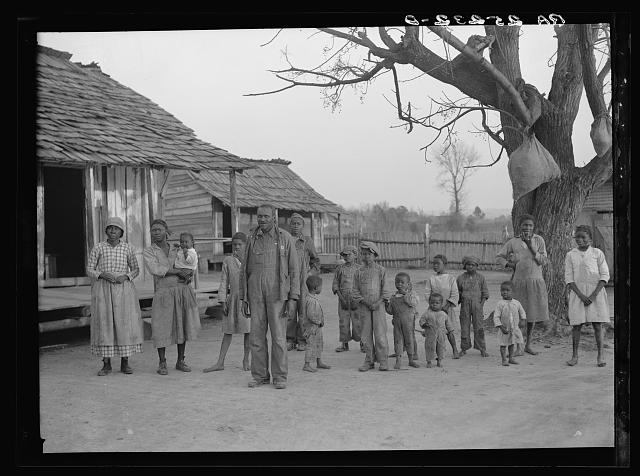
Negroes, descendants of former slaves of the Pettway Plantation 1937 (Library of Congress, 2020)
Curtis points out that Walker Evans protested that he didn’t pose subjects for images, yet he used a tripod mounted camera which meant that subjects must have been asked to stay still. He suggested by his compositions such as the one below that his shots were candid, and yet in reality it would have involved a tripod and probably stopping he street traffic.

Vicksburg Negroes and shop fronts. Mississippi (Library of Congress, 2020)
Dorothea Lange 1936 world’s national icon of the depression, as we now know was constructed to a degree; even though she had a sense of social justice and thought that photography could reveal inequality and talked of “The contemplation of things as they are”. You could ask whether it is ethical that the subject has never had any financial compensation for sitting for Lange although Lange felt she had paid her subject by getting her camp improved at the time.
The FSA photographers certainly manipulated images to achieve their ends. However, they did raise awareness of the impact of the Great Depression and in turn raised investments for improvement projects. For me question of exploitation depends on the way in which it was done. I believe that they generally photographed their subjects with dignity, especially Lange and Evans and I doubt that at the time the subjects felt exploited, though we might say this retrospectively. We also have to acknowledge that the photographers didn’t have editorial control over their images. Possibly more questions should be directed towards Stryker where integrity is being questioned.
My Learning:
Curtis provides a useful framework for assessing a documentary photograph:
• Who is the audience? As images can be moulded to fit the expectations and prejudices of the audience.
• Why was the photograph taken– Motives?
• How was the photograph taken – Equipment, Lighting, other restrictions?
• What can companion images tell us – more background information and additional clues?
• How was the photograph presented – Captions and text can direct the viewer?
References:
Curtis, J. (2020) ‘Making sense of Documentary Photography’ In: History Matters Making sense of Evidence series pp.1–24. (Accessed 29.6.20)
Library of Congress (2020) Farm Security Administration/Office of War Information Black-and-White Negatives At: https://www.loc.gov/pictures/collection/fsa/
Marien, M. W. (2006) Photography: A Cultural History. Great Britain: Laurence King Publishing.
Open College of the Arts (2014) Photography 2: Documentary-Fact and Fiction (Course Manual). Barnsley: Open College of the Arts.
NEXT POST: https://nkssite5.photo.blog/category/exercise-2-14-street-photography/

 Photography 2: Documentary