Exercise 2.8 The Americans
This exercise revolves around the body of work The Americans, by Robert Frank. You’ll need to do your own web research to find relevant images and background information. (Open College of The Arts, 2014:39)
PART 1 Find five images in The Americans where symbols are used. Explain what they are and how they function in the images.
Image 1:

Symbol: Window frames – Segregation- separation of races
This image which he apparently shot only the one of as he caught it as he turned around form shooting something else is on the surface a photograph of people on a bus. The imagery is much deeper than that as he the window panes heighten the division on the bus of white people at the front and African Americans at the back; probably the white children are in the middle as they may be between their White parents and African American carers. The expression on the first African American man is very poignant, he looks deeply unhappy, the expressions on the white boy and lady are classically stern and controlled.
Image 2:

Symbol: Skin colour differences – Class – Racism
The Caucasian baby’ pale white skin is juxtaposition against the dark colour of the nanny’s, denoted by her uniform. The expression on the nanny is neutral, which would be less likely if it were her own child and similarly the child is expressionless, they seem together but separate. In the background the street edge is lined with expensive looking cars suggesting that this is a wealthy neighbourhood.
Image 3:
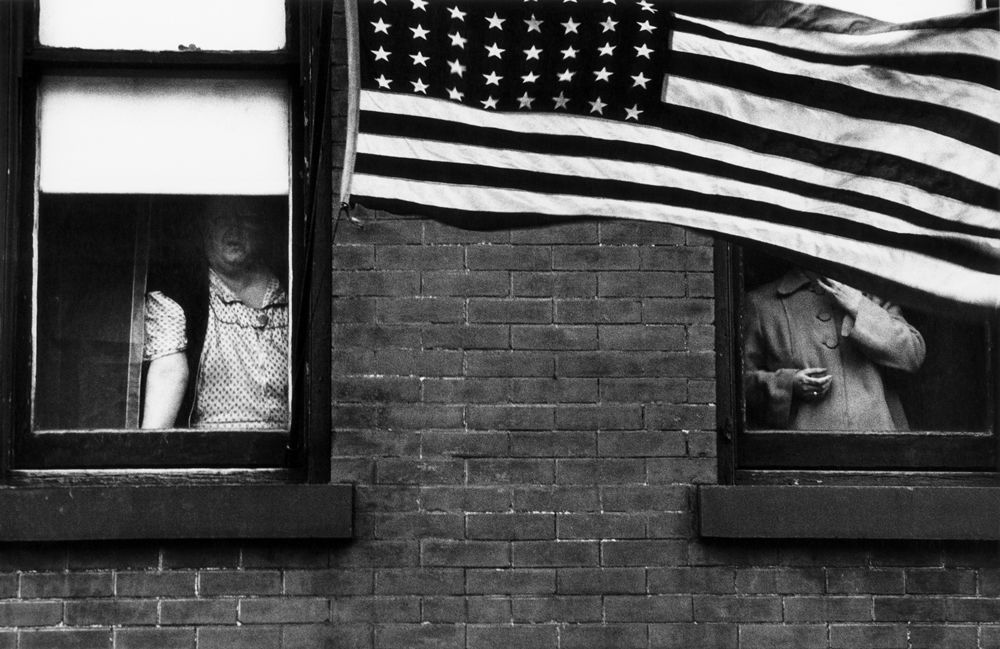
Symbol: American flag – Stars and stripes- American patriotism
The American flag flies from the window of the woman on the left, she has a summer dress on whilst the other is in a coat; is one apartment heated and one not or has the woman on the right just come in from outside? It looks like the woman in the coat is smoking, is this another symbol of a class difference. Certainly, the brick wall denotes a separation. Was this shot chosen by Frank because the flag is obscuring their vision in some way, metaphorically?
Image 4:
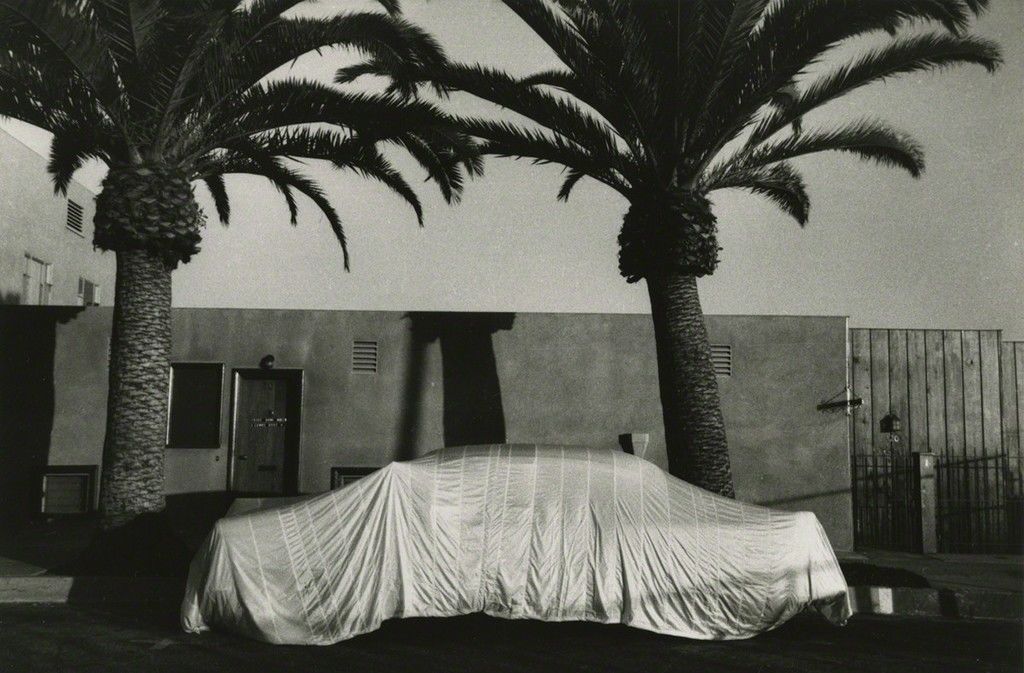
Symbols: Palm trees – California & Covered car- prized possession
The house looks like a small working-class house and the car is covered to keep it clean; is it their cherished car or their employers? Interestingly in Kerouac’s introduction to the book he explains that the “car shrouded in fancy expensive tarpaulin…to keep soots of no soot Malibu falling on new simonize job as who is a two dollar-an -hour carpenter snoozes in house with wife and TV” (1994).
Image 5:

Symbol: Shiny car- wealth & factory – wealth
The shiny car seemingly glides on the empty road outside the large factory. The factory appears bland and harsh. Are the roads quiet because it is a Sunday, or quiet because the workers are all inside working? The road is angled upwards, this would have been deliberate; is it to signify upward mobility?
Part 2. Read the introduction to The Americans by Jack Kerouac. Find symbolic references that you can also identify in Robert Frank’s photographs – not necessarily the five images that you chose for the first part of this exercise. (Open College of the Arts, 2014:38)
Symbols mentioned in the text:
- Coffins and Juke boxes “you end up finally not knowing anymore whether a jukebox is sadder than a coffin” (Kerouac p.1)
- Cowboy “Tall thin cowboy rolling butt” (Kerouac p.1) “big hatted cowboys” (Kerouac p.3)
- Roads “Long shot of night road” (Kerouac p.1), “The mad road,” (Kerouac p.2)
- American Flag “American flag canopy in old busted car seat” (Kerouac p.1)
- The sky and clouds “tangled night sky”, “black sheep clouds” (Kerouac p.2
- Crosses “Three crosses where cars crashed” (Kerouac p.3)
References:
Cobb, J. (2019) ‘How Robert Frank’s Photographs Helped Define America’ In: The New Yorker 11/09/2019 At: https://www.newyorker.com/news/daily-comment/how-robert-franks-photographs-helped-define-america (Accessed 24/05/2020).
Frank, R. (1994) THE AMERICANS. Vol. 1. In: The Art Book. Directed by Frank, R. (1994). pp.31–31. At: http://dx.doi.org/10.1111/j.1467-8357.1994.tb00040.x
Frank, R. and LensCulture (2020) The Americans – Photographs by Robert Frank | LensCulture. At: https://www.lensculture.com/articles/robert-frank-the-americans (Accessed 24/05/2020).
Indrisek, S. (2018) How Robert Frank’s ‘The Americans’ Broke the Rules of Photography. At: https://www.artsy.net/article/artsy-editorial-robert-franks-the-americans-matters-today (Accessed 24/05/2020).
Kerouiac, J. (2020) ‘The Americans INTRODUCTION’ At: https://www.oca- student.com/sites/default/files/Kerouac_Americans.pdf (Accessed 24/05/2020)
Open College of the Arts (2014) Photography 2: Documentary-Fact and Fiction (Course Manual). Barnsley: Open College of the Arts.
The New Yorker (2017) ‘Eight Photographers on Their Favourite Image from Robert Frank’s ‘The Americans’’ In: The New Yorker 25/04/2017 At: https://www.newyorker.com/culture/photo-booth/eight-photographers-on-their-favorite-image-from-robert-franks-the-americans (Accessed 24/05/2020).
 Photography 2: Documentary