Exercise 2.9
Read Mraz’s essay in full. Research the work by Salgado to which Mraz refers and evidence your research in your learning log. (Open College of the Arts, 2014:39)
My notes:
Mraz reflects on Salgado’s representation of his homeland and compares this to Mexican photographers such as Manuel Alvarez Bravo, Nacho Lopez, Hector Garcia and the “new photojournalists”.
Sebastio Salgado
Born in Brazil, started as a freelance photographer and eventually entered Magnum, published books and has had many exhibitions. Best known for documentary projects on hunger, workers, and migrants around the world. Has always photographed through Latin American eyes “Finally you photograph with all of you” (Mraz, 2002:15).
His first book Other Americas, described by Mraz as depicting misery and gloom with “a dominant tone of mystery” (Mraz, 2002:16). Salgado believed that the hunger and poverty exposed here are simply part of the landscape, however Mraz thinks that Salgado forgot the causes of capitalism, class differences and over expanded cities as he fell into the trap of representing his community picturesquely; however he did display alienation and estrangement through structures like doors and crossing gazes.

According to Mraz, Salgado represents despair when photographing children playing with animal bones, emphasising poverty by the absence of real toys, prostration on the floor and solemn faces. Lopez similarly photographs children playing with a rat but says that he is showing creativity with his low angled shot.
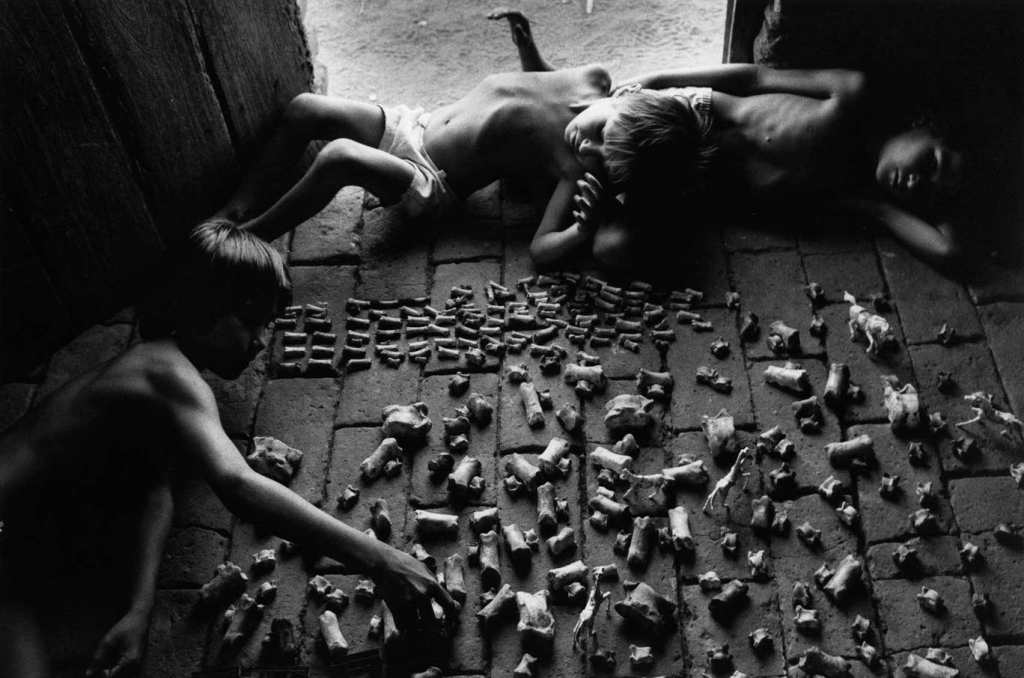
Salgado represents death in animals in explicit ways whilst Lopez is more matter of fact. Salgado shows the landscape as distressed, he uses cactus the Mexican symbol as sharp threatening points, whilst Alvarez Bravo treats it with humour.
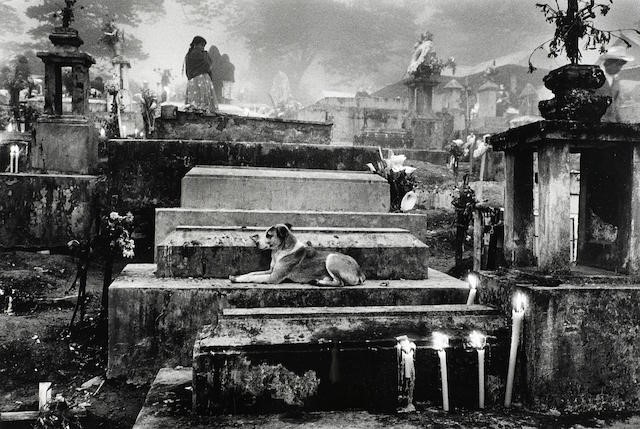
Mraz says that Salgado is obsessed with death and points out that this is common to other Mexican photographers. Nacho Lopez photographed a man being measured for his coffin whilst Alvarez Bravo photographs girls stood near a mortuary sign, all shoot in graveyards.
(Sebastião Salgado, 2020)

Mraz notes Salgado’s fine arts tradition of images with minimal explanations, allowing viewers to form their own opinions rather than giving specific context, saying that images are more expressive than photojournalism telling us more about the photographer. Salgado put universal and eternal symbols above specifics in an image, which Mraz describes as symbols and metaphors. Mraz believes that the best photojournalism fuses information and expression, shown in this image from his chapter Garimpeiros in The Workers, of gold miners as ants on the landscape:


I like Salgado’s description of the need to get inside what you are photographing:
“When you work fast, what you put in your pictures is what you brought with you – your own ideas and concepts” and that when spending time on a project you learn to understand your subject; Salgado describes a synchronicity between subjects and photographer resulting in them giving the pictures to him. Jonathan Jones in the Guardian explains “The picture is not being taken by a passive camera, though. It’s by the person holding the camera” as he “somehow puts his soul into the image” (Jones, 2015)
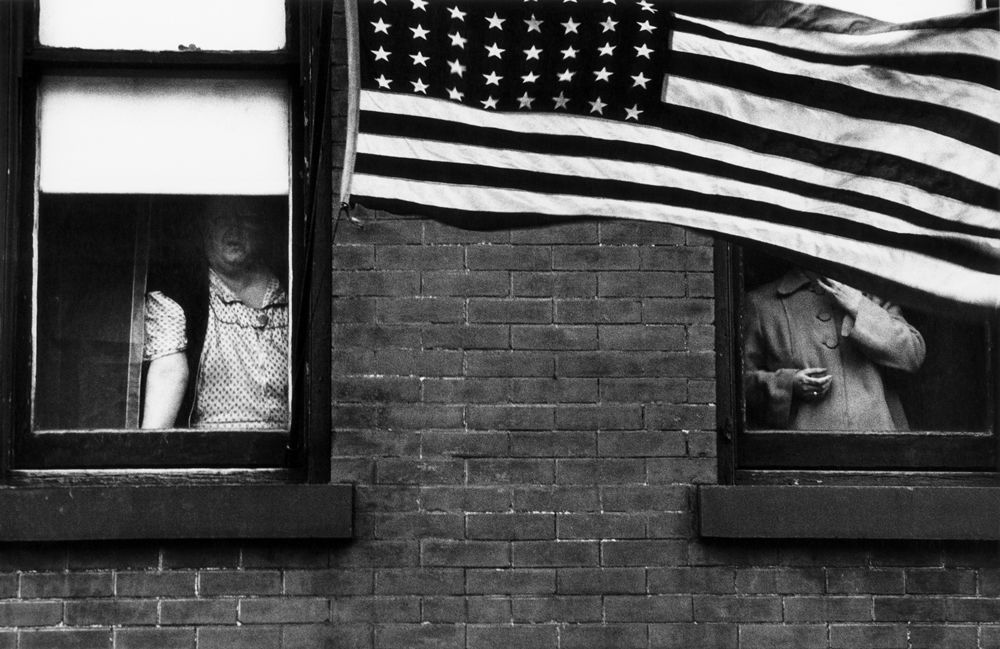
Pedro Meyer a pioneer of digital photography captures juxtapositions and relies more on the decisive moment than immersion:


He was actively involved with Sem-terra movement in Brazil, revolting dispossessed peasants, book: Struggle of the Landless. The 1997 book Terra uses expressive captions to contextualise; this is a book in two parts, one of the people the land and their hardships and one of migration and rural land takeovers. Photographing migration and urban landscapes was new for him. Though he has been criticised for aestheticizing misery it also shows strong formal design and photographic modernism, emphasising geometry, and visual contrast. This work is a contrast to the traditional picturesque work for the masses that he gave in Other Americas and is “an effort to get Brazilians what they need” (Mraz, 2002:28)
1993 book Migrations on refugees and migrants used a similar structure and his portrayal of the US-Mexican border and migrants is dark. Salgado shares that he works with fast film and opens the diaphragm to give huge depth of field and that volumes of photographs are important to him, “Reality” says Salgado, “is full of depth of field” (Jones 2015)
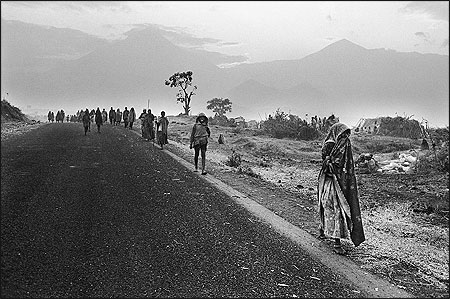
Migrations: The Story of Humanity on the Move (Nieman Reports, 2020)
Mraz calls Salgado a “new breed of photojournalist”(Mraz, 2002:30); Salgado says himself that he rejects the idea that he creates art saying that he is more concerned to report the historical moments in which he lives. He began by following a traditional path in subject and technique, picturesque and mainstream, however he discovered that to say anything new he needed to go beyond the stereotypes to show the struggles of communities, “his practice of commitment to the oppressed, and his capacity to stretch the limits of what is acceptable” (Mraz, 2020:30) offers a model of photojournalism for the future.
My Learning:
- Salgado represents his community picturesquely, although he also showed alienation and estrangement.
- Salgado is and Lopez focused on death in common with other Mexican photographers.
- Salgado shows the landscape as distressed.
- Alvarez Bravo treats the landscape with humour.
- Salgado put universal and eternal symbols above specifics in an image,
- Pedro Meyer captures juxtapositions relying on the decisive moment more than immersion
- Salgado says reality is full of depth of field
- Salgado went beyond the stereotypes to show the struggles of communities
- Salgado used minimal explanations and context to allow viewers to form their own opinions
References:
Bonhams: Sebastião Salgado (born 1944); Cemetery of the Town of Hualtla de Jiménez, Mexico, from Other Americas; (2020) At: https://www.bonhams.com/auctions/21017/lot/96/ (Accessed 27/05/2020).
Exhibition (2020) At: http://www.new-york-art.com/old/Mus-cof-onlyskin.php (Accessed 27/05/2020)
Figure Eight, Serra Pelada, Brazil, 1986 (2018) At: https://thephotographersgallery.org.uk/print-sales/explore-artworks/figure-eight-serra-pelada-brazil-1986 (Accessed 27/05/2020).
Jones, J. (2015) ‘Sebastião Salgado: my adventures at the ends of the Earth’ In: The Guardian 18/05/2015 At: http://www.theguardian.com/artanddesign/2015/may/18/sebastiao-salgado-photo-london-photography (Accessed 27/05/2020).
Mraz, J. (2002) ‘Sebastio Salgado: Ways of Seeing Latin America’ In: Third Text 16 (1) pp.15–30.
Nieman Reports (2020) At: https://niemanreports.org/articles/migrations-the-story-of-humanity-on-the-move/ (Accessed 27/05/2020).
Orr, G. (2015) ‘Brazilian photographer Sebastião Salgado captures the essence of a’ In: The Independent 06/09/2015 At: http://www.independent.co.uk/arts-entertainment/photography/brazilian-photographer-sebasti-o-salgado-captures-the-essence-of-a-continent-in-his-series-other-10487443.html (Accessed 27/05/2020).
Pedro Meyer – Heresies, the book (2008) At: http://www.pedromeyer.com/book/ (Accessed 28/05/2020).
SFMOMA, (2020) Coffin Makers, Nonoalco Street, Mexico City At: https://www.sfmoma.org/artwork/2011.258/ (Accessed 27/05/2020).




 Photography 2: Documentary