PART 2 THE B&W DOCUMENT: RESEARCH

THe FSA project

Do your own research into the FSA project and the work of the photographers listed here and others. (Open College of the Arts, 2014:44).

The Farm Security Administration Photographic Project (1935-1942), the most famous of America’s documentary projects, was among President Roosevelts efforts to fight the depression as a rural relief effort. It began under the Resettlement Administration in 1935, that became the Farm Security administration (FSA) in 1937. Roy Stryker was the head of the historical section in the RA Information division and supervised roughly 20 people to make a pictorial record of the impact of the Great Depression on the people; his actual brief was to gather photographic evidence of the agencies good works and give these to the press  (Marien, 2006:278) . Eighty thousand pictures were taken to “document the problems of the depression so that we could justify the New Deal Legislation that was designed to alleviate them” (Curtis, 2020:4).

Stryker understood the value of making a visual record and said that he could show depression without showing social strife, for instance strikes, however to me many of the images do exactly that. I have researched many of the FSA photographers before, such as Walker Evans, Dorothea Lange, Margaret Bourke-White and Arthur Rothstein, though I have turned up one or two new facts in this research. Walker Evans was dismissed after a year because his images were too uplifting and picturesque; whilst Rothstein was accused of fakery when he moved a Steer’s skull to make a better image and many of the photographers were charged with altering their photographs for impact. I had not heard before of Gordon Parkes and Esther Bubley, who were employed when the focus changed from rural to urban life, Parkes photographed the office cleaner and Esther Bubley women workers.  

Ultimately many of the 175,000 images weren’t used especially if they didn’t fit Stryker’s objectives. Of the FSA photographers many such as Walker Evans, Paul Taylor and Dorothea Lange moved into gallery photography afterwards.

After my reading of Curtis’s piece below I am more aware that these documentary photographers posed as “fact gatherers” and were consciously persuading others.

References:

Curtis, J. (2020) ‘Making sense of Documentary Photography’ In: History Matters Making sense of Evidence series pp.1–24. (Accessed 29.6.20)

Open College of the Arts (2014) Photography 2: Documentary-Fact and Fiction (Course Manual). Barnsley: Open College of the Arts.Curtis, J. (2020) ‘Making sense of Documentary Photography’ In: History Matters Making sense of Evidence series pp.1–24. (Accessed 29.6.20)
NEXT POST: https://nkssite5.photo.blog/category/coursework/part-2-the-bw-legacy/project-people-surveys/exercise-2-13-james-curtis/

PART 2 THE B&W DOCUMENT: RESEARCH

Research point Worktown

Explore the website Humphrey Spender’s Worktown. Briefly reflect in your learning log on Humphrey Spender’s documentary style and the themes of Worktown, with particular emphasis on the ethics and purpose of the project. (Open College of the Arts, 2014:42).

Spender was the main photographer for the Mass observation project. This was begun by Tom Harrison, anthropologist and Humphrey Jennings, surrealist painter and Charles Madge, poet, in Bolton in 1937. It aimed to record the lifestyles of ordinary people and was dubbed “Anthropology at home”; He took approximately 850 images in Bolton and Blackpool between 1937 and 1938, its scale was unique.

Spender was keen that people shouldn’t be influenced by the presence of the camera as they might react artificially and also intended to avoid preconceived theories; so they shot in concealed ways which led to them being called “spies, pryers, mass-eavesdroppers, nosey-parkers, peeping toms, lopers, snoopers, envelope-steamers, keyhole artists, sex-maniacs, sissies, society playboys.” (Spender quoted on Bolton Worktown). He used a rangefinder camera with 35mm film which was unusual then as most were using large format cameras.

Library reading room, April 1937. Photograph: Humphrey Spender/Bolton Council, from the Collection of Bolton Library and Museum Services

Crowds on Blackpool beach, 1937-38, photographed by Humphrey Spender. Photograph: Humphrey Spender/© Bolton Council, from the Collection of Bolton Library and Museum Services

The Mass Observation (MO) was influenced by various elements. Harrison believed in close observation and lived in the slums of Bolton with others who made daily observation. Whilst Spender had a strong social conscience and was concerned about social injustice (Bolton Worktown, 2020); he knew that his photographs could draw attention to inequalities in society. His photographs and did draw attention and he was recruited by the Daily Mirror as a travelling photographer. It has been said that their work laid the foundations for the welfare state (Jackson, 2015).

This style of candid photography is still popular today, however you could take it further and claim that the MO was a forerunner of today’s surveillance culture. I think that it is it’s firstly intention that ameliorates this; Harrison and Spender aimed to use the project to expose and educate the rest of the country and society to the realities of life in some places/sectors. I also think that the way Spender has recorded the issues that concerned him, with objectivity and integrity also ratifies his images and his contribution to the project.

It is probable that had they been overt in their methods of collecting and recording everyday life the results would not have been so honest.

My Learning:

The intention, ethics and methods of photographing affect the validity and reception to a project.

References:

Bolton Worktown – Photography and archives from Mass-Observation (2020) At: https://boltonworktown.co.uk/ (Accessed 29/06/2020).

Jackson, K. (2015) ‘Worktown: The Astonishing Story of the Project that Launched Mass Observation, by David Hall – review’ In: The Guardian 16/12/2015 At: http://www.theguardian.com/books/2015/dec/16/worktown-astonishing-story-mass-observation-david-hall-review (Accessed 29/06/2020).

90 and counting (2000) In: British Journal of Photography pp.12–13. 19.04.00 At: https://www.oca-student.com/sites/default/files/oca-content/key-resources/res-files/bjp_spender.pdf (Accessed 29.6.20).

Open College of the Arts (2014) Photography 2: Documentary-Fact and Fiction (Course Manual). Barnsley: Open College of the Arts.

NEXT POST: https://nkssite5.photo.blog/category/research-point-fsa-project/

PART 2 THE B&W DOCUMENT:PEOPLE SURVEYS

Exercise 2.12

Read ‘In the American East’ by Richard Bolton (in Bolton, 1992, pp.262–83) and write a 200-word reflective commentary on its relevance to documentary practice. Then look at the work of Charlotte Oestervang in Appalachia (Open College of the Arts, 2014:42).

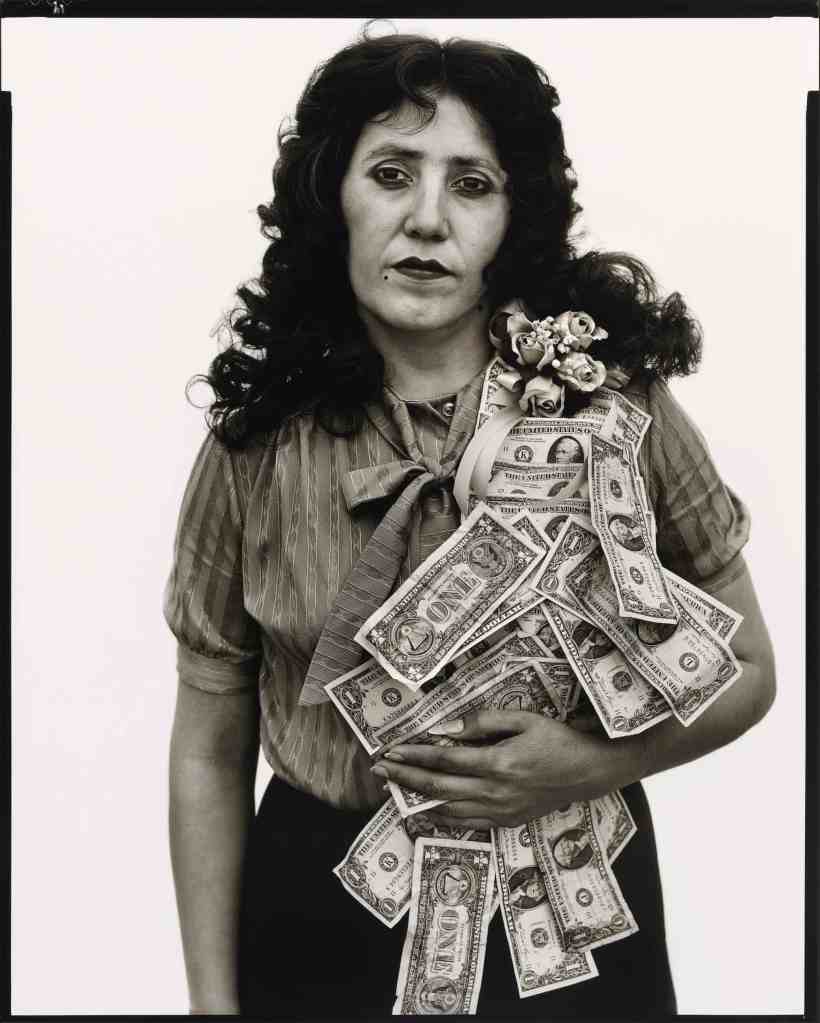
In 1979 Avedon began photographing the “marginal and dispossessed citizens of the West”, those in usually uncelebrated jobs. Bolton examines how Avedon “refashions this class” and how art is used in public relations.

Avedon decontextualized his subjects in front of a shadowed studio backdrop, reducing the 3D effect and exaggerated it further with post photographic processing. Bolton suggests this is to emphasis expected ugliness and sloppiness of such subjects and to effectively “render them mute”; Avedon says that a portrait is not a likeness and that his are truthful. Bolton goes so far as to say that Avedon “exploits members of a lower class for the edification of his own” (Bolton,1992:265), his view is that Avedon’s typologies are reduced to absurdity by formal devices and in particular repeating the subject’s “direct, uncomfortable, awkward, grim” look (Bolton, 199: 267).

     (Richard Avedon: In the American West – in pictures, 2017)

Bolton goes on to suggest how the art press helped what he calls this constructivism, that it was a trail run for a different type of advertising and that the publicity that obsessively controlled it made it successful, that it became an “empty vessel” to promote the artist, the museum and the corporate sponsor.

Charlotte Oestervang’s portraits of people in Appalachia do give us some context as they are taken in their own surroundings; however I’m not sure that this shows them more respect, how do we know if she has manipulated their surroundings? They stare directly at the camera and are shot starkly rather like Avedon’s and still leave me uncomfortable.

 (Foto, 2020)

My learning here in about the relevance of these works in relation to documentary practice is questions about:

  • Context
  • Control
  • Manipulation
  • stereotyping
  • Bias
  • Social responsibility

These are some of the same issues raised by Sander’s, Nelson and Penn’s work that I addressed below. I guess the important thing is to be aware of these issues and to take the approach that you think is socially and morally appropriate.

Bibliography:

Foto (2020)Volume 6 Number 1. At: https://issuu.com/foto8/docs/vol6no1 (Accessed 28/06/2020)

Richard Avedon: In the American West – in pictures (2017) In: The Guardian 25/02/2017 At: http://www.theguardian.com/culture/gallery/2017/feb/25/richard-avedon-american-west-texas-in-pictures (Accessed 28/06/2020).

Smithson, A. (2010) Charlotte Oestervang. At: https://lenscratch.com/2010/09/charlotte-ostervang/ (Accessed 28/06/2020).

Open College of the Arts (2014) Photography 2: Documentary-Fact and Fiction (Course Manual). Barnsley: Open College of the Arts.

NEXT POST: https://nkssite5.photo.blog/category/research/a2-research/research-point-worktown/

PART 2 THE B&W DOCUMENT: PEOPLE SURVEYS

Exercise 2.11

Read the information that accompanied August Sander’s exhibition People of the 20th Century at the San Francisco Museum of Modern Art. Write a 200-word reflective commentary on Sander’s seven-category system. Briefly discuss the implications of his classification system within the socio-cultural context of the time. Make connections with contemporary practice such as that of Zed Nelson, if appropriate. (Open College of the Arts, 2014:41)

Reflective commentary:

I saw 80 of Sander’s photographs from his same work “People of the 20th Century”, at an Exhibition at the National Museum Cardiff (13.12.19; it was great to see his work first hand, which I’d already studied when doing my Identity and place course.

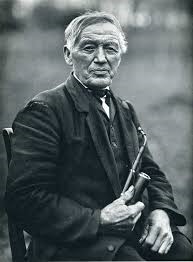
Sandler made posed portraits of ordinary people from across society, who he grouped to occupational, social or familial types; he then put these into seven archetypal categories: The farmer, The Skilled tradesman, The Woman, Classes and Professions, The Artists, The City and The Last People (the elderly and disabled).

These images were taken by August Sanders in the early 20th century and published in 1929 as Antlitz der Zeit (Face of Our Time). They have been put online by various galleries or on Pin interest and are used here in an educational context only.

Walter Benjamin in his “A short history of photography” suggested that people use Sander’s work to increase “physiognomic awareness” in what he described as dangerous times (Jeffery, 1981:132.) The author Alfred Doblin said the work had evidence of social tensions in classes and generations (Jeffery, 1981: 133), calling Sandler a realist. Jeffery suggests that there was some subversiveness about the work, as it is a history of Germany in transition, and maybe that is what I caused the Nazi authorities to disapprove of his categorisation and stop his work. Now, and possibly more so in the wake of the “Black lives matter” campaign and focus on discrimination, this scientific objectivity, including the separating of women would be seen disapprovingly, I think.

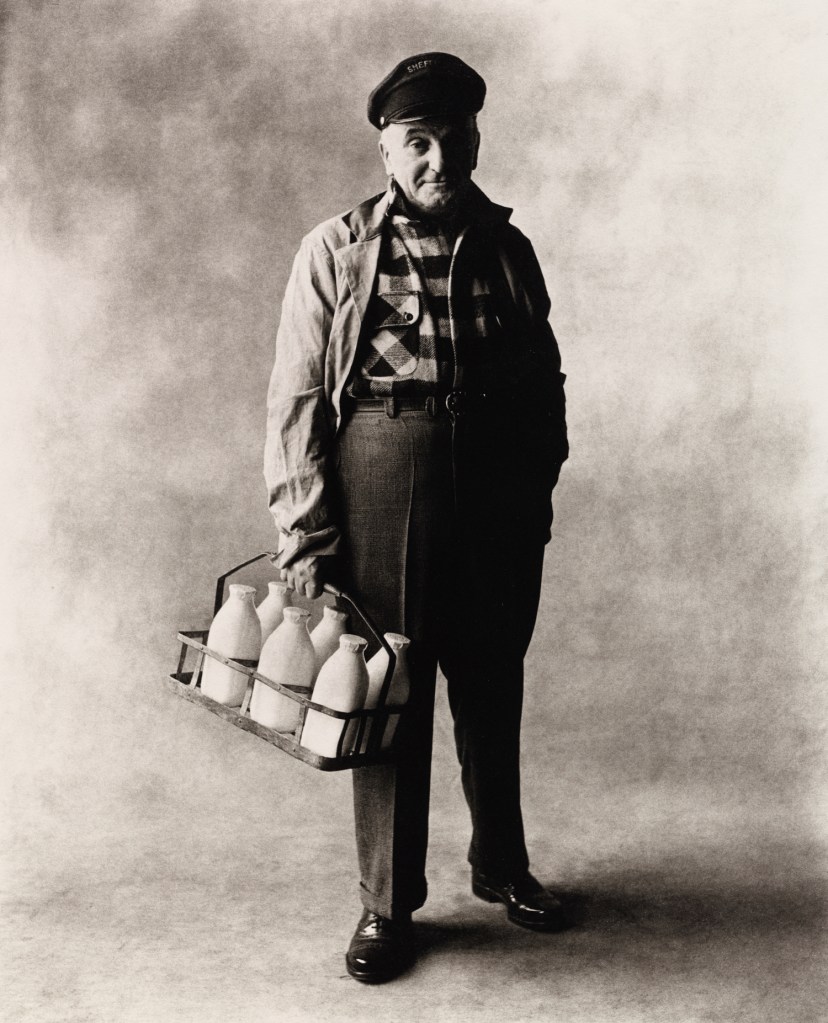
It is suggested by the OCA, that Zed Nelson’s Disappearing Britain and Small Trades by Irving Penn have some connections to Sander’s work. Certainly, Small Trades does document common occupations and in a straightforward manner, but these are not across society as Sanders did.

Milkman 1951     Pompier Paris 1950 (fireman) (The Irving Penn Foundation, 2020)

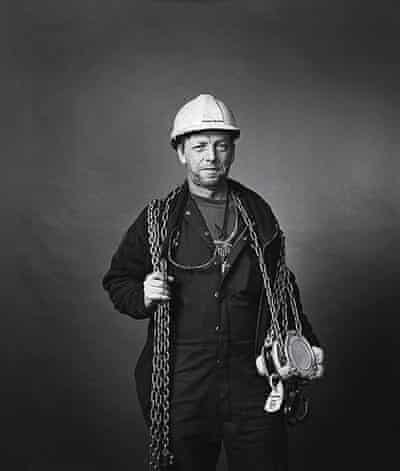
Nelson focuses on dying trades presenting them as art photography; his subjects usually stare into the camera proudly as do Penn’s. They have relevant props as Sanders portraits often did.

     (Morrison, 2011)

Although contemporary with “Arty” lighting a sense of nostalgia pervades both of these works; they are both preserving the past rather than cataloguing the now as Sander did.

These photographers had different motives for photographing in what on the surface seems like a similar way.

References:

ASander (2002) At: https://www.oca-student.com/sites/default/files/oca-content/key-resources/res-files/asander_sfmoma_0.pdf (assessed 28.6.20)

Jeffrey, I. (1981) Photography: A concise history. (London): Thames and Hudson London.

Morrison, B. (2011) ‘Goodbye to all that’ In: The Guardian 12/03/2011 At: http://www.theguardian.com/artanddesign/gallery/2011/mar/12/goodbye-to-all-that-zed-nelson-photographs (Accessed 28/06/2020).

Morrison, B. (2011) ‘Goodbye to all that’ In: The Guardian 12/03/2011 At: http://www.theguardian.com/artanddesign/gallery/2011/mar/12/goodbye-to-all-that-zed-nelson-photographs (Accessed 28/06/2020).

Morrison, B. (2011) ‘Goodbye to all that’ In: The Guardian 12/03/2011 At: http://www.theguardian.com/artanddesign/gallery/2011/mar/12/goodbye-to-all-that-zed-nelson-photographs (Accessed 28/06/2020).

Open College of the Arts (2014) Photography 2: Documentary-Fact and Fiction (Course Manual). Barnsley: Open College of the Arts.

The Irving Penn Foundation (2020) At: https://irvingpenn.org/small-trades (Accessed 28/06/2020).

NEXT POST: https://nkssite5.photo.blog/category/exercise-2-12-in-the-american-east/