EXERCISE: THE MYTH OF OBJECTIVITY
Write a 250-word reflective commentary on the above quotes by André Bazin and Allan Sekula. Briefly compare their respective positions and record your own view on the issue of photographic objectivity (Open College of the Arts, 2014:28)
This is the quote supplied from André Bazin:
“For the first time, between the originating object and its reproduction there intervenes only the instrumentality of a non-living agent. For the first time an image of the world is formed automatically, without the creative intervention of man…in spite of any objections our critical spirit may offer, we are forced to accept as real the existence of the object reproduced, actually, re-presented…” (Bazin and Gray, 1960).
In this article Bazin compares the differences between film/photography and painting/sculpture, asking “what are they?” and “what do they mean?” He was particularly interested in the nature of reality, and thought that painting and sculpture could only represent with expression, and so might not be realistic. Though he admitted the presence of the personality of the photographer and that their option to choose their purpose for photographing; Bazin sees the process as scientific rather than artistic, that it reproduces reality, and that the camera is objective (through an object), credible and without evidence of the human hand. He also sets out that photography is able to present something in such a realistic way that y0u will look at it afresh.
This is the quote from Allan Sekulla:
“If we accept the fundamental premise that information is the outcome of a culturally determined relationship, then we can no longer ascribe an intrinsic or universal meaning to the photographic image.” (Sekula, 1997, p454).
He believes that every photograph carries a message, and this is dependent on its cultural definition as information is a culturally determined relationship. He says that photographic literacy is learned and semantic properties cannot live in the image alone and therefore you can’t ascribe a universal meaning to a photograph.
To illustrate his belief Sekula deconstructs Stieglitz’s photograph “Steerage” (1911) alongside Lewis Hine’s “Immigrants going down the gangplank” (1905) to show the effect that context and culture/ history have on the meaning of an image.

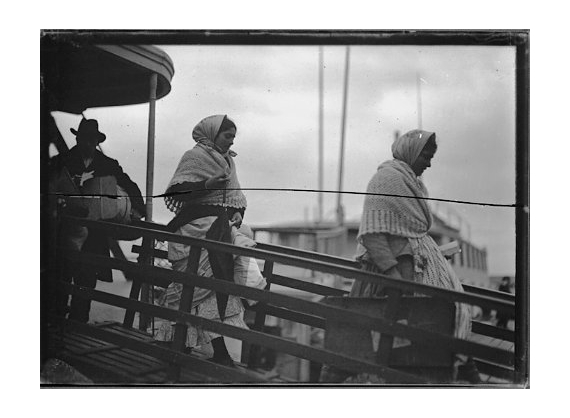
Their subject matter is very similar but Sekula argues that the social and historical contexts of the photographers were different and therefore so were their intentions. Stieglitz’s “Steerage” was first published in Camera work magazine where photographs were considered artistic. On the other hand Hines was a Sociologist, Sekula describes him as an aesthetic realist, and his photograph appeared in a social-work journal. Sekula describes Hine’s as more like a report, but even so Sekula notes that he is expressing concern rather than just documenting fact. Sekula refers much to Barthes and in doing so points out that as the conative function of a photograph may be culturally determined it may sometimes give a photograph the status of a document.
My view:
The positions of Bavin on the status of the photograph “we are forced to accept as real the existence of the object reproduced, actually, re-presented…”(Bazin,1945, p7) and Sekula that “information is the outcome of a culturally determined relationship, then we can no longer ascribe an intrinsic or universal meaning to the photographic image “ (Sekula, 1997, p454) are quite different.
Having read them I am directed back to Berger who asked, whether photographs are an artefact, or a trace left by light that has passed through an object (Berger, 2013).
I cannot share Bavin’s view, and that commonly held at the time when documentary photography was in its golden age that a photograph is an unquestionable true representation of something. Bavin is excluding from the photographic process the effect of purpose, preparation, subjective capturing and processing; and this is increased now by digital and citizen photography and journalism. The photographic image is also biased by Editors and Curators, amongst others post shooting. However it is still true that many viewers are unaware of the potential for the bias in photographs outside manipulated processing.
I think like Sekula that it is actually more complicated than art photography versus documentary photography in terms of an image’s realism or expressionism. As genres become blurred we must be aware of all the influences acting on an image including cultural and contextual when we are assessing objectivity.
References:
Alfred Stieglitz/ The Steerage | 33.43.419 | Work of Art | Heilbrunn Timeline of Art History | The Metropolitan Museum of Art (2020) At: https://www.metmuseum.org/toah/works-of-art/33.43.419/ (Accessed 09/03/2020).
Barthes, R 1964, ‘Rhetoric of the Image’, in J Evans, S Hall (eds.), Visual Culture:the reader, Sage PublicaEons, London
Bazin, A. and Gray, H. (1960) ‘The Ontology of the Photographic Image’ In: Film Quarterly 13 (4) pp.4–9.
Berger, John. (2013). Understanding a Photograph. 1st ed. New York: Aperture Foundation
Hine Lewis | Immigrants Going Down Gang Plank From Ferry Boat That Lands Them On Ellis Is. | MutualArt 2020.) At: https://www.mutualart.com/Artwork/Immigrants-Going-Down-Gang-Plank-From-Fe/18423F7C3CBB7E61 (Accessed 09/03/2020).
Open College of the Arts (2014) Photography 2: Documentary-Fact and Fiction (Course Manual). Barnsley: Open College of the Arts.
Sekula, A ( 1997) ‘On the Invention of Photographic Meaning’, 1997, p.454) At: https://zscalarts.files.wordpress.com/2013/12/on-the-invention-of-photographic-meaning-sekula.pdf (Accessed 10.3.20)
 Photography 2: Documentary