Don’t set limitations as they create preconceptions
Boundaries of documentary are being pushed already
Be aware of factors that may distort the purpose of images
Project What makes a document?
Walton: On the nature of photographic realism – photography as a way of showing and seeing rather than just representing, we see the world through the photograph
Every photograph is a document but with time can be more
Photographs have a message about the event/subject photographed and a message about the shock of discontinuity (separation from context), this makes all photographs ambiguous (Berger)
Photographs are often used with words to fill this broken continuity
The general meaning of an image is not instantaneous but is found during connections (Berger).
The truth in a photograph may be limited by the photographer
Project A postmodern documentary
Postmodernism provides a new framework for considering photographic truth and objectivity
Consider my intentions when photographing and remember my responsibilities to truth
When accessing truth and objectivity remember to consider all influences, cultural, contextual, editorship…
Photojournalism should show the intention of the photographer
Read Simon Bainbridge’s article on the 2011 Hereford Photography Festival. Core resources: Hereford_Bainbridge.pdf. Select one of the bodies of work in the article and write a 200-word reflective commentary in your learning log. (Open college of the arts, 2014:30)
Simon Bainbridge’s Time & Motion Studies presents work that results from deliberate and sustained observation. The five photographer’s concepts with carefully considered strategies are more prominent than their aesthetics. They are communicating ideas about subjects that aren’t necessarily photogenic. Each work has appeared in the British Journal of Photography.
Donald Webber’s Interrogations are real ones of suspected criminals in Ukraine, ‘the result of his personal quest to uncover the hidden meaning of private, unpleasant encounters with unrestricted Power.’ For this Webber worked hard to access to his subject.
Robbie Cooper’s work Immersion is acollection of stills and videos that show the various expressions appearing on people’s faces as they play video games and watch YouTube. In this case Cooper collaborated with psychologists and learnt new technologies to capture his images.
Manuel Vasquez work Traces is based on surveillance culture, images captured mainly in anonymous public places.
I was most interested in the work of George Georgiou (The Shadow of The Bear, 2009-10) and that of his partner Vanessa Winship (Georgia 2009-10) as they shot in the same places at the same time but with completely different agendas.
Georgiou’s project looks at the aftermath of the peaceful ‘colour’ revolution that took place in Ukraine, against a backdrop of Russia resurging as a major international power and is interested in the ongoing interference in both their sovereign and domestic affairs. It shows how people of Georgia and the Ukraine negotiate the space that they find themselves in, individually though with their shared history in the Soviet Union. Georgiou, whilst staying hidden, captures people in their everyday lives and shoots repeatedly from the same vantage point. If there is a decisive moment in his work it comes when he edits from hundreds of his images. The images are sequential but he disrupts the sequences when he presents them, another way that he forms decisive moments.
(IN THE SHADOW OF THE BEAR, 2020)
Vanessa Winship shoots the same subjects but in the open, with their knowledge and usually engages them with a direct stare seeking a connection. Her subjects are usually shot with minimal context and look vunerable. Winship describes their existence as a “Kind of fantasy of sorts” as “there is a kind of melancholia, an underbelly that almost inevitably sets itself against such exuberance”; this is especially so when she visits after a summer of war .
“I found my friends exhausted but very much alive, alive in a way that is only possible when one is so close to the possibility of death” (Agence, 2020). Against this backdrop she says that she searched for those that represented this romanatic fantasy, dancers, wedding guests and so on. Her work explores memory, identity and history (Agence, 2020).
“My work explores concepts of borders, land, memory, desire, identity and history,” wrote Vanessa Winship in 2011. She is a thoughtful photographer who moves between genres – reportage, documentary, portraiture, landscape. Her most memorable images are quiet and luminous.
(Agence, 2020)
I find Winship’s work reflective in a melancholy and enigmatic way both on the place and the people. Whilst I find Georgiou’s work more brutal and honest possibly. The work of these two photographers illustrates how motive affects the way that subjects are captured, edited and presented to form the decisive moment in their work.
Open College of the Arts (2014) Photography 2: Documentary-Fact and Fiction (Course Manual). Barnsley: Open College of the Arts.
Next, listen to Jon Levy, founder of Foto8, talking about documentary in the art gallery athttp://oca-student.com/node/100127Note down your reactions to Levy’s comments in your learning log(Open college of the arts, 2014:30).
Jon Levy on the intention of the photographer
He talks about the intent of the magazine Foto8 being about storytelling, not fictional but as reports of issues that are out there. His main criteria for photojournalism is being able to see the intention of the photographer, and this before the work is presented; this for him is the judge of whether a photograph is photojournalism. He suggests that bringing in work that isn’t obvious photojournalism is useful (for instance local, personal stories) as they can initiate a wider understanding of photojournalism. Sometimes the quieter and sometimes emotional stories can reveal important issues and connect more. Levy says it’s how they work that really matters, rather than how they look, that should decide whether they are photojournalism. Photojournalism has tended to be a western view of the rest of the world, but this shouldn’t necessarily be so; the trend for vernacular photography, which can be at home not in the rest of the world can be effective. Levy suggests that if you want to tell a story whether you have your own point of view or bring an outside point of view, both are equally valid. Accessibility has broadened photography and gives more points of view and different perspectives which can only be good.
A summary of Levy’s perspective:
Its an interesting comment that photojournalism should clearly show the intention of the photographer.
Quieter stories can be equally effective at revealing issues and connect with viewers better.
It is how stories work that is important; I guess whether they work or not rather than whether they are conventional photojournalism.
Photojournalism should just be that that is viewed as a Western view of the world.
Both inside and outsider views are equally valid for photojournalism.
We should embrace the broadened view of photojournalism that greater accessibility brings.
My thoughts:
I don’t feel qualified at the beginning of this course and my first forays into documentary photography to do much except take notes of these ideas. However going forward I will take serious note of the importance of showing the intention of my work, and comfort in the notion that quieter can be good at revealing issues and connecting with an audience, and to be aware that t is how stories work that is important.
References:
Open College of the Arts (2014) Photography 2: Documentary-Fact and Fiction (Course Manual). Barnsley: Open College of the Arts.
Write a 250-word reflective commentary on the above quotes by André Bazin and Allan Sekula. Briefly compare their respective positions and record your own view on the issue of photographic objectivity (Open College of the Arts, 2014:28)
This is the quote supplied fromAndré Bazin:
“For the first time, between the originating object and its reproduction there intervenes only the instrumentality of a non-living agent. For the first time an image of the world is formed automatically, without the creative intervention of man…in spite of any objections our critical spirit may offer, we are forced to accept as real the existence of the object reproduced, actually, re-presented…” (Bazin and Gray, 1960).
In this article Bazin compares the differences between film/photography and painting/sculpture, asking “what are they?” and “what do they mean?” He was particularly interested in the nature of reality, and thought that painting and sculpture could only represent with expression, and so might not be realistic. Though he admitted the presence of the personality of the photographer and that their option to choose their purpose for photographing; Bazin sees the process as scientific rather than artistic, that it reproduces reality, and that the camera is objective (through an object), credible and without evidence of the human hand. He also sets out that photography is able to present something in such a realistic way that y0u will look at it afresh.
This is the quote from Allan Sekulla:
“If we accept the fundamental premise that information is the outcome of a culturally determined relationship, then we can no longer ascribe an intrinsic or universal meaning to the photographic image.” (Sekula, 1997, p454).
He believes that every photograph carries a message, and this is dependent on its cultural definition as information is a culturally determined relationship. He says that photographic literacy is learned and semantic properties cannot live in the image alone and therefore you can’t ascribe a universal meaning to a photograph.
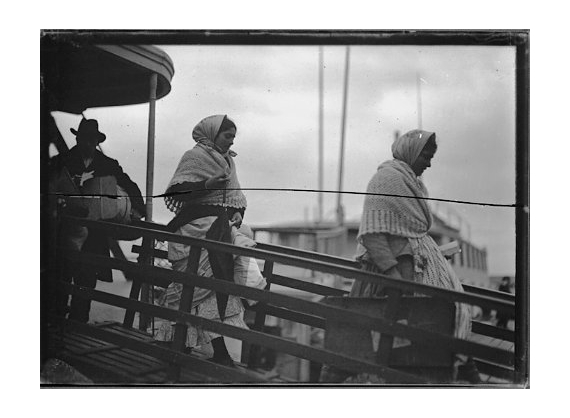
To illustrate his belief Sekula deconstructs Stieglitz’s photograph “Steerage” (1911) alongside Lewis Hine’s “Immigrants going down the gangplank” (1905) to show the effect that context and culture/ history have on the meaning of an image.
(Stieglitz, 2020)
(Hine, 2020)
Their subject matter is very similar but Sekula argues that the social and historical contexts of the photographers were different and therefore so were their intentions. Stieglitz’s “Steerage” was first published in Camera work magazine where photographs were considered artistic. On the other hand Hines was a Sociologist, Sekula describes him as an aesthetic realist, and his photograph appeared in a social-work journal. Sekula describes Hine’s as more like a report, but even so Sekula notes that he is expressing concern rather than just documenting fact. Sekula refers much to Barthes and in doing so points out that as the conative function of a photograph may be culturally determined it may sometimes give a photograph the status of a document.
My view:
The positions of Bavin on the status of the photograph “we are forced to accept as real the existence of the object reproduced, actually, re-presented…”(Bazin,1945, p7) and Sekula that “information is the outcome of a culturally determined relationship, then we can no longer ascribe an intrinsic or universal meaning to the photographic image “ (Sekula, 1997, p454) are quite different.
Having read them I am directed back to Berger who asked, whether photographs are an artefact, or a trace left by light that has passed through an object (Berger, 2013).
I cannot share Bavin’s view, and that commonly held at the time when documentary photography was in its golden age that a photograph is an unquestionable true representation of something. Bavin is excluding from the photographic process the effect of purpose, preparation, subjective capturing and processing; and this is increased now by digital and citizen photography and journalism. The photographic image is also biased by Editors and Curators, amongst others post shooting. However it is still true that many viewers are unaware of the potential for the bias in photographs outside manipulated processing.
I think like Sekula that it is actually more complicated than art photography versus documentary photography in terms of an image’s realism or expressionism. As genres become blurred we must be aware of all the influences acting on an image including cultural and contextual when we are assessing objectivity.
Read the article ‘In, Around and Afterthoughts (on Documentary Photography)’ by Martha Rosler in Bolton, R. (ed.) (1992) The Contest of Meaning. Cambridge, MA: MIT Press (p.303).This is available as a core resource on the student website at: http://www.oca-student.com/resource-type/course-specific-resources/contest-meaning-pg-303. Make notes in your learning log or blog. (Open College of the Arts, 2014:27)
Notes:
Rosler asks “how can we deal with documentary photography as a photographic practice and what remains of it now?” (Rosler,1992:333).
Documentary came to represent the social conscience of liberal sensibility presented in visual imagery and had its place in a war on poverty as journalist attention was brought to working class lives and slums; although it was often perceived as muckraking and obtained by unethical means.
Documentary photography may have appeared moralistic and yet the notion of charity that it inspired actually preserved wealth was not at odds with reformist documentary which argued for giving a little to subdue the dangerous lower classes, but was essentially victim photography.
Rosler cites Szarkowski who said that a generation ago documentary photographers were serving a social cause to persuade others to make things better but were then superseded by those who used the approach and manipulated for their personal ends; liberal documentary looking for change was in the past Rosler agrees. She calls for a “radical documentary that exposes.
Rosler states that a documentary image has 2 moments, the immediate and then the conventional aesthetic-historical moment, as your response to an image is rooted in social knowledge.
Susan Meiselas (a photographer who worked for magnum and covered the war in Nicaragua) as a response to Rosler’s comments suggests documentary practise was contaminated by underlying assumptions of imperialism and colonialism and couldn’t ever be radical (Strauss, p15). Meiselas also suggests that Rosler relies on assumptions of how documentary work is actually received (Strauss p 17).
The liberal pseudo reformist documentary that exposed poverty and slums has now gone and has been replaced by documenting other issues. However reading her essay has made me think harder about my intentions when I photograph and the responsibility that a photographer has.
References:
Open College of the Arts (2014) Photography 2: Documentary-Fact and Fiction (Course Manual). Barnsley: Open College of the Arts.
Rosler in Bolton, R. (ed.) (1992) The Contest of Meaning. Cambridge, MA: MIT Press (p.303).
Strauss, D., 2014. Words Not Spent Today Buy Smaller Images Tomorrow. new york: aperture.


 Photography 2: Documentary