PART FIVE: NEW FORUMS FOR DOCUMENTARY

PROJECT THE DOCUMENTARY PROJECT

Documentary projects

Look at the digital version of Penny’s Blurb book on her blog: http://marmalade-cafe.blogspot.co.uk/2012/02/not-our-time.html

Listen to OCA assessors Clive White and Maggy Milner talking about the project on WeAreOCA: www.weareoca.com/photography/student-work-uncovered-penny-watson/   (Open College of the Arts, 2014:110)

We have been directed to look at some of the documentary projects of OCA photography students. Here are my observations:

Penny Watson-Not our Time

This a day in the life of her Nanna, I believe not long before her death. It is a sensitive, spy on the wall, project with mundane images of her Nanna’s everyday life.

Briony Campbell-The Dad Project

I have visited this work before. Its exploration of loss has similarities with Penny’s work. I find Briony’s work more explorative and conceptual than Penny’s. Perhaps I just subjectively prefer her visual images.

Harry Pearce-A Dozen Eggs

Here his family-based project has an added dimension of handwritten text provided by his family to accompany his image. Theas in Briony and Penny’s work is magnified, shared, and made interesting.

Beth Aston-Behind the scenes

A biographical self portrait focusing on her illness. This is a brave subject, shared honestly. Also, with a strong aesthetic quality, lent by the use of black and white, unusual perspective and a cohesiveness of presentation. It is good to be taken back in my mind to autobiographical work that I enjoyed doing particularly in my Identity and Place course, Mirror, Image and Text, and in my Context and Narrative course, Photographing the Unseen and Putting yourself in the picture. Though none of these were nearly so raw as Beth’s work, but I did find them reflective and cathartic.

The above works are contrasted with the following 2 projects.

Omar Camilleri- Feet

This project appears light-hearted, however there was a deep spiritual and conceptual process behind it. A collaboration between a painter artist, and the photographer and another who had a shared concept to see reality through visuals of feet. It shows how the good choice of a topic combined with honed observational skills can create an interesting body of work.

Tanya Ahmed-Living on 100th Street

This subject was photographed by Bruce Davison 40 years ago, Tanya photographed it as it is today to give a current portrait. It is her insider view of the street, focusing on the people rather than the environment, in a collaborative manner.

My learning:

I can see that these works are driven by strong strategies and where needed, careful research. They are of course technically strong. Though the projects are varied, they are all evidently personal and driven by a strong purpose, perhaps with the exception of Omar’s. I have discovered myself that being passionate about what you are photographing is important to the quality of the outcome, though to be honest because of the limitations of the pandemic I have not always been able to chose subjects that I am excited by during my documentary course. I realise that when working on level 3 I must ensure that I find subjects that I am passionate about. Won’t it be nice when our choice of subject is opened up again, when we can go inside buildings and get close to people.

References:

Camilleri, O (2010) Feet At: http://omarcamilleri.com/2010/09/23/feet-photographic-exhibition/  (Accessed 06/04/2021)

Campbell, B. (2011.) The Dad Project. At: http://www.brionycampbell.com/projects/the-dad-project/ (Accessed 06/04/2021).

Harry Pearce (2012) A dozen Eggs. At: https://www.harrypearce.co.uk/ (Accessed 06/04/2021).

Lomas, M. (2012) Student Work Uncovered – Penny Watson. At: https://www.oca.ac.uk/weareoca/photography/student-work-uncovered-penny-watson/ (Accessed 06/04/2021).

Open College of the Arts (2012) Student Work Uncovered – Tanya Ahmed. At: https://vimeo.com/42467929 (Accessed 06/04/2021).

Open College of the Arts (2012) Tanya Ahmed: Living on 100th Street. At: https://vimeo.com/43594038 (Accessed 06/04/2021).

Open College of the Arts (2014) Photography 2: Documentary-Fact and Fiction (Course Manual). Barnsley: Open College of the Arts.

Watson, P (2012) marmalade and Profile, V. my C. Not Our Time. At: http://marmalade-cafe.blogspot.com/2012/02/not-our-time.html (Accessed 06/04/2021).

Next Post: https://nkssite5.photo.blog/2021/04/08/research-and-reflection-visual-arts-data/

Next Post: https://nkssite5.photo.blog/2021/04/08/research-and-reflection-visual-arts-data/
PART FIVE: NEW FORUMS FOR DOCUMENTARY

POST DOCUMENTARY ART

RESEARCH POINT

Learn more about crowd funding by reading the following articles:

‘The 7 Essentials of Crowd-Funding Your Next Photography Project’ (Light Stalking March 2012):

http://www.lightstalking.com/crowd-fund-photography/Crowd Funding’ (WeAreOCA September 2011): www.weareoca.com/photography/crowd-funding/ (Open College of the Arts, 2014:1085)

Crowd Funding

I’ve heard the term crowd funding many times, but never really taken the time to understand how it works. It seems it’s a method of raising finance for a personal project- that much I did understand. Having read the OCA post on the subject I can see that it’s a great possibility for creating impact with photographic projects.

The Kickstarter project launched in 2009 as a web platform for funding personal creative projects is described as the original crowd-funding concept. The concept is that funds are raised by offering creative rewards to individual backers who pledge varying amounts. The OCA post cites the example of Pete Brook’s Prison photography projects for which he has raided $8000 from 142 supporting people. This was done by a pitch that touched the collective conscience and offering items such as limited editions, signed books and so on. Other crowd funding platforms mentioned are the UK WeFund, and Empash; these platforms deal with donations and take commission. There are arguments that projects may be trivial and self-indulgent, but then how would they reach their target funds? There is also the suggestion that once funded projects could be released pro-bono creating a surplus of free documentary work. The point is also made in the OCA post that work can be professional even if it isn’t commercial. The author concludes that crowd funding creates “digital democratised photography”. I make no apology for the fact that here I have summarised the article, which I have done to clarify my understanding of what feels like a “dark art” to me.

In my further browsing on crowd funding, I was interested to also come across Crowd books, a platform for crowd funding books.

I found some tips online for successful funding photographic projects by crowd funding, curtesy of lightstalking:

  1. Build enthusiasm before launching your project.
  2. Create a personal and story-telling video.
  3. Set a realistic but achievable funding goal.
  4. Keep your project specific with clearly defined goals.
  5. Target specific groups and individuals – build your networks.
  6. Offer rewards that don’t require a lot of overhead.
  7. Create updates and keep people engaged.

These all seem good ideas also to use when setting up an exhibition or for marketing for any project.

I’m not sure crowd funding will be something that I’ll ever use, but at least I understand the process a little better now and will keep it at the back of my mind.

References:

Jose (2011) Crowd Funding. At: https://www.oca.ac.uk/weareoca/photography/crowd-funding/?cn-reloaded=1 (Accessed 06/04/2021).

Kickstarter (2021) At: https://www.kickstarter.com/ (Accessed 06/04/2021).

Open College of the Arts (2014) Photography 2: Documentary-Fact and Fiction (Course Manual). Barnsley: Open College of the Arts.

The 7 Essentials of Crowd-Funding Your Next Photography Project (and How We Funded Ours) (2012) At: https://www.lightstalking.com/crowd-fund-photography/ (Accessed 06/04/2021).

Next Post: https://nkssite5.photo.blog/category/research/a5-research/resaerch-point-oca-documentary-projects/

PART FIVE: NEW FORUMS FOR DOCUMENTARY

PROJECT THE DOCUMENTARY PROJECT

5.5 Exercise

Visit the web pages of the Kingsmead Eyes project (http://gideonmendel.com/kingsmead-eyes/ or http://www.kingsmeadeyesspeak.org/).

Investigate the original 2009 project and the latest Kingsmead Eyes Speak project.

Write notes in your learning log about how the work is presented on the website, in particular the use of mixed media – stills, video and audio.  (Open College of the Arts, 2014:107)

Kingsmead eyes- Gideon Mendel

This was the result of a long collaboration with the Kingsmead Community school in Hackney when he was photographer in residence. He was partnered also by Crispin Hughes and the poet Joelle Taylor. Mendel engaged year 5 students in photography workshops encouraging them to be creative whilst sharing their lives and cultures and building bonds between communities and the school.

In Kingsmead eyes (2009) at the same time Mendel made portraits of each child and assembled them into composite images which he used in a video installation featuring their work and their words. Here in turn, they share their stories and backgrounds through visual and audio. Their mages are interestingly from a child’s perspective, the height (stairways, corridors) and the interest (their families, toys) and to us seem very creative like the inside of a box of chocolates – but this is the benefit of an untamed child’s view, which is great.

For his subsequent project Kingsmead eyes speak (2011), Mendel worked with fewer students for a shorter period. Their work is presented on different platforms both as slides/gallery with accompanying text and audio files as well as video presentations by the students.

I particularly like the way the students explain in whichever format, why they like their images and why they’ve shot some of them. The combination of various media gives the students a variety of opportunities to share their perspectives and ensures that it reaches their audience. It also ensures that viewers have the opportunity to be affected by what media touches them best.

I have researched Mendel’s work recently, notably his HIV /AIDs work in Africa and global warming work Drowning World. I found before that he uses alternative ways of storytelling to reach audiences. Mendel shows again in this work his belief that photography has the ability to make positive change in the world. He is also demonstrating his inclination to give long term commitment to projects to bring make impact.

References:

Kingsmead Eyes Speak (2011) Kingsmead Eyes Speak led by Gideon Mendel. At: http://www.kingsmeadeyesspeak.org/kingsmeadeyes/ (Accessed 06/04/2021).

Mendel, G (2009) Kingsmead Eyes At: http://gideonmendel.com/kingsmead-eyes/ (Accessed 06/04/2021).

Open College of the Arts (2014) Photography 2: Documentary-Fact and Fiction (Course Manual). Barnsley: Open College of the Arts.

Next Post: https://nkssite5.photo.blog/category/research/a5-research/research-point-crowd-funding/

PART FIVE: NEW FORUMS FOR DOCUMENTARY

PROJECT THE DOCUMENTARY PROJECT

RESEARCH POINT

Research the current activities of Photovoice (www.photovoice.org) and also look into archive projects such as New Londoners: Reflections on Home.

Briefly reflect on the documentary value and visual qualities of the work that you research. (Open College of the Arts, 2014:107)

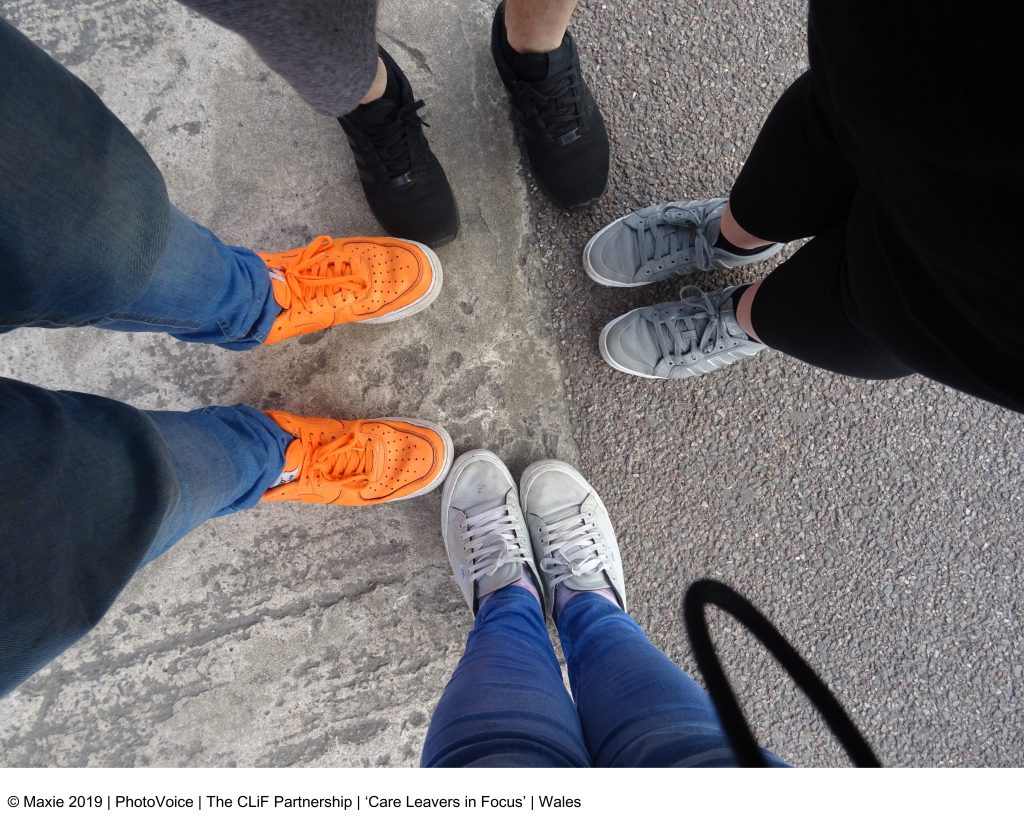
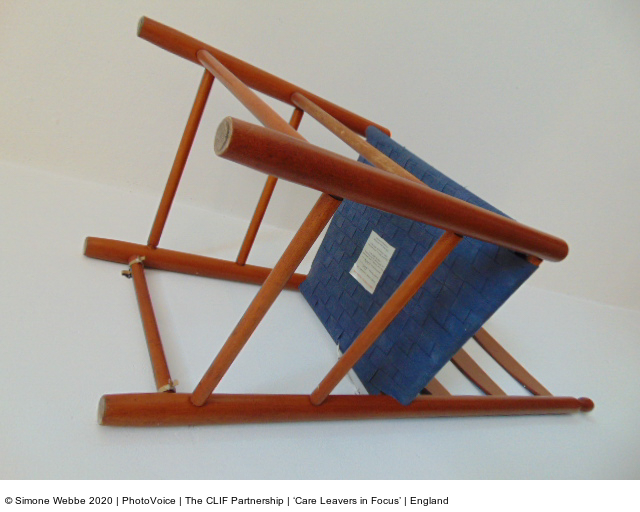
A current project is Care leavers in Focus (CLiF)

a 3-year project exploring the perspectives of those leaving care. Through workshops using photography and storytelling as a tool for self-expression, care leavers can reflect on what they need from support services and other providers. These insights are then shared with local authorities and organisations to improve their responses. Participants make captioned images with advocacy stories and images to share at exhibitions:

A message for other care experienced people: Your seat at the table might be upside down but you’re capable of turning it around. A message for policy makers: Sit us down, and listen. Don’t hinder opportunities for care experienced people.
Moving into my flat wasn’t easy but it wasn’t hard. It was a rocky road knowing you’re going to start a whole new journey all over again. Especially knowing myself in the big world we live in. Moving was the light at the end of the tunnel.
Friendships: Friends can have a really positive impact when you’re having a hard time but It’slonger in care and live independently, it can be really lonely. I feel I could be better supported to meet new people and form friendships so that I have that support network.

(PhotoVoice, 2008)

The visuals here are thought provoking and have punctum which causes you to stop and look for meaning, even without the text.

Looking through the archive projects I found that generally the overseas projects show less interesting photography than the UK projects; by interesting I mean unusual visual perspective or a more conceptual viewpoint.

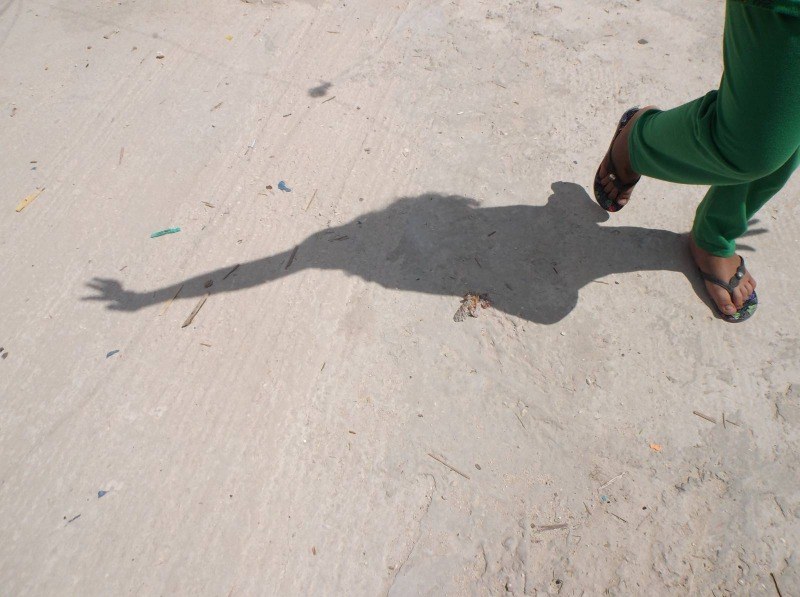
And We Shall Find Tales in the Shadows” project in Jordan in 2014.

An exception for me is this project. Here Photo voice worked with a group of 14–20-year-old Syrian refugees and their host community in Jordan.

(PhotoVoice, 2008)

Their work shares insights into the way I which their childhood has been snatched from them and they believed that “politicians would help change things & that if people listened to what they had to say, that the world might change and they may be able to one day, return home.”

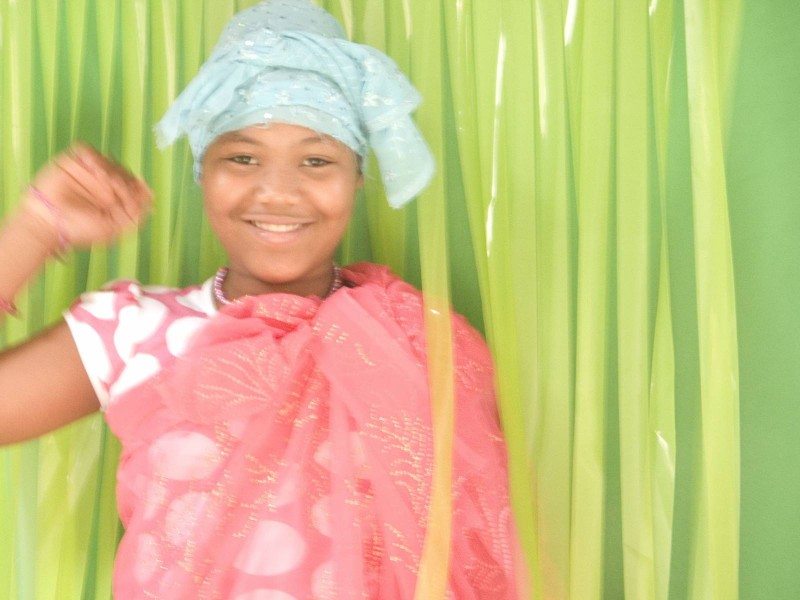
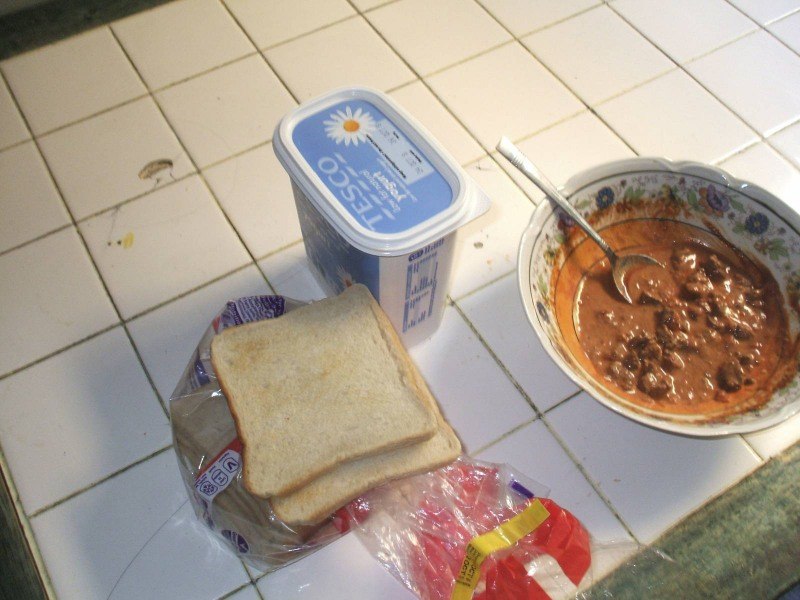
The New Londoners project (2006-8)

was a project with young refugees aged of 16 to 23, from over 10 countries as they settled and began to integrate into the UK. The aim was to help young people see themselves not as ‘New Londoners’ rather than refugees. This work shows more of a variety of quality and in the work, which is probably representational of the photographic work form across the projects:

(PhotoVoice, 2008)

This work is more of a mixture of quality, some being blurry and some well shot as well as some interesting representation of aspects they want to share.

Overall, the documentary value of the Photovoice projects is high, it presents a reality and a viewpoint. It gives people the tools and the skills to express themselves through photography and carries strong messages. The visual messages are strong and create impact whether they present as unskilled “snaps” or crafted images.

References:

Open College of the Arts (2014) Photography 2: Documentary-Fact and Fiction (Course Manual). Barnsley: Open College of the Arts.

PhotoVoice (2008) New Londoners. At: https://photovoice.org/new-londoners/ (Accessed 05/04/2021).

Next Post: https://nkssite5.photo.blog/category/coursework/part-five-new-forums-for-documentary/project-the-documentary-project/exercise-5-5-kingsmead-eyes/

PART FIVE: NEW FORUMS FOR DOCUMENTARY

POST DOCUMENTARY ART

5.4 Exercise

Read the article ‘Images that Demand Consummation: Postdocumentary Photography, Art and Ethics’ by Ine Gevers (Documentary Now! 2005). Core resources: IneGevers.pdf

Summarise in your learning log the key points made by the author. (Open College of the Arts, 2014:105)

Ine Gevers is a Dutch art curator, activist and writer. Here she suggests that documentary should engage with the world not just record it. Where photographer, viewer and subject come together in a “consummation of the image”.

Here is a summary of her main points:

  • Since the 70’s there has been a blurring of the boundaries between photography as document and as art- she calls this post-documentary photography.
  • She is particularly interested in how image makers are stretching the boundaries of perception, expanding aesthetics.
  • Aesthetics and ethics have been considered opposites post-documentary artists are trying to restore their former connection.
  • She probes the concept of aesthetics, suggesting that it broadens and makes you notice what you’ve not before. However, that old style aesthetics can constrict viewing and viewpoints.
  • Photography can open up our world by sharing experiences, but it can close down our view by turning subjects into objects and “murdering their individuality”. Sontag called this numbing our conscience.
  • Photography can be democratising as it creates a reality that is more real than real, even though there are always efforts to expose the limits of representation.
  • Martha Rosler is cited as one who though not a documentary photographer she regularly uses documentary photography in her work subverting objectivity in photography.
  • Allan Sekula is also cited, who has appropriated documentary photography, using it aesthetically to show its ambiguity.
  • She explains how the horrors of subjects such as the twin towers attacks made us look beyond instant immediately consumed images that cause one- dimensional reactions. Examples given are black pictures, with sound (Moore’s documentary), Alfredo Jaar’s images of the Rwanda atrocities that were all, but one contained in closed boxes for his installation (Lament of the images, 2002).
  • Alain Badiou’s philosophy is shared- where artists remain faithful to personal truths, even in opposition- exemplifying artists and ethics being intertwined. He argues for interventionist ethics that are situation specific as the truth is an event, not an opinion.
  • Photographs carry no weight in themselves but by acquiring meaning they can unleash a truth process, which can be followed by a process of completion encompassing artist, image and viewer. The viewer then as co author gives weight to the image.
  • She suggests this may align with Barthes punctum, the extra that may seem to be added to an image.
  • Gevers suggests that this truth moment, makes the viewer come alive, and teach viewers to perceive differently. This sets in motion something other than the observable, enabling “one that consummates to become someone”. For this the viewer must be able and willing to consummate the image. Then when the viewer is involved in the image, they can become autonomous, and ethics and aesthetics can be a partnership.

My learning:

To consider that it may be the way that images are consumed, viewed and interpreted that gives documentary photography its autonomy.

Reference:

lne Gevers curator \ writer \ activist (2005). ‘Postdocumentary Photography, Art and Ethics’ by Ine Gevers (Documentary Now! 2005). At: https://www.oca-student.com/sites/default/files/IneGevers.pdf (Accessed 04/04/2021).

Open College of the Arts (2014) Photography 2: Documentary-Fact and Fiction (Course Manual). Barnsley: Open College of the Arts.

Next Post: https://nkssite5.photo.blog/category/research/a5-research/research-point-photovoice/

PART FIVE: NEW FORUMS FOR DOCUMENTARY

POST DOCUMENTARY ART

Exercise 5.3

Listen to Jim Goldberg talking about Open See and his exhibition at the Photographers’ Gallery: http://vimeo.com/22120588

Visit Goldberg’s website http://www.opensee.org and reflect on how or if it works as a documentary project within the gallery space.  (Open College of the Arts, 2014:105)

The interview

This short clip shows preparation for an exhibition. He was part of a magnum team sent to photograph different aspects of Greece for the 2004 Olympics, his focus was immigrants. He talked of the immigrants he came across from various countries, some trafficked, some economic migrants, and some prostitutes. He shared his images and annotations of their stories, but with no idea given about the number of images and how they fitted into the final exhibition.

Goldberg’s website

This functions as a gallery space for images and text of displaced, economic migrants, illegal migrants, and refugees. The front page presents images in a compact montage, as if on gallery walls, guiding the viewer across them.

The side bar tabs:

Wilhelm-Hack-Museum: annotated images of immigrants and their stories.

Tate: A video how to fold a single sheet of images into a book, which is useful; probably an interactive activity at the Tate exhibition.

Deutsche Borse: Another video with a story about a refugee boat, and how to make a paper boat.

Objects: such as torture files to support obtaining amnesty, wallets of the dead, fake adverts and interviews.

Resources: with website links that informs about the issues of many of his subjects.

Reflections:

It is interesting but again lacks information for instance a summary and detailed context. The images are small, and I expected to be able to click on them and they would open in their own windows so I could have closer look, but this was not possible.

Overall, though fragmentated there is a lot of information presented: documents of people’s journeys. The work is collaborative, he uses a variety of media and has unusual narrative techniques. Though disjointed the work together tells a themed story and is a good example of a balance between expression and information in a gallery and could be shared and articulated in an art gallery space.

I can compare this with my viewing of his work see previously, “Raised by wolves” (1989) which documented the lives of runaway teenagers living on the streets of San Francisco and Los Angeles from 1987 and 1993. In this he used photographs, video stills, found documents, and handwritten texts by the subjects themselves. Here he also tells the story in different ways: a traveling art gallery exhibit, a book, a website, and an experience, though most of the book is photographic as even the handwritten notes are photographed using these texts and his imagery to share their experiences.

What struck me then was the huge variety of presentation that he has used in this project and the same is apparent in his website. The mixed media he uses adds an earthiness and reality to the narrative in the photojournalistic style.

 References:

A Completely True Work of Fiction: Jim Goldberg’s Raised By Wolves (2018) At: https://www.magnumphotos.com/arts-culture/art/jim-goldberg-raised-by-wolves/ (Accessed 20/2/2021).

AMERICAN SUBURB X. (2018). JIM GOLDBERG: [online] Available at: http://www.americansuburbx.com/2009/11/theory-raised-by-wolves-as-non.html (Accessed 20/2/2021).

Open College of the Arts (2014) Photography 2: Documentary-Fact and Fiction (Course Manual). Barnsley: Open College of the Arts.

OPEN SEE – JIM GOLDBERG (2021) At: http://www.opensee.org/ (Accessed 20/02/2021).

The Photographers’ Gallery (2011) ‘Interview with Jim Goldberg’ At: https://vimeo.com/22120588 (Accessed 20/02/2021).

Next Post: https://nkssite5.photo.blog/category/coursework/part-five-new-forums-for-documentary/post-documentary-art/exercise-5-4/

PART FIVE: NEW FORUMS FOR DOCUMENTARY

PROJECT DOCUMENTARY IN THE GALLERY SPACE

Exercise 5.2

Read the article ‘The Judgement Seat of Photography’ (in Bolton, 1992, pp.15–48)

Core resources: TheJudgementSeat.pdf

Add to your learning log the key research materials referenced in the text. (Open College of the Arts, 2014:103))

The essay describes The Museum of Modern Art’s (MOMA) evolving relationship with the photograph as art. Curators/directors of MOMA have strongly influenced attitudes to photography generally and the MOMA in particular. Phillips focuses on three influential people in the history of the MOMA and its photography department.

In Walter Benjamin’s essay “The work of Art in the Age of Mechanical Reproduction” (1936) he proposes the terms “cult value” (arts origins in magical or religious rituals) and “exhibition value” (the changing function of a work of art as it becomes portable and can be duplicated). This then leads to greater availability and a lessening of a work’s aura.

Theodor Adorno was sceptical about Benjamin’s arguments but in 1932 the MOMA showed photographs for the first time in “Murals by American painters and Photographers”.

It was Beaumont Newhall’s (the first curator of the museum) exhibition Photography 1839-1937 that was the first major acceptance of photography as museum art; he focused on the techniques that evolved rather than aesthetics. Barr’s “Cubisim and Abstract Art” (1936), and “Fantastic Art, Dada, and Surrealism” (1936) as well as “Bauhaus 1919-1928” (1938) also showed MOMA’s modernised thinking. Newhall’s catalogue essay articulates his judgement that photographs when taken out of the realms of documentary and journalism, should focus on the qualities of prints and techniques. Newhall suggested that photography should be looked at in terms of the Optical (details) and chemical laws (tonal fidelity). Newhall’s first exhibition as curator was “60 photographs: A survey of Camera Aesthetics’”, which concentrated on authenticity, and personal expression.

Moholy Nagy shared the same photographic vision as Newhall as did Ansel Adams. Later Newhall became the director of photography and Edward Steichen the head of the department; apparently Newhall failed to elevate photography to the status of fine art. Steichen’s approach was different, less the photographer as an autonomous artist and more curators as “orchestrators of meaning” with exhibitions “The impact of War” (1951), “The road to victory”, “The family of man” and “The bitter years” (1962). Steichen’s installations were more about design, and popularising photography, than the photographer’s eye or the individuality of images. I first looked closely at Steichen’s work at the Tate Modern exhibition The radical eye. Modernist photography from the Sir Elton John collection (November 2016). I was fascinated by his portrait of Gloria Swanson which looks almost 3 dimensional. Here Steichen shows how he evolved from photographing in soft focus to a modernist crisp focus.  As a curator he was responsible for showing that photography could be channelled into mass media, but weakened the “cult value” of photography as fine art.

John Szarkowski succeeded Steichen in 1962 as director of MOMA’s department of photography and returned to a more formal museum space and revives Benjamin’s “cult value” of photographic work. Szarkowski reconstructed a modernistic aesthetic for photography, photography in its own aesthetic realm; he presented his ideas on photography’s formal properties in his book The Photographers Eye (1964), and the individual qualities of photographers. I read his book a while ago when first studying how to read photographs.  Szarkowski set out his intention for his book as “an investigation of what photographs look like, and of why they look that way” (Szarkowski, 2009).

I found it interesting how he makes clear that photography invaded the territory of art, could not work to old standards and had to find its own ways of making its meaning clear. Photography was invented by scientists and painters but the professional photographers it produced were varied in their skills and had increased vastly by the early twentieth century. There was a deluge of pictures, describing new things and in new ways, most especially the ordinary. Szarkowski listed five issues he believed are inherent in photography and organised his selected images in these groups: the thing, the detail, the frame, the time, the vantage point. This gave me another way to look at images and I asked myself them whether any were more influential on a photographer than another. A few years on I realise that these will of course vary according to purpose, mood and inclination. Szarkowski prepared the way for a photographers “aestheticized authorial voice” and re-elevated photography as art in its own right.

Peter Glassi’s (curator at the MOMA) 1981 exhibition “Before Photography” supported Szarkowski’s idea that photography is its own entity.

My learning:

I have a greater awareness now of the impact of directors and curators of museums on the position of photography in art; I was surprised how much influence the MOMA had on isolating and culturally differentiating photography as an art form. It was also good to set in context some previous learning and reading. Today there are many more factors beyond museums and books, such as social media, the internet, that will determine the photograph’s place in the art world.

References:

Benjamin, W. (1935) Art in the age of mechanical reproduction

Newhall B. (1949) A history of photography from 1939 to the present day. The museum of modern art, distributed by Simon and Shuster, New York.

Open College of the Arts (2014) Photography 2: Documentary-Fact and Fiction (Course Manual). Barnsley: Open College of the Arts.

Phillips, C. (1982) The Judgement Seat of Photography. October, Vol22 9Autumn, 1932), pp27-63. At: http://www.jstor.org/stable/778362.The MIT Press. (Accessed 20/02/2021).

Szarkowski, J. (2009). The photographer’s eye. The Museum of Modern art. New York.

Next Post: https://nkssite5.photo.blog/category/coursework/part-five-new-forums-for-documentary/project-documentary-in-the-gallery-space/exercise-5-3-jim-goldberg/

PART FIVE: NEW FORUMS FOR DOCUMENTARY

PROJECT DOCUMENTARY IN THE GALLERY SPACE

Exercise 5.1

Look at the Cruel + Tender brochure for yourself. Core resources: Cruel &Tender.pdf Listen to interviews with two of the featured photographers, Rineke Dijkstra and Fazal Sheikh:

http://www.tate.org.uk/context-comment/video/rineke-dijkstra-cruel-and-tender

http://www.tate.org.uk/context-comment/video/fazal-sheikh-cruel-and-tender

Add relevant notes to your learning log. (Open College of the Arts, 2014:101)

Cruel and Tender

The brochure is a teacher’s guide to the exhibition Cruel+ tender: The real in the 20th century photograph (5th Jun –7th September 2003). The exhibition explores ways of representing “the real” through documentary photography including, portraiture, the notion of truth, the role of the viewer, using a series of images. There were 4 themes in the exhibition:

Occupied spaces– the way that photographers have selected specific people to photograph, and how and where they are shown affects our perception of the images, including the work of August Sandar, Walker Evans, and Paul Graham.

On the Road – Urban and rural space and travelling photographers, Walker Evans records of changing landscapes, Robert Frank’s snapshot style, and Stephen Shore’s attention to detail.

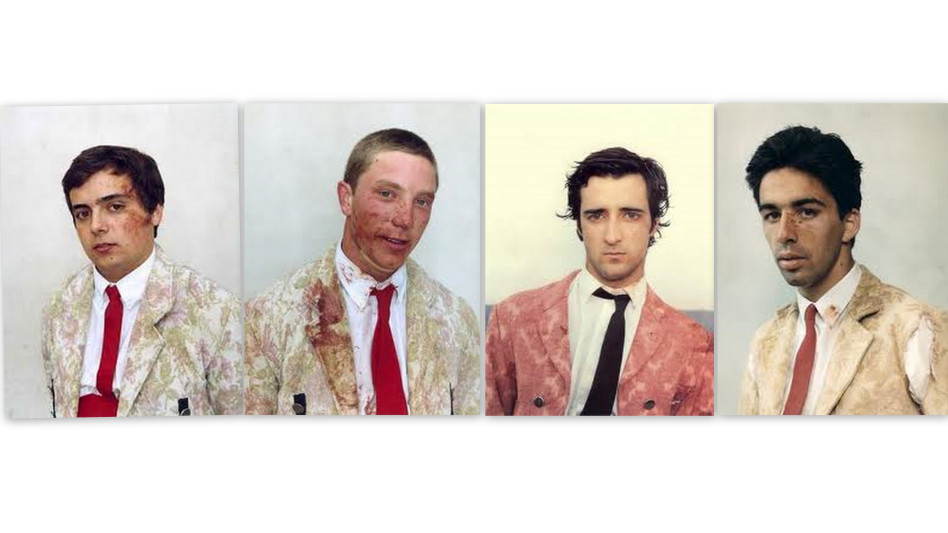
Exploring vulnerability – the cruelness of the intense scrutiny of the camera and the ethics, politics and morality of works. Rineke Dijkstra Matadors and the Mother’s series, Diane Arbus’s photographs revealing private lives and Boris Mikhailov’s series “Case History”.

Industrialisation and consumerism– Photographers who mapped the changing industrial landscape and decline such as the Bechers, Andreas Gursky, and Louis Baltz.

Life stories– Dignified portraits like Fazal Sheikhs.

It would have been good to have seen the exhibition, but I was able to discover more by reading the Tate post on the exhibition (Tate,2003). The photographers in the exhibition were chosen as they have a sense of “tender cruelty”, with a swaying between estrangement and engagement in their work which results in realistic observational photography.

References:

Cruel and Tender tool kit final (2003) At: https://www.oca-student.com/sites/default/files/CruelTender.pdf (accessed 16.2.21)

Open College of the Arts (2014) Photography 2: Documentary-Fact and Fiction (Course Manual). Barnsley: Open College of the Arts.

Tate (2003) Cruel + Tender: The real in the twentieth century photograph – Exhibition at Tate Modern. At: https://www.tate.org.uk/whats-on/tate-modern/exhibition/cruel-tender (Accessed 16/02/2021).

The links to the interviews with Rineke Dijkstra and Fazal Sheikh no longer work so I have instead watched interviews with them about their work elsewhere:

Fazal Sheikh: His interest in photographing refugee communities began in Kenya, South Africa in the late 80s; in his work “Ether”, he developed mode of expression he was comfortable with no preconceptions, stepping back, and remaining receptive about what the people and place has to offer. His was able to do this as he spent weeks living in the camps amongst the refugees. Making work that is politically. socially and otherwise helpful to the communities that create the work, a platform for them to speak. through and further a conversation. To encourage viewers to be open and to think more deeply about other communities. He treats subjects as individuals, giving text alongside images that offers their names and political circumstances.

Rineke Dijkstra: is known as portrait photographer who primarily uses a large format camera, so you see a lot of detail, though she minimises visual contextual details, this isolation make you focus on only the subject. She odes though provide a lot of contextual detail in text accompanying her portraits.

I have come across her work several times previously, but I’ve now learnt that she has also taken self- portraits; these were photographed immediately she had finished swimming and was exhausted, so that she would capture her raw emotional state. A useful reminder to use yourself to experiment with ideas. From this Dijkstra developed her work with photographs of Portuguese bull fighters straight after they have come out of the “ring”. She “finds rawness and vulnerability in people who are physically exhausted, such as mothers who have given birth, or matadors who have just left the bullfighting ring” revealing their fragility as human beings (Letson, 2016); she says it’s difficult to capture natural unguarded portraits normally. Her work emphasises the individual and her empathy for them.

(Letson, 2016)

Both these photographers show respect for their subjects by acknowledging them as individuals and providing as context for viewers their stories.

References:

Letson, G. (2016) RINEKE DIJKSTRA, BULLFIGHTERS 1996. At: https://theincubator.live/2016/11/27/rineke-dijkstra-bullfighters-1996/ (Accessed 13/02/2021).

Open College of the Arts (2014) Photography 2: Documentary-Fact and Fiction (Course Manual). Barnsley: Open College of the Arts.

Photographer Fazal Sheikh Discusses Common Ground (2017) At: https://www.youtube.com/watch?v=vHUF0a7H9Wk (Accessed 13/02/2021).

Rineke Dijkstra: A Retrospective (2016) At: https://www.youtube.com/watch?v=uSAmkX26cdw (Accessed 13/02/2021).

Next Post: https://nkssite5.photo.blog/category/coursework/part-five-new-forums-for-documentary/project-documentary-in-the-gallery-space/exercise-5-2-the-judgement-seat-of-photography/

RESEARCH AND REFLECTION: LEARNING PART 4

THIS IS A SUMMARY OF THE MAIN LEARNING THAT I HAVE TAKEN AWAY FROM PART 4

PROJECT GAZE AND CONTROL

Reading On Foucault: Disciplinary Power and Photography by David Green (Exercise 4.1)

  • I had not thought of photography as a mechanisms of surveillance to observe/and classify people in order to normalise disciplinary power.
  • As Green suggests if this is so, we should develop alternative ways of working with photography.

The Photograph as an Intersection of Gazes ((Exercise 4.2)  

The seven types of gazes identified gives me something to reflect on I my work going forward:

  1. The photographer’s gaze: the camera’s eye which structures the image.
  2. The magazine gaze: chosen by editing for emphasis.  
  3. The reader’s gaze: a reader’s interpretation, influenced by their experience & imagination.
  4. The non-western subject gaze: confrontational/distanced look/ absent gaze.
  5. Explicit western looking: which is unusual as westerners usually look off camera.
  6. Returned or refracted gaze: usually by mirrors or cameras
  7. Academic gaze: a subtype of the reader’s gaze.

It’s an interesting concept that some photographers are experimenting inviting viewers to interpret them rather than accepting the photographers gaze as their own. I will be more aware going forward of the interplay and relationships of the various gazes and their potential effect on the viewer, and the ambiguity in the work in particular.

PROJECT DOCUMENTS OF CONFLICT AND SUFFERING

Reading  the articles ‘Walk the Line’ (Houghton, 2008) and ‘Imaging War’ (Kaplan, 2008( (Exercise 4.4) raises issues such as:

  • How far should we go with publishing images of war and disasters?
  • What images are suitable?
  • Are there any lines to be crossed?
  • Are the answers defined by ethic, commerce, respect for individuals or their families, politics, relationships between media companies and governments, or are they simply personal?

It is the photographer who must be mindful of the way the images may by used. I believe whether an image should be used or not I think, comes down to if using it adds impact to the story.

THE ETHICS OF AESTHETICS

‘Imaging Famine’ (Exercise 4.5) This research project in 2005 highlights issues that persisted in images of famine:

  • Stereotypical images of victims
  • Could positive images of people in need be presented?
  • Can photographers provide images with context, understanding and explanation?
  • Does immediacy enabled by technology cause simplified compositions?
  • Can just one picture share a good understanding of issues?
  • Are photographers simply image makers or do they have wider responsibilities?

To print or not to print (Exercise 4.7)  

When choosing what to include in an image I would:

  • Think about what I consider decent, is there consent?
  • Consider privacy, is it a public occasion seems to be the crux of this
  • Ask would the presence of the camera invite violence?

This was the first time that I’ve read The National Press Photographers Association, code of ethics (2017), in particular it  states that our primary role is to report visually on the significant event and varied viewpoints in our common world….the faithful and comprehensive depiction of the  subject at hand”. When photographing as documentary I must remember this.

REFLECTING ON THE WAR PHOTOGRAPHS

Has made me consider topics such as journalist embedding, staging for cameras, rapid publishing, post camera manipulation and their effects on the quality of media images.

PROJECT POST-COLONIAL ETHNOGRAPHY

It was good for me to reflect on colonial and post-colonial world especially certain “traps” that have been identified:

  • Nostalgia – Romanticism of primitive beauty
  • Imbalances of power between photographer and subjects
  • Disciplinary cataloguing and comparing
  • Primitivism
  • Decontextualising
  • Infantising of non-industrial people

I was pleased to find photographer’s work such as David Ju/’hoansi Bushmen (2021), George Rodgers (En Afrique, 2016) and Eduardo Masferré (1909 – 1995) who had avoided most of these traps – I will now be alert to them when viewing such work again.

Next Post: https://nkssite5.photo.blog/category/learning-log-research-and-reflection/zoom-oca-meetings/oca-student-led/7-1-21-4-2-21/

PART 4: ETHICS AND LOOKING AT THE OTHER

PROJECT POST-COLONIAL ETHNOGRAPHY

RESEARCH POINT

Do your own research into the bodies of work discussed in this project. Can you find any examples of work carried out amongst indigenous peoples that, in your view, honestly document the lives of their subjects without falling into some of the traps that we’ve been discussing here? If so, how has the photographer achieved this? (Open College of the Arts, 2014:64)

The “traps” that have been identified in Post colonial ethnographic photography:

  • Nostalgia – Romanticism of primitive beauty
  • Imbalances of power between photographer and subjects
  • Disciplinary cataloguing and comparing
  • Primitivism
  • Decontextualising
  • Infantising of non-industrial people

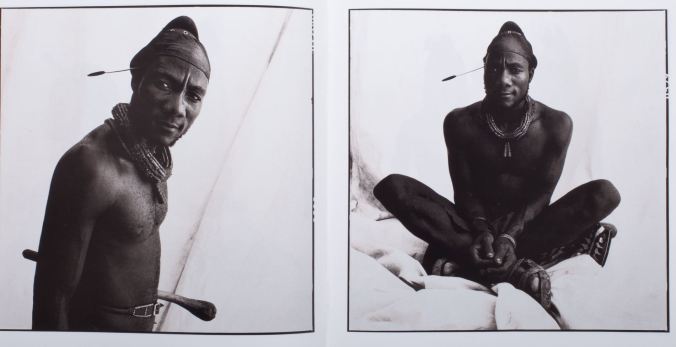
Peter Lavery’s work in “of humankind” does decontextualise his subjects; this seems to enhance the stereotyping, the power imbalance, cataloguing and comparing traps suggested above. Indeed even in the foreword of the book ‘Of Humankind’ by Robin Muir (2000) says that Lavery’s portraits remind us that photographers deal in things which are continually vanishing and which no contrivance on earth can bring back”, underlining the nostalgic element of his photography.

(Of Humankind, 2000)

Conversely David Bruce’s work though sometimes posed against a backdrop is aesthetic, shot with dignity, and his subjects look empowered and generally look to be enjoying themselves.

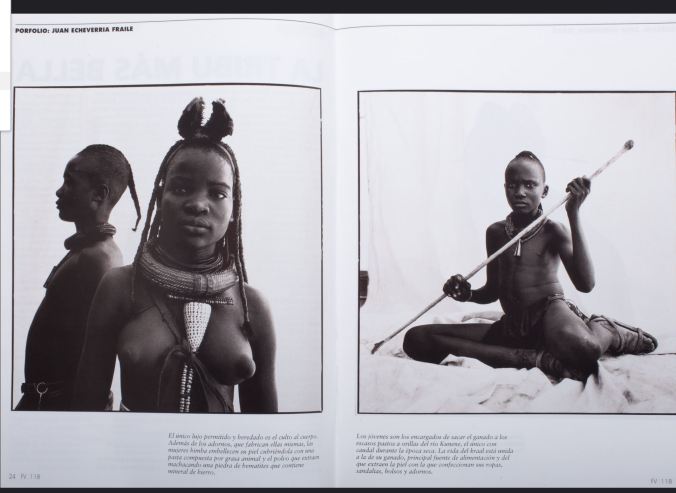
Juan Echeverrria’s images of the OvaHimba tribe in Namibia could be interpreted as voyeuristic and decontextualised; whilst they are taken out of context they do have a realism about them and the subjects share some character and assertiveness.

Namibia_Paisajes_desde_el_tren (2021)

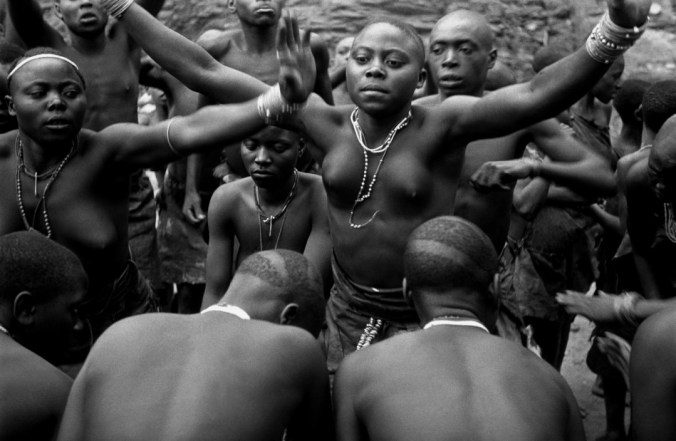
When searching for examples of work which don’t fall into the “traps” I returned to the work of George Rodger who took the image that struck me on the front of the Tribal Portraits catalogue. I was pleasantly surprised that although his work En Afrique was taken between 1947 and 1979 it avoids the pitfalls mentioned above; the nudity is in context, subjects are photographed in context and are certainly not romantised; indeed he gives detailed context with each image.

(En Afrique by George Rodger, 2016)

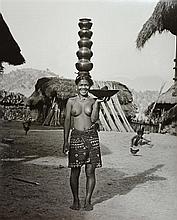
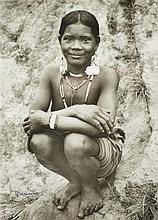
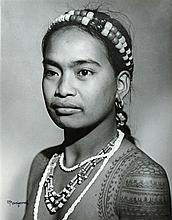
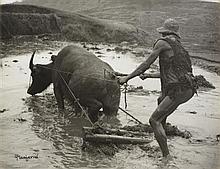
I also thought back to a photographer whose work I came across when in the Philippines a couple of years ago, Eduardo Masferré (1909 – 1995) a Filipino-Catalan who made documentary reports about the lifestyle of native people in the region of the Cordillera of the Philippines in the mid 1950s. I was very struck with his work at the time, which is contained in his book people of the Philippine Cordillera (1988) and was interested how I would view it now I have studied these aspects of tribal photography.

Eduardo Masferre Paintings & Artwork for Sale (2021)

I was pleased to see that although there is a fascination with subjects smoking pipes, most of his images are shot with context in a documentary style which gives information about their way of life. Where there is partial nudity it appears as a natural part of their dress and the emphasis of the photograph is clearly not on this but another aspect, such as the girl with the pots on her head and the smoking woman above. Though there is the occasional image which seems to have been shot simply for the beauty of the subject female, male, old or young, there is no suggestion of imbalance of power between him and his subjects or infantizing of them. For work which was shot between 1947 and 1959. I would say the work is sensitive to the people and a good documentary record and agree with the review from the book cover that the people are shown with “strong faces that meet one’s gaze with great integrity – Masferre preserved all of these in timeless images that transcend ethnography and imbue documentary fact with deeper meaning.” (Masferre and Devilla, 1988).

References:

Eduardo Masferre Paintings & Artwork for Sale (s.d.) At: https://www.invaluable.com/catalog/searchLots.cfm?scp=m&ad=DESC&alf=1&issc=1&artistref=3tvi2dj9ip&shw=50&ord=2&row=51 (Accessed 14/01/2021).

En Afrique by George Rodger (2016) At: https://www.magnumphotos.com/arts-culture/george-rodger-en-afrique/ (Accessed 13/01/2021).

Ju/’hoansi Bushmen (s.d.) At: https://davidbrucephotography.co.za/juhoansi-bushmen/ (Accessed 12/01/2021).

Masferré, E. and De Villa, J. G. (1988) People of the Philippine Cordillera: Photographs, 1934-1956. (s.l.): Devcon I.P. Incorporated.

Namibia_Paisajes_desde_el_tren (s.d.) At: https://www.flickr.com/photos/juan_echeverria_reportajes/sets/72157629307741656/show/ (Accessed 13/01/2021).

Namibia_Paisajes_desde_el_tren (s.d.) At: https://www.flickr.com/photos/juan_echeverria_reportajes/sets/72157629307741656/show/ (Accessed 13/01/2021).

Of Humankind (2000.) At: https://www.peterlavery.com/of-humankind (Accessed 13/01/2021).

Open College of the Arts (2014) Photography 2: Documentary-Fact and Fiction (Course Manual). Barnsley: Open College of the Arts.

Next Post: https://nkssite5.photo.blog/category/learning-log-research-and-reflection/reflection/a4-reflection/my-learning-part-4/