It is personal project. It began a year ago, I was in lockdown in England and not allowed to travel to my then “second home” in Wales. During this time, I observed many discussions on social media about visitors to our “second” town, as well as Welsh national media highlighting lockdown infringements. The coverage was mostly one-sided and uncomfortable to read. As the year progressed and I travelled to my second home, I was able to gauge the real breadth of feeling from local residents and visitors; though not “local” I am well established in the community here and talk to people on both sides of the divide.
The second part of this year I have been resident here in what is now my only home. I continued researching, capturing media articles and comments, knowing I would probably use the material for assignment 5. I have added to this note on conversations had, overheard and related. Now I need to develop a visual photographic response to this personal, and socio-political study. I would like to explore layers of truth, something that has interested me increasingly as I have progressed through the documentary course. Though my research has been during the coronavirus year 2020-2021, I don’t intend the work to focus on this; the research highlights local/societal/nationalist issues that exist normally, such as the economy, resources, housing, tourism, and hospitality businesses.
Working title: Tensions arising from visitors.
Theme: Different truths.
Methodology: Photograph local contentious subjects such as, caravan parks, holiday houses, shops, roads, footpaths. Present images with short text/captions from research.
Audience: Myself. I will create it for myself, depending on the outcome I might release to the community later as a healing tool; currently it would inflame the situation locally.
Further research: Photographers, and bodies of work to support my presentation approach, through websites, books, talks, and online interviews. I may also look at my archive of images, to compliment those that I shoot over the next month.
Approach: Probably a slideshow sharing images with overlaying text contradictory to each photograph, and possibly a third layer (perhaps audio) communicating another perspective on issues.
I have not found it as easy to evaluate the critical review against the assessment criteria as it is photographic assignments, however:
Context and demonstration of technical and visual skills
I have researched using secondary source material: facts, images, ideas, quotations, through reading, listening and participation in talks and lectures.
I have analysed the material and used it critically to construct and support my opinions about my subject.
In the essay I have brought in and engaged in some of the theoretical and particularly ethical issues I encountered during the course such as power, respect, context, intent, social and a photographer’s responsibilities.
My choice of subject was driven by learning during the coursework and interest that grew from several photographic talks form a year ago; particularly the Lumix Festival talks in June 2020 which focused on reconsidering perspectives in documentary photography.
The essay also grew from being inspired by the working ethics of particular photographers such as Mark Neville and Robert knoth whom I heard speak virtually; as well as commentators on documentary photography such as Fred Ritchen Michelle Borge and Stephen Mayes.
Demonstration of creativity
My personal thoughts on photographic practice stimulated by the course guided my choice of topic.
I chose my critical review subject so that I could delve deeper into particular types of working in documentary photography that I encountered during the course.
Following my research and analysis I have formed and given my own opinions on how a photographer can benefit the communities that they photograph.
I redrafted at the end of my writing many times to try to give my personal voice as well as using the work and practice of others for examples.
Quality of outcome
I have shared ideas of photographic practice to demonstrate how photography can helped communities photographed.
To do this I have related to wider social political and economic issues.
I have structured the essay using subtitles and signposting to guide the reader.
I have written the essay in an academic style and referenced all material used.
I have included photographic images as suggested in the brief although I don’t feel that they are essential to the critical review.
I hope that I have communicated my ideas and evidence clearly.
Write a 2,000-word critical essay on one of the many debates that you’ve explored so far in this course. You may use any of the research materials you’ve collated so far or do further research. (Open College of the Arts, 2014:95)
For assignment 4 I decided to explore how documentary photography can be effectively disseminated for the benefit of communities that it is photographed in. This was initially sparked when I first encountered the work of Mark Neville in: The Port Glasgow project, Deeds not words, Parade, and battle against stigma, when I was at a virtual artist’s talk at the Photographers Gallery in April 2020. Since then I have taken a particular interest in other photographers and photography projects that work with communities that try to ensure that the work benefits the people photographed.
When researching for my assignment, amongst others I identified the photographers below who I have researched in more detail to analyse where their work and practices would fit into my critical review.
Nick Danziger(b1958) is a British photographer and film maker.
He has photographed disadvantaged across the world and has been recognised as “raising public understanding of contemporary social, political and environmental issues through documentary films and photography”(Danziger, 2021). Whilst doing this he often steps away from impartial reporting in order to “give a voice to those who rarely feature in the media” (Widewalls, 2021).
In 2001 he made a photographic study of people living in extreme poverty in eight countries to share the impact of armed conflict on women; this was to see what progress was being made towards meeting the eight ‘Millennium Development Goals’ set by the United Nations to eradicate poverty, end hunger, save lives and improve education by 2015. This work “Eleven Women Facing War” provided a powerful insight into the world of women caught up in vicious conflict in Bosnia, Kosovo, Israel, Gaza, Hebron (West Bank), Sierra Leone, Colombia and Afghanistan. Danziger said
“We often talk about the victims of war,…I hope these images and stories are a tribute to these women’s indomitable spirit, endurance and bravery” (Imperial War Museum, 2016).
The International Red Cross (and promoter of international humanitarian law) called the images “incredibly powerful and a true testament to the horrors of war and the power of the human spirit” (Imperial War Museum, 2016). His images are illuminating:
However the power comes from their testimonies that he provides alongside his images. It is not clear from his images how other than by raising awareness, he has created impact; but there is evidence of impact. 10 years later he followed up the subjects to reveal their stories on short films and stories. One, Mariatu, whose hands were amputated by guerrilla soldiers in Sierra Leone, is now safe and well and living in Canada and has fulfilled her dream to be a Mother. Mahu Bibi, a 10 year old from Afghanistan, looking after her brothers against all odds, unfortunately was not found. He originally shot in black and white and shot a decade later in colour to show the passage of time, a useful idea.
In 2018 Danziger photographed substance-users and treatment centres around the world, focusing on issues surrounding substances that are often not illegal. His work was exhibited at the commission on Narcotic Drugs event in Vienna. He hopes that policy makers will be affected by the images “because of the people within the pictures…I think it’s really important to understand how …it shows a variety of individuals that have been users, or currently are dependent and receiving treatment” (anyoneschild, 2018), as a greater understanding could bring possibilities of rehabilitation through treatment centres where those are available – He hopes his pictures and the exhibition may lead to policy changes.
I have reported on Mendel before when I attended an AOP breakfast Club meeting in June 2020 (South, 2020). My subsequent research has shown Mendel to use visual activist alternative ways of storytelling. When discussing his work he said he still believes that photography “has the ability to make positive change in the world”. His photographic projects have challenged apartheid in South Africa, perspectives on AIDS/HIV globally and latterly climate change (Tank Magazine, 2012).
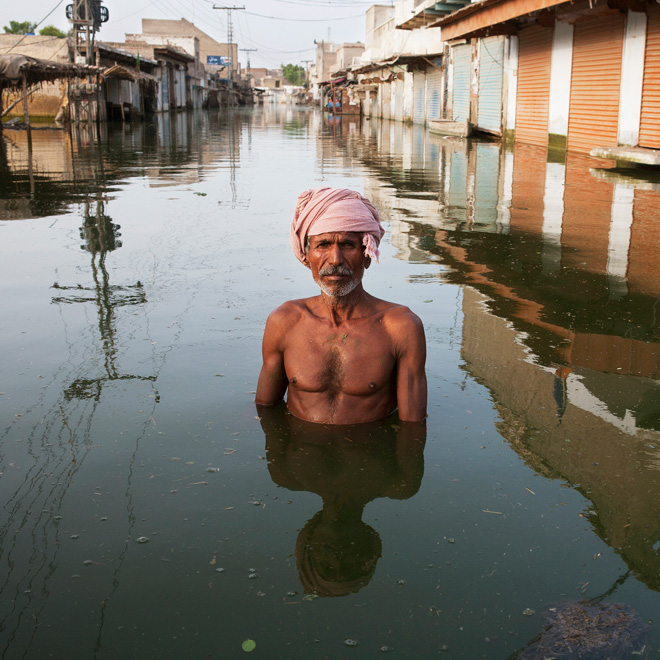
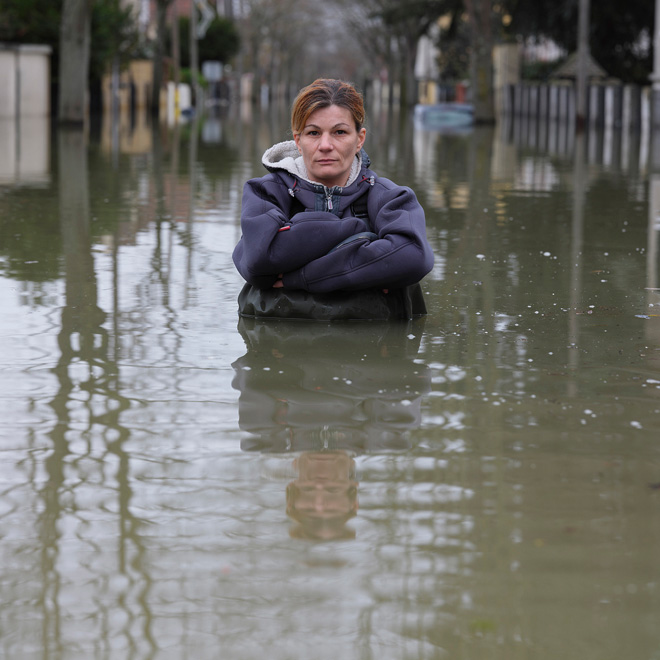
His work Drowning World begun in 2007 which he describes as an art and advocacy project about flooding, his personal response to the climate crisis (Mendel, 2021). This work has been used in climate change activism in collaboration with Greenpeace and Extinction Rebellion, exhibited in galleries and published in magazines. Interestingly Mendel combines conceptual and metaphorical photography with activism. Initially he shot images of two floods, one in the UK and one in India, but has since captured flood zones worldwide, poor and affluent. His work includes “submerged portraits”, symmetrical liquid reflections, water damaged photographs, video footage, as well as photographs of his images in actual demonstrations.
(Mendel, 2021)
In his video installation The Water Chapters explores individual, family and community responses to flooding, which also gives environmental context.
In the 1990s Mendel used an award to help him fund his work “Broken Landscape” documenting HIV/AIDS. He says that just as his ways of story telling broadened so he shifted from photojournalist to visual activist; in particular including individual’s stories in their own words with their own images.
A chapter of this work “Framing aids” was made into 13 posters which were used by organisations to raise awareness about HIV issues. Part of this project “We are living here” documents the effect of lifesaving antiretroviral treatment on poor rural communities, one of the key projects that established a model for widespread rollout of HIV treatment across South Africa. Mendel’s showcase of the positive impacts of the Anti-viral program set up by NGOS and the local health department, “provided a model that others could learn from and a reason to expand similar programs” (Ritchen, 2013).
In 2003 he was approached by the HIV/AIDS alliance to photograph some of their projects world-wide, where he made documentary images to show their works including, testing, counselling, providing clean needles to injecting drug users and educational programs. The final chapter of this work “Through Positive Eyes” was a collaborative global advocacy project; here he gave the camera to HIV subjects, in seven cities around the world, so they could tell their own stories and add another layer to their representation to try to reduce the stigma which stops many from accessing medication.
(Mendel, 2021a)
Mendel says “I feel a personal responsibility to make this project speak as loudly as possible” (Mendel, 2021b). He shows long term commitment in his work and uses alternative ways of story telling to reach audiences, raise awareness o issues and stimulate others to take action.
Ritchin, F. (2013) Bending the frame: Photojournalism, Documentary, and the Citizen. (s.l.): Aperture New York.
Marcus Bleasdale (b1968)
A British documentary photographer who increasingly uses his work to influence decision makers and global policy makers worldwide. He focuses on human rights issues using photographs to highlight issues and engage people, the issues are more important to him than the photographs (Durbanova, 2017).
His work on the conflict in the Democratic Republic of Congo, highlights the effects on the people of the exploitation of natural resources in a book “One Hundred Years Of Darkness” (2002). “The Rape of the Nation” (2009) documents his work on the issues around minerals, their use in technical products and how they finance conflict. “The Unravelling” (2015) documents the brutal conflict in the central African Conflict.
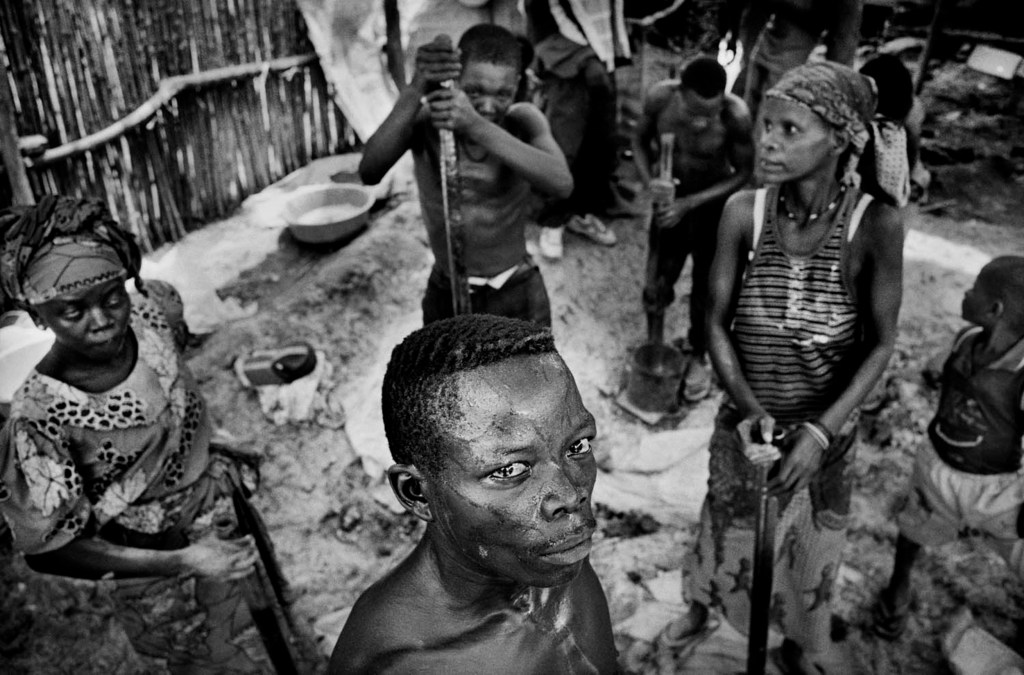
Bonded workers crush rocks in Mongbwalu, eastern Congo. Whole families work in slave conditions for warlords, controlling huge amounts of land, where gold is extracted to finance their military campaigns. 2004
The rape of the Nation, 2004 (Bleasdale, 2021)
Bonded workers crush rocks in Mongbwalu, eastern Congo. Whole families work in slave conditions for warlords, controlling huge amounts of land, where gold is extracted to finance their military campaigns.
Gold at a mine near Mabari. The rebels claim a share for “security”. Gold is plentiful in the Central African Republic, but corruption and political instability have kept the profits from benefiting the people.(Bleasdale,2021)
The Unravelling, 2005 (Bleasdale, 2021) A Muslim rebel stands guard as men and boys dig for
He is a frequent collaborator with NGOS such as, Human rights Watch, Medecins Sans Frontieres. His previous profession in banking gives him useful insight into audiences, he gave up his half a million pound a year job to pursue photojournalism. When Bleasdale worked with Human Rights Watch on the exploitation of Gold Miners In the Democratic Republic of Congo he exhibited it in Geneva to the financiers of the industry (Ritchen, 2013:105). He believes its important to work with Human rights lawyers and advocacy groups and that the media should have a complementary relationship with them (Durbanova, 2017); then use social media and other avenues to communicate with impact.
He is great example of a photographer who knows how to target hie audiences effectively. His work on human rights and conflict has been shown at the US Senate, US House of Representatives, The United Nations and the Houses of parliament. Ritchen points out that such collaboration with NGOs helps to provide information and logistical access and credibility, “They can amplify the impact of what is produced” (Ritchen, 2013:105). In an e mail to Ritchen he explained “The work I have done over the past twelve years for Human Rights Watch is not about financial reward but about how effective we can make the work we produce” (Ritchen, 2013:105). He believes that photographers and NGOs/advocacy groups together can influence policy makers.
Ritchin, F. (2013) Bending the frame: Photojournalism, Documentary, and the Citizen. (s.l.): Aperture New York.
My learning:
This research has helped me to see different elements that exist in making impact with documentary photography.
Danziger’s work shows the power of the context, personal testimony from subjects and the text accompanying images. Mendel’s work speaks of the power of alternative ways of story telling to make impact and that of sharing positive actions. Bleasdale’s work exploits his networks and understanding of the business world to create collaboration and impact. All of these photographers believe in photographing to raise awareness of issues and collaborate with NGOS, advocacy organisations and then seek ways to communicate with impact.
VISUAL STORY TELLING WITH NGOS, FOUNDATIONS AND NON PROFITS WITH ED KASHI – vii Insider
Ed Kashi is a photojournalist, filmmaker, speaker and educator of 40 years. I found this talk on the Vii website when researching for my assignment 4 essay.
INTRO: PAUL LOWE: on Ed, he’s always thinking about his audience when working, who is he trying to reach and what’s the best way.
ED KASHI:
His motivation as a visual storyteller is to engage with the world and issues that he cares about. He choses the projects that he engages with underreported issues or to take new angles with issues that we think we know about. Suggests that
“we ask ourselves if we want to create work that has positive impact on the worldwork that has meaning outside of the media landscape” and says that “Sometimes its more important to reach a few thousand important people than 40 million people through the general media if you want to make change” (viiphoto.com).
He has learnt there were different outlets to get his work out, he’s a story teller not an activist ultimately but wants to effect change; so it’s important to partner yourself with the right organisations/people to effect change.
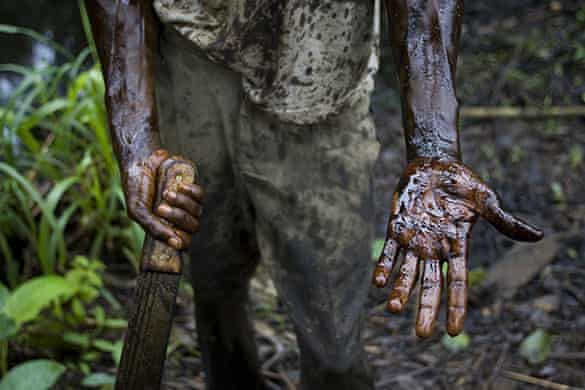
Nigeria: Niger delta 2004-2007 consciously partnered with NGOs and international organisations like, Oxfam Amnesty International, non-profit and academia, that could really make a difference to oil exploitation in West Africa; Oxfam used images from his book Curse of the Black Gold (2010) its work to advocate for a bill to create more transparency in gas and mining industries that was pending in the USA, a bill that was passed.
A report by Amnesty International suggests in the past 50 years at least 9m barrels worth of oil have leaked into land and rivers in the region
An oil spill, polluting groundwater and ruining cropland, from a well owned by Shell that had been left abandoned for over 25 years
(Tregaskis, 2010)
Vietnam: Commissioned by the Vietnam Reporting Project in San Francisco as they wanted to report on Agent Orange; this is passed down genetically. Made a film paid for by Ford which compelled the congress to give 4 million dollars to a city to clear up a contaminated pond.
As editorials budgets started to shrink and opportunities changed so he worked more with organisations like National Geographic but with a more deliberate focus on advocacy.
The open society foundation in New York commissioned him to work on police force profiling in several European countries, and how people were being impacted. He took portraits and their testimonies, which he believes is an efficient and powerful way to share a story.
Landmines in Afghanistan commissioned by UNICEF to make 3 short videos for social media
Work on the Kurds for National Geographic.
Malnutrition in Afghanistan, for UNICEF.
2013 He decided he wanted to do a project on mental health in Syrian refugee youth, as it was an issue he was aware and upset about. He knew International Medical Corporation were operating in the region; he pitched his idea to them, they financed his trip for his work and once it was done he got it published in Time magazine – an example where the paradigm was turned upside down as usually he would go to a magazine to ask if they’ll commission and finance a story; later it might filter down into non profit and NGOs to use. However some won’t publish work financd by an NGO because they think there may be a political agenda or it might not be objective.
(Kashi and Winokur, 2013)
A personal project on worldwide Chronic kidney disease around the world (CKDu a plague on the rural poor), that the Guardian have recently commissioned him to do a new piece; now there are some solutions happening.
Kashi says that when working with collaborative clients on advocacy work shine a spotlight an issue but also show how its being solved, which he sees as a more constructive form of journalism, “ solution journalism”.
He was asked whether NGO work could be seen as abandoning your journalistic stance or be biased; Kashi suggests that this can be countered by keeping your radar up for any pushing of an agenda or amplifying a problem for their fundraising, and if so making an ethical decision on whether to do the work. He’s never experienced that, and points out that there are many problems that don’t have two sides and simply exist.
Asked whether there is tension between working with different types of clients, that puts off editors commissioning him, he says he hasn’t noticed. He’s happy as long as he maintains a truthful ethical approach to his work.
The cornerstone of his work is to initiate his own ideas, but to do this he has to go after grants.
He suggests that you think/feel what you care about and immerse in that and from that work will flow. As an already successful photograher it maybe that he can afford to be less money focused in his work, but he does believe that better paid work will come from less well paid work, “If you make the work the work will come to you”.
“People out there care, and if you create powerful imagery it can make changes” (viiphoto.com).
He believes “deeply believe in the power of still images to change people’s minds. I’m driven by this fact; that the work of photojournalists and documentary photographers can have a positive impact on the world” (about- Kashi, 2021).
My learning:
It was good to hear how Kashi has suceessfully managed to work on issues that he finds important to create impact, especially with non-traditional editorial type clients.
His focus on authorship and maintaining creative independence.
How it is possible to effectively use the new paradigms for producing and financing projects and of expanding one’s skillsets to include audio and video as well as still photography. (viiphoto.com).
In a nutshell:
“It took me years to understand how my work was already having an impact, and that I could translate it more directly into collaborative relationships with NGOs, foundations, and nonprofits, and then utilize the media to reach a broader audience” (viiphoto.com).
During my research for assignment 4 critical review I listened to an interview with Ed Kashi on a podcast (Smith, 2018) and would like to add the following notes:
Kashi states that he is driven by the issue “how can I contribute something to the world that is meaningful?”, “I want to have impact”. If asked to go somewhere wants it to be something he has an impact with.
Kashi says he’s fuelled by either “an anger or belief that there’s an issue or injustice that I want to learn more about, I wanna find a way to tell a story about, to raise awareness and now increasingly to be a part of that change”.
Tries to be smarter with decisions and strategies.
He enjoys proposing ideas and getting them accepted by editorial, NGOs or others.
He knows that he must have the right partners advocate for change.
Must be open to broad range of commissions that can take his work and advocate for change.
Kashi suggest that for those starting out as a storyteller you need to create a body of work that you care about and also shoot video and collect audio. He suggests finding a grant award or crowd funding or own publication, as media is the dissemination tool but not where you’re going to make much money.
Photography and Moving Image assessment advice drop in Zoom meeting: 26.1.21
I thought it was time that I engaged in preparing for assessment as I’ve not looked at submitting online assessment yet, as it has will be for my next assessment. I have heard peers discussing their online submissions and picked up some information.
Prior to this learning session I looked briefly at the digital assessment guideline.
Things that I noted:
Overall be intentional about what you share – self curate
The narrative about my assessment can be given in the learning log
On the creative 3 pieces of work: they can be across the course, no maximum of images
There was a question on the size of images (pixels) to submit which Dan couldn’t answer then – though apparently the G drive can easily cope with large image sizes.
Showing self-curation is important throughout the process; for instance you can share a body of work but cut down the number of images in it.
Upload images don’t give as links to learning log/blog, but then can link/ref to learning log; also could add relection/narrative why chosen these images in narrative presentation.
The learning log can be 12 entries, including 2-3 entries for each learning objective.
1 learning log entry can be a guide to what I’m presenting. Or I can upload a document in the creative work folder (word doc) to act as a guide.
Word count / time limit for reflective presentation or evaluation is 6 mins, or 750 words Actions:
We peer reviewed Neil’s assignment 5 work, bird hides in Scotland, in particular the colour treatment of them; its always good to hear other’s views. We often share work between meetings online so it has become a very supportive group.
I shared some initial thoughts about my assignment 5. I am considering using text that I’ve collected over the past year from social media and the press, mainly about the tensions between locals and tourists. I shared that I thought I would juxtaposition the text against local images that don’t support text. His idea was received positively. I then asked for ideas how I could present the work as a book was the obvious choice to me, but I was wary of presenting it as a book because assignment 3 had been a book. There were ideas that I could do it as a slide show with either text or audio overlaying it. Using power point and sound files was suggested as better than doing in lightroom, apparently each slide can have its own audio (soundbites). I always find the group useful for technical support.
7.1.21
We peer reviewed Bob’s project for assignment 5. It was useful to hear how he’d mocked up a whole gallery to show his work in virtually using photoshop and a perspective tool.
Then we discussed Jonathan’s work which I just contributed some personal text as a caption to one image, as he’d previously shared it at the a Thames Valley OCA meeting. We had a lively discussion about the possible interpretations of one image, which he’s now rethinking.
Some of the documentary students have now moved onto level 3 and we spent quite a bit of time discussing level 3 work and studying; for me looking ahead this is useful.
I’m already thinking ahead to level 3 and what I could base my work on; I’ve not had any significant brainwaves but am getting a flavour of what is required and this might help me.
As I’m working on my critical review no I had no work to share.
THIS IS A SUMMARY OF THE MAIN LEARNING THAT I HAVE TAKEN AWAY FROM PART 4
PROJECT GAZE AND CONTROL
Reading On Foucault: Disciplinary Power and Photography by David Green (Exercise 4.1)
I had not thought of photography as a mechanisms of surveillance to observe/and classify people in order to normalise disciplinary power.
As Green suggests if this is so, we should develop alternative ways of working with photography.
The Photograph as an Intersection of Gazes ((Exercise 4.2)
The seven types of gazes identified gives me something to reflect on I my work going forward:
The photographer’s gaze: the camera’s eye which structures the image.
The magazine gaze: chosen by editing for emphasis.
The reader’s gaze: a reader’s interpretation, influenced by their experience & imagination.
The non-western subject gaze: confrontational/distanced look/ absent gaze.
Explicit western looking: which is unusual as westerners usually look off camera.
Returned or refracted gaze: usually by mirrors or cameras
Academic gaze: a subtype of the reader’s gaze.
It’s an interesting concept that some photographers are experimenting inviting viewers to interpret them rather than accepting the photographers gaze as their own. I will be more aware going forward of the interplay and relationships of the various gazes and their potential effect on the viewer, and the ambiguity in the work in particular.
PROJECT DOCUMENTS OF CONFLICT AND SUFFERING
Reading the articles ‘Walk the Line’ (Houghton, 2008) and ‘Imaging War’ (Kaplan, 2008( (Exercise 4.4) raises issues such as:
How far should we go with publishing images of war and disasters?
What images are suitable?
Are there any lines to be crossed?
Are the answers defined by ethic, commerce, respect for individuals or their families, politics, relationships between media companies and governments, or are they simply personal?
It is the photographer who must be mindful of the way the images may by used. I believe whether an image should be used or not I think, comes down to if using it adds impact to the story.
THE ETHICS OF AESTHETICS
‘Imaging Famine’ (Exercise 4.5)This research project in 2005 highlights issues that persisted in images of famine:
Stereotypical images of victims
Could positive images of people in need be presented?
Can photographers provide images with context, understanding and explanation?
Does immediacy enabled by technology cause simplified compositions?
Can just one picture share a good understanding of issues?
Are photographers simply image makers or do they have wider responsibilities?
To print or not to print (Exercise 4.7)
When choosing what to include in an image I would:
Think about what I consider decent, is there consent?
Consider privacy, is it a public occasion seems to be the crux of this
Ask would the presence of the camera invite violence?
This was the first time that I’ve read The National Press Photographers Association, code of ethics (2017), in particular it states that “our primary role is to report visually on the significant event and varied viewpoints in our common world….the faithful and comprehensive depiction of the subject at hand”.When photographing as documentary I must remember this.
REFLECTING ON THE WAR PHOTOGRAPHS
Has made me consider topics such as journalist embedding, staging for cameras, rapid publishing, post camera manipulation and their effects on the quality of media images.
PROJECT POST-COLONIAL ETHNOGRAPHY
It was good for me to reflect on colonial and post-colonial world especially certain “traps” that have been identified:
Nostalgia – Romanticism of primitive beauty
Imbalances of power between photographer and subjects
Disciplinary cataloguing and comparing
Primitivism
Decontextualising
Infantising of non-industrial people
I was pleased to find photographer’s work such as David Ju/’hoansi Bushmen (2021), George Rodgers (En Afrique, 2016) and Eduardo Masferré (1909 – 1995) who had avoided most of these traps – I will now be alert to them when viewing such work again.
Do your own research into the bodies of work discussed in this project. Can you find any examples of work carried out amongst indigenous peoples that, in your view, honestly document the lives of their subjects without falling into some of the traps that we’ve been discussing here? If so, how has the photographer achieved this? (Open College of the Arts, 2014:64)
The “traps” that have been identified in Post colonial ethnographic photography:
Nostalgia – Romanticism of primitive beauty
Imbalances of power between photographer and subjects
Disciplinary cataloguing and comparing
Primitivism
Decontextualising
Infantising of non-industrial people
Peter Lavery’s work in “of humankind” does decontextualise his subjects; this seems to enhance the stereotyping, the power imbalance, cataloguing and comparing traps suggested above. Indeed even in the foreword of the book ‘Of Humankind’ by Robin Muir (2000) says that Lavery’s portraits remind us that photographers deal in things which are continually vanishing and which no contrivance on earth can bring back”, underlining the nostalgic element of his photography.
(Of Humankind, 2000)
Conversely David Bruce’s work though sometimes posed against a backdrop is aesthetic, shot with dignity, and his subjects look empowered and generally look to be enjoying themselves.
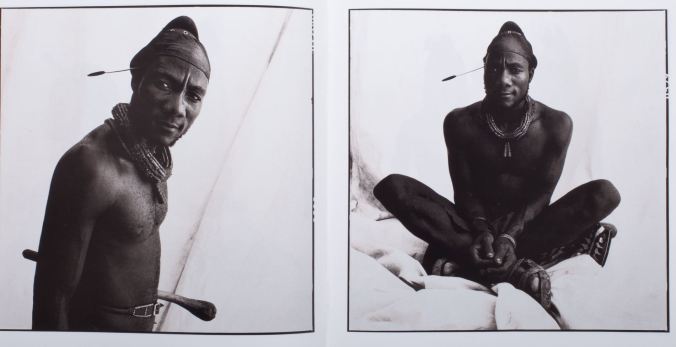
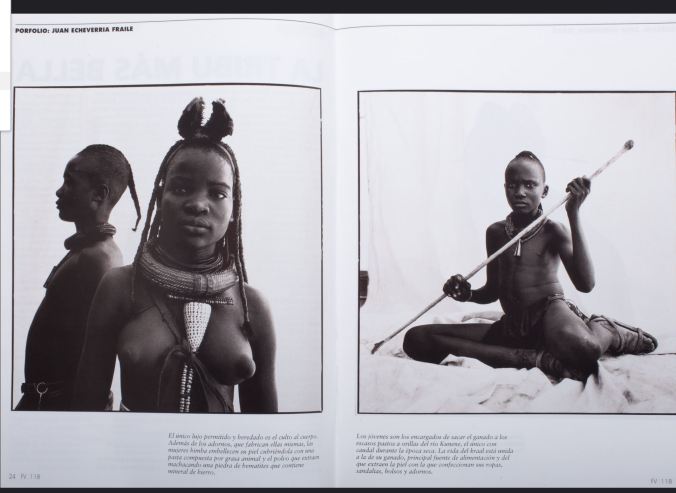
Juan Echeverrria’s images of the OvaHimba tribe in Namibia could be interpreted as voyeuristic and decontextualised; whilst they are taken out of context they do have a realism about them and the subjects share some character and assertiveness.
Namibia_Paisajes_desde_el_tren (2021)
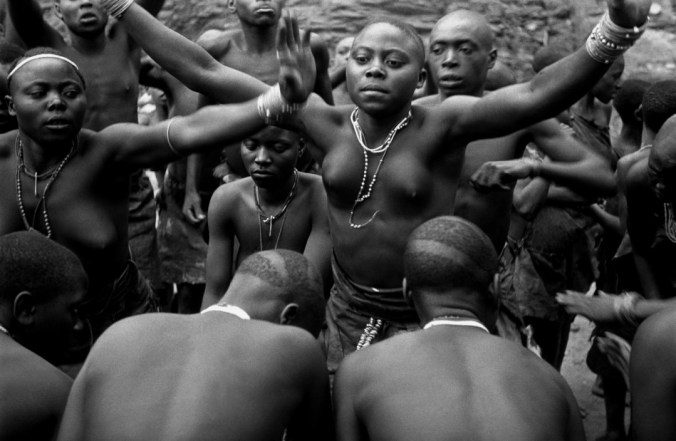
When searching for examples of work which don’t fall into the “traps” I returned to the work of George Rodger who took the image that struck me on the front of the Tribal Portraits catalogue. I was pleasantly surprised that although his work En Afrique was taken between 1947 and 1979 it avoids the pitfalls mentioned above; the nudity is in context, subjects are photographed in context and are certainly not romantised; indeed he gives detailed context with each image.
UGANDA. Wagasero girls wear strings of beads around their foreheads. 1948
KENYA. Masai Mara. Well befofe sunrise a young Masai candidate for circumcision stands the taunting of junior Moran who have already been circumcised at the age of 13 to 15. 1979.
UGANDA. Pygmies. “Dance of the forest people”. The Bachimbiri and Wagasero dance their own version of a courting dance, the “Kamundere”, before a semi-circle of men of the tribes who kneel before them. 1948.
(En Afrique by George Rodger, 2016)
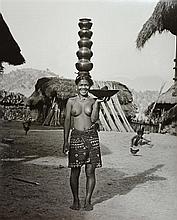
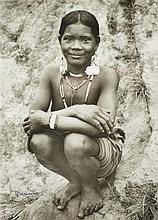
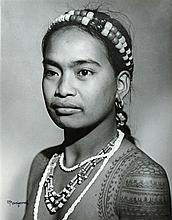
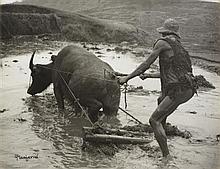
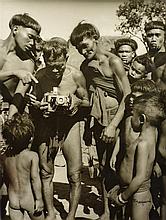
I also thought back to a photographer whose work I came across when in the Philippines a couple of years ago, Eduardo Masferré (1909 – 1995) a Filipino-Catalan who made documentary reports about the lifestyle of native people in the region of the Cordillera of the Philippines in the mid 1950s. I was very struck with his work at the time, which is contained in his book people of the Philippine Cordillera (1988) and was interested how I would view it now I have studied these aspects of tribal photography.
Eduardo Masferre Paintings & Artwork for Sale (2021)
I was pleased to see that although there is a fascination with subjects smoking pipes, most of his images are shot with context in a documentary style which gives information about their way of life. Where there is partial nudity it appears as a natural part of their dress and the emphasis of the photograph is clearly not on this but another aspect, such as the girl with the pots on her head and the smoking woman above. Though there is the occasional image which seems to have been shot simply for the beauty of the subject female, male, old or young, there is no suggestion of imbalance of power between him and his subjects or infantizing of them. For work which was shot between 1947 and 1959. I would say the work is sensitive to the people and a good documentary record and agree with the review from the book cover that the people are shown with “strong faces that meet one’s gaze with great integrity – Masferre preserved all of these in timeless images that transcend ethnography and imbue documentary fact with deeper meaning.” (Masferre and Devilla, 1988).
Browse the catalogue Tribal Portraits: Vintage and Contemporary Photographs from the African Continent, Bernard J Shapero Rare Books. Core resources: TribalPortraits.pdf
Write a brief reflective commentary in your learning log. (Open College of the Arts, 2014:96)
Tribal Portraits Vintage and contemporary photographs from the African continent, a catalogue from a sale of photographs in 2008 by Bernard J Shapero; the images were taken from 1856 to 2008 and the text states that is presents the images as art.
The cover image is full of promise, offering a different perspective. However from that starting point most of the images are stereotypical portraits of African people. Mostly the women are presented a full frontals, naked from at least the waist up and the images ae predominantly women. Vincenti’s late 19th century images of men are one of the few exceptions. I was surprised to see Lehnert and Landrock African women photographed in obvious western style poses, but accept that these have their place in the history of tribal photography.
Its unfortunate that the images aren’t presented chronologically, as there is no progression or logic in the presentation. Contemporary photographers Malick Sidibe and Seydou Keita present a welcome relief to the stereotypical earlier photographs; but to call this a mixture of contemporary and historical tribal photography is misleading as most of the images are from 1856 to the 1950s and there are only a handful of 21st century images such as Graff’s and comparatively few late 20th century images.
I also take issue with some of the captions such as item 9 Portrait study billed as an “unusual informal grouping” when in fact the women are they are sitting on western chairs and have obviously been arranged to a degree.
My favourite image is item 18 by Riefenstahl, the Nuba Dancers of Kau (1975); it is full of life and skilfully captures a vibrant and realistic picture, the nudity appears as natural as obviously was, there is context and it is unposed. Ricciardi’s images of the late 1960s in Kenya also have welcome life to them.
My conclusions, that there is obvious documentary value in the collection but we could learn more easily from the catalogue if the images were present chronologically or by region or even with more context; if presented in the former way we would at least be able to ascertain if there has been any progression in the photography. I guess the motivation was simply to sell the images and I should not wish for anything beyond that; it is however a good source of tribal photographs.
References:
Open College of the Arts (2014) Photography 2: Documentary-Fact and Fiction (Course Manual). Barnsley: Open College of the Arts.













 Photography 2: Documentary