RESEARCH AND RELECTION: PHOTOGRAHERS TALKS

THE PHOTOGRAPHERS GALLERY Talk: Hannah Reyes Morales (Online) 24.6.20

Hannah Reyes Morales is a storyteller, photojournalist and documentary maker. Born in Manila, as a child she looked to images to learn about the past. She uses the photograph to understand the present and the people in it. Her work, which often shows individuals in conditions of poverty, is tender and she photographs peoples with dignity aware of the social injustices and extreme inequalities there. I was attracted to this talk as I have visited and worked in the Philippines many times.

She grew up looking at images in history books that made her uncomfortable as they portrayed native Filipinos as savages; I remember seeing images like this when I visited the Philippines last year; for instance a poster about the human zoo that was set up in 1904. Though she couldn’t articulate the discomfort she felt, she understood the need to be equal with those we photograph, rather than photographing people out of context.

Hannah wanted to represent people around her, and became a photojournalist in the time of the drug war, with violence, death, mass incarceration. But she also saw life continuing and happening and wanted to help make space to show this other side: love and intimacy in a hostile environment. She described it as becoming more intentional about what she was capturing.

She reached a point where she had to do work that she aligned with even though she had to validate why her Filipino perspective was important; she explained how the Filipino perspective is unique but also global, partly because of the wide “diaspora” (a scattered population that originate from a geographic locality). Indeed her understanding of America was defined by the contents of the Balilkbayan boxes (corrugated box) containing items sent home by overseas Filipinos. 

Hannah talks about the importance of the Filipino concept of other people “Kapwa” and seeing yourself in others, a shared inner self when she is working, as this is what she aspires to when taking photographs. She recognises the humanity in herself and others and this is how she engages in the act of story telling. . Kapwa is also about sharing burdens whilst at the beginning she was answering individual questions with her photos she now thinks in general about not forgetting the past but moving forward. Hannah realises now that she has enough bodies of works that are threaded together to begin to answer questions

Roots from ashes connects her to her grandmother who along with others was interred in 1944 bythe Japanese Imperial in red house, and repeatedly raped for days. Though many of the are now dead some gathered together to tell their story through the media, in the hope of seeking support and justice.

The Shelter from the storm is her work about women displaced by typhoons who wind up working in the sex trade. She remembers seeing historical news cuttings of women being used in the sex trade under Vietnamese rule as well as the American’s. The work is about how Filipino women’s’ bodies are commodified. She is also trying to understand intra generational trauma.

Her work on beauty culture and redefining beauty across 5 continents, focuses on how to reclaim or redefine beauty and how it is now much more inclusive:

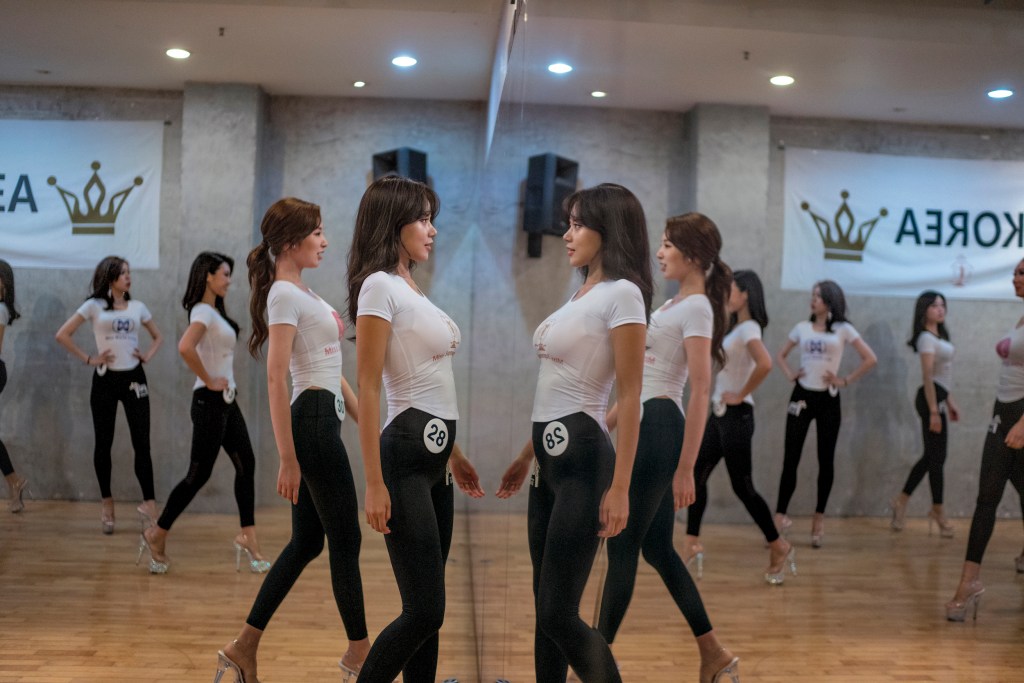
She believes that as a photographer you need to learn when to step aside to let someone tell their own story, so a good translation is one that doesn’t alter someone else’s narrative.

In the time of Corona Virus she returns to the importance of understanding where she is in the context of history and to use photography to heal by moving forward. She hopes that the work that she’s done will have some effect on those situations. Hannah’s success is her immersion in the country is that she’s not capturing what’s literally in the photograph and that she widens the lens to open the image.  I’m interested that she thinks it is important to document your own communities but would also like to see a more inclusive landscape for photographers; for instance that there is perspectives of the Philippines from outsiders and those outside of mainstream authorship -She has hopes that all will be able to be interpreters.

My Learning:

  • When documenting someone elses story consider stepping aside to let them tell their own story.
  • Try to photgrah people in context and with dignity
  • She has varied styles of photographing I terms of colour saturation, lighting and perspective but these can still sit together well as a series.

References:

Givhan, R. and Morales, H. R. (2020) ‘The idea of beauty is always shifting. Today, it’s more inclusive than ever’ In: National Geographic 07/01/2020 At: https://www.nationalgeographic.com/magazine/2020/02/beauty-today-celebrates-all-social-media-plays-a-role-feature/ (Accessed 27/09/2020).

Talk: Hannah Reyes Morales (online) At https://thephotographersgallery.org.uk/whats-on/talks-and-events/talk-hannah-reyes-morales-online (Accessed 22/07/2020).

Hannah Reyes Morales (2020) At: https://hannah.ph/Redefining-Beauty (Accessed 27/9//2020).

Next Post: https://nkssite5.photo.blog/category/learning-log-research-and-reflection/zoom-oca-meetings/oca-tutor-led/andrea-norrington-20-7-20/

RESEARCH AND REFLECTION: PHOTOGRAPHERS TALKS

DOCUMENTARY PHOTOGRAPHY RECONSIDERED – AOP WEBINAR – 30th June 2020

Michelle Bogre moderated a panel discussion by: Stephen Mayes, Nina Berman, Ed Kashi and Paul Wenham-Clarke who presented work and then discussed how we should reconsider documentary photography during a time when it is more relevant than ever but at the same time is undergoing great changes.

Stephen Mayes who has managed top level photographers teaches and writes about the ethics and practice of photography.  He believes we should consider digital photography as a separate discipline to traditional photography, and we should be aware how audiences are changing as our world does.

Nina Berman, a documentary photographer, filmmaker, author and educator, gave examples of how to photograph with dignity, in particular in areas of sexual abuse.

Paul Wenham-Clarke applies previous skills in advertising photography to documentary; he gave good examples of ways to involve subjects and be truthful.

Ed Kashi, photojournalist, filmmaker, speaker and educator, has transformed his photography from a traditional approach into a more hybrid one using a variety of media.

Lots of questions were raised such as:

  • Is the line between documentary and Art photography indelible? 
  • Can we trust the photo or has photography been transformed into something different?
  • How does digital photography change the relationship between subject and presentation?
  • What is digital photography proof of?
  • whose truth is a photograph?
  • Do we need new ethical standards?

My learning:

This talk combined with the Lumix Festival talks that I have briefly summarised below has given me a lot of food for though for my critical essay, and hence I have only given a brief outline of the content of the discussion.

It has also led me to buy Michelle Borges book “Documentary Reconsidered” (2019) which I shall now read.

Reference:

Documentary Photography Reconsidered (2020) At: https://www.the-aop.org/what-s-on/events/current-events/documentary-photography-reconsidered (Accessed 30/06/2020).

Next Post: https://nkssite5.photo.blog/category/learning-log-research-and-reflection/photographer-talks/hannah-reyes-morales-24-6-20/

RESEARCH AND REFLECTION: PHOTOGRAPHERS TALKS

LUMIX FESTIVAL VIRTUAL TALK 22.6.20 STORYTELLERS OF THE FUTURE

Live talk with FRED RITCHIN moderated by Karen Fromm

This was the another Lumix Festival talk that I found particularly inspiring, so much so that I may build on some of the ideas for my assignment 4 critical review. The questions that are at the heart of this festival are important to me going forwards:

  • How can visual storytellers be useful in the world?”
  • “How can they make the right kind of impact with their photographs?”
  • “How do the image-makers of the future create meaningful media?”

Ritchen is a professor in photography and a co-director of the New York University Magnum foundation photography program; he’s also worked as the picture editor of the New York Times Magazine. He co-founded PixelPress (1999) an online publication experimenting with new methods of storytelling and has recieved an award for ethicl behaviours in photojournalism.

The premise of his talk was that we should do things differently to get real responses to images. He pointed out that whilst digital media is fast changing in journalism image-based storytelling still largely consists of the single photograph, slide show, and short video. He asked:

  • Can the visual storyteller act as an author who interprets issues and events with subtlety and depth, rather than be employed mainly to illustrate text or provide images to attract readers?
  • Can the journalistic photograph be used to provoke important questions?
  • Can the visual journalist be respond in addition to what they see, be proactive and aim to reduce suffering ahead of time.
  • How can readers be encouraged to be come more engaged and given more complex narrative?
  • How do we preserve what’s left of the credibility of the photograph?

To support this Ritchen gave lots of examples of good practice, rather than images that will win prizes – some of them follow below:

Images of death:

In June 1969 in Life magazine “The Faces of the American Dead, One Week’s Toll,” were published just as the simple identity card pictures only of fallen US soldiers in the Vietnam war that week. These Ritchen says provoked stronger impact than war pictures would have, saying that “it was no longer the repetitive recitation of statistics concerning each week’s dead that was sufficient, but the requirement that each person killed must be looked at and recognized as a unique individual.” (Ritchen, 2020).

(LIFE Magazine June 27, 1969, in Ritchen, 2020)

This idea was also used more recently in the New York Times “Faces of the Dead” where you could click on one of thousands of squares to see images of a U.S. soldier killed in Iraq or Afghanistan and also search for the war dead by location which enabled readers to engage more proactively with the information

On May 24, 2020 the New York Times created a front-page memorial for those Americans who have died from COVID-19 in a different manner, detailing just the names, age and hometown of the dead, and a short phrase describing something important about each individual’s life. Ritchen applauds the way this individualises those that died and worked against the fatigue with numbers. Ritchen suggest that in the Age of Image there may be more effect in the less that can be seen (Ritchen, 2020).

New York Times, May 24 2020 (Ritchin, 2020)

Ritchin also cited the work I have previously studied by Anton Kusters (https://nkssite5.photo.blog/category/learning-log-research-and-reflection/photographer-talks/anton-kusters-4-3-20/) where a beep on the soundtrack represents a death in a concentration camp, and an image of the sky above represents each concentration camp. I can see that Ritchen is promoting is methods of visually narrating that provoke thoughts of the normal lives of those dying in wars, to show that there was life beyond the image.

Ritchen also drew attention to the book “Nuclear nightmare: Twenty Years since Chernobyl” (2006)

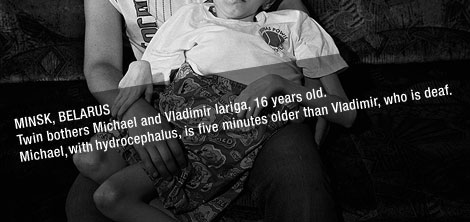
with photos by knoth, this was particularly interesting as I’d heard a talk by Knoth the previous day (https://nkssite5.photo.blog/category/learning-log-research-and-reflection/photographer-talks/knoth-and-barnard-photography-in-a-fragmented-world-21-6-20/ ). In this work Knoth’s images supports documentation of the impact of nuclear accidents in eastern Europe, on the health of people.

Nuclear NIGHTMARES (s.d.) At: http://www.pixelpress.org/chernobyl/ (Accessed 11/07/2021).

Nuclear NIGHTMARES (s.d.) At: http://www.pixelpress.org/chernobyl/ (Accessed 11/07/2021).

The idea of a “rollover” combined with an image for additional information was new to me.

I have also since explored the Four Corners Projectconceived and compiled by Fred Ritchin, supported by the International Center of Photography and the World Press Photo Foundation. The software is open-source and free for use by the public. Users can put information into the corners of photographs, eg code of ethics, backstory, image context, links or related images. This looks like a great resource that I must try out.

These examples above align with Ritchen’s belief that we need meta-photographers who think what to do with images and how to get good coverage from them. Interestingly he suggests that photo books are probably more respectful than the swipe cultures of social media photography.

This talk by Ritchen has been really inspiring.; the last time a photographer and panel impacted me so much was the Mark Neville talk 4.4.20 (https://nkssite5.photo.blog/category/learning-log-research-and-reflection/photographer-talks/mark-neville-4-3-20/ ).

MY LEARNING:

As a documentary photographer to make a difference:

  • Be accurate, don’t add or subtract things from the visual elements or stage to make something look exciting
  • Don’t revictimize people, by replaying negative, sordid or sad scenes.
  • Contextualise accurately
  • Don’t be reactive
  • Think about the impact of work on the world
  • Avoid stereotypical images
  • Try Interactive photos” portraits
  • Show images but the reveal information, such as “Rollovers” to give delayed information
  • Value photo books
  • Try using the template from The four corners

Generally it has made me think about how a visual storyteller should do things differently to:

  • Remember I am an author when photoraphing and have a responsibility to understand properly what I am seeing/showing
  • interpret with subtlety and depth
  • provoke important questions and photograph to create reaction/response
  • Respect and collaborate
  • be proactive
  • use diverse strategies available in the digital environment, to engage the reader and allow for more complexity in the narrative

References:

Four Corners Project (2020) At: https://fourcornersproject.org/en/about/ (Accessed 22/06/2020).

Nuclear NIGHTMARES (2020) At: http://www.pixelpress.org/chernobyl/ (Accessed 23/06/2020).

Ritchen, F. (2020) Remembering the Dead, Differently. At: https://www.fotodemic.org/features/remembering-the-dead-differently (Accessed 11/07/2021).

Storytellers of the Future | Lumix Festival für jungen Bildjournalismus (2020.) At: https://lumix-festival.de/en/themen/storytellers-of-the-future/ (Accessed 23/06/2020).

Next Post: https://nkssite5.photo.blog/category/learning-log-research-and-reflection/photographer-talks/documentary-reconsidered/

RESEARCH AND REFLECTION: PHOTOGRAPHERS TALKS

23.6.20 LIVE LUMIX FESTIVAL TALK – STORYTELLERS OF THE FUTURE

This photographer and his talk was along the same theme as Fred Ritchen’s talk above and I may use some of the material for my critical essay so I’ll only post a summary here for now.

Misha Vallejo

Like Ritchen he believes we need new approaches which aren’t romantic so tha we can bring truth to photography. He researches and works in a humanistic way, and shared his project “Secret Sarayaku”, which records the struggle of the Kichwas who live in Ecuador and are defending themselves from the exploitation and destruction of the rainforest for purposes of extracting oil. He used a variety of media to document the lives of the people in Sarayaku over three years, and works in a non- linear way. His work is collaborative and empowering for the subjects.

My learning: In relation to my assignment 3 I note his comment on book making: Start the project first, and the project will suggest what the end result should be like.

I was interested that Vallejo says it is important to listen to people outside the photography world and not to need validation from the photographic world – as Ritchin said, the best work doesn’t always win prizes.

References:

Gonzalez, D. (2018) ‘At Home in the Jungle, Everything Is ‘Alive and Has a Spirit’’ In: The New York Times 20/04/2018 At: https://www.nytimes.com/2018/04/20/lens/at-home-in-the-jungle-everything-is-alive-and-has-a-spirit.html (Accessed 22/06/2020).

Home (2020) At: https://secretsarayaku.net/home?locale=en  (Accessed 22/06/2020).

Next Post: https://nkssite5.photo.blog/category/learning-log-research-and-reflection/photographer-talks/fred-ritchen-22-6-20/

RESEARCH AND REFLECTION: PHOTOGRAPHERS TALKS

I was lucky to be able to attend the lumix Festival virtually and captured 3 talks which were particularly thought provoking, this was the first one.

New Perspectives on Documentary Practices (virtual Lumix Festival 21.6.20)

HOW TO POSITION ONESELF IN A FRAGMENTED WORLD? A LIVE TALK: Iris Sikking in conversation with Lisa Barnard and Robert Knoth

The topic “New Perspectives on Documentary Practices” reflects on the changing role of journalistic photography in today’s world; current tendencies in visual-journalistic storytelling and the development of visual narrations that subvert the traditional viewing habits, expectations and stereotyping of classical documentary photographic narrative forms.

Lisa Barnard and Robert Knoth have broken away form the photojournalistic realm, finding their own visual approach in producing, conceptualising and presenting their projects. They discussed their choices for the presentation platforms, the value of in-depth research, and the tension between the hyper reality of journalism and the more abstract qualities of art and literature, which requires a self-reflexive documentary approach. The idea of fragmentation in society and representation is important in both their works.  

ROBERT KNOTH 

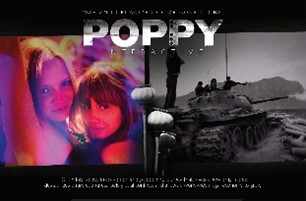
A Dutch photographer working with Antoinette de Jong produced Poppy-Trails of Afghanistan Heroin (2012) an exhibition video installation and book, then a few years later a web site:

  • The story is about the effect of heroin rather than the drugs themselves; the framework behind the heroin trade, such as the war in Afghanistan which is largely funded by drugs trafficking, as are the Somalia, Kosovo, Pakistan, Ukraine, Albania wars.
  • The Book has a non-linear timeline, with layered storytelling. It began as a show case for images of these trails, but this seemed dull, so they let go of traditional photography. They thought a visual urgency was needed for the work, and that it called for different types of photography, for instance different camera formats.
  • The Installation has 4 different screens to bombard viewers as a replication of how people today consume news from several devices at a time; the work also moves around in a random way. It is “fragmentated”, they struggled with how to make the issues clear and present a cohesive narrative so created a broader narrative on the topic to show the layered complexity of social, economic or political issues and the impact on the lives of ordinary people.
(Poppy interactive – Submarine Channel, 2020)

Q: When working on new visual language, can you predict whether galleries/editors will accept it? He never thinks about if it will be liked, his only criteria is will it work?

Q: Do you have advice for emerging photographers working on personal projects?

  • Collect your materials then get out into the field and see what works.
  • Follow your instincts as a creative person
  • Give yourself time to create your own narrative.
  • Hang around and something will happen, improvise, sometimes being flexible leads to things that are better than what you planned; he often uses material he hadn’t planned to.
  • There are always different ways of telling a story.
  • You need to have a vehicle through which you can navigate, a person, narrator

Lisa Barnard – The canary and the hammer (2015)

This work was followed by a book and exhibition (2019) it is her personal journey through the world of gold, its value today and its history:

Through a mix of image, text and archival material, Lisa Barnard provides an insight into the troubled history of gold and the complex ways it intersects with our global economy”.

The project began from the financial crisis 2008 which affected her personally. It’s essentially about whether photography can show what’s hidden. The investigative strategy, often used by photo journalists exposes a deep concern for the needs of the ordinary people, such as the “Pallaqueras” in Peru, who sort the ore on the surfaces for pieces containing gold, photographed for “The Canary and the Hammer”.

It moves in and out of the fictional and documentary narrative, because this is what happens; there are always multiple truths, hence many different styles of photography. The fragmented work signifies the impossibility of representation and getting to the truth as documentary photographers and for viewers; look at the fragments and present these, rather than shy away from a story that is easy to tell. The exhibition was intended to reveal the hidden aspects of gold in an unsettling and claustrophobic way. I was struck by the 1950s newsreel music in the video and the way you navigate it in many directions.

Barnard is less motivated by books, more by web docs, and says that work should be about the viewer. The need for funding forces you to think about your motives and intention (audience, where they will be viewing), she suggests you should be true to your concept and ideas but make them accessible (not too text heavy, too fragmented), as a visual artist the visuals have to come through. Show your work to outsiders to check it’s accessible. She also believes it’s important to give photos back to those you’ve taken.

Both these photographers realised that traditional journalism was not working for them and decided to follow a different approach; these stories are too big for papers and magazines, but galleries regard them as photojournalists.

My learning:

  • Follow your instincts as a creative person.
  • Collect your materials then get out into the field and see what works.
  • Don’t make assumptions photograph everything otherwise you’ll miss the story that emerges – See laterally around the subject, improvise, being flexible may lead to things better than those planned.
  • Give yourself time to create your own narrative.
  • Work doesn’t have just one visual output and each work responds to the medium it’s presented with, this addresses the idea of fragmentation in society. There are always different ways of telling a story. look at the fragments and present these, rather than shy away from a story that is easy to tell
  • Be true to your concept and ideas but make them accessible (not too text heavy or fragmented.
  • In an exhibition you can tell well layered stories in non-linear ways.
  • Web docs or interactive web sites are more flexible than books, as once books are done they’re done; also they make things accessible to you that is difficult to do in a book and are an important addition to the cannon of photography.
  • As a visual artist the visuals must come through.

References:

Knoth, R. and de Jong, A. (2020) Robert Knoth and Antoinette De Jong. At: https://www.knothdejong.com (Accessed 24/06/2020).

New Perspectives on Documentary Practices | Lumix Festival für jungen Bildjournalismus (2020) At: https://lumix-festival.de/en/themen/neue-perspektiven-des-dokumentarischen/ (Accessed 24/06/2020).

News : Lisa Barnard (2020) At: http://lisabarnard.co.uk/news/ (Accessed 24/06/2020).

POPPY Interactive – Submarine Channel (2020) At: https://submarinechannel.com/poppy-interactive-documentary/ (Accessed 24/06/2020).

Warner, M. (2019) Lisa Barnard’s investigation into the troubled history of gold. At: https://www.bjp-online.com/2019/08/the-canary-and-the-hammer/ (Accessed 24/6/2020).

Next Post: https://nkssite5.photo.blog/category/learning-log-research-and-reflection/photographer-talks/lumix-misha-vallejo-23-6-20/

PART 3 A COLOUR VISION: PROJECT DOCUMENTARY, PERFORMANCE AND FICTION

Exercise: Seeing is Believing:

Read the WeAreOCA blog post ‘Seeing is Believing’: http://www.weareoca.com/photography/seeing-is-believing/

Read all the replies to it then write your own comment, both on the blog page and in your own blog. Make sure that you visit all the links on the blog post. Base your opinion on solid arguments and, if you can, refer to other contributions to the blog. (Open College of the Arts, 2014:82).

The post raises the question whether seeing is believing. This is done in the context of the assassination of Bin Laden and the challenges to it because of the lack of visual evidence at the time. Not all of the links work now, however it directs us to the work of Joan Fontcuberta “Deconstructing Osama” made prior to the event, where he distorts photographic truth as he photoshops himself into a disguised Bin Laden. In his work generally Joan Fontcuberta fuses fact and fiction, pushing viewers to doubt their own perceptions in a bid to dispel the myth that ‘the eyes do not deceive’; he challenges us to examine how images are made, exhibited and seen, and how their ‘truth valueʼ may be exploited (Bainbridge, 2014).

The work of photographer Pedro Meyer and his book Truth and Fictions is mentioned in the blog. Meyer a pioneer of digital contemporary photography, maintains that all photographs – manipulated or not – are equally true and untrue” (Pedro Meyer,2020). Interestingly he also argues that unseen elements such as memory or emotion present themselves with a physical reality equal to visible objects. In his photographs, these elements often appear with a clarify that connects his work to the tradition of “Magical Realism”.

So what are my thoughts about the blog post and posts which date from 2011 and are now 9 years long?

The vehicle raised in the blog for discussion about whether seeing is believing was the refusal to  release images of Bin Laden’s body, are met in various ways. Obama stated that he thought that it was morally wrong to display such a graphic image, and yet other bodies were shown; so was the decision really to prevent him being martyred by his followers or to prevent a larger retaliation? It is also strange that the photograph of Obama Clinton and advisors witnessing the assassination from their situation room was thought morally right. The reactions to this were varied at the time and those contained in this blog. Some accepted the event happened without visual evidence, whilst it caused some to question the reality.

Discussions in the blog are interesting and wide ranging:

Can we believe without visual clues? (nmonckton, 6.5.11).

Objectivity is always open to question (Richard, 8.3.15)

You don’t need to see to believe (Philoca, 6.2.16)

There is no longer blind faith in photographs (Michele, 24.2.19)

For my part I don’t need to see to believe, especially in this instance as I don’t believe the American government would have risked putting out false information that could later be disputed. In some things I might need to see to believe – it depends on the likelihood of something having occurred and the integrity of the source providing the information.

I am interested in Ian Shaw’s comment (5.11.20) asking has the belief in the truth of a photograph as a document changed since 2011? It probably has, and the photograph is less useful as a document of evidence than it used to be, now there is a shared understanding of how post processing and construction can be done.

For me the central question that I come away with is how should we best document reality?

References:

Bainbridge, S. (2014) Mind Games. At: https://www.bjp-online.com/2014/11/joan-fontcuberta-national-media-museum-bradford/ (Accessed 27/10/2020).

O’Hagan, S. (2011) ‘Osama bin Laden’s body: the world’s most incendiary image’ In: The Guardian 06/05/2011 At: http://www.theguardian.com/artanddesign/2011/may/06/osama-bin-laden-photograph-obama-body (Accessed 27/10/2020).

Open College of the Arts (2014) Photography 2: Documentary-Fact and Fiction (Course Manual). Barnsley: Open College of the Arts.

Pedro Meyer: Truth from Fiction (2020) At: https://luag.lehigh.edu/exhibitions/pedro-meyer-truth-fiction (Accessed 27/10/2020).

Seeing is Believing (2011) At: https://www.oca.ac.uk/weareoca/photography/seeing-is-believing/ (Accessed 27/10/2020).

Next Post: https://nkssite5.photo.blog/category/learning-log-research-and-reflection/photographer-talks/knoth-and-barnard-photography-in-a-fragmented-world-21-6-20/

PART 3 THE COLOUR VISION: RESEARCH

Research point Charley Murrell and Hannah Starkey

Investigate Murrell’s Constructed Childhoods and Starkey’s Untitled series. How do these photographers employ imaginative and/or performative elements to construct their narratives? In what sense is the end result ‘real’? What aspects of their work might you consider adopting in your own practice? (Open College of the Arts, 2014:81)

Hannah Starkey

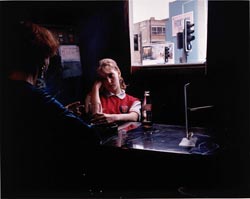
Hannah Starkey’s photographs reconstruct everyday scenes with actors, usually of women pictured in banal daily routines, often placed as lonely figures “segregated with metaphoric physical divides such as tables or mirrors” (Saatchi, 2020). She repeatedly turns her subjects backs to viewers or puts them in heavy shadow, clouding identity features.

Starkey uses a filmography approach, large scale photographs carefully constructed with film lighting; though constructed her images are dynamic “their charge comes from the possibilities and surprises only a still image can yield, from the pleasures and challenges of looking carefully at an arrested moment” (Strong Women, 2020). The images are best seen at the scale she intended, approximately 4 by 5 feet, when you can see the small details they contain.

Her work is mostly “untitled”, with a date only which connects to a memory. Starkey says that she reimagines what she has observed and by carefully reconstructing them she can capture “the small gestures and glances of everyday experience while also subverting traditional notions of documentary and street photograph” (O’Hagan, 2018). She explains that she combines “documentary with the slickness of advertising and the observational style of street photography. I think I’ve become more reflective and considered, but the performative element has been a constant” (O’Hagan, 2018).   

Is her work real? Her work blurs fiction and reality. Starkey says that she is more interested in psychological truth than the photographic truth (O’Hagan, 2018). Like Wall she is using the opportunity to recreate moments real and imagined in her own time so that she can present them in a controlled way. Like Wall she is honest about her manipulation, angled mirrors, perspective, acting, placing small details and post digital manipulation after the fact.

I feel much the same way about her work as I do Wall’s. It provokes questions about whether it is documentary, which for me rests on whether they are accurate reconstructions or seductive interpretations; from what I read they are the later and therefore for me not documentary.

Charlie Murrell

In her work Constructed Childhoods she explores the impact of images that surround children’s everyday lives, found in magazines, on TV, the Internet, adverts, and even products. All these images constantly present ideals and can negatively impact on their self-image and esteem.

Murrell’s images are Tableaux constructed in her and the children’s homes. The children are acting in adult roles, in adult poses, she reinforces the gender roles in her images by the use of pink and blue. The images are a mixture of children acting in a studio shot and manipulated exterior shots, but both are strange and cause you to look hard to interpret them.

Are these manipulated images real? The idea or problem of the projection of ideals is a reality, however these images are constructed. These images are documenting a reality but I believe are over manipulated to be documents; they too are images that provoke thoughts about truth, they may expose realities, but the photographs are fictional representations.

So with regard to the work of Starkey and Murrell:

They use imaginative and performative elements to construct their narratives. Though based in varying degrees of reality they are constructed stories, which may have a place on the edge of documentary as they point viewers towards real issues, I classify them as performative photography rather than documentary photography.

I’m not at this stage interested in using performative approaches in my photography, however I will consider some of the elements that they carefully employ, perspective, signs and symbols, small details when constructing my “real-time” images.

References:

Constructed Childhoods (2020) At: http://charley-murrell.co.uk/childs-play/ (Accessed 27/10/2020).

O’Hagan, S. (2018) ‘Photographer Hannah Starkey: ‘I want to create a space for women without judgment’’ In: The Guardian 08/12/2018 At: http://www.theguardian.com/artanddesign/2018/dec/08/hannah-starkey-photographer-interview-space-for-women-sean-ohagan (Accessed 27/10/2020).

Open College of the Arts (2014) Photography 2: Documentary-Fact and Fiction (Course Manual). Barnsley: Open College of the Arts.

Strong Women (2020) At: https://aperture.org/editorial/hannah-starkey/ (Accessed 27/10/2020).

Saatchi Gallery (2020) Hannah Starkey At: https://www.saatchigallery.com/artists/hannah_starkey.htm (Accessed 26/10/2020).

Next Post: https://nkssite5.photo.blog/category/coursework/part-3-a-colour-vision/project-documentary-performance-and-fictions/seeing-is-believing-blog-post/

PART 3 A COLOUR VISION: PROJECT DOCUMENTARY, PERFORMANCE AND FICTIONS

Exercise: Jeff Wall  

Read the article on Jeff Wall in Pluk magazine. Core resources: pluk_JeffWall.pdf. Briefly reflect on the documentary value of Jeff Wall’s work. (Open College of the Arts, 2014:80).

I have researched Jeff Wall before in an earlier OCA course. This article is a review of Wall’s exhibition at the Tate of his works 1978-2004. It is a showcase of his “fakery” stitching images together, purpose made sets, huge images lit with massive lightboxes, and the cinematography which hallmarks his work. Wall insists that this is just a way of reassembling details after an event, as the pictures are made from his experience; though it’s suggested that the photograph’s meaning is in what is absent.

Wall’s cinematographic technique is described as “near documentary”, suggesting that his work The Invisible man (1999-2000) shows that Wall’s work sits between story telling and photography. Near photography is also the way Wall describes his work as recreations of moments made afterwards.

Wall explains that whilst some photographers like Winogrand or Frank capture moments as they happen he feels he has the licence to see/experience but recreate them carefully which he wouldn’t have been able to do at the time; in this way he doesn’t miss opportunities (Photography is still just evolving, 2020). His work could be mistaken for reportage, but in the spirit of what Anna Fox believes, he is partially honest about the way he fabricates his images, drawing attention to the fabricated nature of his images; and that being so, the mistake would be the viewers as he is not misleading them.

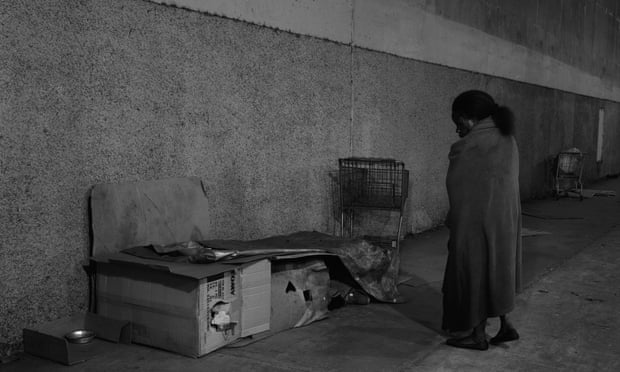
His work Approach (2014) shows a homeless woman standing by cardboard shelter, it’s contentious as he admits that this took a month to recreate but not whether the woman was an actor or not.

Approach 2014 (O’Hagan, 2015)

 Listener (2015) shows a kneeling, shirtless man speaking to the leader of a group gathered around him in a bleak, harshly sunlit place. Wall describes this as something you could see in reportage but omits to tell whether it is actually a moment that he’s seen previously.

  listener 2015 (O’Hagan, 2015)

I like the suggestion that “his practice is one that investigates the effects and meanings of documentary photographs” (Photography is still just evolving, 2020). His work certainly make you reflect on what is documentary and there is a value to this. Wall calls his work a “blend of actuality, reportage, performance, reconstruction and composition” an art form – but is it documentary, I’m not convinced, for me this rests on whether an image was rooted in reality and him being honest about all elements of it.

References:

O’Hagan, S. (2015) ‘Jeff Wall: ‘I’m haunted by the idea that my photography was all a big mistake’’ In: The Guardian 03/11/2015 At: http://www.theguardian.com/artanddesign/2015/nov/03/jeff-wall-photography-marian-goodman-gallery-show (Accessed 26/10/2020).

Open College of the Arts (2014) Photography 2: Documentary-Fact and Fiction (Course Manual). Barnsley: Open College of the Arts.

‘Photography is still just evolving’: Jeff Wall in conversation with It’s Nice That (2020) At: https://www.itsnicethat.com/features/jeff-wall-in-conversation-photography-270819 (Accessed 26/10/2020).

O’Hagan, S. (2015) ‘Jeff Wall: ‘I’m haunted by the idea that my photography was all a big mistake’’ In: The Guardian 03/11/2015 At: http://www.theguardian.com/artanddesign/2015/nov/03/jeff-wall-photography-marian-goodman-gallery-show (Accessed 26/10/2020).

Next Post: https://nkssite5.photo.blog/category/research/a3-research/research-point-murrell-starkey/

PART 3 A COLOUR VISION: PROJECT DOCUMENTARY, PERFORMANCE AND FICTIONS

Exercise: Think Global act local

Read the article ‘Think Global, Act Local’ by Diane Smyth (Tom Hunter November 2012): http://www.tomhunter.org/think-global-act-local/

Research Tom Hunter’s work at http://www.tomhunter.org/html/news.php

Finally, listen to Tom Hunter talking about one of his most iconic images, Woman reading a possession order, on Radio 3: http://www.bbc.co.uk/programmes/b00zt7ky

Summarise your thoughts in your learning log or blog (Open College of the Arts, 2014:76).

Tom Hunter explores local themes in Hackney with his photography, drawing on references from art and history. Hunter say that historical references are there to give gravity to his subjects; using fiction in his work, lighting, posing and staging, simply recreates real life stories. His image “Woman Reading a Possession Order” of a girl reading an eviction order was real, but restaged staging to accentuate the detail, the emotion, the moment.

In the interview he talks about the influence of Vermeer and the Dutch School of painting on his work which began whilst working his college degree. Hunter describes Vermeer as a revolutionary who with “release and social commentary raises ordinary people to a higher level” (Tom Hunter, 2011). Vermeer’s relationship to his local world, focus on minute details and emphasising them led Hunter to use large format photography to capture his locality. Hunter says that he aims to present local stories as Vermeer did with dignity, light, beauty, and space (Tom Hunter, 2011) and continues to use his approach and way of looking.

He has continued his adding historical (fictional) approaches/influences to his work. In Unheralded Stories (2008-2009) his images show the myths that have built up around his community and his photographs reference historical tableaux paintings.  

(Tom Hunter, 2011)

 His series of tableaux Living in Hell and Other Stories (2003-2004), was inspired by Thomas Hardy where Hardy interwove local newspaper articles into his novels; here Hunter interweaves headlines from the Hackney Gazette with images to create social commentary.

(Tom Hunter, 2011)

I don’t believe his use of fictional elements makes his work less truthful, and I think his reasons for using historical influences adds some gravity to the issues he is portraying. It does of course help him to market his work as Art and increases his commerciality; listening to him I don’t think this was his initial motivation and his social messages remain strong, his work is art with social impact.

My learning: Consider using fictional/historical elements, and in particular the use of newspaper articles in my documentary work to support my images with text.

References:

Open College of the Arts (2014) Photography 2: Documentary-Fact and Fiction (Course Manual). Barnsley: Open College of the Arts.

Think Global, Act Local (2020) At: http://www.tomhunter.org/think-global-act-local/ (Accessed 26/10/2020).

Tom Hunter (2011) In: BBC At: https://www.bbc.co.uk/programmes/b00zt7ky (Accessed 26/10/2020).

Gallery (2020) At: http://www.tomhunter.org/gallery/ (Accessed 26/10/2020).

Next Post: https://nkssite5.photo.blog/category/coursework/part-3-a-colour-vision/project-documentary-performance-and-fictions/exercise-hasan-and-and-husan-essop/

PERFORMATIVE DOCUMENTS

Exercise Constructed realities with Hasan and Husain Essop.

View the video on Hasan and Husain Essop at the V&A exhibition Figures and Fictions and write a short reflective commentary in your learning log or blog. http://www.vam.ac.uk/content/videos/f/figures-and-fictions-hasan-and-husein-essop/ (Open College of the Arts, 2014:80)

Living with the constraint that they may not put pictures of people on their wall, they have developed a performative art in its place. They debate and agree an idea, then construct a tableaux using themselves and a camera on a tripod, directing and performing in turn. Their work addresses Muslim identity and taboos. Its unfortunate that I can’t see their work on a website for instance but the examples shown are extremely realistic and could easily be media images.

That being said I wouldn’t endorse their work as documentary, because most often they are creating tableaux and then images of things they’ve not seen but have imagined. Their work is also heaviy processed and altered so that they can reuse themselves within one scene. Overall I would say they are brave and very creative but are making art rather than documentary images.

Reference:

Figures & Fictions: Hasan and Husein Essop – Victoria and Albert Museum (2011) At: http://www.vam.ac.uk/content/videos/f/figures-and-fictions-hasan-and-husein-essop/ (Accessed 26/10/2020).

Open College of the Arts (2014) Photography 2: Documentary-Fact and Fiction (Course Manual). Barnsley: Open College of the Arts.

Next Post: https://nkssite5.photo.blog/category/exercise-jeff-wall/

PART 3 A COLOUR VISION: PROJECT A BRITISH TRADITION

Exercise: Peter Dench  

Read the article on England Uncensored by the BBC Picture Editor Phil Coomes: http://www.bbc.co.uk/news/17190001.Dench talks about his “humorous approach with an underlying social commentary”. What do you think of this approach? Does it work? What are the ethical issues? (Open College of the Arts, 2014:77)

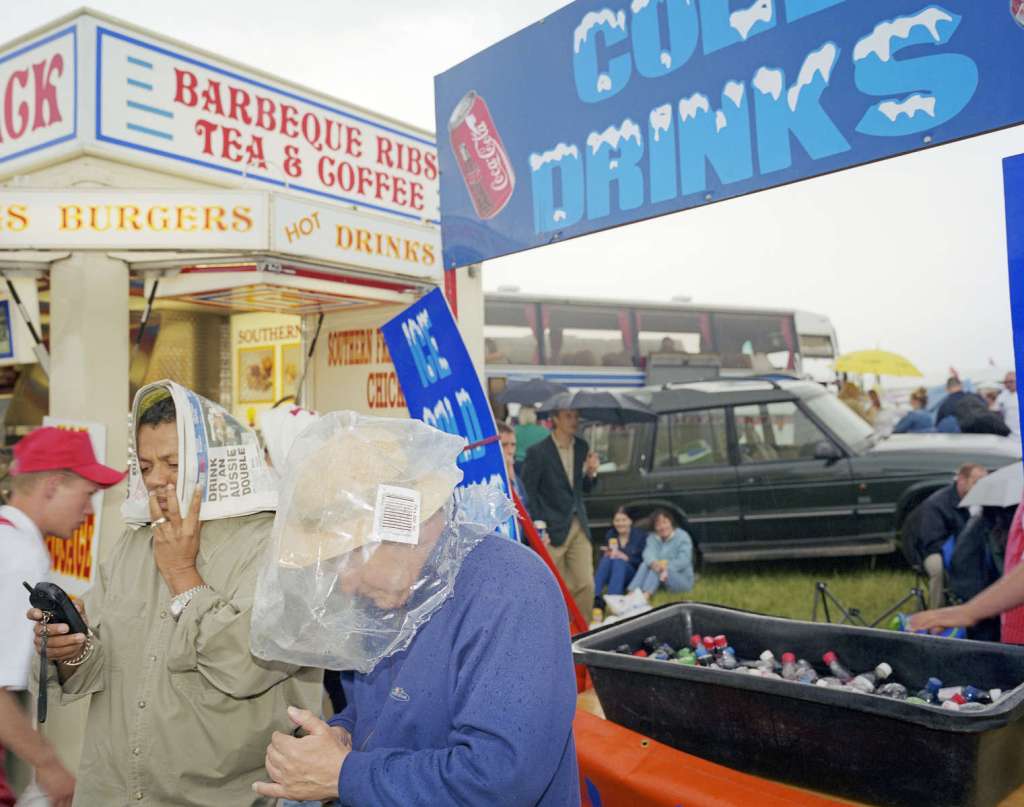
His book England Uncensored (2012) is described in the above article as a social commentary with a voice, Dench describes it the truth warts and all (Neon Sky Creative Media System, 2020). I was interested to read that it was his editor who pushed Dench to move away from his early pictures which are described as simply humorous.

England uncensored (Neon Sky Creative Media System, 2020)

The success of his Drinking of England series encouraged him to to look for further social themes such as ethnicity, love, the weather, clothing and food. Dench believes he is documenting reality to preserve “the nations past” (Coomes, 2012).

The humour in his work comes from his upbringing by the sea and seaside humour; he recognises that pictures can’t be funny alone but should have an effect/message, Dench suggests this can be achieved by dropping images in between them that are different/serious/have impact. He thinks people respond favourably to his humour because most can identify with it.

In some of his work, in fact most if The English Uncensored I agree with his sentiments. I can see that most of his work follows the route of social commentary, though I think it lacks the conceptual nature of Parr, whose influence on his work he is open about. He also uses saturated images and flash in daylight but in a more “smash and grab” perhaps influenced by contemporary media photographers.

Whilst his approach works, selecting and presenting to us contemporary subjects isolated to highlight behaviour/situations, I do question his ethics in some of his work. In particular I find his series The English Summer Season (2019) and Alcohol and England (2014) contain images which are over-exposing and humiliating to individuals. Ethics is a difficult field but to my mind he presents some images where subjects though in public places, they were clearly not in possession of their faculties and are shown in compromising positions.

(Neon Sky Creative Media System, 2020)

Dench may argue that his pictures are honest and humorous, this may be so in the main however some I believe go beyond this and are potentially damaging to subjects and unnecessary.

References:

Ben Smith (2015) A Small Voice Podcast – 010 Peter Dench At:   https://bensmithphoto.com/search?q=dench&f_collectionId=558f13b0e4b0b62583b2124a (Accessed 13/09/2020).

Coomes, P. (2012) ‘England Uncensored by Peter Dench’ In: BBC 29/02/2012 At: https://www.bbc.co.uk/news/17190001 (Accessed 25/10/2020).

‘Drunkenness and debauchery!’: Peter Dench captures events of English gentility (2020) At: https://www.itsnicethat.com/articles/peter-dench-the-english-summer-season-photography-030919 (Accessed 26/10/2020).

Neon Sky Creative Media System (2020) england uncensored. At: http://www.peterdench.com/england-uncensored/England_Uncensored01/ (Accessed 25/10/2020).

Open College of the Arts (2014) Photography 2: Documentary-Fact and Fiction (Course Manual). Barnsley: Open College of the Arts.

Next Post: https://nkssite5.photo.blog/category/coursework/part-3-a-colour-vision/project-documentary-performance-and-fictions/exercise-think-global-act-local/