Exercise: Jeff Wall
Read the article on Jeff Wall in Pluk magazine. Core resources: pluk_JeffWall.pdf. Briefly reflect on the documentary value of Jeff Wall’s work. (Open College of the Arts, 2014:80).
I have researched Jeff Wall before in an earlier OCA course. This article is a review of Wall’s exhibition at the Tate of his works 1978-2004. It is a showcase of his “fakery” stitching images together, purpose made sets, huge images lit with massive lightboxes, and the cinematography which hallmarks his work. Wall insists that this is just a way of reassembling details after an event, as the pictures are made from his experience; though it’s suggested that the photograph’s meaning is in what is absent.
Wall’s cinematographic technique is described as “near documentary”, suggesting that his work The Invisible man (1999-2000) shows that Wall’s work sits between story telling and photography. Near photography is also the way Wall describes his work as recreations of moments made afterwards.
Wall explains that whilst some photographers like Winogrand or Frank capture moments as they happen he feels he has the licence to see/experience but recreate them carefully which he wouldn’t have been able to do at the time; in this way he doesn’t miss opportunities (Photography is still just evolving, 2020). His work could be mistaken for reportage, but in the spirit of what Anna Fox believes, he is partially honest about the way he fabricates his images, drawing attention to the fabricated nature of his images; and that being so, the mistake would be the viewers as he is not misleading them.
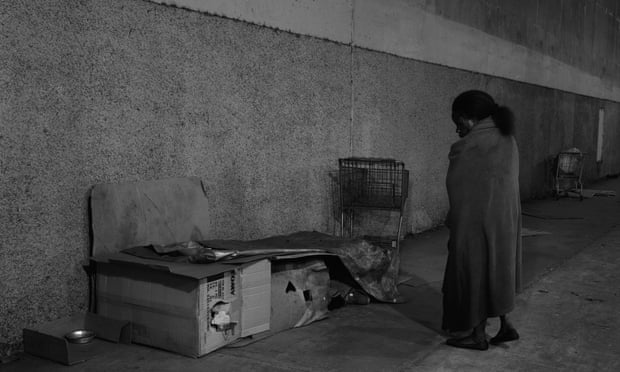
His work Approach (2014) shows a homeless woman standing by cardboard shelter, it’s contentious as he admits that this took a month to recreate but not whether the woman was an actor or not.
Listener (2015) shows a kneeling, shirtless man speaking to the leader of a group gathered around him in a bleak, harshly sunlit place. Wall describes this as something you could see in reportage but omits to tell whether it is actually a moment that he’s seen previously.

I like the suggestion that “his practice is one that investigates the effects and meanings of documentary photographs” (Photography is still just evolving, 2020). His work certainly make you reflect on what is documentary and there is a value to this. Wall calls his work a “blend of actuality, reportage, performance, reconstruction and composition” an art form – but is it documentary, I’m not convinced, for me this rests on whether an image was rooted in reality and him being honest about all elements of it.
References:
O’Hagan, S. (2015) ‘Jeff Wall: ‘I’m haunted by the idea that my photography was all a big mistake’’ In: The Guardian 03/11/2015 At: http://www.theguardian.com/artanddesign/2015/nov/03/jeff-wall-photography-marian-goodman-gallery-show (Accessed 26/10/2020).
Open College of the Arts (2014) Photography 2: Documentary-Fact and Fiction (Course Manual). Barnsley: Open College of the Arts.
‘Photography is still just evolving’: Jeff Wall in conversation with It’s Nice That (2020) At: https://www.itsnicethat.com/features/jeff-wall-in-conversation-photography-270819 (Accessed 26/10/2020).
O’Hagan, S. (2015) ‘Jeff Wall: ‘I’m haunted by the idea that my photography was all a big mistake’’ In: The Guardian 03/11/2015 At: http://www.theguardian.com/artanddesign/2015/nov/03/jeff-wall-photography-marian-goodman-gallery-show (Accessed 26/10/2020).
Next Post: https://nkssite5.photo.blog/category/research/a3-research/research-point-murrell-starkey/
 Photography 2: Documentary