Exercise: Think Global act local
Read the article ‘Think Global, Act Local’ by Diane Smyth (Tom Hunter November 2012): http://www.tomhunter.org/think-global-act-local/
Research Tom Hunter’s work at http://www.tomhunter.org/html/news.php
Finally, listen to Tom Hunter talking about one of his most iconic images, Woman reading a possession order, on Radio 3: http://www.bbc.co.uk/programmes/b00zt7ky
Summarise your thoughts in your learning log or blog (Open College of the Arts, 2014:76).
Tom Hunter explores local themes in Hackney with his photography, drawing on references from art and history. Hunter say that historical references are there to give gravity to his subjects; using fiction in his work, lighting, posing and staging, simply recreates real life stories. His image “Woman Reading a Possession Order” of a girl reading an eviction order was real, but restaged staging to accentuate the detail, the emotion, the moment.
In the interview he talks about the influence of Vermeer and the Dutch School of painting on his work which began whilst working his college degree. Hunter describes Vermeer as a revolutionary who with “release and social commentary raises ordinary people to a higher level” (Tom Hunter, 2011). Vermeer’s relationship to his local world, focus on minute details and emphasising them led Hunter to use large format photography to capture his locality. Hunter says that he aims to present local stories as Vermeer did with dignity, light, beauty, and space (Tom Hunter, 2011) and continues to use his approach and way of looking.
He has continued his adding historical (fictional) approaches/influences to his work. In Unheralded Stories (2008-2009) his images show the myths that have built up around his community and his photographs reference historical tableaux paintings.
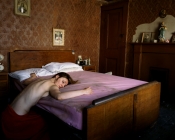
His series of tableaux Living in Hell and Other Stories (2003-2004), was inspired by Thomas Hardy where Hardy interwove local newspaper articles into his novels; here Hunter interweaves headlines from the Hackney Gazette with images to create social commentary.
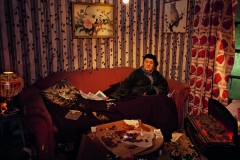
I don’t believe his use of fictional elements makes his work less truthful, and I think his reasons for using historical influences adds some gravity to the issues he is portraying. It does of course help him to market his work as Art and increases his commerciality; listening to him I don’t think this was his initial motivation and his social messages remain strong, his work is art with social impact.
My learning: Consider using fictional/historical elements, and in particular the use of newspaper articles in my documentary work to support my images with text.
References:
Open College of the Arts (2014) Photography 2: Documentary-Fact and Fiction (Course Manual). Barnsley: Open College of the Arts.
Think Global, Act Local (2020) At: http://www.tomhunter.org/think-global-act-local/ (Accessed 26/10/2020).
Tom Hunter (2011) In: BBC At: https://www.bbc.co.uk/programmes/b00zt7ky (Accessed 26/10/2020).
Gallery (2020) At: http://www.tomhunter.org/gallery/ (Accessed 26/10/2020).
PERFORMATIVE DOCUMENTS
Exercise Constructed realities with Hasan and Husain Essop.
View the video on Hasan and Husain Essop at the V&A exhibition Figures and Fictions and write a short reflective commentary in your learning log or blog. http://www.vam.ac.uk/content/videos/f/figures-and-fictions-hasan-and-husein-essop/ (Open College of the Arts, 2014:80)
Living with the constraint that they may not put pictures of people on their wall, they have developed a performative art in its place. They debate and agree an idea, then construct a tableaux using themselves and a camera on a tripod, directing and performing in turn. Their work addresses Muslim identity and taboos. Its unfortunate that I can’t see their work on a website for instance but the examples shown are extremely realistic and could easily be media images.
That being said I wouldn’t endorse their work as documentary, because most often they are creating tableaux and then images of things they’ve not seen but have imagined. Their work is also heaviy processed and altered so that they can reuse themselves within one scene. Overall I would say they are brave and very creative but are making art rather than documentary images.
Reference:
Figures & Fictions: Hasan and Husein Essop – Victoria and Albert Museum (2011) At: http://www.vam.ac.uk/content/videos/f/figures-and-fictions-hasan-and-husein-essop/ (Accessed 26/10/2020).
Open College of the Arts (2014) Photography 2: Documentary-Fact and Fiction (Course Manual). Barnsley: Open College of the Arts.
Next Post: https://nkssite5.photo.blog/category/exercise-jeff-wall/
 Photography 2: Documentary