Virtual study event: Susan Bright – Collaboration & Creative Practice
In conversation with Arpita Shah and Dan Robinson (OCA) 2.6.20:
When asked about her current work, that she is now reassessing things. In a discussion on ageism she explained she is very much against any limits being set of any kind.
Bright did a PHD in curating and now a curator and writer. In he lecture she says that photographic practice is inherently collaborative. Bright considers what curating can be, and its possibilities when working with others, such as, photographers, assistants, and writers.
She talked about her her Guest Curation of PHotoESPAÑA 2019 working with 5 artists, including Elina Brotherus and Clare Strand. It is interesting the way she curated Elina’s solo exhibition “Playground”, with the exhibition designer and Elina being very involved; the exhibition space is site specific and printed in some places to fit curved wall and book of cards with instructions that can be used as a game. I found it especially interesting how when curating Elina’s work about Mothering she paced the photographs on shelves like family pictures. Strands work in the exhibition was about photography’s inability to communicate especially if you don’t know the context so work must be placed in the context of where we’re living now.
SHE DISCUSSED THE WORK OF:
Sharon Core whose work is about shifting communication; the work is photographs of paintings which means there is some misinformation about the original work. This was placed with the work of Laura Letinskies, in the exhibition “double take”; her work is about how we understand and consume photography.They both use the strategy of disruption, which Bright recognises in her curating
Delio Jasse work: O Outro Capitulo. Uses items from flea markets as people are selling things as they move upwards where he found photos of a Portuguese family who had relocated to Angolia, and he reproduced them with liquid light and painted on them related official documents such as passports and has layered up identity.
Patrick Pound collects rather than photographs images and objects and it only become art once he’s put them in an exhibition. His art is curatorial; For instance his exhibition “Air” includes pan pipes, model airplanes, images of someone blowing and so on; this was site specific as the objects were all drawn from the museum. This completely changes the relationship between artist and curator as he publicises criticising editing and staging the show.
Bright talked about the collaboration that she’s used in her book Art Photography Now, and Auto Focus, which I have and must revisit. Both projects highlight the in-flux nature of her work and the various roles a curator and those she collaborates with play.
My learning:
To consider more carefully the role the curator plays
To consider working collaboratively – Though I do increasingly as I participate more and more in forums, hangouts and zoom meeting outside of the OCA.
Think creatively when planning gallery layouts – consider adapting work to suit the space it is showed in.
Note to self: Check out book Home Truths Photography and Motherhood foreword
Anna Fox Photographer and Professor photography at Thames Valley OCA virtual meeting 16.5.20
Believes in FRICTION (fact a fiction in photography), she’s not an historian but reads history of photography all the time.
When she studied in 1980s, colour documentary was going on, she wanted to exhibit and publish it, and has done with many books including, Work stations, Blink, in many different designs and fabrics. Fox edits Langford’s basic photography The guide for serious photographers also Behind the Image Research in photography with Natasha Carvana (I have, however a new chapter is coming in the next edition). She has been teaching since 90s (Farnham University) which she says is one of the best in the world for documentary photography, and runs MFA at Farnham (2 year program); a collaboration with the National Institute of Design in India. I asked her about this.
Her Father was a keen amateur photographer, her mother was at art school, then publishing and graphic design, so her home was full of books, including those on photography. Both photography and fiction and comedy inspire Fox. She explained that stories teach you how to construct narrative, and how to use text and images. Fox says to think of text as you think of images, so it doesn’t feel like it’s image added to text, or vice versa, it should feel like one work (as Sophie Calle does); consider carefully, font, sentence breaks, to give the significance and the emphasis you want. Fox doesn’t like to see text added at the end of a project as it should take as much time to work out as the images do.
SHE TALKED MUCH ABOUT STAGED REALITIES:
Cartier- Bresson’s work which she described as broken fractions of a second and asks, is this reality, or is it the equivalent of staging and composing?
Fox talked about other examples of construction, such as payment for photographing people, like Edward Curtis when photographing native Indians in the early 1900s. She suggested that payment can lead to over exaggeration of the dress and character of subjects. Fox also cited the famous Dorothea Lange’s Migrant Mother, which we now know was posed; I didn’t realise that Lange had a big commercial career and was used to staging images
She asked us if a Robert Capa photograph “Fallen Soldier” from the Spanish Civil War was staged and explained that his editor in America put under one of his pictures “war doesn’t look like much”, and this could have led him to construct and dramatize his pictures more.
The book Falkland Road where the subject is a street of prostitutes in Mumbai, Mary Ellen Marks paid her subjects.
Philip Lorca decorcia paid prostitutes for his images in Hustlers, though he acknowledged this and titled the photos the price he paid each (which was what they would have earnt). The commissioners thought that ethically unsound, fox thinks otherwise.
“Everyone” (1994) https://sophie-ristelhueber.format.com/untitled-gallery inspired her book My Mothers Cupboards. The work with images of scars is presented alongside references to war in Yugoslavia so it looks like its injuries from the war then discovered that these pictures were from people post-surgery, it was not as Anna first thought when she viewed the work.
Fox also discussed Photo montage such as that of Blair in front of an inferno – more staging of photography that can aid fantasy.
Photographers who emerged out of American photography that make fabrication is viable such as Gregory Crewdson.
The Emigrants book by W G, Sebald where the narrator recounts his involvement with and the life stories of four different characters, all of whom are emigrants (to England and the United States). It includes many black and white, unlabeled found photographs and creates a reality about them inserting them in the story, so you feel like you’re reading a documentary.
Didier Massard whose book with strange animals in it had an ISPN that would place it in the natural History department and yet it was fabricated photographs; the animals and fauna looks like actual animals but as you proceed through the book you realise the photos are of imaginary creatures; it is both funny and fascinating,
Joan Fontcuberta (1997) project is a parody, where he becomes a journalist in order to tell the supposed history of the first initiative of the Foundation Sputnik. In order to give the story authenticity, the artist incorporates a large number of historical documents, but also if you look closely you can see that he is in each of the images; it’s both funny and fascinating.
Interestingly Fox asks why were people disappointed that sitters were paid? Someone suggested it might matter if a photographer claims the image is real. Fox answered that if they won’t say which, then the suspense can be useful, however if it’s relevant it is important to say whether staged or not.
Fox thinks of herself as an author with various different connections to truth.
She lists amongst her teachers: Karen Knorr, Martin Parr, Paul Graham; they influenced her in different ways, Knorr with her printing, lighting, Parr with lighting, flash and colour, and Graham with making banality and melancholy everyday interesting, and overall how to get these things into photographs, beauty, satire, and meaning, with an intelligent story and a sense of humour.
Her first body of work was Basingstoke 1985/86 (35 images) which hasn’t been published which means she can now add images. She chose this subject as it was a small town nearby and didn’t want to travel but did want to tell a story of thatcher’s Britain. In this work she describes the colour, flash and humour of Parr, the structure, image/text irony of Knorr, and the banality of subject from Graham. Making this she collected text at the same time as images not thinking about what goes with what at this time, editing as she went along, with just the feeling she wanted to inspire, be humorous, but no more, it was then she realised she had her own voice.
Workstations was her 2nd commission, the subject of Office life in London, again in Thatcher’s Britain; this showed aggressive pursuit of wealth and success. The text makes it look like it’s shot in one office (with the daily timings added) but it isn’t. After this she was then asked to emulate this style but couldn’t do it as the meaning of individual work is wrapped up in its style.
Cockroach Dairy (1996-99) a story of a real invasion of her house, using a real diary she’d kept. Fox kept the feeling of authenticity with the book design, though she had to rewrite diary so it would print well and then added in some real-time events. She used film and autofocus, as cockroaches moved quickly, and consequently had little control over framing. The cockroaches get bigger as go through book, then the cockroaches disappear, and the house is sold.
My Mother’s cupboards and my Fathers words (2000) -the information “my father’s words” is hidden on the back cover, is not just about her mother and her father, but about relationships in general.
Her father’s words were directed at all women in his house and pictures of her Mother’s cupboards. It is both nasty and funny; Fox secretly wrote down the words under the table , She explained how she choose which images with which text such as “She’s bloody rattling again” using wine glasses as the image as they rattle. Sometime the images are chosen as juxtapositions.
Q: As her father was ill at the time does this explain the narrative? A: no because he was always like this, though maybe it was exaggerated, though it may have made him less physically aggressive and more verbally aggressive. Apparently Her father thought it was funny but her mother was upset about the book. This is an example that work doesn’t always come out immediately, this work was made 20 years ago and is now being exhibited.
Fox talked of her Peers:
Hannah Starkey– fox suggests her work is about women in public spaces however Starkey doesn’t tell people about her images. These are constructed images with actors but linked to reality.
Tom Hunter who has emulated Vermeer and turned on head ways of photographing squatters making them look heroic. He works on the Hackney community.
Gillian Wearing, asking us to question her work with people holding texts, is this reality or not. Fox says that this shows you that portraits on their own don’t generally tell you much.
Goldfrapp the singer who Fox collaborated with on the book Country girls 1996-2001, she grew up in the same rural village. She posed for fox’s deliberately staged images as a dummy half-dead, using flash again. We discussed the meaning of Sweet FA; I was unaware that Fanny Adams was murdered at 8yrs at nearby Alton, chopped to pieces supposedly by a bank clerk; Apparently a tinned meat brought out for sailors which they named Sweet Fanny Adams but changed to “Sweet Fuck All” as it was so tasteless. There was a local fascination with the vulnerability of women.
Photographers who surprised her:
Roger Ballen a South African photographer who developed a style he describes as ‘documentary fiction’. His photography has a performance element to it as well as incorporating drawings, painting, collage and sculptural techniques to create elaborate sets; here there are no people altogether, replaced by photographs of individuals now used as props, by doll or dummy parts or but improvised scenarios’.
Trish Morrissey a fellow student at RCA, whose series Front, places herself in family photographs on beaches, replacing a family member.
Alison Jackson another fellow student at RCA, who uses spoof style of photojournalism on royals and celebrities. She published a series of satirical photos featuring spot-on Trump impersonator in a fake Oval Office, surrounded by scantily-clad beauty contestants and then caused a stir in New York by hiring the lookalike—and more underdressed models—to appear in headline-grabbing performance piece outside of Trump Tower.
Chris Dorley-Brown whose images are startling coloured and sharp; they look like they’re acted out but they’re not, they’re just taken over time (he stayed put for hours and photographed and added images together) to make narratives about city life.
Alex Prager, her work Face in the Crowd, features large-scale photographs of elaborately staged crowd scenes, often with the subject looking disarmingly straight at the photographer. Her work comes out of documentary but she’s deliberately working with the idea of fiction.
Susan Lipper, her workDomesticated Landabout the wilderness has becoming occupied with traces of human presence. Apparently she wouldn’t want it to be called a documentary but as artistic work that shed created as she likes to work with fiction. She spends a long time editing to order as series images and changes the order -so look at how she decides this and the meaning of one on another.
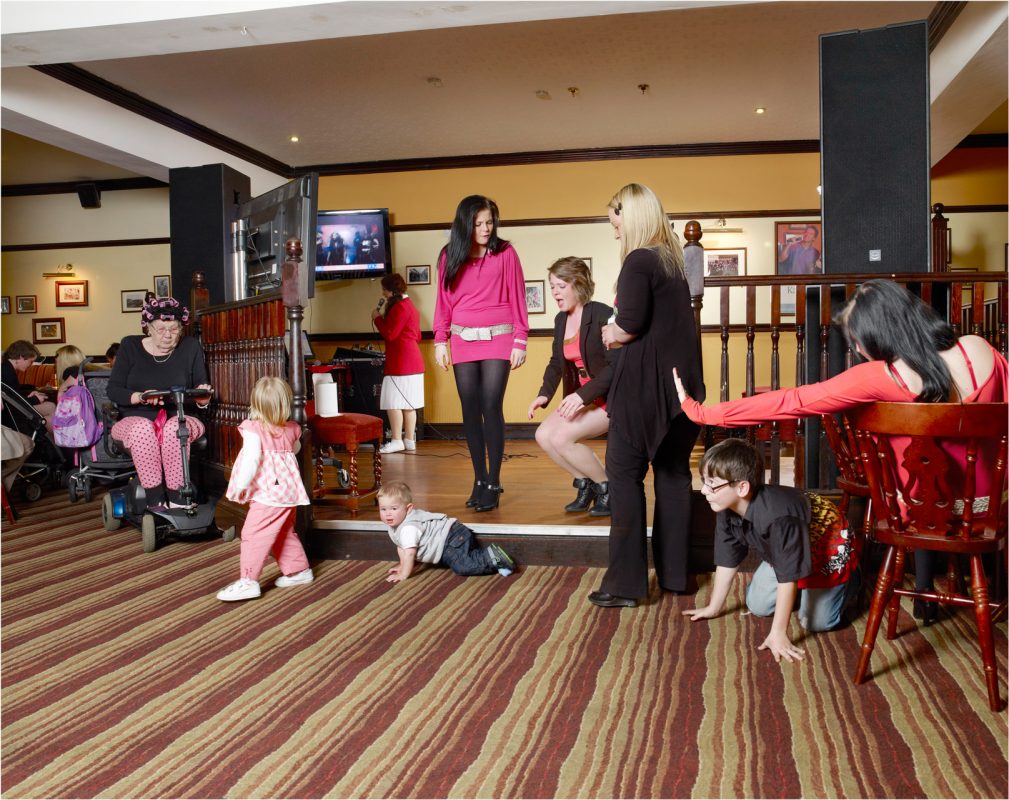
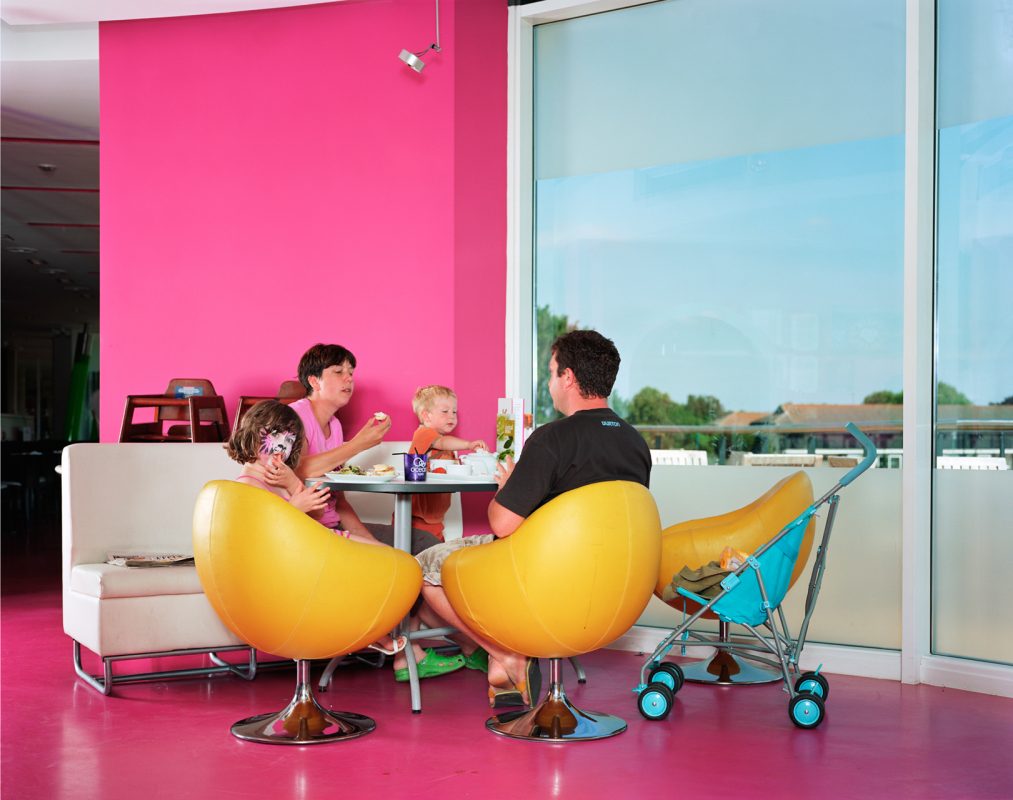
Fox then talked about her work Resort 1 and 2 made at Butlins with a Medium format camera and flash. Even she felt awkward as people were on holidays and not interested as they think you’re selling something and intruding. So decided to make documentary work with a lighting director and team which worked as people thought they were a film crew and liked being in the pictures. In the pictures that holiday makers were using flash at the same time as herself she made the same comments as Martin Parr did that as other lights were going off with hers, the lightening was wrong but she joined together to get the correct effect.
(Anna Fox, 2020)
It was useful to hear that when shooting a Karaoke image after 4 hours didn’t get one image she liked, so she stitched several images together. Butlins banned the image below from the exhibition as it wasn’t the image they wanted to promote – the woman on the mobility scooter.
(Anna Fox,2020)
Similarly, an image of a family round a table took 3 hrs. for her to get and eventually she joined 3 images together.
(Anna Fox, 2020)
In her work “A moon and a smile” Fox took archive images of French leisure spaces and then took photos today of same leisure spaces now as they are accessible to more. She photographed over 8 hours and added people to the images.
(Anna Fox, 2020
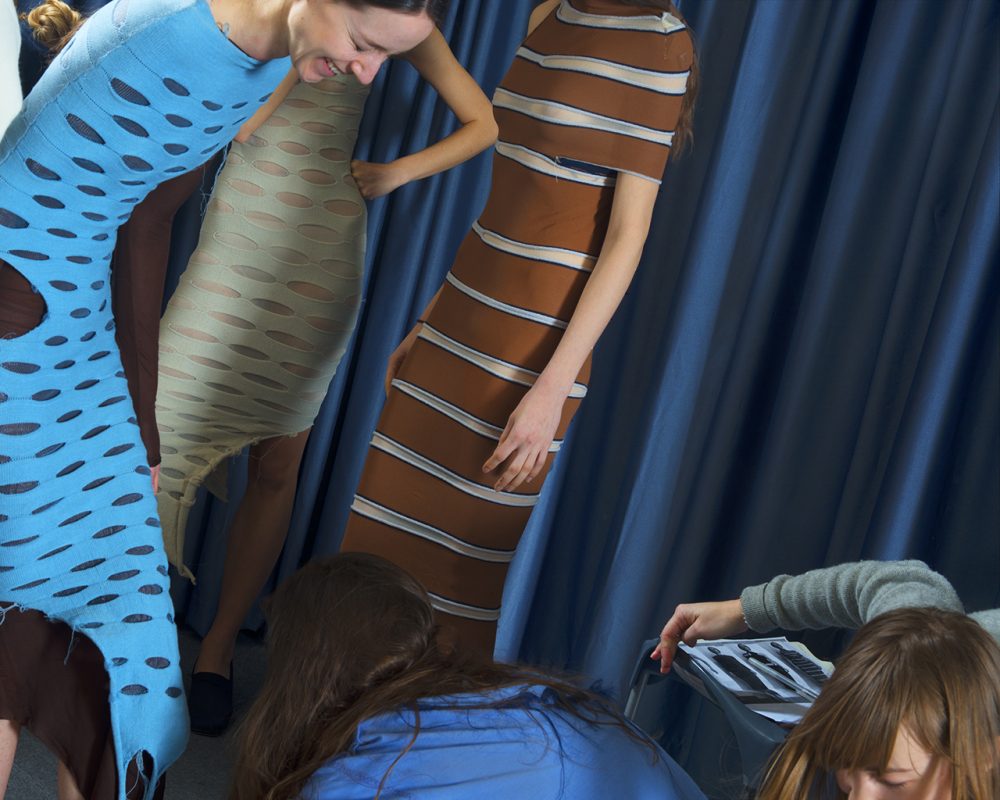
Blink her new work was shot at central St Martins. When the students were asked afterwards they didn’t recognise the place – so it’s her fiction of the space. She shot this in digital because she was short of time, and is more convinced of it as a tool now as the quality so good. She says that analogue is expensive not used much, so maybe if going to use do most of the work on digital and the final on analogue – Digital has democratised the media,
(Anna Fox,2020)
On her involvement with the project Fast forward, began with conference at Tate modern (I tried to get tickets) there have now been 3 conferences. Fox believes that women in photography not been talked about or recorded enough and she thinks it has a lot to do with networking as they don’t seem to be able to do it in the same way as men.
Q & A:
How do you think men network? They promote and help each other as a group effort to move upwards for women more individual struggles to get on because not enough success. Women have networks were pushed into by the patriarchal society like domestic roles but not professional. We must take responsibility without blame. We need to do it ourselves and then work equally with men; not believing in yourself is a problem especially for women. Fox says that it’s important to see and understand the working practices of women photographers.
How do you decide which award opportunities are worthwhile? Look at reputation and don’t to enter pay except Taylor Wessing for instance where they’ll use the money to fund the prize. Do judges look at the name of the photographer? Look at judges and what their background, their criteria. It’s about exposing your work to people you want to know you Same as for portfolio reviews. Remember to get your work checked so you’re sure it’s not there because of an emotional attachment.
What extent does research play in your photography? It’s huge but don’t necessarily record it, it does play a big role in her photography, particularly fiction – likes to be informed, don’t forget to articulate your research.
Where is the line between documentary work to raise awareness, and pointing the camera downwards? You have to make yourself a good enough photographer to be telling the story in the right way, intention is important. It is important how you represent people, she doesn’t like to feel uncomfortable about work.
Regarding projects she suggests keep your proposals fluid, so that you can change it as it develops and then evaluate to justify your changes. Fox says context is everything; Work should give people space to think speak about something
LEARNING POINTS:
Overall I learnt a lot about the possibilities for “FRICTION” the fusion of fiction and documentary photography. I also picked up many other ideas:
Consider using fiction to support ideas for my photography
When using text and images integrate as one body of work. Consider carefully, sentence breaks, font and emphasis.
Be aware of the variety of types of staging possibilities.
Think about all possibilities of book design, suit the design to the project.
Remember that even for experienced photographers it can take a long time to get an effective shot.
Don’t forget to fully articulate your research.
Intention and integrity in your work is important
Ensure your work gives people something to speak about.
The Photographers Gallery Slow Looking Mohamed Bourouissa 16.5.20
Mohamed Bourouissa (b. in 1978 Algeria) he works across photography, video, painting and sculpture. His practice often examines socio-economic processes, invisible tensions between different social milieus and the related cultural divisions. In his artist talk at the gallery he says his work is about identity, generation, resilience and the mechanisms of society. He uses photography as it is easy to capture everything quickly. He gives the subjects picture to help to create trust. He hopes it helps people to understand their own histories.
Slow looking virtual event
Bourouissa immerses himself in communities and the media he uses, the 3 images are from 3 separate projects over a 15 year period where he looks to communities at the margins.
Image 1: Shoplifters series
(Slow Looking, Mohamed Bourouissa, 2020)
The slow looking description:
Thin dark walnut covered frame, thick cream coloured border.
Man facing photographer
Man pan partially turned
Dark skinned, facial features
Wearing…
Difficult to make out … because of the graininess of the photograph
Facial expression
Seems as he says to the photographer as the photograph is taken
Tide bottles bleached bright light (flash me)
Is standing in convenience store…description
Description of shelves either side of the man
The series is made up of appropriated portfolio of polaroids of shoplifters the shop owner had already take. Each photograph depicts and individual who has been caught stealing items from the store. The store owner allows them to take the products free of charge if they agree to pose for a photograph. The artist says that it illustrates the mechanisms of power within photography. There is the sense of amusement in the portraits.
Comments/questions:
I’m surprised he was a shoplifter. I thought to start with he was working there.
Did the shop owner display the photos then?
Where was the shop? Yes the shop is in Brooklyn.
It makes explicit the transaction between photographer and subject.
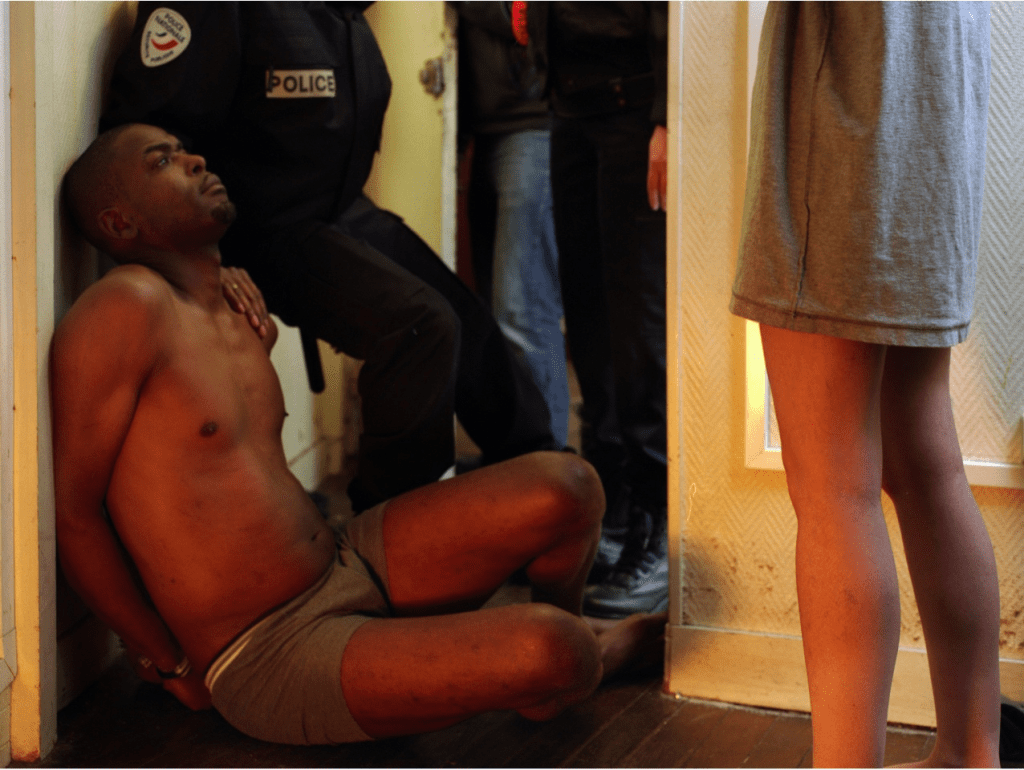
Image 2: Le Prise: The catch –Periperique series (2005 & 9)
(Slow Looking, Mohamed Bourouissa, 2020) This image was taken 2008 and is currently on show at TPG
The slow looking description:
Landscape framed with a thin white frame with a white border
Around the size of a kitchen cupboard
On the right
Detail of wallpaper which is hard to see
Door frame framing the left of the image
Details in the background non human: The floor
The figures, where they are supple
The figure in the foreground description in minute detail, his expression
The other figures starting with the one nearest him restraining him, then the other two sets of legs and what they suggest about the individuals.
Back to foreground standing figure, raises questions about why we cant see their arms, are they held up?
The lighting doesn’t look totally natural to tell what time of day it is, but looks like a warmly toned light behind
I didn’t realise on viewing this and listening to the audio description that this image was staged. Apparently this series sets out to subvert the common stereo types of youths, living in the infamous suburbs of Paris creating a sensitive depiction of an often demonised community. The title of the series references the ring road that defines central Paris from the suburbs as well as the peripheral stories of the populations living there. Bourouissa grew up in these suburbs, which have been known for fierce riots. He required the complicity of the subjects and he situated himself as both director and implicated witness in each image. Each is distinctly framed and considerately cropped with the character caught in a situation of disturbance, he said he wanted to represent those that are generally only portrayed by news photographer and lift them from social representation to a more classical realm of representation form social documentary into the field of aesthetics. The heart of this project is internal tension. Here he plays on certain ambiguities and play on poetic conventions
Peripheral suburbs and the lives of these people. They are based on art historical references placed against everyday events on the outskirts of Paris and reframe photojournalist approaches to change understanding of these situations
Comments and questions:
Caroline comments that the images do have a religious feel to them
I find his facial expression very interesting. You mentioned it looks irritated but for me he looks almost in despair -The restrained man looks extraordinarily dignified, almost resigned to his fate -It feels like a Christian/religious image to me – Yes it looks very biblical- Reminds me of Caravaggio like Italian Renaissance painting
I think the way you described the sets of legs in the previous image was as the artist would have liked as it added to the ambiguity
Image 3: Nous Sommes “Halles”: We are Halles 2002-3
Slow Looking, Mohamed Bourouissa, 2020)
The slow looking description:
Around the size of a dining table that seats 8, not framed but held by metal poles
Describes the background, a central district in Paris
Describes the background figures
Describing the main foreground subject … looks confident as she stares into the lens the sun casts shadows on her eye
Honesty as she describes the roll of fat
This is his earliest work which was exhibited in a building that was previously a department store, so the work returned to where it was shot. It was shot in collaboration and inspired by the book “Back in the days” by an African American fashion fine art and documentary photographer. The collaborating photographers decided to make a project in le Halles as it was very important place for the younger generation for shopping and hanging out. Bourouissa was connecting to his own habits of shopping and hanging out and probably knew some of the subjects, who were young people coming into the centre of Paris and claiming the space. It is presented as a glicee print at the gallery
They are arresting large photographs.
Comments/ questions:
Are they staged? Not staged but shot people he knew as he encountered them – I agree it looks like they’ve stopped her mid shop- She would be unlikely to be able to smoke that photograph in that hand whilst holding the bags. So I feel its posed.
I remember the area well from around 2006-2008 when a friend of mine lived there. There was a strong sense of community, it was very multicultural but it was also ‘gentrifying’ and property prices/rents were rising fast, so that locals were being squeezed out.
I think there was a film called Les Halles I think it’s about conflict in that community
MY LEARNING:
It can be difficult to tell whether a photograph is staged or not
A reminder to look carefully and at details
Examples of ways to act out your concepts including historical emulation
A reminder to be creative about how to show exhibit your work and possibilities to do it in relevant local ways
Interesting following the artist talk with Anna Fox and our discussions on whether its appropriate to stage images – in these cases it was integral to the concepts
Can photographs by connecting to your own habits
Your own locality can be a useful starting point and you can do something useful
Photographer Rankin recreates a famous photographic image. He works alongside David Bailey on the famous 1963 Vogue picture of model Jean Shrimpton, using 1960s photographic technology.
Bailey brought energy, charm and Technical brilliance to fashion photography and produced iconic images. Here Rankin tries to cop’s Bailey’s image of Jean Shrimpton with his own girlfriend posing:
Uses a rolliflex the same backdrop, same cardboard flap for wind, same pose…Then shot digitally to compare. The point was that he learnt a lot by going through the copying process.
Also watch Richard Avelon: Contesian (2015) Richard Avedon 7 fashion photographs that Changed the world BBC: At: https://www.youtube.com/watch?v=kj5O0sRXSlQ (Accessed 18/05/2020).
HOW TO RESEARCH:
Think laterally and use other media poetry, music, art, tv, films
Look at lighting and the construction of photos
Delve deep but explore wide
Follow up references on what you’re reading
Read what’s interesting
Move on if something is not grabbing you – be selective
Remember to look at the stars not your feet – Stephen Hawkins
“So remember to look up at the stars and not down at your feet. Try to make sense of what you see and wonder about what makes the universe exist. Be curious, and however difficult life may seem, there is always something you can do, and succeed at. It matters that you don’t just give up.”
Professor Stephen Hawking from speech given at Cambridge University in 2017.
OCA librarian Helen Barrett – Students are welcome to contact for any help (e.g. using the Online Library) this was new to me that we can contact and use her, for referencing and even if looking for research outside of UCA/OCA). Contact details are: library@oca.ac.uk or Ask the Librarian on OCA Discuss. Helen works work Monday to Friday 8.30-14.30. Also as part of the OCA Learn launch, Helen has also created a Library guide for photography students https://ucreative.libguides.com/OCAPhotography
ON REFERENCING: Good to re find that UCA recommends paperpile
RESEARCH ACTION
Your response
30 second rule – take 30 sec straight afterwards only to record my response/important points
Key elements you take from a photographer’s work – As I do
Maybe I should keep an index of my photographers research across all courses – this would be good for work that’s not relevant at the moment or that I’ve not used.
SYSTEMS
Guilty of open tab syndrome. Maybe back them up on a draft sheet?
Check out Evernote for storing you tube links *** trellofor note taking notion for note taking
ALIVE V DEAD TIME
So much content online at the moment, share with others even if it’s poor
Be critical of your sources question everything
Think about the source of the story- context/angle
If you only read the books that everyone else is reading, you can only think what everyone else is thinking – be divergent
Note to self to make a personal index of research done on photographers across all courses
Checkout evernote for storing you tube links?
Be curious – don’t let the course work stifle my curiosity; so don’t feel guilty about taking time now to access all the virtual material available even if its slows me down
Look for Dan Robison q and A on new assessment under the forum photography under Covid 19.
References:
BBC Two – Bitesize Secondary, Creative and Media, Media, David Bailey – recreation of an iconic photograph (s.d.) In: BBC At: https://www.bbc.co.uk/programmes/p010wn00 (Accessed 18/05/2020).
We discussed the new submission system, particularly whether it will remain after COVID19. Then as usual we shared talks, books and research that we’d done.
Bob shared his tips on converting raws to BW in photoshop, his methods are very different to mine as I prefer to use lightroom but I made notes should I need to return to them:
Uses photoshop does a copy
For each process he makes a new layer
Then does an S curve
brings up sky by masking. When masking feathers to soften the edges.
When he’s got a punchy image the converts to BW by using a grad filter
Dodges working off of luminosity to create a contrast between dark and light
Sharpening uses high Filter- highpass and by changing the radius Can change the sharpness
Uses linear light and over sharpens slightly for printing
Adds a vinaigrette round the outside which emphasises the middle of the image
Uses Adobe camera raw to convert to jpeg
Prefers bridge for cataloging than lightroom
My takeaways to try with B/W conversions are:
When masking feathers to soften the edges.
Try converting to BW by using a grad filter
Try over sharpening slightly for printing
Try adding a vinaigrette round the outside which emphasises the middle of the image
Apparently there is an open zoom meeting 1pm 13th May on new assessment system which I will join.
Photography general STUDENT LED VIRTUAL HANGOUT 3.5.20
This forum is student led but was joined by photography tutor Clive White, which is what interested me. Again it was nice to put some names I’ve seen online to faces.
It speaks to your values and the perspective and skill that you bring to the work
It is often forged as you follow the inspiration on your influences as well as commit to your intuition
Virginia Woolf “Your voice is the confluence of inspiration, dedicate practice, and strategic risk”.
Stages to finding your voice might be:
Discovery phase: Its when seeds are planted and you are often disappointed with your work, you might have ideas but clear ways forward, so ask yourself:
What new ideas or skills are obsessing me right now?
Who are the practitioners that I can learn from here?
Emulation phase: Think about other’s work to immerse your self in and how to practice the skills I want to improve/learn
Divergence phase: Once you’ve achieved enough mastery then youll want to move on from emulation:
to do this take intuitive steps and bend or break the rules you’ve learned.
Push yourself out of your compfort zone
Crisis phase:
be careful that you push yourself out of your comfort zone even if it exposes vulnerabilities
refuse to settle for good enough- hone your skills
We then discussed how to stay motivated in these challenging times, Clive said that its important to do work that’s meaningful for you, finding your bliss and follow it – I think that’s what I’m struggling with at the moment!
We also discussed landscape assignment 6, one said it was a waste of time, I disagreed with that and said that I thought it brought a lot of personal growth.
Some with assessment looming asked for ideas on how to show work in a virtual exhibition, there were some suggestions:
Though I both gave and got something from this group hangout it was less useful/stimulating that the other hangouts/groups that I attend so I wont attend again for a while but the nuggets that I took away I have highlighted.
Slow Looking: Anton Kusters The Photographers Gallery –Virtual event 25.4.20
A session looking at and reflecting on the work facilitated by Caroline Dawson an access and inclusivity consultant working with museums, galleries and artists to improve access to art for everyone.
Anton Kusters Deutsche Börse 2020 Nominee who is shortlisted for his exhibition The Blue Skies Project exhibited at Fitzrovia Chapel, London, UK (15-19 May 2019). This is now exhibited at The Photographers Gallery London.
‘I employ a documentary approach to explore the limits of understanding, the difficulties of representing trauma, loss of the experience of place, and the act of commemoration. More often than not, I end up with no answers whatsoever. I’ve come to understand that answers are seldom there.’ – Anton Kusters (Deutsche Börse 2020 Nominee: Anton Kusters , 2019)
Anton Kusters (b. 1974 in Belgium) makes conceptual photographic projects often investigating the representation of trauma; “he proposes alternative ways of seeing and activating audiences to continue the process of memory” (Deutsche Börse 2020 Nominee, 2019). This work enables viewers to engage with trauma, human rights and genocide.
This is the information given at the gallery:
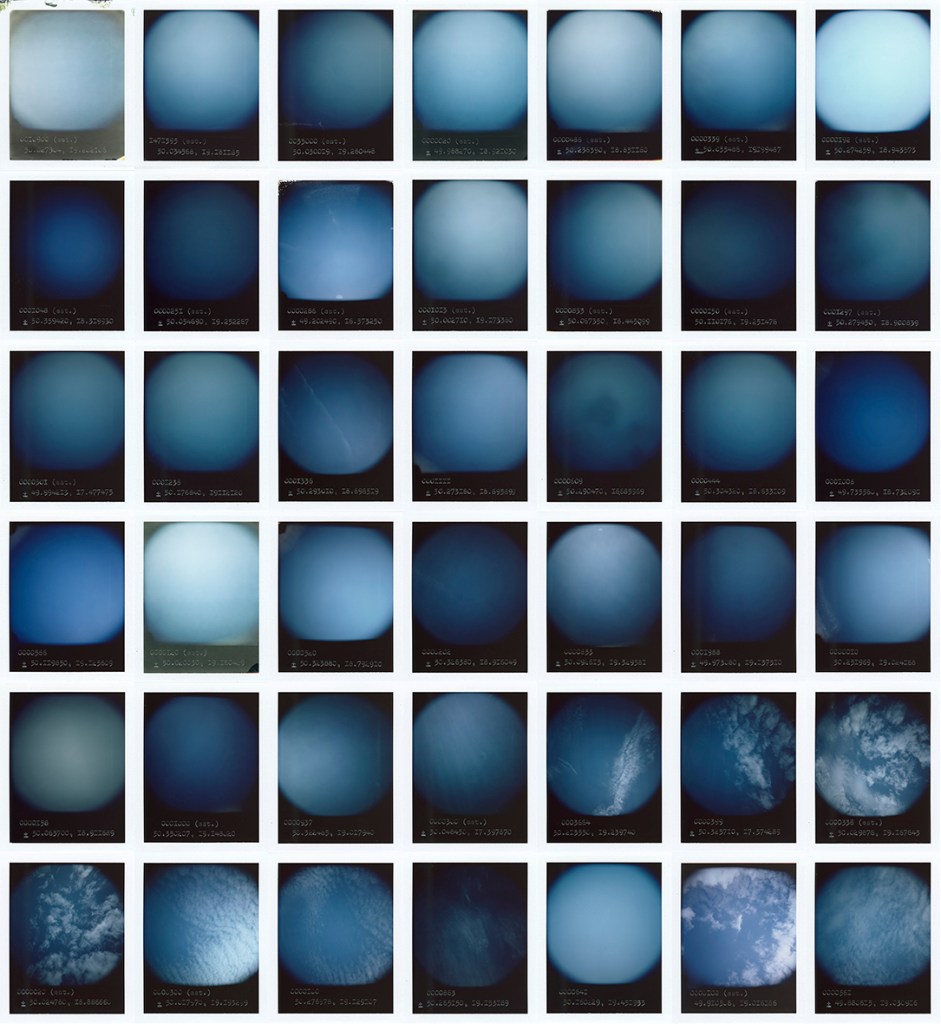
“His Blue Skies Project is an installation containing 1078 polaroid images. All the images show an upward view of a blue sky shot at the last known location of every former Nazi run concentration or extermination camp across Europe during WWII. Over six years, Kusters researched and photographed these often forgotten sites of violence using a simple analogue photographic process of peel-apart instant film. The resulting images were then blind-stamped with the number of victims at that side and its GPS coordinates.
The installation also features a 13 year-long generative audio piece by Ruben Samama, which recreates in sound and length, the period between 1933 and 1945 when the camps operational”.
Caroline gave fantastic audio descriptions, I include them here as this was the first part of my learning:
“The work is on a plinth painted the same colour as the walls so the images look as as they ae floating. The plinth is L 466.5cm, W 260.6 cm, H 90cm (nicely compared to the hieght of a kitchen work surface, the length of an estate car and the width of a London routmaster bus). There are 22 rows of 49 polaroids spaced 1 cm from each other. It feels as if the polaroids are floating in the middle of the space, each image 1 cm spaced from each and the edge, all identical 8.6cm x 10.8 cm in size around the same size as a greeting card”. The sound is an audio piece, it plays a single sound, a soft ping; the pitch changes depending on a pre-defined factors, the pattern of sounds are organically irregular. Each sound represents a victim of one of these camps”.
Each image is the tracking of 1078 blue skies from the 1078 camps of 1933 to 1945 when the concentration camps were open (nearly 13 years 4432 days). These images are reproductions of the originals. Each image is blind stamped with the number of victims and the GPS location.
This was a great introduction to the project. She then went on to describe some of the images:
A camp in Poland
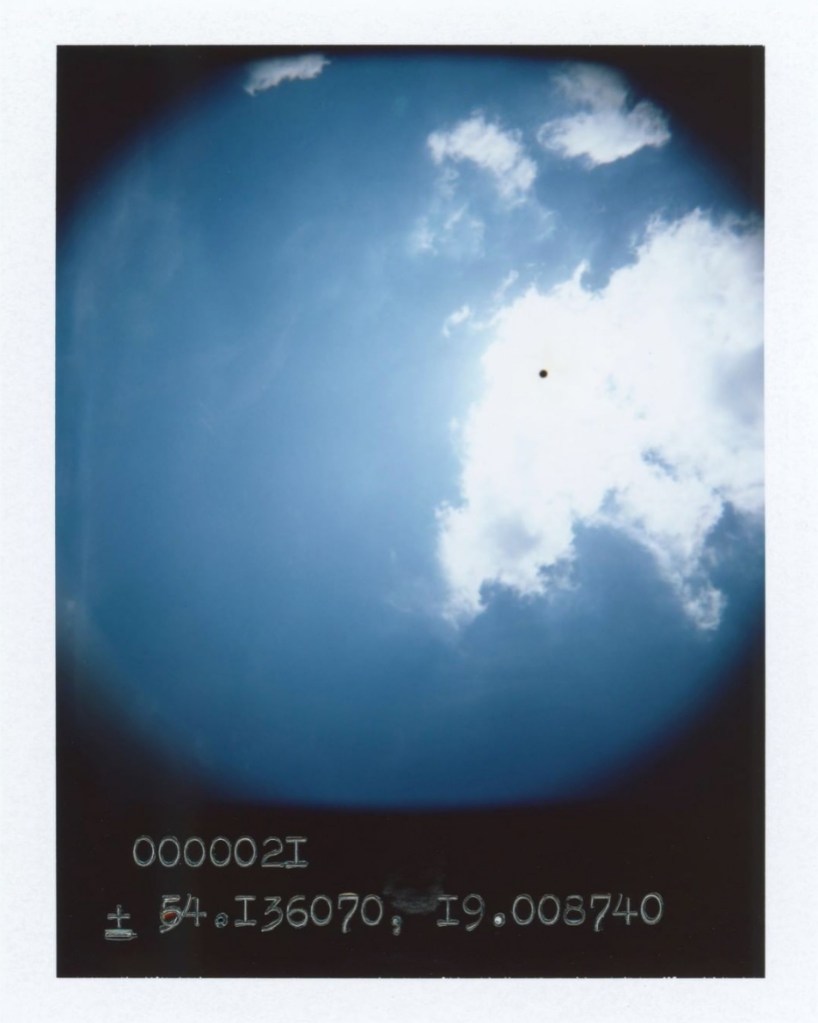
Work 1 – Anton Kusters, Neuteich 0000021 54.136070, 19.008740 (co) from The Blue Skies Project 2019
“Framed with a thin white border which is equal I cm depth all around. Within the border is a black rectangle, the majority is filled with an upshot of the sky, the corners of the rectangle is black and the coloured part of the image is roughly circular in shape, almost as if a fish eye lens has been used the corners are black, a blue summers blue sky roughly circular in shape, blue like light denim jeans, a collection of clouds are swirling around one larger cloud this cloud seems to be bleached white by the sun. The bottom of the polaroid is black where it has been blind stamped with information”.
A camp in central Germany one of the first and largest.
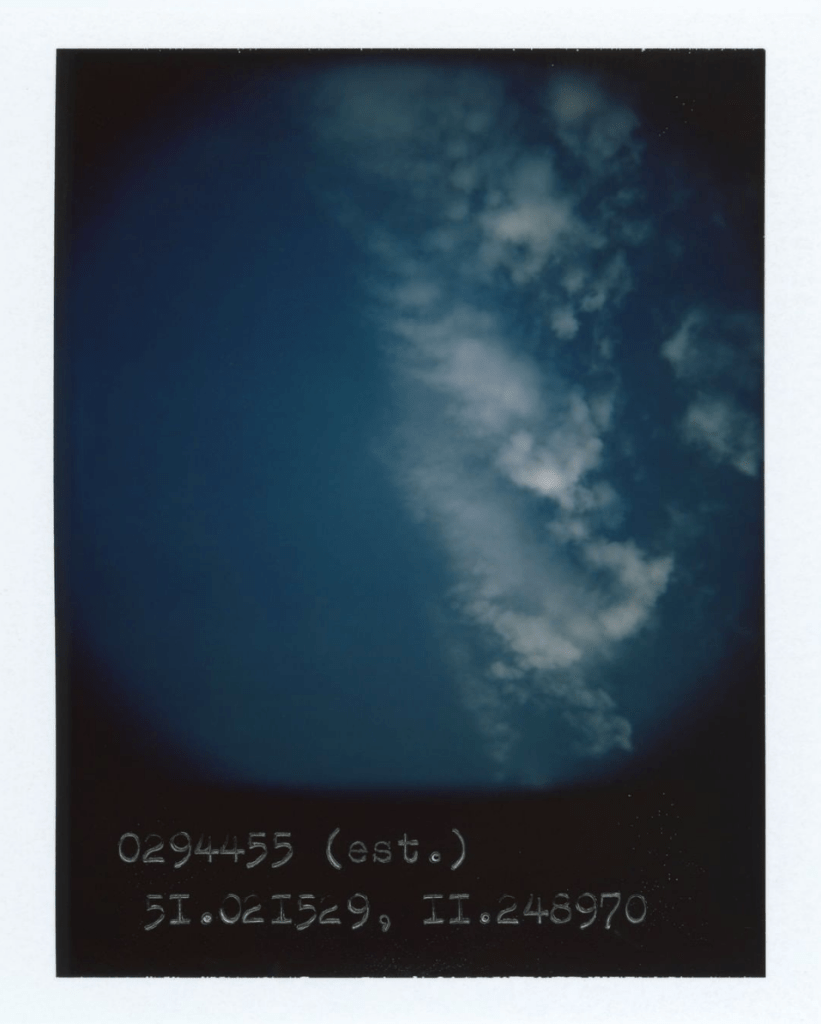
Work 2 – Anton Kusters, Buchenwald 0294455 (est.) 51.021529, 11.24897 (ex) from The Blue Skies Project, 2019
The description is similar except: “the sky within this circle is dark it looks almost unnatural almost like when there is about to be a thunderstorm and the sky turns an unusual dark shade of blue. Spreading across the right side of the image is a network of thread like misty clouds that all seem to be joined together by thin clouds and misty areas. The clouds themselves are so papery that they appear to be lighter versions of the sky in colour”.
A camp in South Germany
Work four Antom Kusters, Thansau 0000050 (est.) 47.827194, 12.154291 (co) from The Blue Skies Project
“The majority of rectangle filled with an upshot of the sky. Unlike the other polaroids described the blue of this one is so dark that it fills the majority of the rectangle making it impossible to decipher the edge of the circle that frames it. The inky blue seamlessly merges with the black. There are no clouds, it looks like it was taken at dusk or perhaps even later, it is so concentrated that when I look at it reminds me of looking into a blue fountain pen ink cartridge”.
Missing image Work 4 – Anton Kusters, Poniatowa 0028000 (est.) 51.178257, 22.061046 (co) from The Blue Skies Project, 2019
A camp in south eastern Poland
“The sky within this circle is again an inky blue…almost the colour of dark denim, but unmistakably an image of the sky, due to the very faint wispy clouds across the top of the photograph, like flour dusted on a kitchen work surface. At the bottom left of the sky area a smaller more concentrated smaller area of white cloud I the vague shape of a triangle”.
Installation description:
“There is enough space between the walls and each side of the plinth to walk around. As I move around the space and try to take in the vast spread of polaroids I am struck by intensity of the project, 1087 polaroids is a lot of photographs and although visually the subject is simple conceptually there is a lot to take in. This sea of 1087 blue rectangles, each one representing a place of trauma, with each one recording the number of victims of each concentration camp, the sheer vastness of it, combined with the sound piece, which to me begins to feel like an assault of noise as I consider that each sound represents a victim, history comes very close. Here Kusters provides space for the audience to consider their own place in history and engage in with the evolving dialogue around trauma human rights and genocide”.
MY LEARNING FROM LISTENING TO THE AUDIO DESCRIPTIONS:
I have been fascinated by Caroline’s audio descriptions previously but what struck me here was how much audio description she was able to give of a simple image. I noticed that she gives useful comparisons to add her descriptions like:“like the height of a kitchen work surface, the length of an estate car and the width London routemaster bus” and “around the same size as a greeting card”.
She also uses lots of similes: “blue like light denim jeans”, “like flour dusted on a kitchen work surface”
And other visual comparisons: “so concentrated that when I look at it reminds me of looking into a blue fountain pen ink cartridge”
Overall I am reminded how one should look long and closely at an image to take in all parts of it.
THESE ARE THE QUESTIONS WE ASKED CAROLINE AND TGP:
Q: Why the blue skies? This was answered in the artist talk another day, he said he asked himself what his Grandfather have would seen if he had been taken The solace of the endless sky landscape.
Q: Was he on location or did he use google planet? He travelled to each location.
Q: Regarding the relationship between image and the spoken word, why does Caroline describe with equivalents and their pheromonal comparisons? When writing an audio description she writes as if writing for a visually impaired audience and says it’s important not to take authorship of the piece.
Q: Why are the numbers and coordinates blind stamped rather than written? A suggestion was that blind stamping is embossing and it is probably difficult to find an annotating process that will last on a polaroid. Apparently Kusters expectation is that in 13 years the polaroid’s will fade but the blindstamping will remain. Somebody suggested that it replicates the tattooing process in the camps.
Q: Why are the polaroids displayed on a table? Previously have been displayed on walls but was shortlisted from its appearance at another gallery which was a church space on a table and so was displayed here in a similar way. It was commented that it gives them a greater physical presence, like a memorial, also like the feeling of having an horizon.
Q: What has caused the vignette? Do you have any information on the camera used? No but it must be the lens masking part of the image as he takes the photograph. The artist later answered that He used a very cheap polaroid camera, hence the huge vinaigrettes.
Q: What do you think is behind the circular effect, in terms of feeling? These were some responses:
It looks to me almost like they are taken through a telescope, Like the sun? The moon? The universe? I find there’s something almost claustrophobic about them, it feels more intimate, It makes me feel like I’m captive and looking out, the idea of claustrophobia is interesting particularly in relation to the condition of the prisoners in the camp, like you’re trapped, it would make sense if it were a pinhole camera – the simplicity of the process also suggests a very direct connection to the site
Q: Is there any logic in the sequencing? Not known but Kusters answered this in his talk; he tried different ways of sequencing but none of those felt right, so he used a computer to generate 1078 random order and the images are always displayed in this way.
Q: Why is the size of these polaroids are different to the normal? Not known although they are described by the gallery as peel-apart instant film.
This slow looking event was followed in a few days by a live artist’s talk which gave us to ask him some of our unanaswered questions
DEUTSCHE BÖRSE 2020 NOMINEE: ANTON KUSTERS: VIRTUAL TALK AT THE PHOTOGRAPHER’S GALLERY 30.4.20
‘I employ a documentary approach to explore the limits of understanding, the difficulties of representing trauma, loss of the experience of place, and the act of commemoration. More often than not, I end up with no answers whatsoever. I’ve come to understand that answers are seldom there.’ Anton Kusters (Deutsche Börse 2020 Nominee: Anton Kusters , 2019)
Kusters explained:
The work was inspired by the recent knowledge that his Grandfather was almost taken by the Nazi but had a narrow escape. Kusters doesn’t know which camp this was to so he visited them all over 5 ½ years travelling he visited every concentration camp, and to be there when there was blue sky, photograph and then move on. Often there were no visual remains of the camp sites he visited. There were 42,000 camps in Europe of a variety of types: extermination, ghettos, concentration, work… Only the location of 140 camps are known exactly, 250 known approximately, for only 200 the area but not the location was known.
The size of the camp hasn’t determined the voice of the victims so that they have an equal voice; however he did spend a whole day in each of the 23 main camps but a very short time in the others. Kusters was able to visit in excess of 15 camps per day because the camps were built in 23 clusters within 100km with 3-120 subcamps.
The fading of the images is significant to the work whilst the blind stamped numbers that fell within that particular sky and the GPS coordinates won’t. Kusters expects the abstractness will makes you uncomfortable because it isn’t telling you anything about the work. That viewers should make sense of the work in their own way and shouldn’t be pushed to think. It was noted that you cannot escape being seen in the work as you will reflect in the surface of the polaroid.
Kuster explained that he met Ruben Samama Music/soundtrack (writer artist and songwriter) after he had been working for a few years on the project already; they want to play the soundtrack for the 4432 days the concentration camps existed, in real time. Ruben thought about how to make the huge historic event and the idea of loss and trauma, into a soundtrack understandable for others, as everything should speak for itself; he stripped the hierarchy of the numbers and produced an organically irregular, electronic soundtrack which plays history in real time, over almost 13 years and every ping is one victim. Samama explained that he made sense of Kusters data in his own way, but wanted to help make it personal for everyone.
Kuster explained that he wants to make a collective memory of important events; if necessary he might help the images to fade so that the skies in the polaroid’s also fade over the time and there becomes an urgency to see the work as it is changing all of he time. Kusters says this change is important as every time you access something your memory changes. The blind stamping will remain. He always has a discussion with galleries so that they consider whether they use the originals and help them to age as they are engaged with, or do they use a replica which will not damage.
He was asked what went through his mind when he pressed the shutter on the last image? It was in the only camp on British soil in Alderney he drank a chocolate milk in honour of his grandfather, he still has the carton; this was the first time that he thought of himself rather than the work driving him.
I WAS ABLE TO LOOK AT LEARN IN DEPTH AT AN UNUSUAL PIECE OF CONCEPTUAL PHOTOGRAPHIC PRACTICE- This has encouraged me to:
Consider alternative ways of seeing
Give the opportunity for activating memory
Consider ways of exploring the limits of understanding and things that are difficult to represent
Not to expect answers
Maximize the importance of a physical aspect of work and the possibility that this changes
The importance of the presentation and the possibility of change in this to reactivate responses
Slow art virtual session: The Photographers gallery 4.4.20
I was interested in this meeting as I have been to a physical event like this at the gallery, because of Covid19 the meeting became a virtual one via the Zoom platform.
Caroline Dawson who facilitated the meeting is an access and inclusivity consultant working with museums, galleries and artists to improve access to art for everyone.
We met to discuss 3 pieces of work by UK photographer Mark Neville (b. 1966) Deutsche Börse 2020 Nominee, for the publication Parade (2019). Neville merges art and social documentary photography, through community-based projects, where he explores social functions of the medium, using still and moving images as well as photo books, which are specifically disseminated to a targeted audience or ‘non-art’ demographic. Started in 2016, the same day Britain voted to leave the European Union, he began a three year project based in Guingamp, Brittany (“little Britain”). Mark says:
“Notions of utopia, or ecotopia, underpin these images of farmers, nuns, Breton dancers, baton twirlers, people breeding pigs, dogs, horses, supermarket shoppers, football supporters and football players, families on the beach or attending beauty pageants. Some of the photographs seem to express a real optimism about our chances to achieve that better world, whilst others display an anxiety about the gap between the ideal and the real.’
Mark Neville (TGP website, 2020)
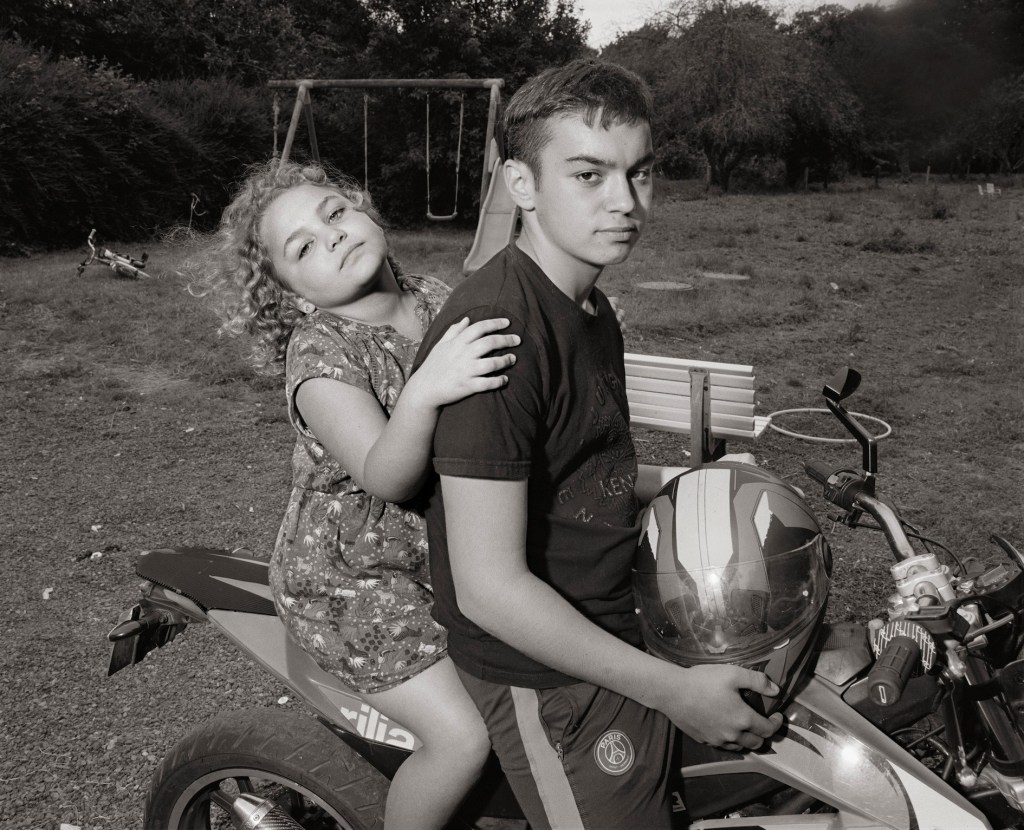
Caroline Dawson gave an audio description of an image by Mark Neville, a black and white image:
Mark Neville Parade#11
We then discussed:
How the audio description given went from a general outlook from the background first and then to the foreground detail. Caroline was taught to Split the image into horizontal lines and read left to right and to start and finish on the part of the image focused on.
Why the image is in black and white? We couldn’t reach a decision.
We commented:
Looks like might have been lit with lights rather than taken spontaneously. I later learnt that this is very much his style to use infill flash from the side
We like the movement in her hair although it looked like to image was posed.
Thought it would be difficult to ascribe context without reading the background information first.
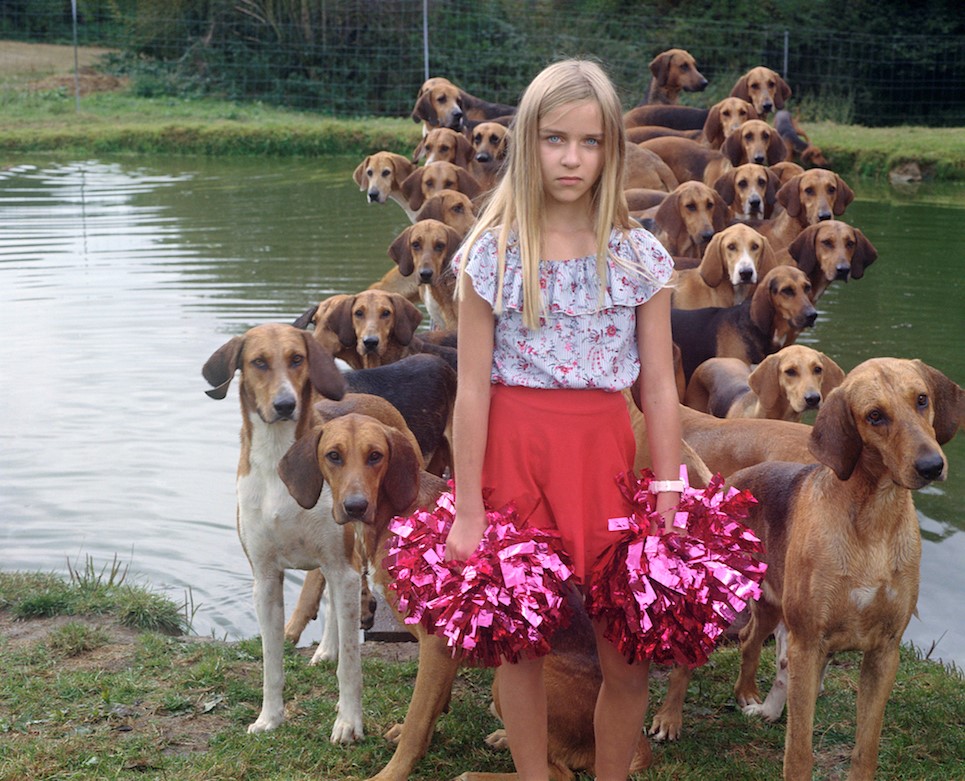
Mark Neville, Parade #7 2017
We asked and sought answers to the question:
Why are the dogs on the pontoon?
We discussed:
Interesting perspective
That with her piercing blue eyes she looks like a model
How would we have felt as a child posing?
Why all the dogs?
Is it always the person at the centre of the image that holds the photographers gaze?
We were told that it took 3 sessions to achieve to get them all looking in the same direction, and yet it is still unbelievable that he achieved it.
Mark Neville, Parade #15
We discussed:
Looked to me as if he valued the horse more that the car until pointed out it’s been there a while (as no tyre tracks).
There is a difference about viewing the images in reality and as a copy, details easier to see – I hope to see the actual photographs after restrictions lift.
A strong image, makes you want to ask so many questions.
We learnt afterwards that the man is a horse whisperer who works with abused animals.
My learning points:
How to really look, dissect and correspondingly describe an image; try looking from the background first and then to the foreground detail and even to split the image into horizontal lines, then read left to right, and start and finish on the part of the image the focused is on.
Really consider if it always the person at the centre of the image that should hold the photographers gaze?
How difficult it is of be sure of an artist’s motive without knowing the context.
Mark Neville Artists Talk the photographer’s gallery 9.4.20
I was lucky to be able to follow the interest that this provoked for me in Neville’s work by attending his Artist talk to accompany his exhibition Parade at the Photographer’s gallery London; however it was also an event that was delivered by zoom, due to Covid19. This worked very well.
Mark discussed his work from a starting point of his first published photographic workPORT GLASGOW (2003) a ship building community.
This came from his desire to have a voice and visibility within the art world. He applied for a competition to make a public art project where he could make a public gift to the community of 8,000. This work is photographs of a community – a social documentary book, which tests notions of authenticity in photographs; some are staged, some sly on the wall, some fashion or staged, whilst some are based on Venetian paintings.
This was never commercially available as a book, but was produced as a book for the people in it instead of as was usual to middle class coffee tables; Neville gave the work back to the subject matter to justify it. The cost would have been £14000 to distribute 8000 of books to the community, but then asked the football club to distribute the book and gave them the money instead, which fitted with his ethos of benefiting the community a work is made in.
He asked for feedback from the community about the project; some was negative, indeed Catholics burned books as they thought there were too many protestant photographs (disappointing at the time, but it was actually a good indicator of sectarian tensions). Later outsiders asked for copies of the book but couldn’t give them it, although later unwanted copies were sold online by their owners for high amounts (Neville commented that this was good as it was a direct economic benefit for the community). Later he responded to requests from curators and exhibited however when he did so the money was again given back to Port Glasgow as were percentages of any picture sales.
Neville’s concept is that photography should always think about its local role. As it deals with reality it has to find a way to change things. His ethos is to find ways that you can use the photographs to service the community they are shot in.
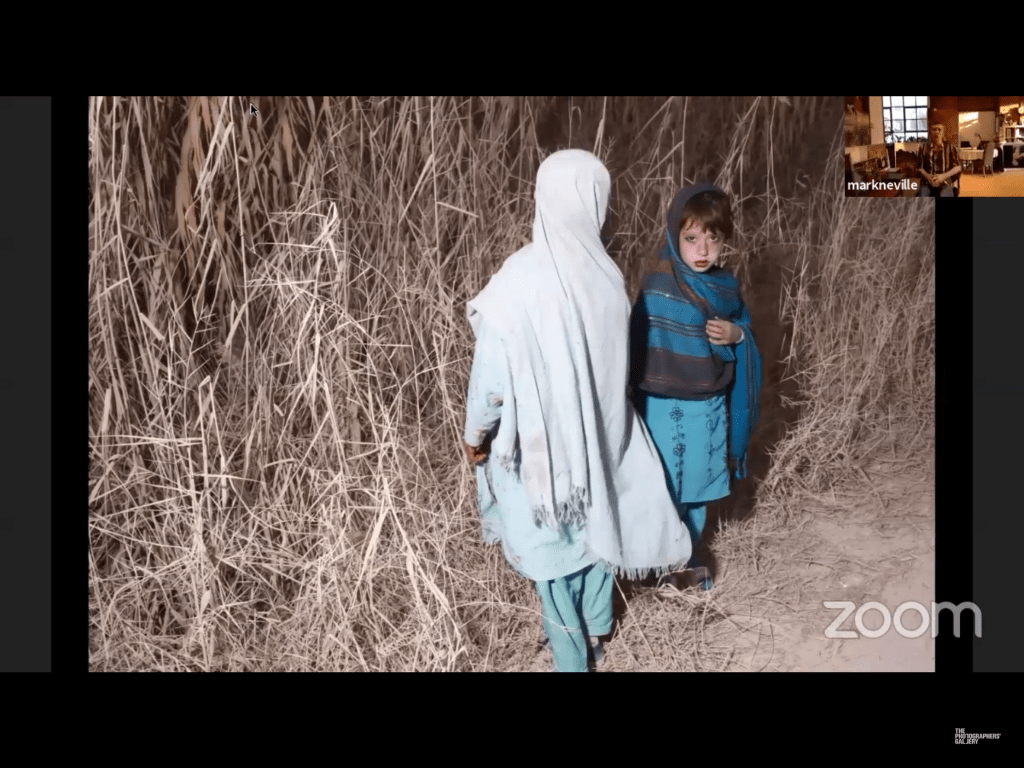
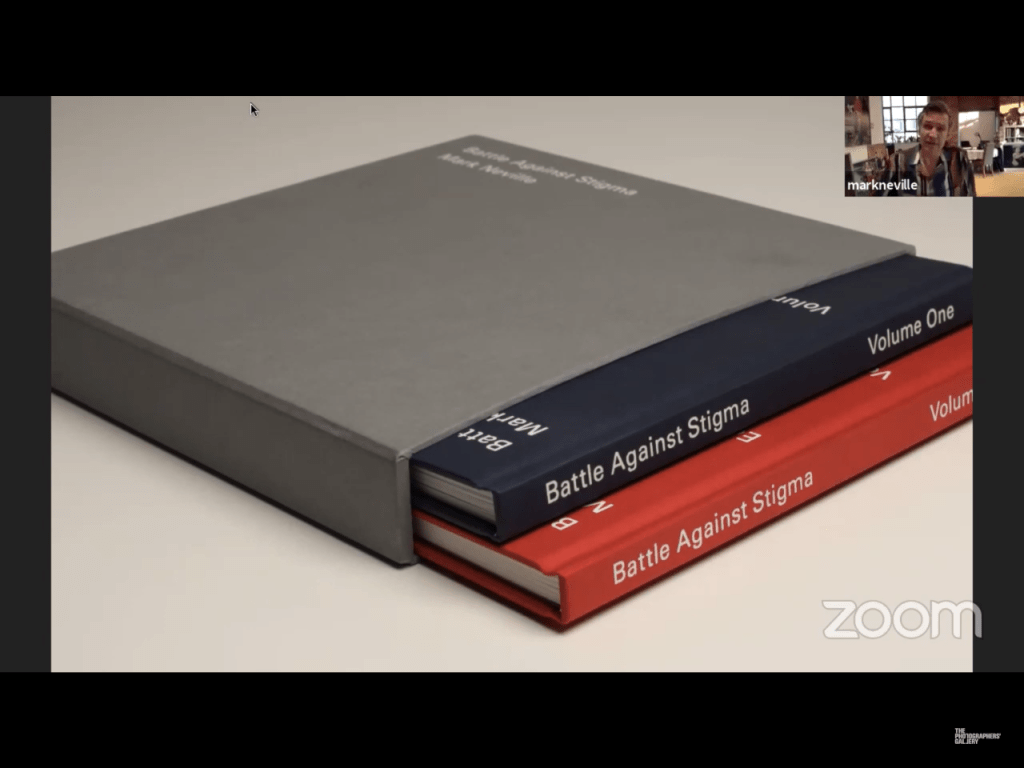
Battle Against Stigma Volume One and Two (Afghanistan 2010)
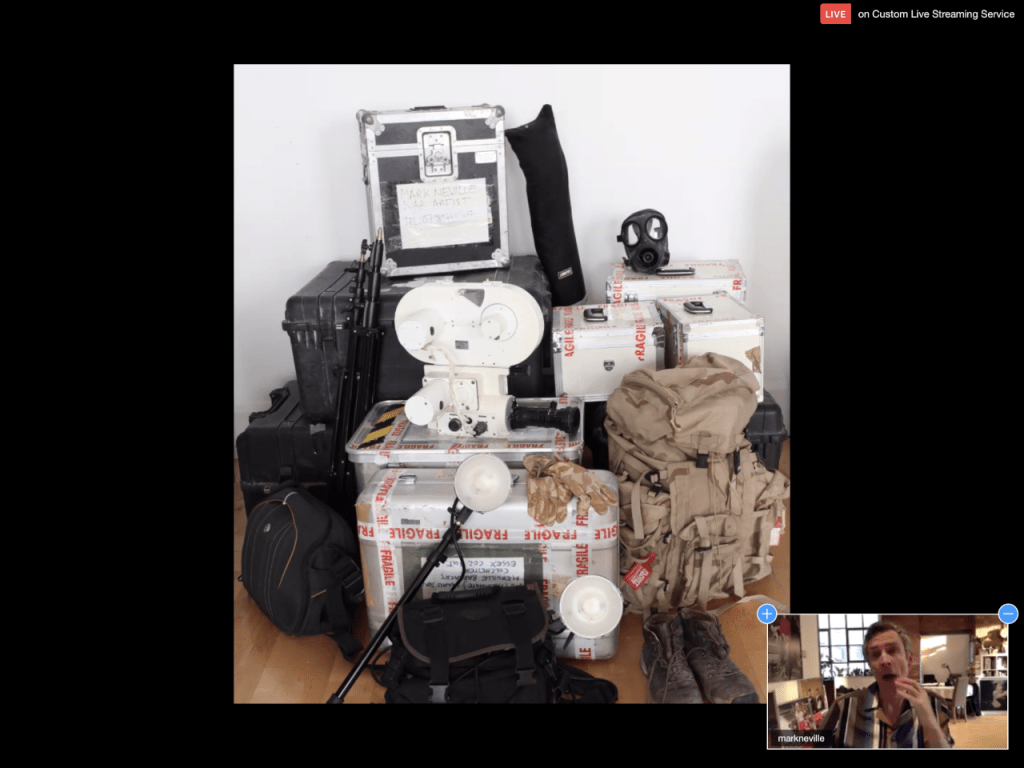
Neville was chosen by the Imperial War Museum to go to the war zone as a war artist. He accompanied the troops to the war in Afghanistan after a month’s preparation. He had to carry his heavy camera kit, maintain 2m distance between soldiers, avoid mines; it was a very stressful and confined remit for taking photographs.
In particular he was shocked how young the soldiers were, and that it was bizarre that children would suddenly appear out of nowhere unaccompanied. He also recalled how he made friends made quickly and for life.
He wanted to use his work to encourage veteran troops suffering from PDSD to come forward (as Mark he suffered adjustment disorder). It took until four years after his return to get the various permissions, funding, images and text for Battle Against Stigma. He went to ministry of Defence for support, but after initial support they forbid his PTSD essay that he’d written, and accounts from the troops to be presented with the images from the war as it might imply that each photograph is someone with PTSD; so he made it as two separate volumes in one slip case.
The first volume retells his experience when he was sent out to Helmand, the second volume contains written testimonies about PTSD and adjustment disorder from serving and ex-serving soldiers. Once published the UK border force seized the first edition of 500 in 2015; The 2nd consignment of 1000 arrived safely and he delivered them to mental health charities, homeless centres, Military Departments of Community Mental Health and Education Centres, veteran mental-health charities, probation officers, prison libraries, and directly to veterans themselves and so on to get to the veterans before the UK border forces wanted this consignment of books also.
In the Independant on Saturday 23 May 2015 Neville put the following message:
‘Battle Against Stigma’ is not being commercially distributed. If you are a former serviceman or woman who feels you may be suffering with adjustment disorder, or you know someone, a friend or relation, in pain, please write to Mark Neville in confidence at info@markneville.com, and he will send you a free copy (Neville, 2015).
Following this he received e-mails every 10 minutes asking him for copies. Neville said that this is the book that has had the most tangible effect of all his work, he believes because he tapped into hidden pain.
STOP TANKS WITH BOOKS due for publication this summer
His motive here is to try to stop the war in Eastern Ukraine with this book, where 2 million people have been displaced, one of the biggest displacement in the world. The work contains photographs, essays, sociological research into the war zone, as well as elements about life continuing, such as images taken for the New York Times of Odessa a resort in the Ukraine as well of those about displaced people. The book has been sent out to politicians and the publisher endorses this model that books can and should change lives and that people shouldn’t have to pay for them’.
Neville says he is keen on the first image as it makes connections between the Church and the Mafia.
Parade 3-4 yr. project in Brittany
Neville was opening an exhibition there for his Port Glasgow book the same day that the UK’s departure from the European Union was announced. The work that began then also had an emotional connection with Brexit.
In his work Parade Neville made a portrait of a provincial agricultural region, through 6 visits (2016-19) mainly within a 30 km diameter of the small town of Guingamp. The work is about what a community means and Ecotopia – about our relationship with nature and animals. The Breton culture, the local football team and Breton dance Fêtes are their main cultural activities. They have a small but successful football team, and so the work is exhibited in the entrance to the football stadium so ever as part of his community based ethos. Every other Saturday there is an audience of 20, 000, so the images were delivered back to the community.
Illustrating how he connects art and social documentary practices, he also photographed different agribusinesses in the community – from small holdings to large industries. The photobook, is now accompanied by a publication of essays by Brittany farmers with pearls of wisdom articulating the need for a sustainable, humane, type of agriculture, and it was sent out to UK and European ministries of agriculture and food as well as key policy makers, calling for the urgent adoption of more ecological methods of farming. This free book that Neville co-wrote “Parade texts” a pdf published in 2 languages has been sent out to schools, community centres, libraries, schools, politicians, agricultural communities; it is all about the need for access to land to produce sustainable food, so produce isn’t substandard and to encourage subsidies for small sustainable farming.
During the work he combined planned, constructed photograph, and spontaneous imagery. Neville photographed the different agribusinesses in the community from small sustainable farms with only a handful of animals to large agricultural industries.
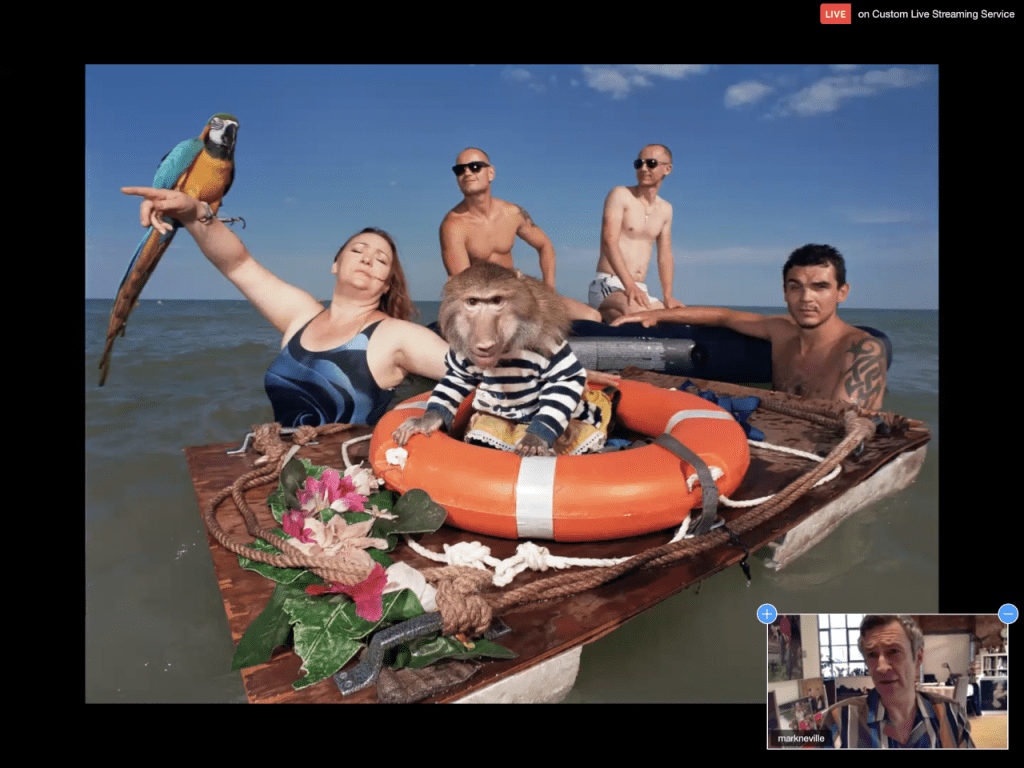
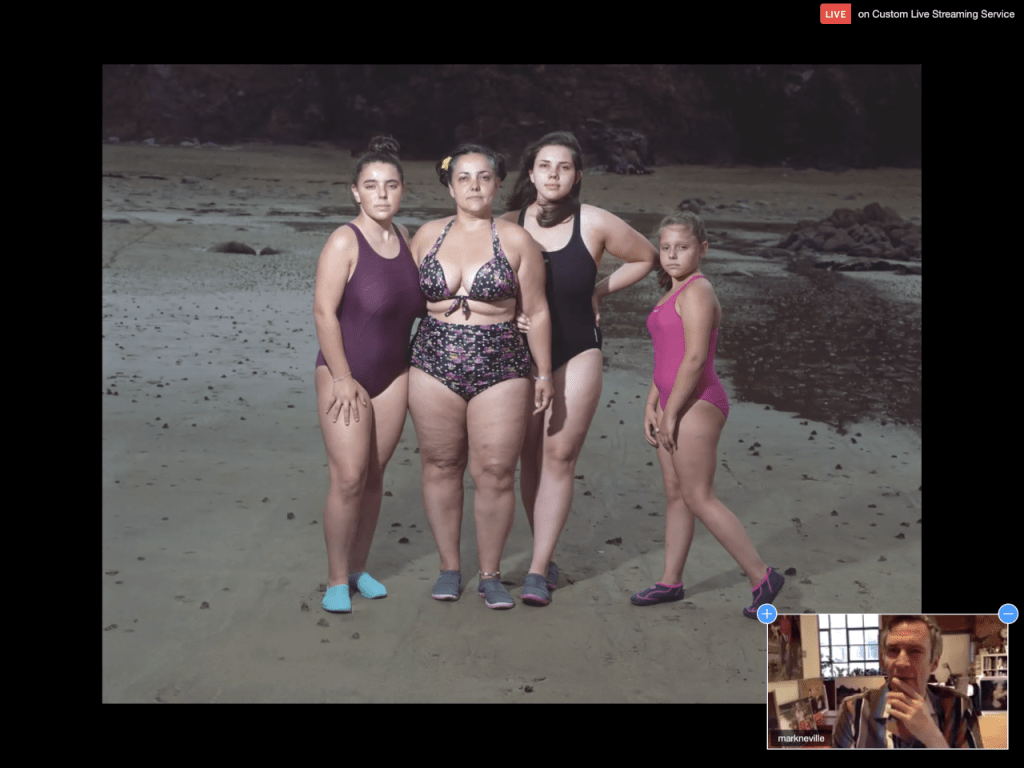
Due to his feeling about Brexit when he started the work there, he wanted the images to have a multilayered feel to them, as he viewed the work as therapeutic journey for himself rather than an end target. He thinks of terms of reference when photographing, such as new wave movies and the posture and the palette of these swimmers that are like Flemish paintings. Some images were constructed by re-visiting people and places whilst some dynamically or fluidly – there is a tension between chance and construction.
Neville talked about some of the images from Parade:
Parade#15 Man horse and car: This image already described portrays ahorse whisperer and is about establishing a bond. He trains them to stand on cars to develop this trust.
Parade #7 The baton girl and dogs previously described; he met her when she was baton twirling and asked her to pose, and he comments on her striking eyes. He also met a man who breeds hunting dogs and then chose his man-made lake as the location – which seems an odd association but was very effective. Neville thinks the image looks like a collage, as if it shouldn’t be happening; though if you look closely you can see the tension between the “construction and the moment” which he believes is essential for a good documentary image.
Here the girl that modeled stands in front of her portrait (Zoom session TPG 9.4.20)
NEVILLE THEN TOOK QUESTIONS AND WAS VERY GENEROUS WITH HIS TIME AND ANSWERS.
Do you know where you’re going to end up when you start in a community?
Neville says he asks 3 questions of himself/the project before starting:
Q1: What do I really make work about? As projects have a long life take a lot of time and energy and have to sustain him as a subject matter (a demographic, an issue, a place, a group of people, an aspect of social documentary practice or society), he has to really believe in a project to begin it.
Q2: What can I do that will be of use here? How to honestly do some good, how can what I do have some kind of social value? How people are going to benefit from it? Should they get a copy of the book, if so who should get copies of the book: MP’s, the local community, the whole of the UK, really think who the audience is. It is a photographer’s responsibility to use whatever platform we have and to use this to chip away and effect change.
Q3:Fundraising, how to find the money to make this happen?
However work does develop as Parade did initially it was about the Breton V British culture but became more about Ecotopia – about our relationship with nature and animals
What does community mean to you? It’s sort of a search for acceptance into a community he’s not of, so of course he’s never really accepted, so he goes on to the next search.
Are you trying to put a spotlight on your childhood with your pictures of children? No not at all, just an intent to spotlight inequality in society. He explained that when making these projects as a sort of search for a family, though he’s not part of it he tries to immerse himself – likes to be accepted.
How was Parade received by the community? They appreciated the work being exhibited at the stadium, but it’s been difficult to follow up on the text sent out, as the virus has halted it’s, there may be a reassessment of social values and ultimately ecology but he will chase it hard after the virus to ensure it has impact.
Do you think your work will change after Covid19? Almost all his photos are of people however he thinks it’s slightly irresponsible of people to go out and take photos during Covid19, as photography has got to be safe and respectful.
My Question: How do you finance these projects? This is difficult: grants (Like the welcome trust, The Arts Council of England), writing to charities and philanthropists, newspapers he does a lot of research to make the most from his fundraising and the networks it comes from, his own money, (Neville doesn’t benefit financially from the projects). He manipulates where he might be asked to be sent by assignments for newspapers like the New York Times, to places that he can legitimately use to fund issues that he wants to highlight.
Tell us about your photographic style and use of flashlight and almost overexposure: he showed his medium format camera with the flash attached on the top from the side which doesn’t flatten the image and isn’t as harsh as when flashed from the front; this gives you a more painterly feel when on the move camera with flash attached. It is also about getting a good depth of field as documentary photography is about revealing detail. He takes references for his images from all sorts of sources, design, paintings and uses his lighting to make these references. Some images he just sees in colour some in black and white hence the mixture in his work.
Explain the idea of the book changing the world: A book is different to the news or a print, as a book has a life and it has a value. A photobook is hard to ignore a photo book if as it has strong images in it, especially if no ulterior motive can be seen for the community; each book must have several captivating images.
MY LEARNING POINTS:
This was an amazingly interesting and thought provoking interview. I think it will help to give me some extra purpose going forward and especially working towards and possibly when choosing my level 3 project. These are points that I particularly intend to take away with me:
Documentary photography can connect art and social documentary practices.
Tension between the moment/chance and construction can be very effective in documentary images.
That it is possible and can be effective to mix several visual and practical styles within one body of work: staged, some sly on the wall, fashion or classical painting in style.
Consider many different types of references for your own work, design, painting, fashion, newspaper….
Try using a fill flash from the top side when taking portraits on the go (I could do this with a strobe and small soft box – maybe I need to get a stick to attach it to.
You can use lightening to align your work with your references for images.
Consider that documentary photography may be about getting a good depth of field as documentary photography is about revealing detail.
It reminded of something I have discovered myself, that photographic work can be therapeutic to yourself.
Make sure you are really interested and believe in a project that will take a lot of time and energy before you start it.
Don’t worry if I change my mind where I’m going with a project once I immerse myself in it.
There is a difference about viewing the images in reality and as a copy, details easier to see – I hope to see the actual photographs after restrictions lift.
There are many ways to exhibit work other than in a gallery.
Ask yourself should the photographs to service the community they are shot in?
Think about the local role of any project – if it is about reality should it seek to change or just highlight something?
A huge variety of material can be contained with a photographic project: images, texts, essays, letters, eye witness accounts and so forth.
Read Miranda Gavin’s reviews of Anders Petersen’s French Kiss and Jacob Aue Sobol’s I, Tokyo for Hotshoe magazine and research the work of Daido Moriyama. Write a short reflective commentary about the connections between the styles of Moriyama, Petersen and Sobol. (Open College of the Arts, 2014:52).
My reflections:
I remember seeing some of Moriyama’s images at the London Photo Show last year which prompted me to buy the book Daido Moriyama (Nishi et al, 2001). As a co-founder of the 1960s magazine Provoke, he tested the conventions of photography, grainy and blurry images were more than acceptable and he pushed photography to the extreme (Nishi et al, 2001) and chaotic.
Looking at Peterson’s approach the influence of Moriyama is clear, in particular in Moriyama’s work Limited edition vintage prints; there is the same stream of consciousness in his images, one idea leaping to the seemingly unrelated next.
Jacob Aue Sobel and Anders Petersen, both Scandinavian photographers made the book “Veins”(2014) together where their work is presented in the same book but in two halves; with their subject matter and style it would be difficult to distinguish their work had it been mixed. They are both drawn to seediness, nudity, blood intimacy, and “human strangeness”, but Peterson’s work is a little softer. Sobel like Peterson uses full bleed images without captions, but they are less blurry.
Sobel said that Petersen showed him photography is a way of life in itself “Just the way he immerses himself in the subject. You look at his pictures and you feel that he had to make them. For him, photography is an obsession as well as an art form.” (O’Hagan, 2013).
Both the style of photography and some of the subject matter between the three photographers has similarities:
Interest in minutiae
Expressionist approach
Black and white format
High contrast -extremes of light and dark
Harsh tones
Strong emotion
Unconventional composition
Private/intimate and sexual connotations
Suggestive juxtaposition
Moriyama was the forerunner and Sobel created the later more contemporary work, they all photographed what could be called intimate documentary, however Peterson and Sobel developed their own styles from this. I have to say that though I was drawn to Moriyama’s work, I find Peterson and Sobel’s work disturbing and hard to find the same simplicity and beauty in.
DO SOME INDEPENDENT RESEARCH INTO STREET PHOTOGRAPHY
My response:
Street photography in the early days was staged, and was the extension of the studio, but with the advent of smaller less conspicuous cameras photographers were able to work on the street without being seen. Stephen McLaren editing “Magnum Streetwise” said the cornerstone of what is now known as street photography is “the impulse to take candid, unrehearsed pictures in the public realm” (2019).It normally features chance encounters and random accidents in public places, but doesn’t have to take place in the street. The French “Flaneur” the city walker was one of the earliest street photographers observing the streets closely for theatrical moments and inspiration. That said we are now aware that Street photography does not need the presence of a street or even an urban environment.
Street photography is prevalent again, with the work of photographers such as Vivian Maier, Chris Steele Perkins, and Martin Parr. I have in the past explored the photography of many photographers famous for their Street Photography; for instance Garry Winograd famous for his edgy close ups, William Klein whose work wasinnovative and intimate, often shot at eye level, Elliot Erwitt known for his wit in his images, and Cartier- Bresson of course. So here I will explore the street photography work of photographers who I’ve not researched before:
Christian Anderson
Is an American Magnum photographer who says his roots are in the classical street photography tradition especially influenced by Brice Davidson, and Moriyama. He has moved towards street photography that is relevant to him, working digitally and worrying less about the technical aspects and more about the emotional aspects of subjects. He crops hard to exclude extraneous contextual information.
USA. New York City, NY. 2014. Cherries spilled on crosswalk.
Capturing and “trying to be aware of an emotional sense of the people that I am photographing” (McLaren, 2019:48) is important to him. He describes how when working on the street he scans and then notices everything and wonders who people are and what they are thinking about. He uses the available street lighting, neon signage and smog to create atmosphere around his decontextualized subjects.
CHINA. Shanghai. 2017. Street portrait.
USA. NYC. 2017. Police in front of Trump Tower.
FRANCE. Sete. 2012. A red dot on the glass of a bus stop.
I do particularly like his use of colour as accent and for atmosphere, more especially knowing he what was naturally on the street; it’s hard to believe that some of his portraits are shot on the streets rather than in a studio.
Sergio Larrain
A Chilean photographer worked professionally only during the 1950s and 60s. He lived a solitary life, saying he only did work that he cared for. One such project was on the reclusive mafioso from the streets of Palermo, Corleone and Ustica. He believed that photography should be free of convention but not forced, you should “Don’t ever force things, otherwise the image would lose its poetry. Follow your own taste and nothing else” .(McLaren, 2019:251).
GREAT-BRITAIN. England. London. 1959.
Village on the way to Machu Picchu
Between the island of Chiloé and Puerto Montt, Chili, 1957 (Sergio Larrain, 2020)
Island of Chiloe, Chili, 1957
Santiago, Chili, 1963
His images are poetic but the thing that I take away from them the most is the unusual perspective he used, I guess this came from the freedom from constraint he valued and the value he put on following your instinct.
Constantine Manos
He shot initially in black and white, these are some of his first serious images taken when he was 18:
(Daufuskie Island, South Carolina, 1952)
Manos switched to colour after 30 years for his work “American Color” (1995), for which he deliberately sought out a different type of picture, he felt that American was waiting to be photographed differently; he continued this as he was enjoying it with American color 2:
(American Color 2, 2010)
In 2001 he shot in Havana, Cuba, 2001 walking the streets “There was much life in the streets, and people were not self-conscious. In their daily lives there was a poetry, not found in more materialistic and industrialized societies” (Havana, Cuba, 2001).
(Havana, Cuba, 2001)
He later returned to black and white with a digital Leica, he claimed he’d gone back to basics “Looking for remarkable moments that make you catch your breath” (McLaren,2019:281).
I read that he was against cropping, as he thought it made you lazy; you should move your feet instead. I feel the same way, in that I should get it right as I am looking at something, there and then. Often when you look at his photos, he has people in both the background, mid and foreground but rarely overlaps the bodies, this seems to sharpen his message. Manos said that “A successful picture is always a surprise” (McLaren,2019:281) and his images are full of ambiguity. There are a lot of small details in his photographs, maybe this is how he achieves the poetry in his images.
Jonas Bendiksen
I choose to look at Bendiksen because at first look his photography seems quite different to the other photographer’s I’ve reviewed above or maybe I expected it to be because of his Scandinavian origins?
Apparently, he thinks about his approach hard before shooting, saying the research puts you into the right frame of mind, but that when he shoots “I guess I’m a fairly simple photographer. There is very little hocus-pocus about what I do” (McLaren, 2019:69), it’s fairly instinctive.
GEORGIA. Abkhazia. Sukhum. 2005. Although Abkhazia is isolated, half-abandoned and still suffering war wounds due to its unrecognized status, both locals and Russian tourists are drawn to the warm waters of the Black Sea. This unrecognized country, on a lush stretch of Black Sea coast, won its independence from the former Soviet republic of Georgia after a fierce war in 1993.
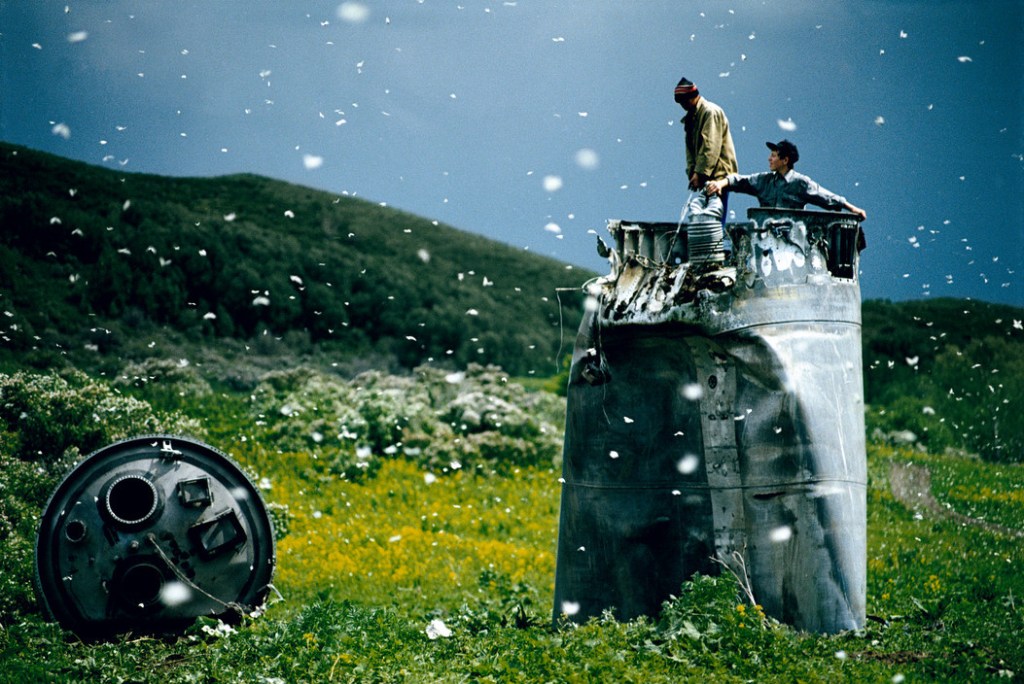
RUSSIA. Altai Territory. 2000. Villagers collecting scrap from a crashed spacecraft, surrounded by thousands of white butterflies. Environmentalists fear for the region’s future due to the toxic rocket fuel.
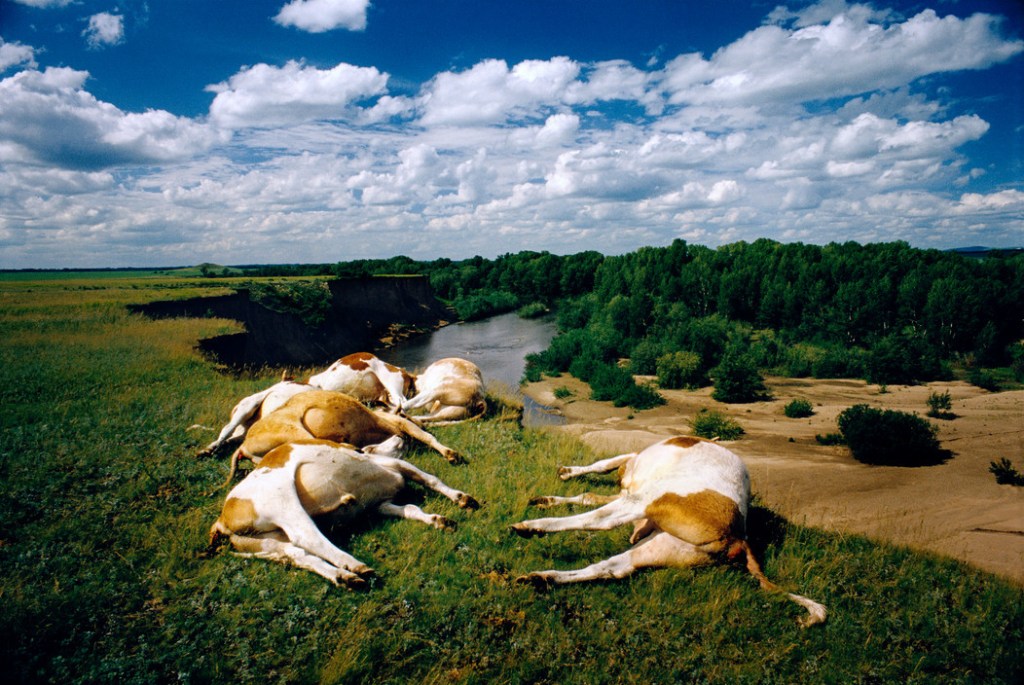
RUSSIA. Altai Territory. 2000. Dead cows lying on a cliff. The local population claim whole herds of cattle and sheep regularly die as a result of rocket fuel poisoned soil.
BANGLADESH. Asulia. 2010. Brick kilns marooned in water. They normally use the kilns 4-5 months a year in the driest seasons (from november approx). This type of brick kiln is ubiquitous in Bangladesh, but is a heavy polluter (as its coal-fired and ineffective), both in terms of CO2 and air quality. As I was shooting a storm came in with heavy winds and rainfall.
Workers digging up submerged bricks and throwing them up unto land for them to be collected and taken to the waiting boat.
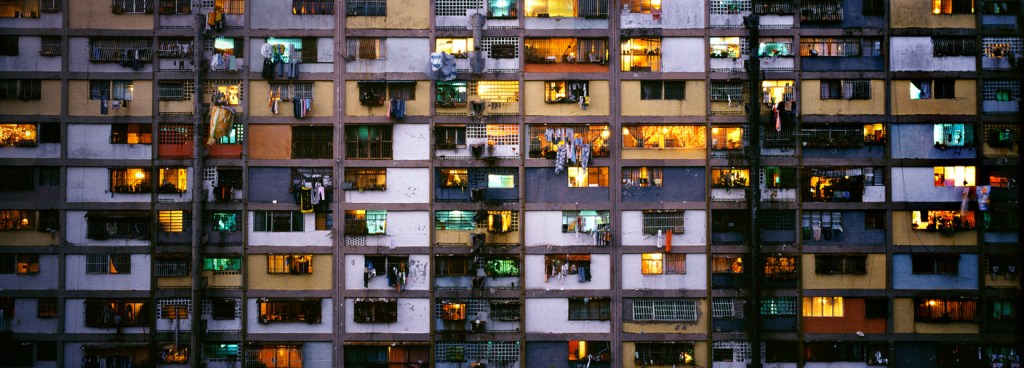
VENEZUELA. Caracas. 2006. The facade of an apartment building in Barrio 23 de Enero. The areas apartment blocks have been home to communities of squatters since the late 1950s, and the area has played impoortant role in social and political events in the country.
I’m interested in his work on urban development and future urban development, “when I’m out on the street, I try to leave all the thinking behind” (McLaren,2019:71).
MY LEARNING:
Try to be aware of an emotional sense of the people
Consider using the available street lighting, neon signage and smog to create atmosphere around subjects.
Don’t force things,
Follow your own instincts and leave thinking behind.

















 Photography 2: Documentary