Exercise 2.12
Read ‘In the American East’ by Richard Bolton (in Bolton, 1992, pp.262–83) and write a 200-word reflective commentary on its relevance to documentary practice. Then look at the work of Charlotte Oestervang in Appalachia (Open College of the Arts, 2014:42).
In 1979 Avedon began photographing the “marginal and dispossessed citizens of the West”, those in usually uncelebrated jobs. Bolton examines how Avedon “refashions this class” and how art is used in public relations.
Avedon decontextualized his subjects in front of a shadowed studio backdrop, reducing the 3D effect and exaggerated it further with post photographic processing. Bolton suggests this is to emphasis expected ugliness and sloppiness of such subjects and to effectively “render them mute”; Avedon says that a portrait is not a likeness and that his are truthful. Bolton goes so far as to say that Avedon “exploits members of a lower class for the edification of his own” (Bolton,1992:265), his view is that Avedon’s typologies are reduced to absurdity by formal devices and in particular repeating the subject’s “direct, uncomfortable, awkward, grim” look (Bolton, 199: 267).
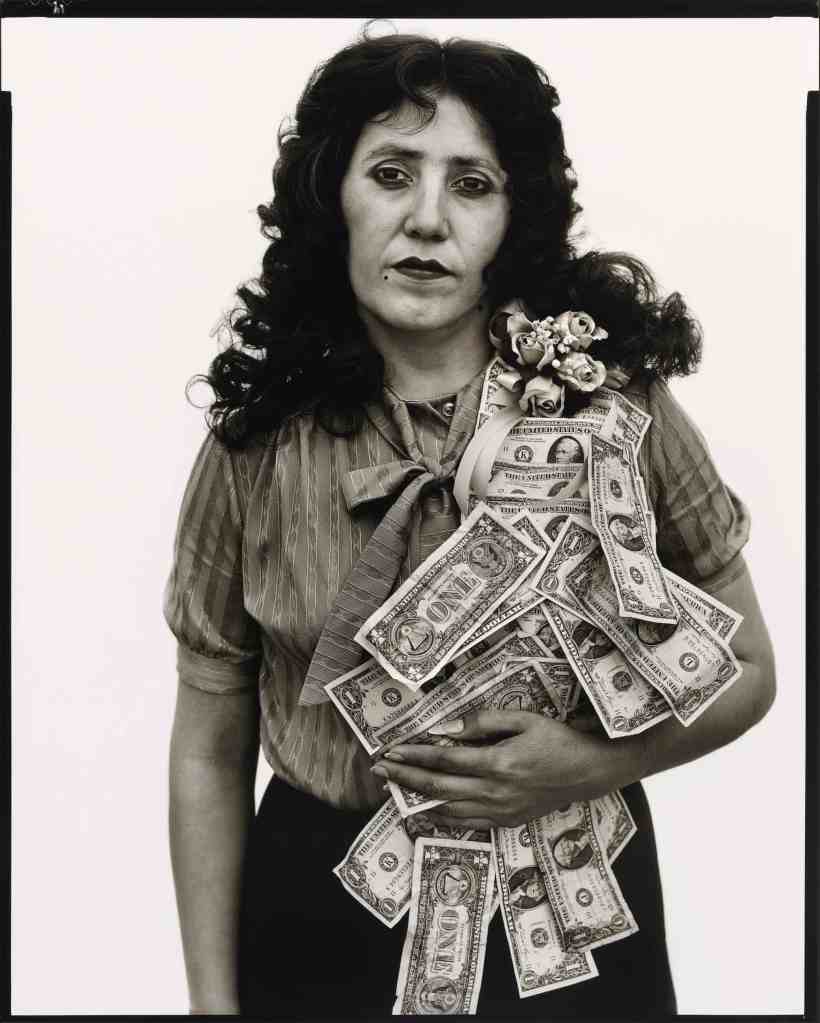

(Richard Avedon: In the American West – in pictures, 2017)
Bolton goes on to suggest how the art press helped what he calls this constructivism, that it was a trail run for a different type of advertising and that the publicity that obsessively controlled it made it successful, that it became an “empty vessel” to promote the artist, the museum and the corporate sponsor.
Charlotte Oestervang’s portraits of people in Appalachia do give us some context as they are taken in their own surroundings; however I’m not sure that this shows them more respect, how do we know if she has manipulated their surroundings? They stare directly at the camera and are shot starkly rather like Avedon’s and still leave me uncomfortable.

(Foto, 2020)
My learning here in about the relevance of these works in relation to documentary practice is questions about:
- Context
- Control
- Manipulation
- stereotyping
- Bias
- Social responsibility
These are some of the same issues raised by Sander’s, Nelson and Penn’s work that I addressed below. I guess the important thing is to be aware of these issues and to take the approach that you think is socially and morally appropriate.
Bibliography:
Foto (2020)Volume 6 Number 1. At: https://issuu.com/foto8/docs/vol6no1 (Accessed 28/06/2020)
Richard Avedon: In the American West – in pictures (2017) In: The Guardian 25/02/2017 At: http://www.theguardian.com/culture/gallery/2017/feb/25/richard-avedon-american-west-texas-in-pictures (Accessed 28/06/2020).
Smithson, A. (2010) Charlotte Oestervang. At: https://lenscratch.com/2010/09/charlotte-ostervang/ (Accessed 28/06/2020).
Open College of the Arts (2014) Photography 2: Documentary-Fact and Fiction (Course Manual). Barnsley: Open College of the Arts.
NEXT POST: https://nkssite5.photo.blog/category/research/a2-research/research-point-worktown/
 Photography 2: Documentary