Read the article ‘Cannon Fodder: Authoring Eugène Atget’ by Abigail Solomon-Godeau (in Photography at the Dock, 2009, pp.28–51). This article is provided as an Appendix at the back of this course. NOTE: If you are viewing this course digitally, and you do not have a copy of this recomended book, please email enquiries@oca.ac.uk to ask for a copy to be sent in the post. (Copyright restrictions allow single photocopies only)
Research the work of the surrealist photographers mentioned above. In your learning log write a bullet list of key visual and conceptual characteristics that you think their work has in common. (Open College of The Art, 2012:48)
MY RESPONSE:
This essay though challenging to read led me to begin researching surrealism, something I admit I didn’t know much about. I think this is the beginning of a journey…
Surrealism emphasised artistic processes whereby the imaginary when recorded “would offer insights into the world of “thought” and therefore disrupt taken-for-granted perceptions and frames of reference” (Wells, 2015:315). Rather like replicating the world of dreams which were thought to be repressed by reason.
French poet Andre Breton the founder of the movement, called surrealism a desire to bring clarity to the “passionate consciousness of the world perceived by the senses” (Wells, 2025:316). Wells (2015) suggests that surrealism was radical because it aimed to disorientate the spectator, push conventional ways of seeing and challenge rational frameworks.
Surrealism seeks to reveal the uncanny beneath familiar everyday things, it encourages us to see the world differently; Dali said “Nothing proves the truth of surrealism so much as photography” (Franklin, 2016:151). Franklin suggests that surrealism sat easily with photography as the camera can instantly catch juxtapositions and incongruities that we don’t always see, as well as the ambiguity and visual poetry that photography can provide. It was embraced because of other … such as geometry, subversion, scope given to the subconscious, the role of chance and a reason the dawdle like a flaneur.
Certainly some of the roots of surrealism can be traced back to the 19th century idea of the “flaneur” or dawdling observer, and Surrealism offered the growing movement of street photography freedom from previous photographic traditions. The surrealists were inspired by Atget’s photographs of Paris. Atget’s focus in Paris was medieval and local, where everything was significant and there to be recorded. Atget’s Paris is mostly empty of human figures, showing only traces only of human habitation. Clarke (1997:91) calls it psychological mapping of the cities secrets, suggesting that Atget’s photographs “imbibe rather than photograph the city” citing the image Cour 41 Rue Broca (1912) as an example of attention to detail, lack of human figures, strange and expectant atmosphere and slightly surreal:

Cour 41 Rue Broca (1912 (Bunyan, 2020)
Atget does seem to be a forerunner of Surrealism shooting juxtapositioned reflections in shop windows and statues seemingly coming to life, indeed Franklin (p152) says that much of the visual language of street photography was invented by him. Indeed as the OCA coursebook explains Cartier-Bresson, André Kértész, George Brassaï and Man Ray all continued and developed some elements of the photographic style that Eugène Atget had experimented with in Paris a couple of decades previously.
References:
Wells, L. (2015) Photography: A Critical Introduction. Abingdon: Routledge.
Franklin, S. (2016) The Documentary Impulse: Phaidon Press.
Clarke, G. (1997) The Photograph: Oxford University Press.
Bunyan, D. M. (2020) Eugène Atget Cour 41 rue Broca – Art Blart. At: https://artblart.com/tag/eugene-atget-cour-41-rue-broca/ (Accessed 03/06/2020).
MAN RAY (1890-1976)
Man Ray grew up in New York as a child and drawing and painting as he discovered artistic life, including the gallery of Alfred Stieglitz, who promoted artists as Cézanne, Matisse and Picasso. As he began painting he was cubist inspired. He moved to Paris in the 1920s, though originally a painter tending towards abstraction, he turned to photography in the 1920’s. He was a neighbour of Atget and part of the first joint surrealist exhibition in Paris; in 1925 he bought 42 photographs from Atget as he saw a surrealist style in the work. André Breton once described Man Ray as a ‘pre-Surrealist’; certainly in the mid 1920s, his work, influenced by Marcel Duchamp, had Surrealist undertones, and he continued to draw on surrealism, and is part of the first surrealist exhibition in Paris at the gallery Pierre with Jean Arp, Max Ernst, André Masson, Joan Miro and Picasso.
During the 1920’s, Man Ray revolutionised photography with his photogram technique he called “Rayography”, a way to make photography without camera, giving a ghost-like aspect as a result of three-dimensional effects of objects shadows. He photographed portraits for personalities as well as fashion photography. In 1931, Man Ray exposed a photographic negative for the second time by mistake, which was the beginning of his Sabattier effect, often mistaken for Solarisations; this appealed to surrealist demands for a fusion between the imaginary and the real as if dreams. In 1940, during the Military Occupation in Paris, Man Ray returned to the United-States.
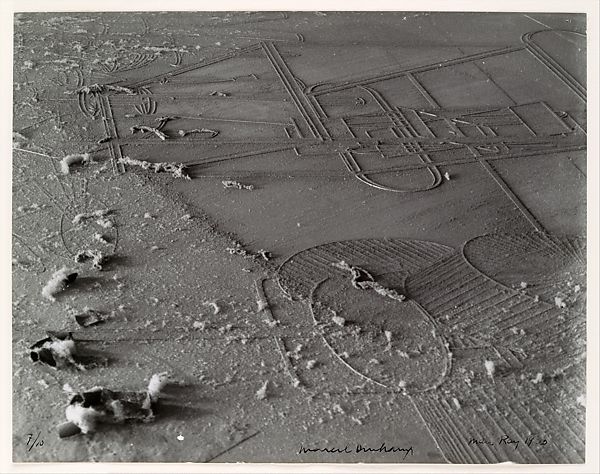
Dust Breeding 1920
I found it difficult to find what I would call documentary images from Man Ray, but as inspiration for abstract and conceptualism I have included the above image which is fascinating. This image is attributed to Man Ray and Marcel Duchamp. He was asked to photograph an artists work which was not exciting to him, he practiced on a sheet of glass with a year of dust on it with a 2 hour long exposure; from this image he removed the edge of the dusty glass and a little of the studio beyond from the original negative so that it became a separate entity.
Man Ray made much use of negative spaces, accidental compositions, and broke photographic rules. Mann ray said that he painted what couldn’t be photographed and photographed what couldn’t be painted, and it does seem that he consolidated a photographic style that Eugène Atget began.
References:
Man Ray | Dust Breeding | The Met (2020) At: https://www.metmuseum.org/art/collection/search/271420 (Accessed 04/06/2020).
MAN RAY Surrealism (2020) At: http://www.galeriedesmodernes.art/en/artists/man-ray-surrealism-307 (Accessed 03/06/2020).
ANDRÉ KÉRTÉSZ (1894- 1985)
He arrived in Paris in 1925 from Budapest and joined in with its bohemian culture. In the 1920’s he met many of the Dadaists including the artist Piet Mondrain. He photographed both from his hotel window and by moving in the streets in the daytime. Clarke says that Kertesz “works on the margins and borders of our visual and mental awareness”, with chance juxtapositions and “unresolvable ironies” (Clarke, 1997: 92). It also seems that Kertesz has the perspective of an outsider, observing instead of showing that he knows the city well. He combined geometry and formal elements with suggestion and enigma resulting in ambiguous images that represented not just what his eye saw but what he felt. He observed subjects from various angles until the composition pleased his eye and valued emotional impact above technique.


Pont Des Arts, 1929
The Daisy Bar, Montmartre,
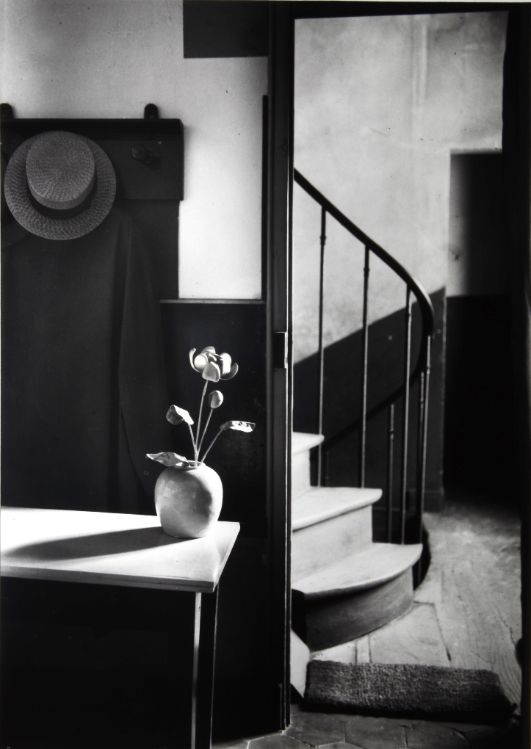
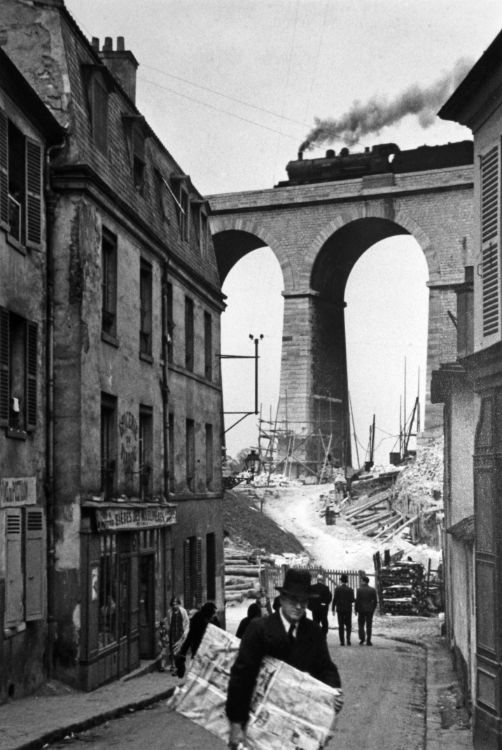
Chez Mondrian, Paris, 1926Paris, 1930 Meudon, 1928
Eventually he fled France and it’s Jewish persecutions, emigrating to the United States. When in New York, Kertész he captured images of people reading, particularly in outside spaces such as parks, window ledges and balconies, particularly from the window of his 12th floor apartment near Washington Square.
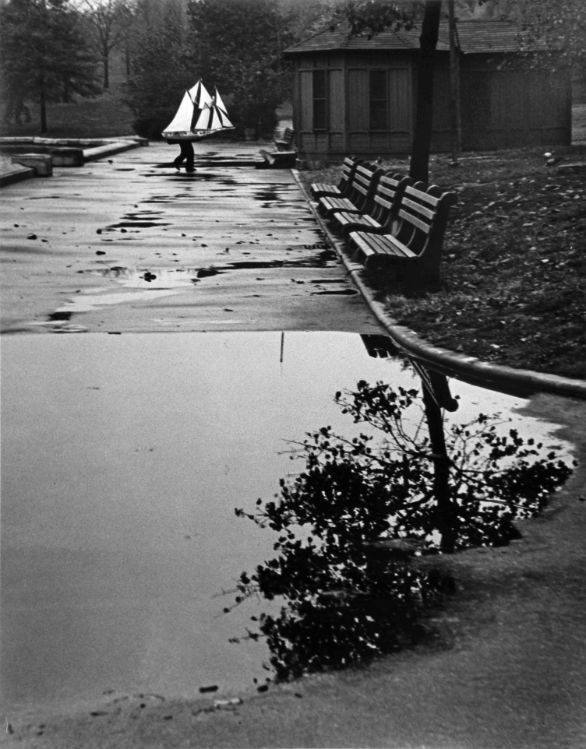
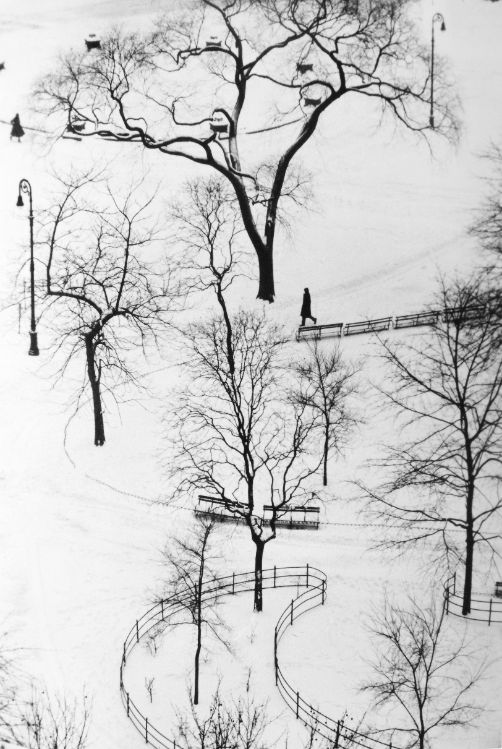
Homing Ship, New York, 1944 Washington Square, New York, 1954
(André Kertész, 2020)
Using a telephoto lens, his views of snow-covered tracks and silhouettes became some of his best known images . After his wife’s death he was reclusive and relied on his telephoto lens to see the world, and took some of his most interesting, abstracted cityscapes. He also created surreal, still-life photographs of his possessions with a polaroid camera. His compositions are dynamically geometric and great examples of seeing things in a different way. All of this and he didn’t consider himself a surrealist but called himself a realist; he certainly made use of ambiguity, interesting framing, juxtapostions, geometric patterns and lines, imagery and negative space.
Reference:
Andre Kertesz. Photographer’s Biography & Art Works | Huxley-Parlour Gallery (2020) At: https://huxleyparlour.com/artists/andre-kertesz/ (Accessed 03/06/2020).
GEORGE BRASSAÏ (1899- 1984)
Brassai is well known for his images of Parisian life between the two world wars, which reveals the complexities and hidden sides of French society and culture. He was tutored by Andre Kertesz a fellow Hungarian and was friends with the city’s creative avante -garde such as Pablo Picasso, Salvador Dalí, and Henri Matisse, among others—and the city’s creative avant-garde.
Brassai photographed like a voyeur on the streets of Paris, rather as Atget and Kertesz did, his work came to life at night when he took pictures of lovers, prostitutes, workers, social gatherings as well as empty streets and parks. Brassai explained “Night does not show things, it suggests them. It disturbs and surprises us with its strangeness. It liberates forces within us which are dominated by our reason during the daytime” (Bunyan, 2020). Clarke suggests that Brassai viewed Paris as a surreal event, bizarre and unexpected photographing at night “to suggest the darkest and deepest of the city’s needs and desires” (Clarke, 1997:92). From his series Paris after Dark (1933) this image allows the imagination psychological space and leaves a viewer uneasy:
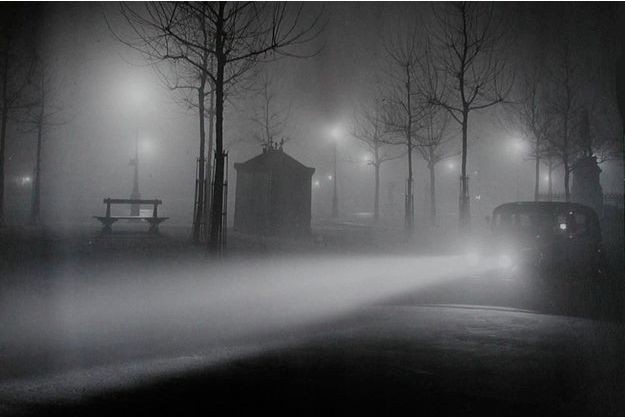
(Photographer Brassaï at SFMOMA , 2020)
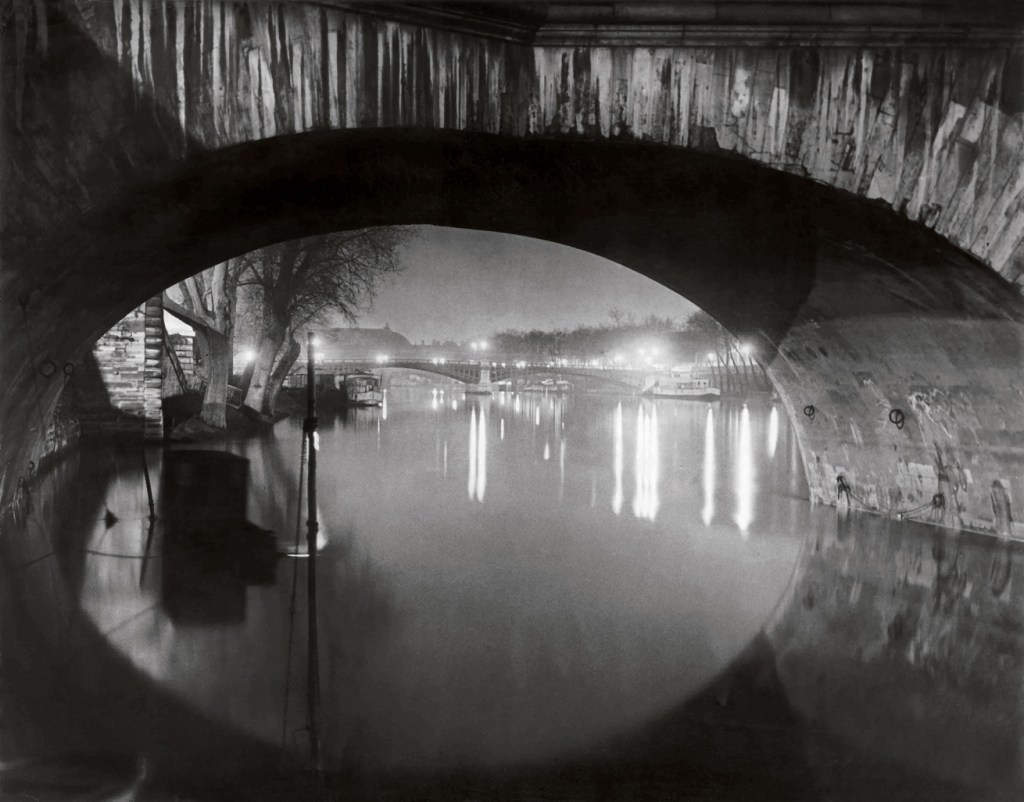
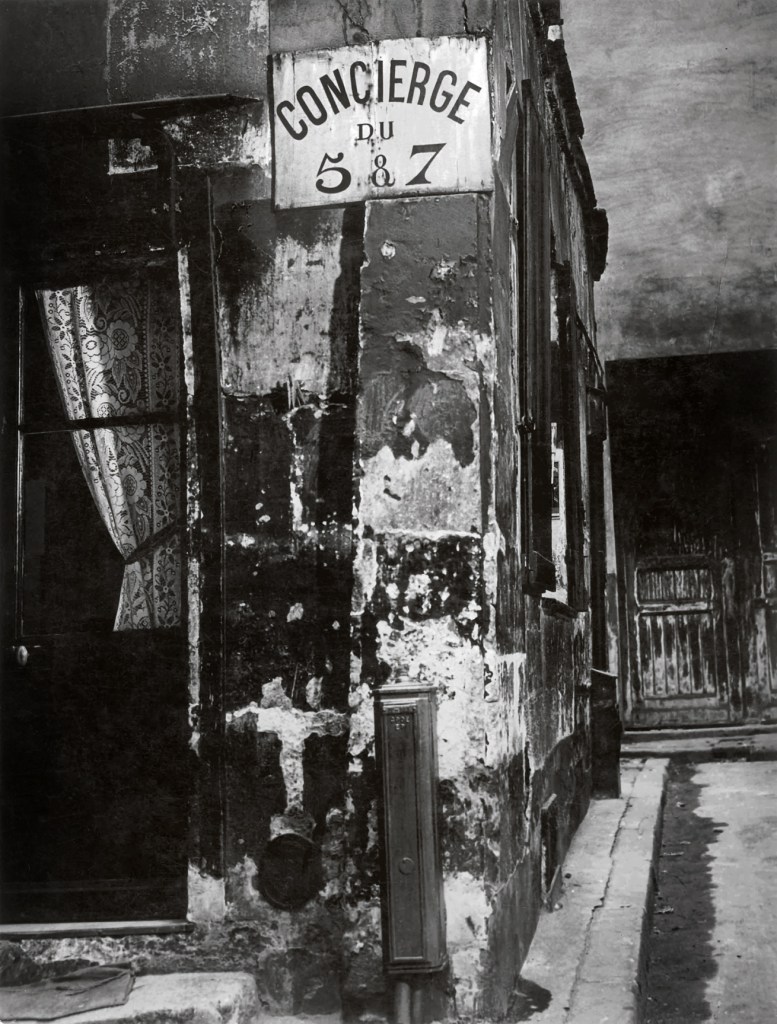
View through the pont Royal toward the pont Solférino c. 1933 Concierge’s Lodge, Paris 1933

The Eiffel Tower seen through the Gate of the Trocadéro 1930-32
(Bunyan, 2020)
Images like the above have a heavy atmosphere communicating much more than the eye can see alone. Brassai himself said ““In certain photographs, objects take on a particular light, a fascinating presence. Vision has fixed them “as they are in themselves” […]. It confers a density that is entirely foreign to their real existence.” (Brassaï, undated note).
Though the night was his greatest inspiration he also shot many images of the city in daylight, monuments, and details of everyday life. His Photographs from the thirties show his keenness for
geometric styles or abrupt cuts, shown in his famous cobblestone images of city streets.

(Lebowitz,2016)
Brassai was very interested in composition, where he combined documentary clarity with aesthetic experimentation; he shot from unusual angles, caught surreal moments and unstaged subjects, but with poetic intimacy. He shows how everything is worthy of portraying for those who know how to look as he captured the everyday, the magical, and the mysteries of common life, and made them into art. Brassaï saw things clearly, so that we can see them now:
“Most of the time I have drawn my images from the daily life around me. I think that is the most sincere and humble appreciation of reality, the most everyday event leads to the extraordinary” (Johnson et al,2012:535).
References:
Bunyan, D. M. (2020) Brassaï Extinguishing a Streetlight – Art Blart. At: https://artblart.com/tag/brassai-extinguishing-a-streetlight/ (Accessed 03/06/2020).
Johnson, W. et al. (2012) A History of Photography: From 1839 to the Present. Taschen.
Lebowitz, R. (2016) 10 Photographers Who Captured the Strange and Seductive Sides of Paris. At: https://www.artsy.net/article/artsy-editorial-10-photographers-captured-romance-paris (Accessed 03/06/2020).
Photographer Brassaï at SFMOMA (2020.) At: https://frenchculture.org/events/9092-photographer-brassai-sfmoma (Accessed 03/06/2020).
HENRI CARTIER-BRESSON (1908 – 2004)
Having studied Cartier-Bresson much before I have confined myself here to the surrealist elements of his life and work.
Cartier Bresson had connections to Atget and Man Ray, he was influenced by both Andre Breton (the founder of the surrealist movement who had travelled to Mexico in 1938) and the cubist painter Lhote who apparently taught him about the satisfaction in geometry, which he used along with the rules of the golden ratio (Franklin, 2016). Many of his images show that Cartier- Bresson embraced Surrealism using geometry, subversion, the subconscious, the role of chance and a reason to explore like a flaneur (by his decisive moments); however it is not so in all of his work especially his early reportage work for life magazine. These works show a surrealistic influence:


Henri Cartier-Bresson | Srinagar, Kashmir (1948) (Artsy, 2020) & V and A Children Playing in Ruins, Seville, Spain 1933 (Collections, 2020)

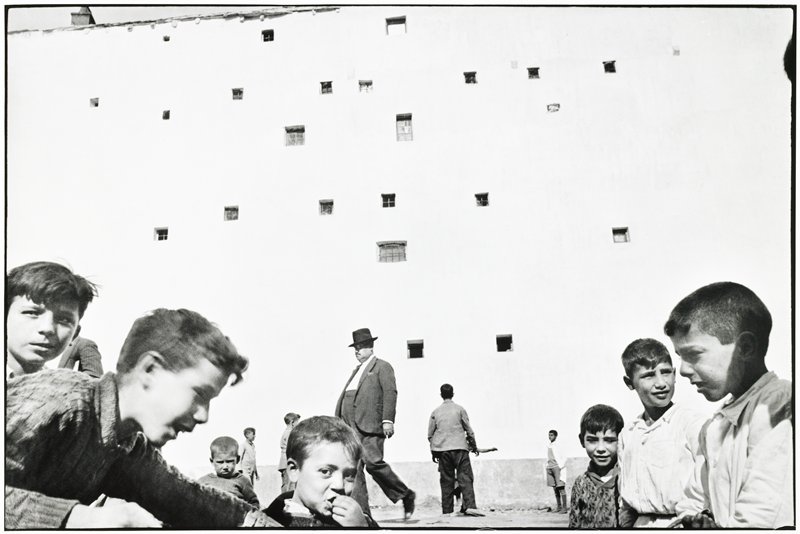
Arena at Valencia, Spain, 1933 (Minneapolis Institute of Art, 2020) & Madrid 1933 (Minneapolis Institute of Art, 2020.)
Cartier-Bresson wrote “I owe an allegiance to Surrealism… because it taught me to let the photographic lens look into the rubble of the unconscious and of chance “(Franklin, 2016:156). It has been suggested that the strength of Cartier-Bresson’s street photography is in “the perceptive grasp of the human condition and their ambiguity” (Franklin, 2016:156). Cartier-Bresson however said that he wasn’t totally focused on geometry as aesthetics, preferring a striving for “elegance”. I had not considered before the amount that surrealism influences are apparent in his work.
References:
Franklin, S. (2016) The Documentary Impulse. (London): Phaidon Press.
Collections (2020) Andalucía. Seville. 1933 | Cartier-Bresson, Henri | V&A Search the Collections. At: http://collections.vam.ac.uk/item/O93840 (Accessed 01/06/2020).
Artsy (2020) At: https://www.artsy.net/artwork/henri-cartier-bresson-srinagar-kashmir-6 (Accessed 02/06/2020).
Minneapolis Institute of Art (2020) At: https://collections.artsmia.org/art/10615/arena-at-valencia-spain-henri-cartier-bresson (Accessed 04/06/2020).
GRACIELA ITURBIDE (b1942)
She photographed in Mexico fifty years after Cartier-Bresson. Her photography can be described as documentary, but fall into the genre of the constructed image and shows elements of surrealism.
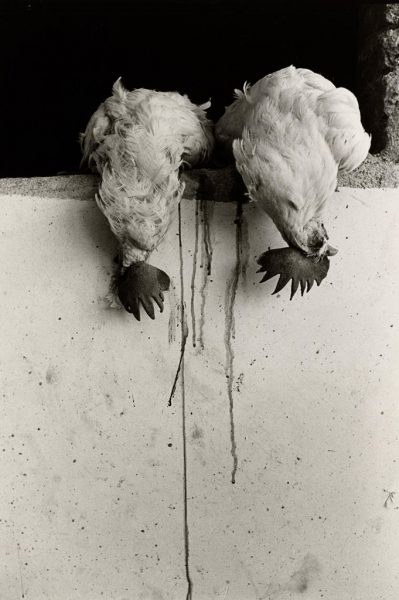
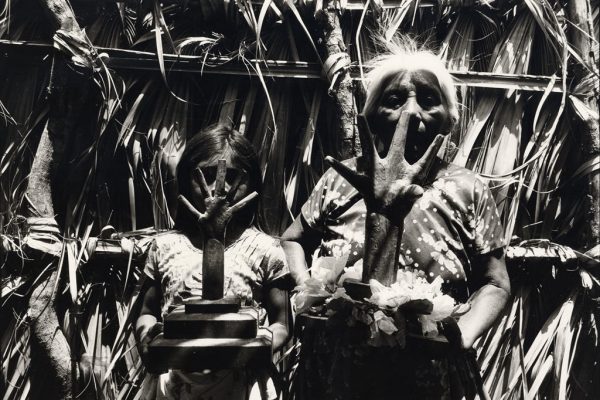

GRACIELA ITURBIDE (2020)
Her images of Mexican society are both personal and poetic, while capturing everyday life visually. She was taught by Manuel Bravo Alvarez another photographer I need to explore more.
Reference:
GRACIELA ITURBIDE: Juchitan – Amber Collection (2020) At: https://www.amber-online.com/collection/juchitan/ (Accessed 01/06/2020).
KEY VISUAL AND CONCEPTUAL CHARACTERISTICS IN THE WORK OF THE ABOVE PHOTOGRAPHERS
- Ambiguous images
- Juxtapostioning
- Use of negative space
- Use of shadows
- Use of geometric patterns
- Shot from unusual angles
- Framed abruptly
- Accidental compositions, use of chance.
- Break traditional photographic rules of composition
- See things differently and show us things differently
- Disrupt our perceptions
- Reveal the uncanny
- Some dream like imagery
- Fusion between the real and the imaginary
- Capture surreal moments
MY LEARNING:
I have also read much about the surrealist movement in art at the same time as researching these photographers. I have always been particularly interesting in different ways of seeing, and unconscious ones in particular and so this has broadened my knowledge. It will be interesting how this might trickle into my photography.
NEXT POST: https://nkssite5.photo.blog/category/research/a2-research/research-point-vivian-maier/
 Photography 2: Documentary