Exercise 2.10
Listen to Daniel Meadows talking about his work. Then read the essay ‘The Photographer as Recorder’ by Guy Lane. (Open College of the Arts, 2014:40)
The link suggested is broken but I listened to British photographer Daniel Meadows discussing his movie High Street Stories: detailing his inspirations, working processes (using both sound and photography), editing and his working methods after being diagnosed with MS. In this Meadows talks about using old traditions for photography, like using tape recordings rather than videos.
Here in 2014-15, he made a series of visits to West Bromwich High Street, indoor and the outdoor markets. To document those who work and use the market, he made many connections with the people he met. The movie is made up of hundreds of Daniel’s photographic images that are animated to accompany the sound recordings made on location, he used stills like broken animation “multi stories”.
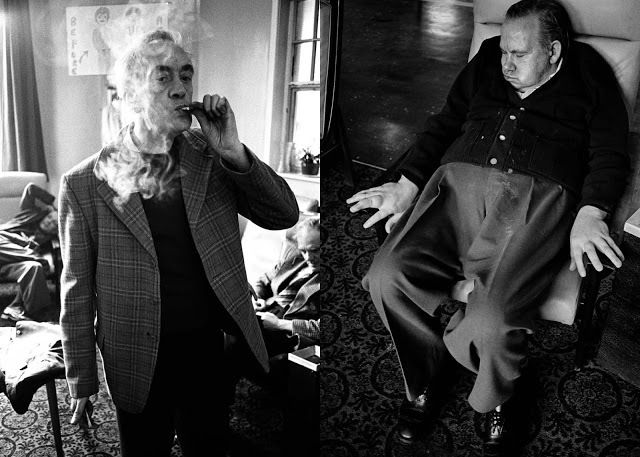
I also watched his work “Smoking room” about mental illness and effectively “care in the community”, where in 1978 Meadows, spent two weeks living in a psychiatric hospital, in a ward for long-term schizophrenics, Clayton Ward. He called the work the smoking room as tokens were earned by the patients as rewards for “Good’ behaviour” which they could exchange for amongst other things tobacco.
He intersperses quotations, narration, and his soundbites on his observations; it all combines as a sort of poetry visual and audio and in a simple but in a very effective way conveys in the space of 4 minutes 34 seconds, the absolute essence of the goings on and essence of like on the ward.

The paper ‘The Photographer as Recorder’ by Guy Lane, looks at Daniel Meadows plans to survey the English people. In this he follows three lines of enquiry taken from Foucault’s “The Archaeology of Knowledge”: the first, Discursive Practice, he describes Meadows non-commercial approach, though publicly funded and with a prospective audience. The second, Emergence, where lane notes that the project was possible because of cultural shifts in photography in the 1970s. The third, Archive, where Lane categorises and assimilates Meadow’s work where the photograph is about urban modernisation discursive intervention. These lines of enquiry Lane suggests are permeated by the absence of tradition in Meadow’s work; he describes Meadows work in Bus Statement as a “dialectic of English life and social change, tradition and modernity, intervention and anxiety (Lane, 2011) 172)
Daniel Meadows is a documentarist, who engages with others to gather as factually as possible, then present stories made out of photographs and/or oral testimony to document our times.
What I’ve learned from Daniel Meadows:
- Use curiosity about the world as a driver
- Engage with others and mediate other stories
- People will talk about their lives
- The effectiveness of “actuality recording”
- Listen carefully as silence is as telling as the spoken word
References:
July 2015 – Café Royal Books (2020) At: https://caferoyalbooks.wordpress.com/2015/07/ (Accessed 28/06/2020).
Lane, G (2011) “The photographer as a recorder”: Daniel Meadows, Records, Discourse and Tradition in 1970s England. In: Photographies 4 (2) pp.157-173.
Multistory (2015) Interview with Daniel Meadows. At: https://vimeo.com/138851324 (Accessed 28/06/2020).
Open College of the Arts (2014) Photography 2: Documentary-Fact and Fiction (Course Manual). Barnsley: Open College of the Arts.
Tube, D. (2013) ‘The Smoking Room by Daniel Meadows’ At: https://vimeo.com/57256054 (Accessed 28/06/2020).
NEXT POST: https://nkssite5.photo.blog/category/exercise-2-11-sanders/
 Photography 2: Documentary