PHOTOGRAPHY ASSIGNMENT 1: REFLECTION AGAINST ASSESSMENT CRITERIA

Demonstration of technical and visual skills

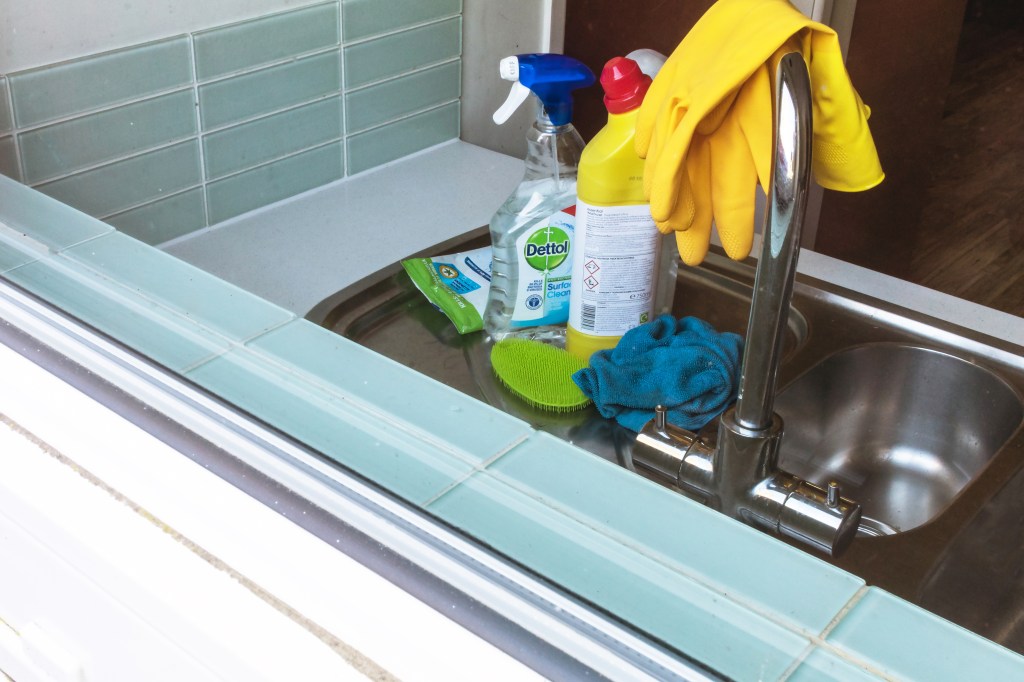
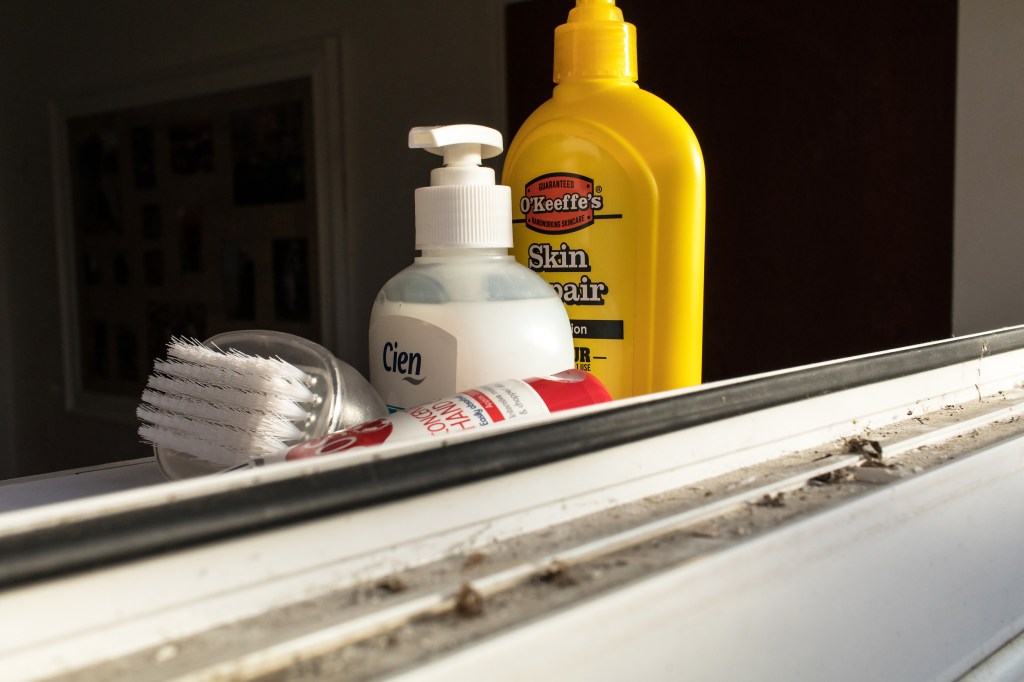
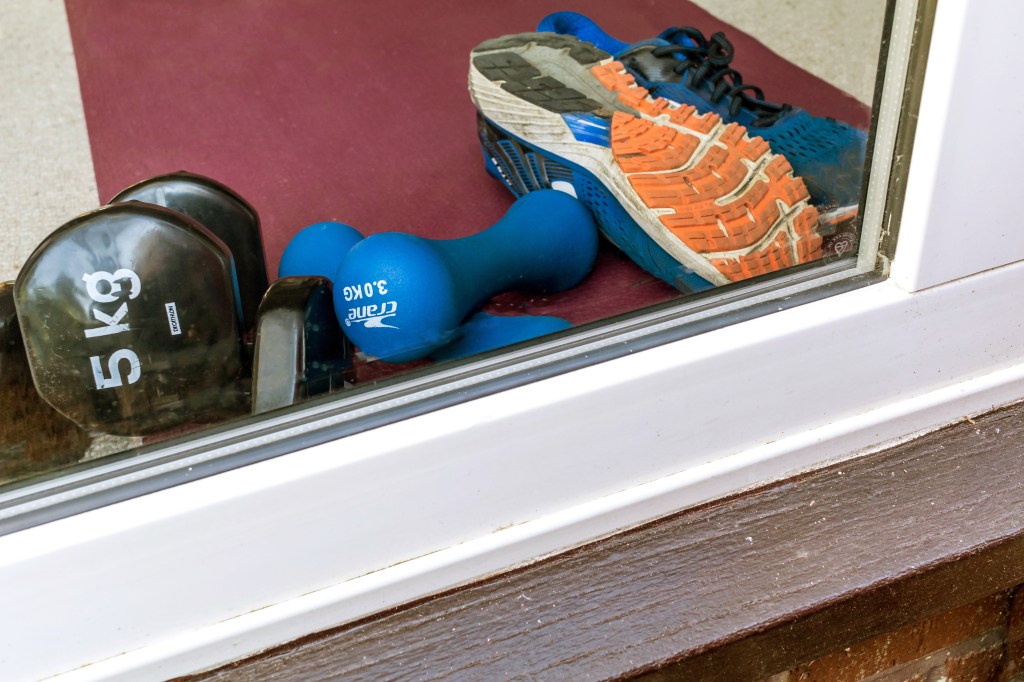
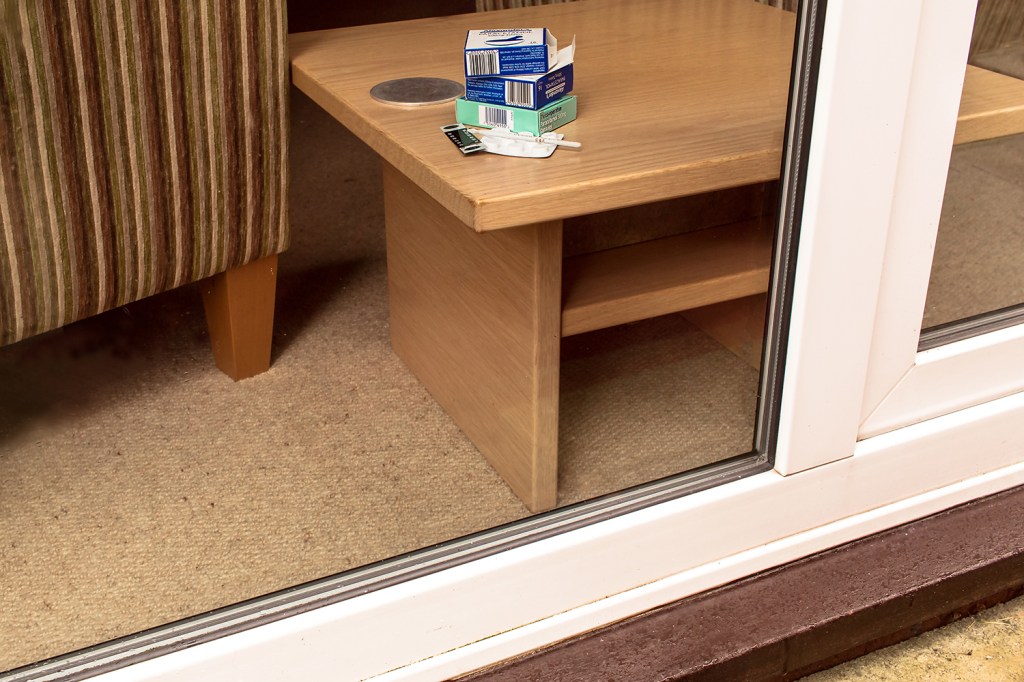
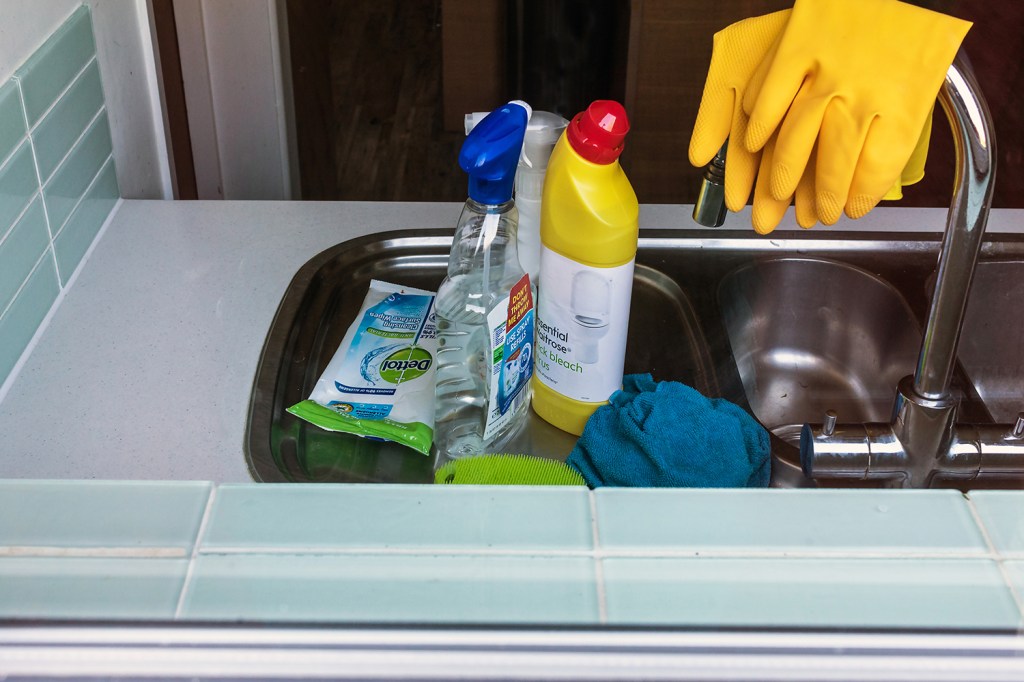
  • Focusing on traces of an isolating community from the outside, my visual strategy was to shoot through windows exposing details in the mundane, keeping things simple and uncluttered and with good depth of field.
  • Technically my concept proved challenging to execute, working with glass is never easy. I experimented both by using reflections and eliminating them. I decided to give the simple detail I wanted, I would eliminate reflections as they would be distracting; this took patience and experimentation.
  • Composition and framing were led by the need to include some window frame as context and I learnt a lot as I tried different perspectives (angles, heights, distances) to achieve this.
  • I decided that I could vary the perspective between images if I maintained continuity of subject strongly enough.
  • I tried various techniques to achieve the clarity that I wanted, working always with a tripod: Good depth of field, clean windows, various times of day and weather conditions (unfortunately it was predominantly sunny for the period), polarising filter (though ultimately I didn’t use this), black fabric as a blocker to eliminate reflections, live view so I could check for shadows, colour casts and distracting details.
  • I used my prime lens efs 24mm to keep the focal distance constant.
  • I shot and revised the images over a couple of weeks until I achieved what was looking for.
  • Achieving consistency of colour across the series of window frames was challenging, as they do vary and of colours shooting conditions changed – I tried my best to make these uniform, but maybe more could have been achieved? Would this have been realistic though?

Quality of outcome

  • The outcome looks simple, but I believe it communicates on other levels as well and that viewers will empathise with the representation.
  • When shooting and editing I constantly returned to my intention and I think has helped to give a clear story.
  • I considered at one stage adding text (perhaps govt messages) to the images, but realised that discontinuity is likely to be minimal and that for a long time to come viewers should quickly connect and give meaning to the images.
  • Importantly I believe that the series does say something to my audience about my personal response and allows them to reflect and respond also.
  • My regret is a lack of punctum, I feel, except in the first image; I considered ways to go beyond the signifiers and signified to achieve this but I wanted to share the ordinary in a simple way so decided against constructing something that wasn’t there.

Demonstration of creativity

  • I was forced to be flexible as the Covid19 situation unfolded, as I had to restart this assignment in a different location from my first draft and under restricted conditions.
  • My loss of equilibrium stalled me for a while, however eventually certain advice helped to get me going again: embrace the constraints, don’t get too wrapped up in the end product, develop the project over time.
  • Though the series may appear simple the windows represent my feelings of isolation and barriers to my freedom, and the hiraeth I felt* whilst the subjects show my reaction to perceived threats to my community and my coping mechanisms – I have expressed my emotions.
  • Some of my creativity in this project was technical as I struggled to get clear shots without reflections of the subjects through glass – I tried a lot of new things.

Context

  • There was an awful lot of reflection over the period I worked on this project. My increased interactions with my peer groups aided this and I have recorded these, as well as my actions after such reflections. I also created a “Covid 19 thoughts” document to capture pertinent reflections and advice.
  • Whilst I was preparing to share the work, I reflected that the work is also a response to me withdrawing from the world not only for my safety but also as I felt isolated from my second home.  
  • My research outside of the coursework was led by concept for my assignment but also by opportunities to attend virtual artist talks and virtual photography events.
  • In fact, the increased opportunities for learning online slowed my ability to submit this assignment but I believe it will be a worthwhile time investment long term. I have set out in learning log and mind maps my learning points from the research that I’ve done and advice that I’ve gathered.
  • I have more general research that I’ve done during this period but will post later as I don’t want to delay this assignment submission further; I suppose it is a regret that I don’t seem to have enough hours to do all the research that I would like to!

*Hiraeth (Welsh pronunciation: [hɪraɨ̯θ, hiːrai̯θ]) is a Welsh word for homesickness or nostalgia, an earnest longing or desire, or a sense of regret (Wikipedia 2020)

Reference:

Wikipedia contributors (2020) Hiraeth. At: https://en.wikipedia.org/w/index.php?title=Hiraeth&oldid=950185684 (Accessed 06/05/2020).

Next post: https://nkssite5.photo.blog/category/submissions/assignment-1-submission/

ASSIGNMENT ONE DRAFT: LOCAL COMMUNITIES

Produce a small photo essay of 10 images that demonstrates your engagement with the lives, experiences and histories of your local community and its people. Decide on a single theme, topic or activity to focus on. Do this assignment with only one camera and one lens.

Provide a short commentary (200 words) explaining your ethos and rationale along with your images (Open College of the Ats, 2014:31).

___

NICOLA SOUTH STUDENT NUMBER: 514516

PROVISIONING AND PROTECTING

COMMENTARY

This theme of this photo essay is of my family isolating at home during the “lock down” of Covid19. My choice of subject was driven by the lockdown necessitated by the world-wide pandemic and the adjustments that myself and my immediate family made as we became a physically isolated community. Though the images may appear straight forward they represent my personal response to the suddenly imposed conditions, and the threat of both the pandemic and the isolation to my family. My intention is to share how my attention was initially funnelled to providing what my community would need to survive in an uncertain situation and protecting us; provisioning and protecting.

My concept was to communicate the protection and adjustments that I built for my community but also the isolation and barriers that I was feeling. I was also suffering from being separated from the place that my soul calls home, my second home 220 miles away that I was forbidden to visit. My visual strategy developed from these personal reactions to the situation.

The windows of my house represent physical barriers between the world outside and inside, as well as emotional ones. The subjects photographed through my windows, though mundane, will be familiar to others who have lived through this time. I hope that viewers will connect to these images through their shared experience of the time, using their imagination and experiences to ascribe exact meanings for them, as they trigger their own responses to this shared situation.

Reference:

Open College of the Arts (2014) Photography 2: Documentary-Fact and Fiction (Course Manual). Barnsley: Open College of the Arts

___

ARTIST STATEMENT

This work shares my experience of isolating at home with my family during Covid 19. The subjects on view are those that I fixated on initially in my personal battle to protect our community. This series is a response to my personal feelings of withdrawal for our protection and to the barriers imposed that separated me from my second home, causing an even stronger sense of nostalgic longing, hiraeth. 

PROVISIONING AND PROTECTING

Provisioning and Protecting #1

.

.

___

Provisioning and Protecting #2


___

Provisioning and Protecting #3


___

Provisioning and Protecting #4


___

Provisioning and Protecting #5


___

Provisioning and Protecting #6


___

Provisioning and Protecting #7


___

Provisioning and Protecting #8


___

Provisioning and Protecting #9


___

Provisioning and Protecting #10


___

Next post: https://nkssite5.photo.blog/category/learning-log-research-and-reflection/reflection/a1-reflection/a1-reflection-against-assessment-criteria/

LEARNING LOG: ASSIGNMENT 1

Assignment one: Local communities Learning log

In preparation…

We were asked to read the section entitled ‘The Photographic Brief’ in Short, M. (2011) Creative photography: context and narrative. Lausanne: AVA Publishing, pp.20–26. See my post: https://nkssite5.photo.blog/category/research/a1-research/the-photographic-brief-short/

The brief

Produce a small photo essay of 10 images that demonstrates your engagement with the lives, experiences and histories of your local community and its people. Decide on a single theme, topic or activity to focus on. Discuss your ideas with your tutor before committing to it. Do this assignment with only one camera and one lens. Provide a short commentary (200 words) explaining your ethos and rationale along with your images. Provide a short commentary (200 words) explaining your ethos and rationale along with your images.

Delivery: For this assignment you’ll need to submit 10 unmounted quality prints. The size should be 8×10 or A4. Liaise with your tutor regarding the technical aspects of printing your photographs.

Aims

The emphasis is on engaging with the world with your camera. You’re encouraged to be a participant-observer in the situations and activities that you photograph. By limiting your field of action to your immediate surroundings, you’ll develop the ability to find the extraordinary in the ordinary – the things that may go unnoticed when you’re familiar with a place. This assignment will develop your observational skills and prepare you for more involved projects towards the second half of the course (Open College of the Arts, 2014, p31).

INITIAL PLANS:

Initially I ran through possible ideas for the assignment I have 2 locations that I engage with Tredreath Pembrokeshire and Old Basing Hampshire. I decided to shot the Boat club comitteeI’m a member of in Tredreath and spent a few weeks exploring ideas and did quite a bit of exploratory shooting late February early March when I was in Pembrokeshire, see my earlier post : https://nkssite5.photo.blog/category/learning-log-assignments-2/assignment-1-local-communities/a1-learning-log/1st-draft-pre-covid-19/

This took me to the 15th of March when the impact of Covid19 began to have an effect on social engagement. I had planned to return to Pembrokeshire for the next committee meeting 26th of March with a developed plan (conceptual, visual narrative) to finish the project. It quickly became evident that this would not be possible.

I dithered whether to stop, move on and return to the work later or start afresh.

I shared my dilemma with the OCA Tutor led meeting 18th March “approaching an assignment”, see post: https://nkssite5.photo.blog/category/learning-log-research-and-reflection/zoom-oca-meetings/18-3-20/

I also shared with my peers at the virtual Thames Valley OCA monthly meeting 21st March facilitated by OCA tutor Jayne Taylor, see posts: https://nkssite5.photo.blog/category/learning-log-research-and-reflection/thames-valley-oca-meetings/21-3-20/

Generally my peers suggested moving on, and we talked about new ways in the current circumstances that I could capture community engagement (Traces of people, disruption in the community, changes in the community, barriers to engaging with the community).

Following these meetings I have resolved to start again with a new idea for assignment 1, even though I lost a lot of time but I was concerned that if we have a “lockdown” opportunities will be even more limited. In the event the lock down did begin March 23rd and I had to conceive a new idea that would show my community engagement withing these restrictions. I contacted my tutor to let him know that I’d lost time by beginning over.

ASSIGNMENT ONE SECOND ATTEMPT:

BRAINSTORMING:

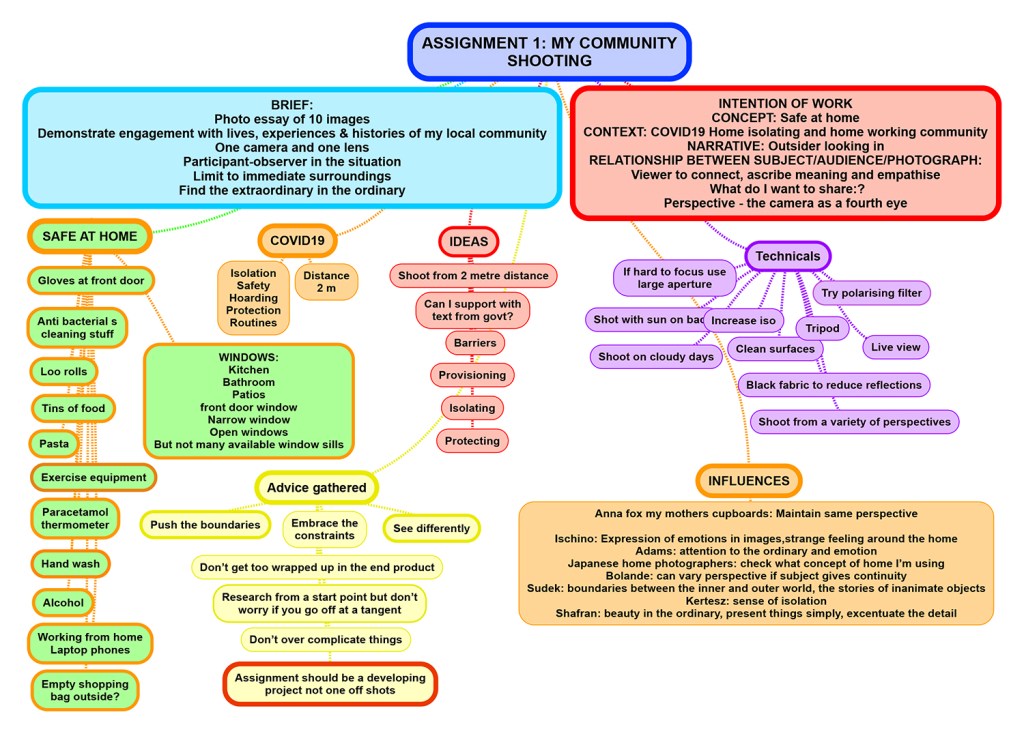
So my first idea and shoots for assignment 1 thwarted I looked for other ideas. Now in Hampshire and quite rural I felt my options were quite limited. I considered shooting from my window or through my gate but there is little footfall outside my street so that didn’t look fruitful. So I turned to the community inside my house, 2 older adults and 2 young ones, some home working some not. I brainstormed some ideas:

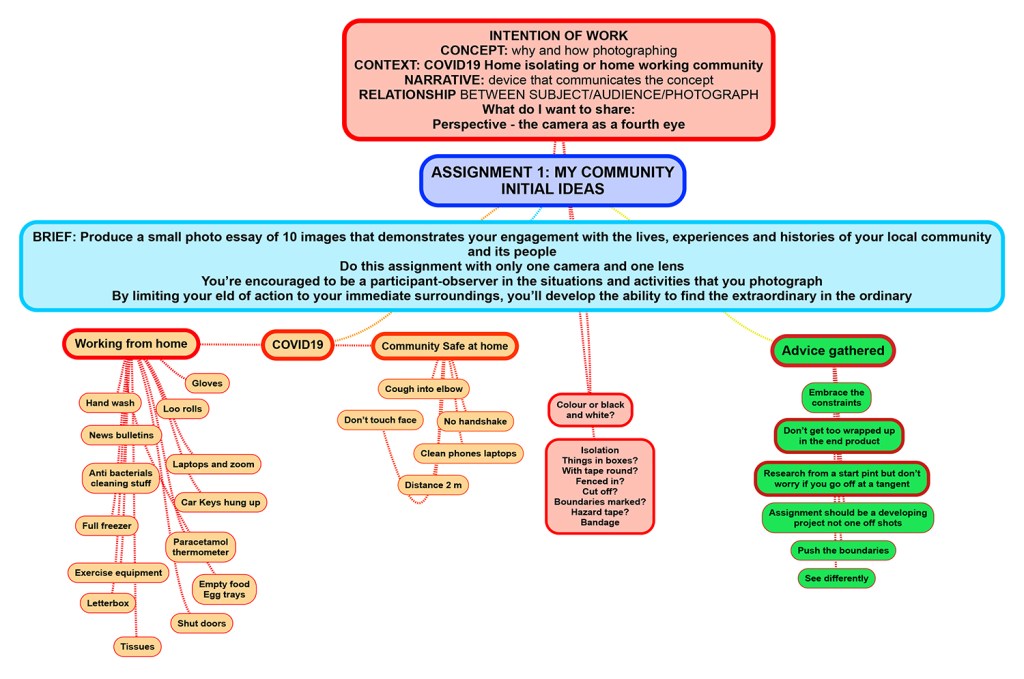
Mindmap Initial ideas:

I also considered advice I had recently in particular, embrace the constraints, don’t get wrapped up in the end product, see differently.

My research made me consider:

  • Express my emotions in the images
  • Pay attention to the ordinary and bring attention to it
  • Really think about what concept of home/community I am sharing
  • That I can vary the perspective if I maintain continuity of subject strongly enough
  • Show a sense of isolation

Advice gathered encouraged me to:

  • Accentuate the detail in the ordinary
  • Show the boundaries between the inner and out worlds
  • Show a sense of isolation
  • Be sure what concept of the home I’m sharing

SHOOTING

I decided to go with the theme of staying safe at home and to begin by photographing by looking in through my windows as an outsider would, I wanted to portray a house in a Covid 19 lock down. I reduced my initial ideas for subjects to about 10 that represented for me life in a lock down house, these would be headed by an image of the front door opening carefully as if to an outsider, and finished with an image of a closed front door with an empty shopping bag outside. I also knew from the outset that this would be a colour project.

To fit with the brief I used one lens, my prime Efs 24mm.

The idea seemed simple but the execution I discovered was not. To begin with I live in a house with few window sills downstairs as they are nearly all full length windows so I had to be inventive to get the variety of locations that I needed. I found reflections were a huge consideration and I experimented with shots without reflections and those with reflections accentuating them. I decided that for the message I intended to share I wanted clear images with detail, so shot at different times of day and directions until I got what I needed.

Part way through I re-clarified my objectives to make sure that I was capturing the right images for my narrative:

  • CONCEPT: Safe at home – a community isolating at home
  • CONTEXT: COVID 19
  • NARRATIVE: Outsider looking in at traces of a protected community inside
  • RELATIONSHIP BETWEEN AUDIENCE/SUBJECT/PHOTOGRAPH: Physical barriers but connections through understanding
  • WANT TO SHARE: Feeling of being outside looking in at a protected world

I decided that it was important to:

  • Express in my images how I am feeling (barriers, isolated, provisioning, protector).
  • Attention and focus on the ordinary
  • Present things simply- don’t over complicate for the sake of it

I shot as close as I could to subjects but could only go so close before I lost the window frame and therefore the context.

Mindmap shooting:

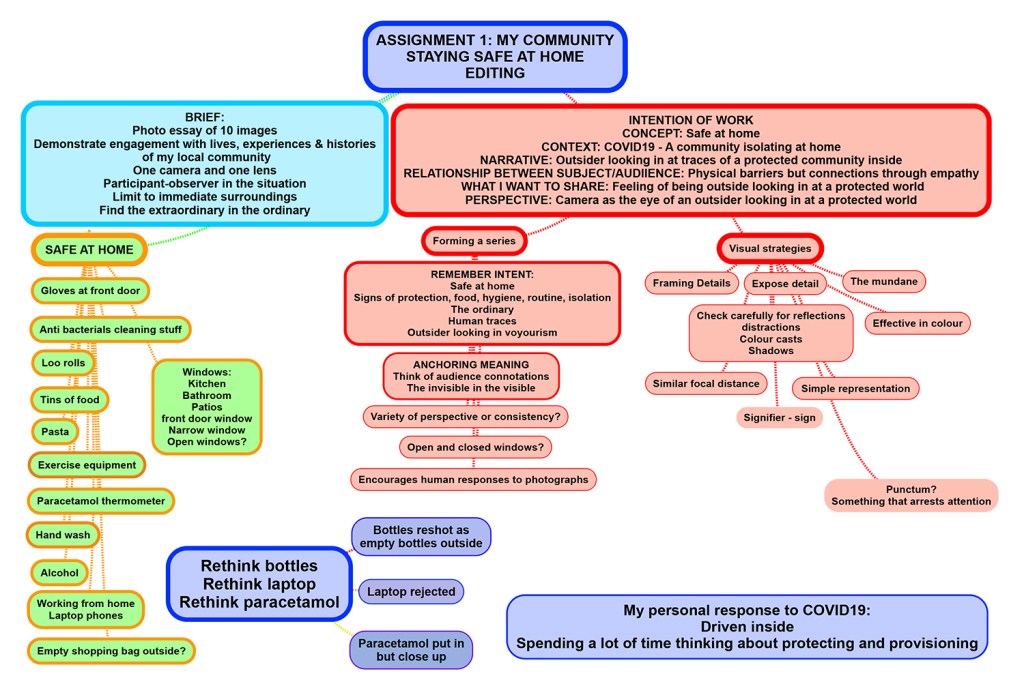
EDITING

As I edited my images I began to form the series.

When shooting I captured windows and subjects both straight on and at angles and considered like Anna Fox in “My Mother’s cupboards” keeping the same perspective throughout the series; I settled on a variety of perspectives but keeping a similar focal length and simple composition. Likewise after asking others I decided that it was okay to have some windows open and some closed, this was more realistic and increased my options when shooting and making the series.

After sharing twice with different OCA peer groups I’d reshot my bottles on the window sill as empty bottles outside the backdoor instead (as this seemed more realistic). And even after reshooting the laptop at a closer distance after peer group advice I chose not to use it and replaced it with a close up of paracetamol packets which I had reshot at a closer distance.

Links to peer sharing opportunities:

Documentary hangout 9.4.20: https://nkssite5.photo.blog/category/learning-log-research-and-reflection/zoom-oca-meetings/documentary-hangout-9-4-20/

Thames Valley OCA group: https://nkssite5.photo.blog/category/learning-log-research-and-reflection/thames-valley-oca-meetings/18-4-20-virtual/

Choosing the final 10 images I prioritised:

  • The ordinary
  • Simple representation (framing, focus, lack of distraction-less is more)
  • Detail in the ordinary – Good depth of field
  • Subjects that viewers will ascribe a Covid19 lockdown connotation to- the invisible in the visible
  • Images that viewers will empathise and respond to
  • Signs of human traces of: protection, safety, provisioning, routines and barriers

Mindmap Editing:

From my first draft of the series I decided to drop this image of the paracetamols on a table as it was too long range, as well as this image of a lap top on a table:

I re shoot the paracetamol at closer range and used this in the final series. I did re shoot the lap top at closer range but ultimately it was still an image I dropped because I thought it fitted less well:

I also deliberated over which of these two images of washing up to use but decided on the angled perspective.

For the final series of 10 I replaced this image of full bottles of wine on the window sill for empty ones outside the door as I felt it was more realistic:

Presentation:

I considered whether to add text to the images such as government orders to the images so that they would have context later, or whether not to in order to allow some discontinuity. I have decided that text won’y be necessary to give context as I’m now sure that the event will live on for a very long time and I think be very easily recognised in the future.

The size of the prints will be A4 which is the ratio as shot.

Next post: https://nkssite5.photo.blog/category/learning-log-assignments-2/assignment-1-local-communities/a1-learning-log/2nd-draft-during-covid19/

RESEARCH: ASSIGNMENT ONE

The photographic brief – Maria Short (2011

The brief for our 1st assignment tells us to read the section entitled ‘The Photographic Brief’ in Short, M. (2011) Creative photography: context and narrative. Lausanne: AVA Publishing, pp.20–26.

THESE ARE MY NOTES:

  • The brief defines the context of the final output
  • May contain relevant information regarding the conceptual approach
  • It can be simple: what you are taking a photograph of, where and why.
  • Give yourself time to develop your idea through practice

The Student brief:

  • Usually a defined period, possibly loose briefs to enable personal responses.
  • They should initiate, develop and articulate ideas translating them into photography.
  • Research and take photographs soonest to share with peers to get feedback – this encourages
  • Read brief carefully
  • Clarify own learning aims

Reference:

Short, M., 2011. Context And Narrative. Lausanne: AVA Publishing SA.

Next post: https://nkssite5.photo.blog/category/learning-log-assignments-2/assignment-1-local-communities/a-1-learning-log/

REFLECTION: COVID 19 THOUGHTS

Emerging from lockdown takeaways:

25/06/2020 AOP Webinar Best Practice – Shooting experiences in the time of COVID-19

Nick Dunmur, in conversation with professional photographers, in a discussion about the realities of making commissioned work in the time of coronavirus and the challenges that they all encounter:

  • Commercial perception of risk and risks of litigation
  • Sometimes working with many subjects at once
  • Sometimes with large crews
  • Problems with working with gloves
  • What happens if photographer gets it/symptoms
  • Suggested to send literature out about expectations
  • Everybody in the shoot needs to be comfortable

It was interesting to get an insight into the world of professional photographers and the current challenges.

23.6.20 Breakfast AOP talk

The impact of Covid 19 on work

Documentary photographer Simon Roberts: Questioning how he will he make work in the future and how will we carry on as visual artists?

I learnt I am not so different to these photographers in the challenges Covid 19 has brought me; the Covid situation stopped my creativity and productivity for a while, and it has made me reflect on the importance and meaning of photography going forward.

18.6.20 AOP breakfast talk

Photographer Gideon Mendel: let unexpected events like Covid release new creative journeys

Lock down takeaways

28.4.20

1854 ACCESS: IN CONVERSATION with Fiona Rogers, Hannah Watson, Shoair Mavlian: Director of Photography Galleries and organisations,

The panel  discussed the industry at large and how the photography community is coping with the pandemic: covering programming and initiatives affected by the lockdown, how organisations are responding to and managing at this challenging time, and highlighting initiatives that have come out of the isolation period.

Ideas that came out of this discussion that echoed with me:

  • Now there are no geographical boundaries for talks and sharing which opens so much up
  • Will we get fatigued by what’s being produced? Content and the initiatives are hard to keep up with? I know I’m struggling to keep up with all the online opportunities and free ones at that!
  • Currently we are consuming by being in the middle of the crisis how will the legacy look out of the context later?
  • There have been many different technologies to get to grip with – will we use them later?
  • It is possible that photography has  lost some of its value in its digitalisation and is there a need for tactile experiences as we get fed up of seeing things on screens; however one doesn’t have to replace with another physical and digital can exist together.
  • Possibly something good will happen for creative processes, there’s lots of room for experimentation and this is a time where people will be forgiving and processes can be refined.

23.4.20

Student led OCA documentary hangout

We spent most of the session discussing Steven Young’s preparatory work for assignment 3. This gave me another way of looking at documentary and the Covid19 situation in particular. Steven is looking at ways of representing Covid19 as lack of attention to our planet.

21.4.20

1854 PRESENTS   IN CONVERSATION WITH MARTIN PARR  21.4.21

Q: How is lockdown affecting your work? Is it important to keep photographing? Yes of course but a challenge. The Marin Parr Instagram foundation has set challenges for photographer. Parr suggests obviously photographing at home and is currently doing a bird table challenge himself. He suggest we should consider whether it make people more or less interested in documentary photography? People may want to escape into a different world?

Q: How do you think changes in travel habits will impact on your work? Parr is happy photographing in the UK and he can express his love/hate relationship through the ambiguity in his photographs.

Q: Simon asked him about the challenges of photographing locally. Yes there is virtue in the challenge of photographing locally rather than strangers.

18.4.20

THAMES VALLEY OCA VIRTUAL MEETING

We discussed the current restrictions on photography and the benefits of working directly with I phones for those who can photograph whilst outside. 4 of us shared our work with our peers for their comments:

My post meeting reflections:

“Thanks to everyone today – sharing my work gave me sometime

for extra reflection and I realised that I feel double isolated at

the moment; this is because I am not allowed to live currently in

my second home (which is emotionally my first home, especially

this time of year) and I am not so integrated now in my local

community here, hence the double isolation! I think this comes

across in my work and my attitude towards it – I shall write this

into my evaluation. Cathartic reflection!

9.4.20 OCA Documentary student hangout

We discussed how were are managing our photography during our lockdowns; it was bizarre that with one OCA member in Canada and one in Australia as well as us in the UK we are all experiencing the same situation – this was a homogenising experience in that normally our cultural/seasonal/time differences are evident, however now it is more like we are all sat in the very same building. It really made me feel that photographically, I am not alone!

15.4.20

1854 Presents: In conversation with Laura Pannack – London based portrait, social documentary work photographer.

Subject: The challenges faced by photographers during lockdown alongside themes of separation in her work. She works a lot with connections, engagement

Q: How to photograph during a lock down?

  • Keep working
  • Shift your project from what it was to something that fits
  • Remove the pressure on the end product
  • Generate a community
  • Look for other inspiration such as poetry, magazines, Ted talks,
  • Projects on connection and changed social contact
  • Think about immediate post covid projects – reuniting, new connections,
  • Trial and error
  • Finding inspiration elsewhere

9.4.20

Mark Neville Artists Talk the photographer’s gallery

We asked him: Do you think your work will change after Covid19? Almost all his photos are of people however he thinks it’s slightly irresponsible of people to go out and take photos during Covid19, as photography has got to be safe and respectful.

My takeaways for the Covid19 situation:

  • Tension between the moment/chance and construction can be very effective in documentary images.
  • That it is possible and can be effective to mix several visual and practical styles within one body of work: staged, some sly on the wall, fashion or classical painting in style.
  • A huge variety of material can be contained with a photographic project: images, texts, essays, letters, eye witness accounts and so forth.
  • Think about the local role of any project – if it is about reality should it seek to change or just highlight something?
  • There are many ways to exhibit work other than in a gallery.
  • It reminded of something I have discovered myself, that photographic work can be therapeutic to yourself.
  • Don’t worry if I change my mind where I’m going with a project once I immerse myself in it.
  • There is a difference about viewing the images in reality and as a copy, details easier to see – I hope to see the actual photographs after restrictions lift.

23.3.20 0CA

The OCA sent some guidelines on “ Reinterpreting learning activities”

“Given the latest Government guidelines on social distancing, we are aware that many learning activities are suddenly more difficult to do. For example, working outside or in public spaces. We are asking students to interpret and undertake activities within these guidelines. While this may be restrictive, it is also an opportunity to be creative, and find new ways of achieving the same learning aims. The forums provide a space to share ideas and get inspiration from others, and your tutors and Programme Leaders are there to help, if you need it.”

18.3.20 Zoom meeting led by Tutor Andrea Norrington

Some of the soundbutes abd advice I took away for photgraphing during a lock down were:

Learn to deviate innovatively…much of the engagement grows out of the obstacles of your surrounding

We spent some time discussing how we might approach assignments in light of the restrictions of the Covid19 virus. There were various suggestions of work to look at on isolated spaces, Raymond Moore, Andre Kertesz (photographed from a window( , Jusef Sudek (The window of my Studio), Timothy Van Zundert (OCA Level 3 student – isolated spaces Blog post), Anna Dranitzke (OCA student – photographs within family home), Nick Waplington (Living Room), Anna Fox, Keith Arnatt,  Robert Adams and my own landscape work!

We discussed embracing  the constraints and creating other worlds.

Next post: https://nkssite5.photo.blog/category/research/a1-research/the-photographic-brief-short/

THAMES VALLEY OCA MEETING

VIRTUAL MEETING 18.4.20

This meeting was held remotely via OCA’s Zoom account due to Covid19 Virus. There was no tutor present this month, but there were 8 of us attending. Work was loaded up to OCA’s Padlet in advance, so we had a chance to review and make comments or prepare questions before the meeting and were also able to exchange comments via the Chat facility, which was archived along with a video record of the meeting .Padlet allowed us to make comments on each other’s work along with general comments on how the meeting went and was archived and remains as a record of the meeting.

We discussed the current restrictions on photography and the benefits of working dicretly with I phones for those who can photograph whilst outside. 4 of us shared our work with our peers for their comments:

Jonathan is finishing landscape and shared hs land art project. We had some interesting discussions on how to present the work in a virtual gallery.

Miriam is beginning an assignment for digital image and culture. We reflected on what digital identity is and how to represent it photographically.

Pauline has just started documentary and shared her Covid 19 street photography. Most of our discussions revolved about how to pull it into a series, where would the emphasis be going forward. Unlike me Pauline is able to walk to built up places to photograph.

I shared my new attempt at assignment 1. My peers didn’t seem to find it as dull as I thought they would. The women seemed to identify the most with the images and thought that there was also a theme of being a Mum and a provider there. It was also commented that there was a feeling of barriers – so hopefully I have inspired some emotional reaction to the images.

Whilst I was preparing to share the work I reflected that the work is also a response to me withdrawing from the world not only for my safety but also as I feel isolated from my second home (which emotionally is my first home) which I am not allowed to visit currently and that I am not integrated as with the local community that I am living within currently I am feeling double isolated. Cathartic reflection!

Since my documentary hangout 9.4.20 I had re-photographed the laptop on a desk at closer range and had substituted the full bottles of wine taken through a window, for empty bottles outside (as I thought that this was more realistic). Once again the consensus was that the laptop on the desk was the image that didn’t fit the series, but the paracetamol close up image was said to fit well – this meshed with what I thought.

It was queried that I have a variety of perspectives on the windows but I explained that I photographed different viewpoints and experimented with keeping a flat or angled perspective but prefer the mixture.

This was the padlet of the meeting: https://oca.padlet.org/jonathan515050/d01nm43f5ro6

My takeaways:

  • Remembering the benefit of sharing with others to get an outsider’s perspective
  • There’s nothing wrong with a simple approach
  • Being able to finalise the series and the assignment

My post meeting reflections:

Thanks to everyone today – sharing my work gave me sometime for extra reflection and I realised that I feel double isolated at the moment; this is because I am not allowed to live currently in my second home (which is emotionally my first home, especially this time of year) and I am not so integrated now in my local community here, hence the double isolation! I think this comes across in my work and my attitude towards it – I shall write this into my evaluation. Cathartic reflection!

New post: https://nkssite5.photo.blog/category/learning-log-research-and-reflection/reflection/covid-19-thoughts/

ZOOM OCA: DOCUMENTARY HANGOUT

STUDENT LED Hangout 9.4.20

This was my first documentary hangout. I have been used to joining landscape hangouts once a month but it took me until now to cross over to the documentary group; in fact several of the members like myself were still active on the landscape hangout and so we have shared our early thoughts about documentary there.

There were six of us on the hangout tonight and we began by discussing how were are managing our photography during our lock downs; it was bizarre, but comforting, that with one OCA member in Canada and one in Australia as well as us in the UK we are all experiencing the same situation.

We also discussed looking ahead to level 3 with one student who has just finished documentary.

I shared my initial series “Staying safe at home”. My peers generally gave positive feedback on my images.

I asked them the following questions:

  • Which of the eleven photographs should I drop t make the series of ten as the brief required?
  • Which of the two sink/cleaning fluid images should I chose, the one with the straight window sill or the diagonal perspective?
  • Is it okay to have mixture of closed and open windows?
  • Is the narrative clear with the images posted between the glove on the front door and the empty shopping bag at the front door?

The consensus that I was given was that I should remove the paracetamols at a distance on a coffee table and the laptop which is a distance from the window.

The group thought that it is okay to mix the open and closed windows.

All agreed that my narrative is clear.

I shared that I think that some of the images are rather obvious and lack the ambiguity that I have come to like; however after one false start prior to lock down on this assignment, (because of being confined to my house due to Covid19) and having effectively lost about a month’s work, I am now keen to finish assignment 1 and move on. The group didn’t seem to share my concerns and encouraged me to proceed.

This virtual conversation and work sharing has helped me in my editing process to change my series of images slightly.

Next post: https://nkssite5.photo.blog/category/learning-log-research-and-reflection/thames-valley-oca-meetings/18-4-20-virtual/

RESEARCH AND REFECTION: PHOTOGRAPHER TALKS

1854 ACCESS: IN CONVERSATION with Fiona Rogers, Hannah Watson, Shoair Mavlian. 28.4.20

Fiona Rogers: Director of Photography and Operations at Webber Represents and Webber Gallery;

 Hannah Watson: Director of TJ Boulting Gallery

Shoair Mavlian: Director of Photoworks.

The panel  discussed the industry at large and how the photography community is coping with the pandemic: covering programming and initiatives affected by the lockdown, how organisations are responding to and managing at this challenging time, and highlighting initiatives that have come out of the isolation period.

The first couple of weeks people didn’t know how to respond exhibitions like Photo London in May were abandoned, photographers didn’t know what to photograph and sales platforms changed. But now people are reaching out in different ways, from physical exhibitions, sales, networking and are changing to online instead.

Photoworks have responded well as they don’t have a venue and have always had a digital presence, now they have Instagram live because photoworks has a big audience on already – so use what you’ve got. In terms of showing work its about overcoming restrictions and maybe doing so on a budget.

Ideas that came out of this discussion that echoed with me:

  • Now there are no geographical boundaries for talks and sharing which opens so much up
  • Will we get fatigued by what’s being produced? Content and the initiatives are hard to keep up with? I know I’m struggling to keep up with all the online opportunities and free ones at that!
  • Currently we are consuming by being in the middle of the crisis how will the legacy look out of the context later?
  • There have been many different technologies to get to grip with – will we use them later?
  • It is possible that photography has  lost some of its value in its digitalisation and is there a need for tactile experiences as we get fed up of seeing things on screens; however one doesn’t have to replace with another physical and digital can exist together.
  • Possibly something good will happen for creative processes, there’s lots of room for experimentation and this is a time where people will be forgiving and processes can be refined.

This was all excellent food for thought!

Next post: https://nkssite5.photo.blog/category/learning-log-research-and-reflection/zoom-oca-meetings/documentary-hangout-9-4-20/

RESEARCH AND REFLECTION: PHOTOGRAPHER TALKS

1854 PRESENTS   IN CONVERSATION WITH MARTIN PARR  21.4.21

Martin Parr in conversation with Simon Bainbridge British Journal of Photography Editorial Director in 4th week of lockdown. This was a live stream event set up to discuss photo books and how to create meaningful work amidst social isolation.

I saw some of hIs work first hand recently at the National museum Cardiff , his show “Martin Parr in Wales.

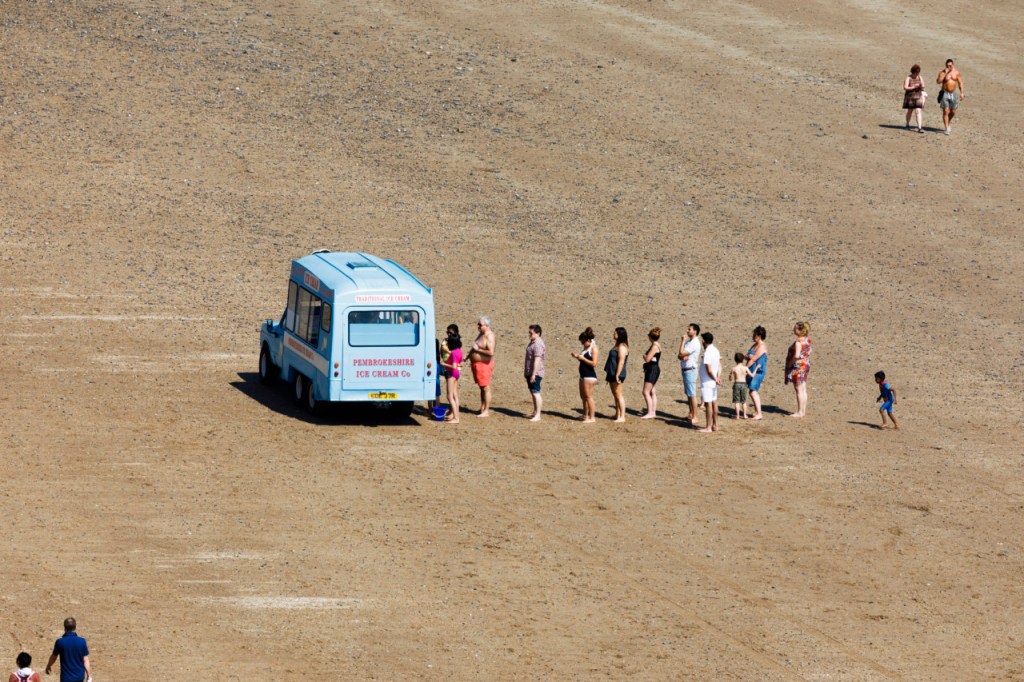
Here though his work focused just on images taken of Wales I was able to see his usual focus on the ordinary but quirky found in local cultures shown in garish colours; he shared his familiar themes of leisure and food, bingo, including beach scenes, local shows along with some images of miners. I recall him commenting there that I also recall him saying at his exhibition that he likes to give order to chaos in his photographs

In this conversation Parr reveals he has been using telephotos on beaches the past 5 years which he called beach therapy (his experimental lab), instead of a macro lens he used previously.

Q: What would you like to be seen as your legacy? “The last resort (2009) and “Common sense” (1999) and the Martin Parr foundation.

Q: You came out of the Thatcher era, what was the influence of this?  the colour school of photography took off and the world of independent photography came through. The opening of the Photographers gallery in 1971 was very important, this was the first photography gallery

Q: How is lockdown affecting your work? Is it important to keep photographing? Yes of course but a challenge. The Marin Parr Instagram foundation has set challenges for photographer. Parr suggests obviously photographing at home and is currently doing a bird table challenge himself. He suggest we should consider whether it make people more or less interested in documentary photography? People may want to escape into a different world.

Q: How do you think changes in travel habits will impact on your work? Parr is happy photographing in the UK and he can express his love/hate relationship through the ambiguity in his photographs.

Q: Simon asked him about the challenges of photographing locally. Yes there is virtue in the challenge of photographing locally rather than strangers.

Q: Can you share work that you have: Larry Saltern “Pictures from home”.

Q: Tell us about your book “Sign of the times” (1992): An exploration of people’s taste and middle class expose rather like “The cost  of living” (1999).

Q: What pictures do you have on your walls? Chris Killip print of Father and son.

Q: Are we at peak photography? It may be more difficult to earn a living but you don’t have to earn a living to appreciate photography.

Q: What happens if someone objects to a photo? It’s an occupational challenge

Q: What are your thoughts about this generation of photgraphers? The diversity, energy and brilliance as it is difficult to invent the new. He admires Steven Gill’s The pillar, a compelling simplicity.

Key things I took away from this:

  • “It is the subjectivity rather than the subject matter that is important in photography”.
  • His suggestion that the challenge of photographing locally, rather than strangers is good.
  • “you don’t have to earn a living to appreciate photography” something I’ve been telling my husband for years.

I must watch out for:

He is working on a festival concept for Bristol next spring (May?) where many venues will be showing photography at once.

He is planning a photography book festival in October, though it may be moved to the spring.

Reference:

Moss, S. (2019) ‘Martin Parr’s 40 years in the life of Wales: ‘Let’s face it – people are funny’’ In: The Guardian 14/10/2019 At: http://www.theguardian.com/artanddesign/2019/oct/14/martin-parr-photos-wales-national-museum-cardiff (Accessed 03/05/2020).(Moss, 2019)

Next post: https://nkssite5.photo.blog/category/learning-log-research-and-reflection/photographer-talks/directors-of-photography-galleries-28-4-20/

RESEARCH AND REFLECTION: PHOTOGRAPHER TALKS

1854 Presents: In conversation with Laura Pannack – London based portrait, social documentary work photographer 15.4.20

Subject: The challenges faced by photographers during lockdown alongside themes of separation in her work. She works a lot with connections, engagement

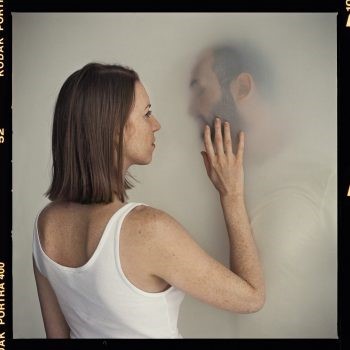
Laura is a London-based photographer, known for her portraiture and social documentary artwork, who seeks to explore the complex relationship between subject and photographer. Interestingly for these lock down times Laura has completed a project based on Brexit called separation, a different type of separation to that which we now face but with some similarities. I am interested in how she has treated this:

       (Laura Pannack, 2020)

I also like the fact that her work is research driven and tries to be as truthful as possible; she says that ““time, trust and understanding” are most important to achieve this.

Laura is currently gathering ideas and taking time away from the screen- she comments:

Q: How do you find approaching people on the street? Be confident, don’t overthink. Be transparent

Q: How to photograph during a lock down?

  • Keep working
  • Shift your project from what it was to something that fits
  • Remove the pressure on the end product
  • Generate a community
  • Look for other inspiration such as poetry, magazines, Ted talks,
  • Projects on connection and changed social contact
  • Think about immediate post covid projects – reuniting, new connections,
  • Trial and error
  • Finding inspiration elsewhere

Q: How did you get started? Curiosity, the support of others/community, building a network.

Q: Have you ever felt frustrated with a project not well received and how do you cope with this? Change your intention. Would be frustrated if can’t get feedback to move forwards, otherwise treat it as a learning curve.

Q: Do you consider yourself a social commentator or a participant? Doesn’t feel she has the right or the intelligence to comment but does like to be present. Struggles to dip in and out of places

Q: Do you feel being a woman has hindered or helped you in your practice? Neither but wouldn’t let it hold her back.

Q: One piece of advice for creativity: Pass ideas on to create a chain of creativity. Not selfish desire but about a circle of energy.

Her work is very interesting and I must look at more of it once I have finished assignment 1. This was the first Zoom 1854 in conversation that I’ve taken part in so it was a learning curve for me in using the technology to interact and pose questions to the artist. It was a useful session and was the beginning of a more positive attitude for me make positives from the current lockdown situation for my photography

Next post: https://nkssite5.photo.blog/category/learning-log-research-and-reflection/photographer-talks/martin-parr-21-4-20/